

Views: 312 Author: NANJING TAIDUN Publish Time: 2026-10-14 Origin: Site
Content Menu
● Why High Tidal Variation Changes Fender Selection Logic
● Fixed Quay-Side Systems: Engineering Capabilities and Limitations
>> How Fixed Systems Handle Tidal Variation
>> Advantages of Fixed Quay-Side Systems
>> Limitations in High Tidal Environments
● Floating Fenders: The Tidal Solution
>> How Floating Fenders Maintain Performance
>> Pneumatic vs. Foam-Filled: Which Floating Solution?
>> Advantages of Floating Fenders in Tidal Ports
>> Limitations of Floating Fenders
● Comparative Analysis: Fixed vs. Floating for High Tidal Ports
>> The PIANC WG211 Perspective
● Selection Framework: A Decision Guide for Port Engineers
>> Choose Fixed Quay-Side Systems When:
>> Choose Floating Fenders When:
● Practical Recommendations and Documentation Requirements
>> Key Documentation to Request from Suppliers
● Conclusion: Matching Fender Technology to Tidal Reality
● Frequently Asked Questions (FAQ)
>> 1. What tidal range makes floating fenders more cost-effective than fixed systems?
>> 2. Can pneumatic floating fenders meet the energy absorption requirements of large vessels?
>> 3. How do floating fenders handle vessels with large bow flare?
>> 4. What maintenance is required for floating fenders in tidal ports?
>> 5. How does PIANC WG211 affect fender selection for high tidal ports?
>> 6. Can fixed and floating fenders be combined in the same berth?
Introduction: The Tide That Changes Everything
In ports with significant tidal variation, the choice between fixed quay-side systems and floating fenders is not a matter of preference—it is a fundamental engineering decision that determines berth safety, operational reliability, and long-term capital efficiency.
I have reviewed hundreds of fender specifications from ports across Asia, Europe, and the Middle East. The same pattern emerges repeatedly: designers specify fender systems based on ideal conditions, then discover during operation that tidal ranges of 6, 8, or even 12 meters render those assumptions obsolete.
This guide provides a comprehensive engineering comparison between fixed quay-side fender systems and floating fender solutions for high tidal variation ports. Drawing on PIANC WG211 (2024) guidelines and real-world project data, it offers practical selection criteria for port engineers and OEM procurement specialists.
A large tidal range creates two fundamental challenges that standard fender specifications often fail to address:
First, the vertical contact zone expands dramatically. A vessel may contact the berth at high tide with its bilge, at mid-tide with its side shell, and at low tide with a completely different hull area. A fixed fender system must cover this entire vertical range with consistent performance.
Second, energy absorption requirements shift with water level. As the contact point moves vertically, the effective compression characteristics of the fender change. A system that performs adequately at mean water level may be severely compromised at tidal extremes.
> *"A big tidal range creates two key problems: the ship contacts the berth at different heights, and energy absorption must stay consistent throughout the tide."*
These challenges explain why fender selection in high tidal ports requires a fundamentally different approach—one that treats the fender system as an integrated vertical solution rather than a collection of discrete units.
Fixed quay-side systems—including cone fenders, cell fenders, and cylindrical rubber fenders mounted directly to the quay face—remain the most common solution for commercial berths worldwide. Their performance in high tidal ports depends heavily on proper vertical coverage design.

The primary strategy for fixed systems in tidal ports involves extending the frontal panel height to cover the full vessel contact zone. For moderate tidal ranges (3–5 meters), a single tall panel may suffice. For larger ranges (6–10+ meters), designers may employ:
- Multiple fender rows at different elevations
- Sliding fender systems that move vertically with the tide
- Extended panels with reinforced steel structures
A sliding fender system represents a hybrid approach—the fender remains fixed to the structure but can slide vertically along guide rails, maintaining contact with the vessel as water levels change .
Fixed systems offer several compelling advantages for high tidal ports:
| Advantage | Engineering Rationale |
|---|---|
| Lower reaction forces | Direct load path to structure; no chain tension amplification |
| Simpler maintenance access | Units accessible from quay level without vessel support |
| Proven performance data | Extensive PIANC-compliant testing and documentation |
| No air pressure maintenance | Solid rubber units require no inflation monitoring |
| Higher energy capacity per unit | Cone and cell fenders achieve high GEA values |
For very large vessels (VLCC, ULCC, LNG carriers), fixed systems remain the benchmark for energy absorption. A single Super Cone fender can absorb 2,000+ kNm of energy—capacity that floating fenders achieve only through multiple units .
The limitations of fixed systems become pronounced when tidal range exceeds 5–6 meters:
Panel height becomes structurally challenging. A 10-meter tidal range requires a panel extending 10+ meters vertically. The bending moments and shear forces on such a panel are substantial. Steel weight increases non-linearly with height, and the panel becomes vulnerable to wave impact and corrosion.
Chain systems become complex. Longer panels require longer chains with greater slack, increasing the risk of chain entanglement, wear, and tension imbalance during berthing.
Performance varies with contact elevation. As the vessel contacts the panel at different heights, the effective stiffness of the fender-panel system changes. PIANC WG211 addresses this through multiple-contact analysis, but many specifications still assume single-point contact .
Installation in existing structures is difficult. For older quays not designed for tall panels, structural reinforcement may be required—often at prohibitive cost.
Floating fenders—pneumatic (Yokohama-type) and foam-filled—offer a fundamentally different approach. Instead of forcing the vessel to contact a fixed elevation, the fender moves with the water level, maintaining consistent contact geometry regardless of tidal state.
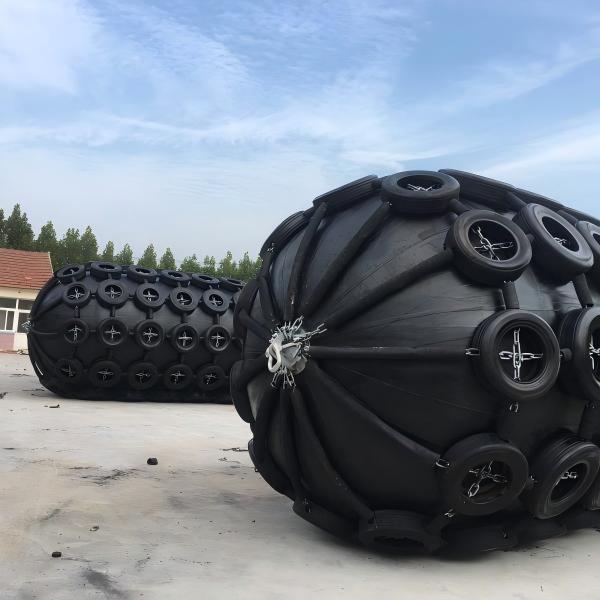
The operating principle is elegantly simple: buoyancy keeps the fender at the waterline, which is where vessels naturally contact the berth .
As tide rises and falls, the floating fender rises and falls with it. The vessel always meets the fender at the same relative position—regardless of whether water depth is 5 meters or 15 meters.
> *"The natural buoyancy of the fenders allows them to be installed in a floating position between ship and dock. This is particularly beneficial in areas with large tidal or seasonal water level fluctuations."*
Two floating fender technologies dominate high tidal applications:
| Aspect | Pneumatic (Yokohama) | Foam-Filled |
|---|---|---|
| Buoyancy mechanism | Air pressure (50 or 80 kPa) | Closed-cell foam core |
| Failure mode | Deflation if punctured | Progressive degradation |
| Maintenance | Pressure checks required | Visual inspection only |
| Energy absorption | High (per ISO 17357) | Moderate to high |
| Reaction force | Low | Low to moderate |
| Best for | STS operations, temporary berths | Permanent berths, exposed locations |
Pneumatic fenders are governed by ISO 17357-1:2014, which specifies performance at 60% deflection with guaranteed energy absorption (GEA) values. A 3,300 × 6,500 mm Pneumatic 50 fender absorbs 1,814 kJ at GEA deflection—performance that rivals many fixed systems .
Foam-filled fenders offer a key advantage: they cannot deflate. Even if the outer skin is damaged, the foam core continues to provide buoyancy and energy absorption. For remote ports where maintenance access is limited, this reliability is invaluable .
The case for floating fenders in high tidal environments rests on several engineering advantages:
Consistent contact geometry. The fender always meets the vessel at the waterline—regardless of tidal state. This eliminates the performance variability that plagues fixed systems in extreme tidal conditions.
Simplified structural requirements. Floating fenders require only mooring points on the quay, not structural attachment capable of resisting full reaction forces. This dramatically reduces civil engineering costs for new berths and makes floating fenders ideal for retrofit projects on older quays.
Adaptability across vessel types. Because the fender moves freely, it accommodates vessels with different freeboard profiles—from laden tankers with minimal freeboard to ballasted bulk carriers riding high.
Energy absorption remains constant. Unlike fixed panels where contact elevation affects effective performance, floating fenders deliver their rated GEA regardless of tide level.
Floating fenders are not universally superior. Key limitations include:
- Mooring and positioning complexity: Chains must be correctly configured to maintain fender position without excessive movement
- Potential for drift: In strong currents, fenders may be displaced from optimal contact position
- Lower energy density: Per-unit energy absorption is generally lower than large cone fenders
- Pneumatic maintenance: Pressure monitoring is essential; deflation risk requires contingency planning
- Not suitable for all berth geometries: Vessels with extreme bow flare or unusual hull forms may require custom solutions
The following table synthesizes the key engineering and operational differences:
| Criterion | Fixed Quay-Side Systems | Floating Fenders |
|---|---|---|
| Tidal range capability | Limited (5–6 m practical max) | Excellent (10+ m demonstrated) |
| Contact consistency | Varies with tide level | Constant at waterline |
| Energy absorption | High per unit | Moderate per unit; multiple units needed |
| Reaction force | Moderate to high | Low |
| Structural demand | High (full reaction to quay) | Low (mooring points only) |
| Retrofit suitability | Difficult | Excellent |
| Maintenance access | Quay level | Requires vessel or workboat |
| Pressure maintenance | None | Required for pneumatic |
| Failure mode | Progressive | Pneumatic: deflation; Foam: gradual |
| Initial cost | Moderate to high | Moderate |
| Lifecycle cost | Lower (if properly designed) | Competitive with maintenance |
| Best application | Moderate tides, high energy demands | Extreme tides, variable vessel mix |
PIANC WG211 (2024) emphasizes site-specific, risk-based design over the prescriptive approach of the previous WG33 guidelines . This shift has significant implications for high tidal ports:
- Berthing velocities must reflect actual site conditions, not generic tables
- Multiple fender contacts must be analyzed, especially where tidal variation affects contact geometry
- Design safety is built into the fender system, not left to the structure
For tidal ports, WG211's emphasis on realistic berthing scenarios reinforces the case for floating solutions where fixed systems cannot reliably maintain performance across the tidal cycle.
Based on the engineering analysis above, the following decision framework applies:
- Tidal range is ≤ 5 meters
- Vessels are uniform in type and freeboard
- High energy absorption per berth is required (VLCC, ULCC)
- The quay structure can accommodate reaction forces
- Maintenance access from quay is preferred
- Tidal range is > 6 meters
- Vessel mix is diverse (different freeboards)
- Structural reinforcement is impractical (retrofit projects)
- Low reaction force is critical
- The berth experiences frequent vessel movement (RoRo, ferries)
For some tidal ports, a combined approach may be optimal. A berth may use fixed fenders at discrete points for primary energy absorption, supplemented by floating fenders covering intermediate positions . This "combination system" approach can address both high energy demand and tidal coverage.
Regardless of system choice, the following practices apply for high tidal ports:
1. Document full tidal range (highest astronomical tide to lowest)
2. Define vessel freeboard range for all design vessels
3. Calculate berthing energy using PIANC WG211 methodology
4. Verify vertical contact coverage for all tide levels
5. Specify performance testing requirements (compression test, GEA verification)
6. Require third-party inspection (BV, SGS, ABS, LR, DNV)
7. Include installation and maintenance manuals in documentation package
- Performance curves with test conditions stated
- Correction factor documentation (velocity, temperature, angle)
- Batch-specific compression test reports
- Material certificates for rubber and steel components
- Third-party inspection reports
- Installation, handling, and maintenance manuals
The choice between fixed quay-side systems and floating fenders for high tidal variation ports is ultimately a question of matching technology to site reality.
Fixed systems excel in moderate tidal conditions where structural capacity and maintenance access favor direct attachment. Their high energy density and proven performance make them the benchmark for large vessel berths.
Floating fenders solve the tidal problem elegantly: by moving with the water, they maintain constant contact geometry and eliminate the performance variability that undermines fixed systems at tidal extremes. Their low structural demand makes them particularly valuable for retrofit projects and older quays.
For port engineers and OEM procurement specialists, the key insight is this: there is no universal "best" fender system. There is only the system best matched to your tidal range, vessel mix, structural constraints, and operational profile.
[CTA]
Need engineering support for high tidal fender system selection?
NANJING TAIDUN MARINE EQUIPMENT ENGINEERING CO., LTD provides OEM manufacturing for rubber fenders, mooring bollards, steel panels, and UHMW-PE pads. With 23+ years of experience and 300,000㎡ production capacity, we support PIANC, ISO, ASTM, and EU standards.
Contact us:
- Email: service@taidunmarine.com
- Website: www.taidunmarine.com
- Services: Custom fender design, energy calculation support, third-party testing coordination, full documentation packages
1. PIANC Australia. "Navigating PIANC Fender Guidelines 2024 (WG211) for Designers and Asset Owners." [https://pianc.org.au/wp-content/uploads/2025/12/Presentation-Slide-Master-PIANC-Fender-Workshop-30-July-2025-Brisbane.pdf]
2. Unified Facilities Criteria (UFC). "UFC 4-152-01: Design: Piers and Wharves." [https://stg.wbdg.org/FFC/DOD/UFC/ufc_4_152_01_2017_c1.pdf]
3. BSI Knowledge. "BS 6349-4:2026 – Maritime Works: Design of Fendering and Mooring Systems." [https://knowledge.bsigroup.com/products/maritime-works-design-of-fendering-and-mooring-systems-code-of-practice]
4. Nanjing Taidun Marine Equipment. "Integrated Fender System with Bollards." [https://www.taidunmarine.com/integrated-fender-system-with-bollards-a-complete-oem-solution-for-safer-berthing-and-mooring.html]
5. J-STAGE. "Revision of ISO17357: Ships and Marine Technology, Floating Pneumatic Rubber Fenders." [https://www.jstage.jst.go.jp/article/jinnavi/191/0/191_KJ00009702478/_pdf/-char/en]
6. PIANC Australia. "Insights into PIANC Fender Guidelines 2024 (WG211)." [https://pianc.org.au/wp-content/uploads/2024/08/PIANC-ANZ_Insights-into-PIANC-Fender-Guidelines-2024_July2024.pdf]
7. ISO. "ISO/CD 25419: Ships and Marine Technology – Double Cruciform Bollards." [https://www.iso.org/standard/90264.html]
8. Nanjing Taidun Marine Equipment. "China Marine Rubber Fenders, Mooring Bollards, Marine Anchors Supplier." [https://www.taidunmarine.com/]
9. ISO 17357-1:2014. "Ships and Marine Technology – Floating Pneumatic Rubber Fenders." [https://www.ratchakitcha.soc.go.th/DATA/PDF/2560/E/106/7.PDF]
10. ASCE. "Performance-Based Design for Mooring and Berthing: Fender Systems, Load Factors, and Global Standards." [https://www.asce.org/education-and-events/explore-education/on-demand-webinars/performance-based-design-for-mooring-and-berthing--fender-systems--load-factors--and-global-standards]
11. Nanjing Taidun Marine Equipment. "Marine Fender Solutions for Shipbuilding Yards." [https://www.taidunmarine.com/marine-fender-solutions-for-shipbuilding-yards-oem-engineering-that-protects-vessels-berths-and-brand-reputation.html]
12. Cochin Port Trust. "North Jetty Tender Document – Performance Tests for Pneumatic Fenders." [https://www.cochinport.gov.in/sites/default/files/2020-01/North%20Jetty%20Tender%20Document-Vol-2.pdf]
The crossover point typically occurs at 6–7 meters of tidal range. Below 5 meters, fixed systems with properly designed panels usually offer better lifecycle economics. Above 7 meters, the structural cost and complexity of tall fixed panels make floating fenders increasingly competitive. However, the decision must also account for vessel mix, energy requirements, and existing structural capacity.
Yes, but with caveats. A single 4,500 × 12,000 mm Pneumatic 50 fender absorbs 6,473 kJ at GEA deflection—sufficient for many large vessel applications . For VLCC and ULCC berths, multiple pneumatic fenders may be required, or a hybrid solution combining fixed and floating units. The key is matching total system capacity to design berthing energy, not relying on a single unit.
Bow flare presents a challenge for all fender types. For floating fenders, the primary consideration is fender positioning and chain configuration. Bow flare may cause the vessel to contact the fender at a higher elevation than the waterline, potentially compressing the fender against the quay. PIANC WG211 requires analysis of bow radius and flare angle in fender selection . Custom fender sizes or multiple fender rows may be necessary.
Pneumatic fenders require regular pressure checks (monthly recommended) and visual inspection for skin damage, chain wear, and valve integrity. Foam-filled fenders require visual inspection for skin abrasion and core exposure. For both types, chain systems should be inspected for corrosion and tension at least quarterly. Trelleborg recommends visual examination at 3-month intervals minimum .
PIANC WG211 (2024) mandates site-specific, risk-based design rather than generic prescriptive rules . For high tidal ports, this means: berthing velocities must reflect actual site data; multiple fender contacts must be analyzed; and the fender system—not the structure—must absorb design energy. This shift favors floating solutions where fixed systems cannot reliably perform across the tidal cycle.
Yes. The combination system approach is explicitly recognized in UFC 4-152-01 . A berth may use fixed fenders at primary contact points for high energy absorption, with floating fenders covering intermediate elevations or serving as backup. This hybrid strategy can optimize both tidal coverage and energy capacity.


