

Views: 425 Author: Nanjing Taidun Publish Time: 2026-05-10 Origin: Site
Content Menu
● Why Steel Frontal Panel Thickness Calculation Matters
● Step 1 — Understand the Load Requirements
>> The Three Primary Load Types
>> Berthing Energy and Reaction Force
● Step 2 — Calculate Minimum Steel Frontal Panel Thickness Using the Hull Pressure Formula
>> Allowable Hull Pressure Values by Vessel Type
>> Practical Example — Frontal Panel Dimension Calculation
>> Using the Formula for Thickness Validation
● Step 3 — Apply Industry Minimum Thickness Standards
>> PIANC Recommended Minimum Thickness
>> Corrosion Allowance Addition
● Step 4 — Select the Right Steel Grade
>> Recommended Steel Grades for Frontal Panels
● Step 5 — Structural Design and Reinforcing Configuration
>> Profiled Panel with Reinforcing Ribs
>> Bending Strength Verification
● Step 6 — Corrosion Protection Requirements
>> Standard Protection Systems
● User Feedback — Real-World Perspectives
● Complete Calculation Checklist
● How Nanjing Taidun Supports Your Frontal Panel Needs
● Frequently Asked Questions (FAQ)
When a 200,000-ton container vessel approaches a berth at 0.15 meters per second, the kinetic energy that must be absorbed is immense. The rubber fender takes the brunt of that impact. But the steel frontal panel—the rigid interface between the fender and the vessel hull—determines whether that force is distributed safely or concentrated into a single point of failure.
I have spent two decades manufacturing OEM rubber fender systems and mooring bollards for global brands. One of the most common questions I receive from port engineers and procurement specialists is: how to calculate steel frontal panel thickness for marine fenders.
This guide provides the complete answer. We will cover load analysis, the hull pressure formula, minimum thickness recommendations, material selection, and step-by-step calculation methods—all backed by PIANC guidelines and industry standards.
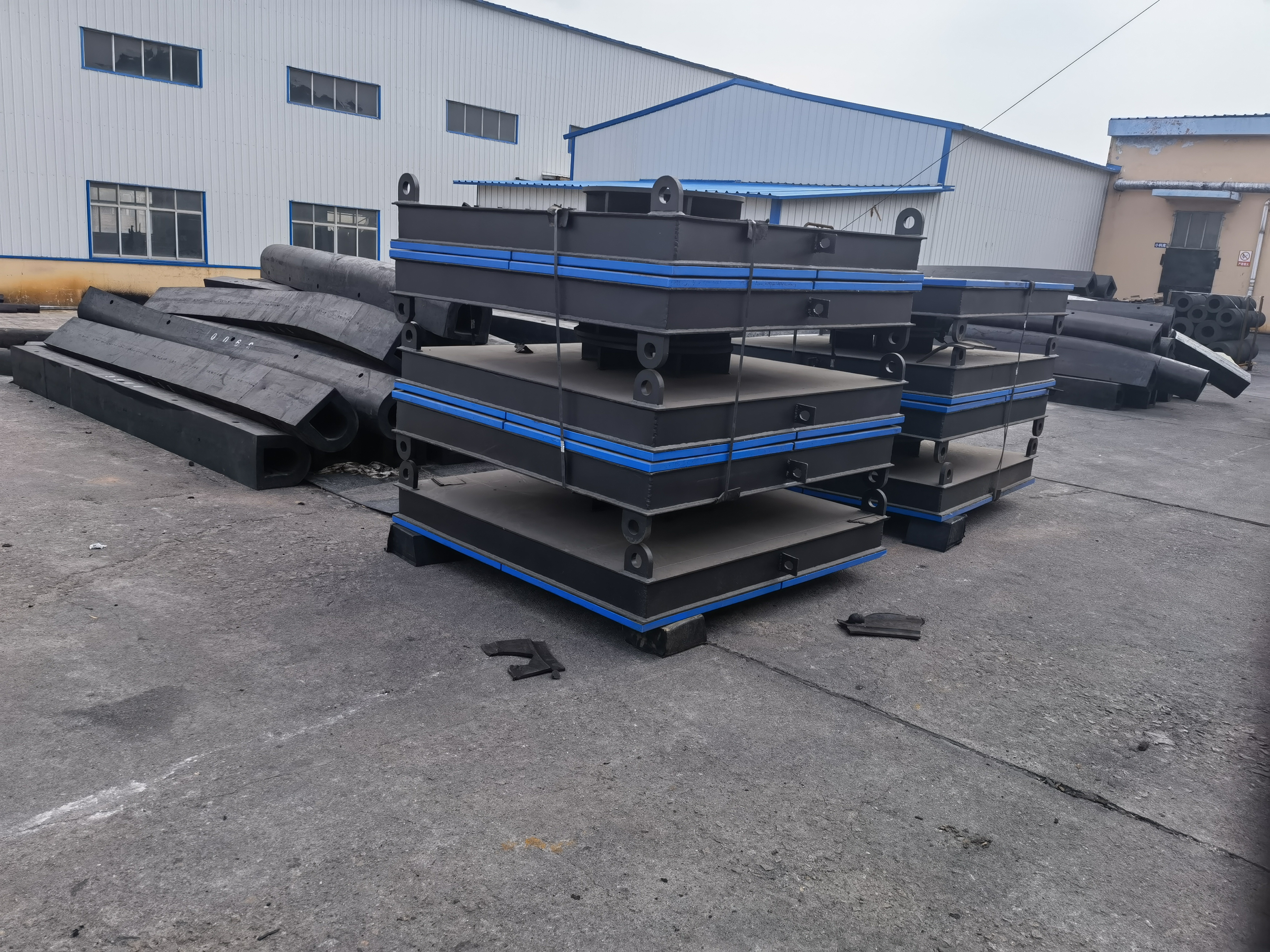
The steel frontal panel serves three critical functions in a marine fender system :
| Function | Description |
|---|---|
| Force distribution | Spreads concentrated impact forces across the vessel hull |
| Structural support | Maintains rigidity under repeated berthing loads |
| Protection | Prevents direct rubber-to-hull contact that causes abrasion |
The Cost of Poor Design:
- Panels too thin → bending, deformation, and premature failure
- Panels too thick → unnecessary material cost and excessive dead weight
- Incorrect material → rapid corrosion and structural compromise
> *"Poorly designed steel panels rank among the leading causes of rubber fender system malfunctions, shortened service life, and safety hazards in ports and marine facilities worldwide."*
Before calculating thickness, you must determine the design loads that the steel frontal panel will experience.
| Load Type | Source | Calculation Consideration |
|---|---|---|
| Berthing impact load | Vessel approach velocity and tonnage | Primary load for thickness design |
| Mooring horizontal load | Wind, waves, and tidal currents | Critical for lateral stability |
| Fatigue load | Repeated berthing cycles | Essential for high-traffic ports |
The starting point for any frontal panel calculation is the reaction force (R) of the rubber fender system. This value is provided by the fender manufacturer, typically at 60% deflection.
> *"Design begins with comprehensive load analysis: impact energy calculations based on vessel size, approach velocity, and berthing angle."*
The core engineering formula for determining frontal panel dimensions is the hull pressure equation .
P = ΣR / (A₁ × B₁) ≤ Pₐ
| Variable | Definition | Unit |
|---|---|---|
| P | Actual hull pressure | kN/m² or psi |
| ΣR | Sum of maximum reaction force of all rubber fenders in the system | kN |
| A₁ | Valid panel width (excluding lead-in chamfers) | m |
| B₁ | Valid panel height (excluding lead-in chamfers) | m |
| Pₐ | Allowable hull pressure of the vessel type | kN/m² |
The allowable hull pressure (Pₐ) varies significantly by vessel type. Use these PIANC-based values when vessel-specific data is unavailable :
| Vessel Type | Allowable Hull Pressure (kN/m²) |
|---|---|
| Gas Carrier (LNG/LPG) | 100 – 200 |
| Bulk Carrier | 150 – 250 |
| General Oil Tanker | 250 – 350 |
| Coastal Tanker | 250 – 350 |
| Panamax Container Ship | 150 – 250 |
| Sub-Panamax Container Ship | 300 – 400 |
| General Cargo Ship | 300 – 600 |
Scenario: A container terminal uses two fenders side by side, each with a maximum reaction force of 600 kN at 60% deflection. The vessel is a Panamax container ship (Pₐ = 200 kN/m²).
Step 1 — Calculate ΣR:
ΣR = 600 kN + 600 kN = 1,200 kN
Step 2 — Rearrange formula to solve for required panel area:
A₁ × B₁ = ΣR / Pₐ = 1,200 / 200 = 6 m²
Step 3 — Determine dimensions:
If the fender requires a panel width of 2.5 m, then:
B₁ = 6 / 2.5 = 2.4 m panel height (minimum)
Once the required panel area is established, the minimum steel thickness must be determined based on :
| Fender Size | Load Condition | Recommended Face Plate Thickness |
|---|---|---|
| Small (D-type, Arch) | Low load | 10 – 16 mm |
| Medium (Cylindrical) | Moderate load | 12 – 20 mm |
| Large (Cone, Cell) | High load | 16 – 25 mm |
| Extra-large (Super Cone) | Extreme load | 20 – 50 mm |
> *"Thickness design is calculated based on maximum design berthing load and selected steel material strength, ranging from 10 mm for small fenders to 50 mm for large, high-load fenders."*
The International Navigation Association (PIANC) provides authoritative minimum thickness recommendations for steel exposed to marine environments .
| Exposure Condition | Recommended Minimum Thickness |
|---|---|
| Plates exposed on two surfaces (both sides to seawater) | 12 mm |
| Plates exposed on one surface | 9 – 10 mm |
| Internal members (not exposed to corrosion) | 8 mm |
> *"International Navigation Association recommends 12 mm as the absolute minimum when exposed to seawater on both faces, 10 mm for exposure to one face, and 8 mm for internal sections not exposed to corrosion."*
Steel corrosion is inevitable in marine environments. To achieve a 20-25 year design life, add a corrosion allowance :
| Environment | Recommended Corrosion Allowance |
|---|---|
| Cold water climates (e.g., Northern Europe, Canada) | 3 mm per exposed face |
| Temperate climates (e.g., Mediterranean, Japan) | 4 – 5 mm per exposed face |
| Tropical / high-corrosion (e.g., Persian Gulf, Southeast Asia) | 6+ mm per exposed face |
> *"If corrosion allowances are not specified, they will invariably be ignored and the life expectancy of the panel will be drastically reduced."*
Final Thickness Formula:
Total Thickness = Minimum Structural Thickness + Corrosion Allowance
Example: A panel exposed on two surfaces in the Persian Gulf:
- PIANC minimum: 12 mm
- Corrosion allowance: 6 mm per face × 2 faces = 12 mm
- Total required thickness: 24 mm
Material selection directly impacts required thickness. Higher-strength steels can achieve the same load capacity with thinner sections .
| Steel Grade | Yield Strength (ReL) | Best Application |
|---|---|---|
| Q235B / A36 / SS400 | ≥235 MPa | Small ports, inland waterways, vessels <5,000 DWT |
| Q355B / S355JR / A572 Gr50 | ≥355 MPa | Large commercial ports, container terminals |
| Corten A / B | ≥345 MPa | High-corrosion environments, minimal maintenance desired |
| 316L Stainless Steel | ≥205 MPa | Offshore platforms, chemical ports, zero-corrosion tolerance |
> *"For harsh environments (e.g., Persian Gulf, tropical ports), consider duplex stainless steel or weathering steel with enhanced corrosion resistance."*
The frontal panel thickness calculation must account for the structural form. Two primary configurations exist :
- Best for: Small to medium fenders (D-type, arch, cylindrical)
- Typical thickness: 10 – 20 mm
- Advantages: Simple fabrication, lower cost
- Best for: Large cone, cell, and drum fenders
- Face plate thickness: 12 – 20 mm
- Reinforcing rib thickness: 10 – 16 mm
- Advantages: Higher rigidity with less weight
> *"Ribbed profiled panels typically use 12-20 mm face plates paired with 10-16 mm thick reinforcing ribs for balanced strength and weight."*
For profiled panels, the maximum bending moment can be estimated using :
Mmax = (R × L₁ × L₂⊃2;) / L⊃2; + F × L₁
Where:
- Mmax = Maximum bending moment
- R = Reaction force
- L₁, L₂ = Span dimensions between supports
This verification should be performed by a qualified structural engineer using limit state design codes (e.g., BS 5950, Eurocode 3, AISC) .
The best thickness calculation is worthless if the panel corrodes away. All steel frontal panels require corrosion protection meeting ISO 12944 standards .
| System | Process | Service Life | Best For |
|---|---|---|---|
| Hot-dip galvanizing | Sandblast to Sa 2.5, dip in molten zinc (≥85 μm coating) | 15-20 years | Most coastal ports |
| Epoxy coating system | Epoxy zinc-rich primer (80-100 μm) + epoxy intermediate (100-120 μm) + polyurethane topcoat (60-80 μm) | 10-15 years | Tidal/splash zones |
| Weathering steel (Corten) | Forms protective patina naturally | 20-30 years | Minimal maintenance requirements |
To prevent premature failure, ensure :
- Sealed box panels prevent water ingress
- Reinforced fixing points around rubber fender connections
- Proper drainage to prevent standing water
- Accessibility for inspection and maintenance
> *"Rubber fender fixing points should be locally reinforced and sealed to prevent water ingress if closed box panels are used."*
We asked our global OEM clients about their experience with steel frontal panel design. Here is what they shared:
> *"We learned the hard way that the PIANC 12 mm minimum is not a suggestion—it's a requirement. We tried 10 mm panels to save costs on a small project. Within three years, they had buckled under normal berthing loads. We replaced them with 12 mm panels and haven't had an issue since."*
> — *Port Engineer, Southeast Asia*
> *"Our biggest mistake was ignoring corrosion allowance. We installed standard 12 mm panels in the Persian Gulf without extra thickness for corrosion. After five years, the panels had lost 3-4 mm of material. We're now replacing them with 20 mm panels."*
> — *Maintenance Director, Middle East Terminal*
> *"Switching from A36 to S355JR steel allowed us to reduce panel thickness by 20% while maintaining the same load capacity. The material cost was slightly higher, but the weight savings on installation and shipping more than made up for it."*
> — *Procurement Manager, European Port Authority*
Use this checklist to ensure your steel frontal panel thickness calculation is complete:
| Step | Task | Status |
|---|---|---|
| 1 | Calculate total reaction force (ΣR) of all fenders | ☐ |
| 2 | Determine allowable hull pressure (Pₐ) by vessel type | ☐ |
| 3 | Calculate required panel area (A₁ × B₁) = ΣR / Pₐ | ☐ |
| 4 | Apply PIANC minimum thickness (12 mm for two-face exposure) | ☐ |
| 5 | Add corrosion allowance based on environment | ☐ |
| 6 | Select steel grade (S355JR recommended for most commercial ports) | ☐ |
| 7 | Choose structural configuration (flat or ribbed) | ☐ |
| 8 | Specify corrosion protection system | ☐ |
| 9 | Verify with qualified structural engineer | ☐ |
At Nanjing Taidun Marine Equipment Engineering Co., Ltd. , we manufacture complete marine fender systems including custom steel frontal panels to your exact specifications.
Our capabilities include:
| Service | Description |
|---|---|
| Custom engineering | Frontal panels designed to your berthing energy and vessel mix |
| Material selection | Q355B, S355JR, Corten, 316L stainless steel |
| Corrosion protection | Hot-dip galvanizing (≥85 μm) or marine coating systems |
| Third-party certification | ABS, BV, DNV, LR, CCS inspection available |
| Complete systems | Fenders, frontal panels, mooring bollards, and accessories |
We serve brand owners, wholesalers, and production facilities in over 80 countries. Request a free frontal panel design consultation by sending us your berthing data and vessel mix.
Q1: What is the minimum steel thickness for a marine fender frontal panel?
A: PIANC recommends 12 mm minimum for plates exposed to seawater on both faces, 9-10 mm for single-face exposure, and 8 mm for internal sections not exposed to corrosion .
Q2: How do I add corrosion allowance to panel thickness?
A: Add 3-6 mm per exposed face depending on water temperature and salinity. For cold climates: 3 mm per face. For tropical/high-corrosion environments: 6+ mm per face .
Q3: What is the hull pressure formula for frontal panel sizing?
A: The formula is P = ΣR / (A₁ × B₁) ≤ Pₐ, where ΣR is the sum of fender reaction forces, A₁×B₁ is the panel area, and Pₐ is the vessel's allowable hull pressure .
Q4: What steel grade is best for marine frontal panels?
A: S355JR (or Q355B) is recommended for most commercial ports due to its high yield strength (≥355 MPa) and good weldability. For high-corrosion environments, consider Corten or 316L stainless steel .
Q5: Can I use a thinner panel if I use higher-strength steel?
A: Yes, higher-strength steel allows reduced thickness while maintaining load capacity. However, the 12 mm PIANC minimum applies regardless of steel grade for durability and corrosion resistance .
1. Nanjing Taidun Marine Equipment Engineering Co., Ltd. (2026). *Marine Fender Steel Frontal Panel: Design Essentials and Key Considerations*.
2. Nanjing Taidun Marine Equipment Engineering Co., Ltd. (2026). *Complete Specification and Design Guide for Fender Steel Panels: Ensuring Durability, Safety, and Performance in Marine Berthing Systems*.
3. Nanjing Taidun Marine Equipment Engineering Co., Ltd. (2026). *Design Work of the Steel Panels for Marine Rubber Fender: Complete Technical Guide & Best Practices*.


