

Views: 263 Author: Nanjing Taidun Publish Time: 2026-08-26 Origin: Site
Content Menu
● Why Anchors Drag in Typhoon Winds
● Danforth Anchor vs Delta Anchor: Core Design Differences
● When a Danforth Anchor Is the Better Choice
>> Danforth anchor limitations in typhoon conditions
● When a Delta Anchor Is the Better Choice
>> Delta anchor limitations in typhoon conditions
● Which Anchor Prevents Dragging Better?
● Typhoon Anchor-Dragging Prevention Checklist
>> 1. Choose the best available holding ground
>> 3. Set the anchor deliberately
>> 4. Inspect the complete anchoring system
>> 5. Establish an anchor watch
● OEM Anchor Engineering for Severe Weather
● FAQ
>> 1. Is a Danforth anchor better than a Delta anchor in a typhoon?
>> 2. What causes an anchor to drag in high winds?
>> 3. How much scope should be used in storm conditions?
>> 4. Can a Delta anchor reset after wind shifts?
>> 5. Should a vessel use two anchors during a typhoon?
>> 6. Does a heavier anchor always prevent dragging?
When customers ask us about Danforth Anchor vs Delta Anchor performance in typhoon winds, our answer at Nanjing Taidun Marine Equipment Engineering Co., Ltd. is clear: anchor type matters, but preventing anchor dragging depends on the full anchoring system—anchor design, seabed, chain, scope, vessel windage, installation, and crew procedure.
As an OEM manufacturer of marine anchors, rubber fenders, mooring bollards, and anchoring equipment for international brands, wholesalers, and marine equipment producers, we see one recurring issue: vessels often blame the anchor after dragging, while the root cause is inadequate scope, unsuitable bottom conditions, incorrect sizing, poor setting, or insufficient monitoring. In typhoon conditions, those details become critical.

Typhoon winds create a fast-changing combination of wind loads, wave action, surge, yawing, and sudden shifts in pulling direction. An anchor can appear secure in moderate conditions, then fail when the load increases or changes angle.
A useful principle for operators is that holding demand rises much faster than wind speed. As wind speed doubles, the required holding capacity can increase by approximately four times. A system suitable for routine anchoring may therefore be inadequate for storm survival.
Anchor dragging during typhoon winds is rarely caused by one factor alone. Common causes include:
- Anchor undersizing for vessel displacement, windage, and emergency conditions
- Insufficient scope, causing an upward pull that breaks the anchor's seabed grip
- A poor or unsuitable bottom, such as weed, rock, shell, very soft mud, or hardpan
- Inadequate chain weight or chain length
- Failure to fully set the anchor before weather deteriorates
- Repeated vessel yawing that changes the loading direction
- Worn shackles, swivels, chain links, windlass components, or connection hardware
- No anchor watch, GPS alarm, or visual bearing check
For marine brands and shipyards sourcing OEM anchors, the lesson is important: the anchor should be engineered as part of a complete ground-tackle solution, not purchased as an isolated weight-based product.
A Danforth anchor and a Delta anchor use different mechanisms to develop holding force. Neither design is universally superior. The correct choice depends on the seabed, vessel type, storage arrangement, operational profile, and expected weather exposure.
| Feature | Danforth Anchor | Delta Anchor |
|---|---|---|
| Basic design | Two broad pivoting flukes with a stock | Fixed shank and plough-shaped concave fluke |
| Best bottom conditions | Sand and soft-to-medium mud | Sand, mud, clay, and mixed general-purpose bottoms |
| Holding-power approach | Large fluke area buries deeply | Weighted tip and plough profile penetrate and bury |
| Holding power per weight | Often very high in suitable soft bottoms | Strong and consistent general-purpose performance |
| Setting behavior | Can set quickly in clean sand or mud | Typically sets reliably due to tip loading |
| Reset after wind shift | May be less predictable after major direction changes | Often better suited to moderate directional changes |
| Weed, rock, shingle | Can struggle | Can struggle, but often more versatile in mixed conditions |
| Stowage | Flat profile can be convenient for storage | Commonly suited to bow rollers |
| Typhoon application | Effective only when seabed and system setup are well matched | Often preferred as a primary all-round working anchor |
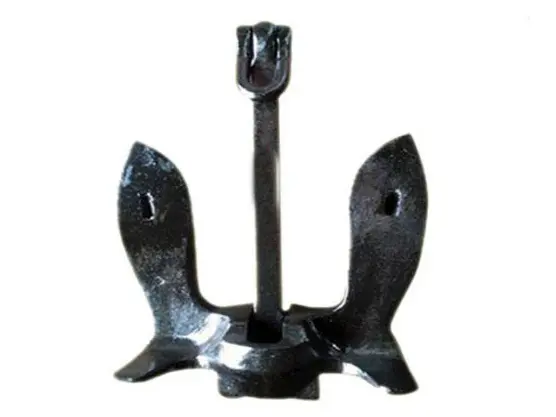
The Danforth design uses two wide triangular flukes that orient into the seabed. The original Danforth design emphasizes a 32-degree fluke angle for holding on common bottoms such as hard sand. Its large fluke area can create impressive holding power relative to anchor weight when it is properly embedded in sand or mud.
The Delta-style plough anchor uses a fixed geometry and a weighted nose. This helps concentrate force at the tip, which supports penetration and setting across a wider range of typical anchoring bottoms. Delta-style anchors are widely regarded as capable general-purpose anchors because their holding performance is strong relative to weight in many bottom types.
A Danforth anchor is often an excellent solution when an operator knows the anchorage has clean sand, silt, or soft mud. Its wide flukes can develop high resistance after deeply burying, which makes it especially valuable as a secondary, stern, kedge, or specialized soft-bottom anchor.
- High holding capacity for its weight in suitable sand and mud
- Broad flukes provide substantial buried surface area
- Flat construction can simplify deck or locker storage
- Useful for vessels where weight efficiency is important
- Effective as a dedicated soft-bottom anchor in an emergency inventory
The key limitation is not that the Danforth design is weak. It is that its best performance is highly dependent on seabed compatibility and correct setting. In grass, rock, coral, shingle, or bottoms with a hard layer beneath soft sediment, the flukes may fail to penetrate, foul, or skate before burying.
A Danforth may also be less forgiving when a vessel swings violently through a major wind reversal. If the direction of pull changes significantly, the flukes can unload and require time or movement to reset. This can be a serious consideration during a typhoon, where wind shifts may be abrupt and severe.
For this reason, our engineering recommendation is to avoid treating a Danforth anchor as a universal "storm anchor." It can be a very strong storm solution when the bottom is confirmed to be compatible, the anchor is adequately sized, and the crew can set and monitor it correctly.
A Delta anchor is generally the safer all-round selection for vessels that encounter changing anchorage conditions, frequent anchoring, or uncertain seabeds. Its plough-style profile and weighted tip support reliable penetration and make it practical as a primary bow anchor.
A Delta anchor's tip loading is one reason it can set effectively. Independent discussion of traditional anchor testing notes that Delta-type anchors have approximately 28% tip loading, helping them penetrate and set, although extreme loads can still cause any anchor to drag.
- Versatile primary-anchor option for mixed operating conditions
- Good penetration due to its weighted tip
- Compatible with many bow roller arrangements
- Consistent handling for vessels anchoring frequently
- Better practical choice when seabed information is incomplete
- Usually more suitable for general commercial and recreational use than a flat-fluke-only solution
A Delta anchor is not a guarantee against dragging. It can still fail when the scope is too short, the bottom is unsuitable, the anchor is undersized, or the vessel experiences shock loads from waves and snatch forces.
Operators should also understand that a Delta anchor is a conventional plough design, not a substitute for a complete typhoon mooring plan. During severe weather, chain configuration, chafing protection, brake and stopper integrity, and real-time position monitoring may matter as much as the anchor itself.
For most vessels seeking a primary anchor for uncertain or mixed seabeds, a properly sized Delta anchor is usually the more practical choice. It offers general-purpose performance, predictable handling, and reliable penetration across common anchoring grounds.
For proven sand or mud bottoms, a properly selected Danforth anchor can offer excellent holding power for its weight. It may be especially valuable as a second anchor or as part of a purpose-built storm anchoring arrangement.
The best practical answer is often not "Danforth or Delta?" It is:
- Delta as the primary working anchor
- Danforth as a secondary or soft-bottom specialist
- Adequate chain, scope, and connection hardware
- A weather-specific anchoring procedure
- Continuous monitoring before and during typhoon exposure
At Taidun Marine, we support OEM customers in specifying anchors around real operating conditions rather than only catalog weight. This may include material selection, fabrication process, surface treatment, weight range, certification requirements, shank configuration, and compatibility with the vessel's bow roller or anchoring arrangement.
An anchor that is correctly selected but incorrectly deployed can still drag. Before typhoon-force weather arrives, crews should follow a disciplined preparation process.
Prioritize sand, firm mud, or clay where permitted and safe. Avoid exposed areas, lee shores, known weed beds, rock, coral, shingle, and steeply sloping bottoms whenever possible.
A poor bottom can reduce holding capacity dramatically. One reported test comparison found a plough anchor resisting 1,157 pounds in sand and mud but only 66 pounds in sand and shingle. [pacificyachting]
Scope is the ratio between rode length and water depth. More scope lowers the pulling angle at the anchor and helps the fluke remain buried.
For normal anchoring, a 5:1 to 7:1 scope is commonly used as a practical reference. In worsening weather, operators may need more scope if sea room, depth, traffic, and local regulations allow.
Do not throw the anchor. Lower it under control while the vessel makes slight sternway, then pay out rode progressively. After sufficient scope is deployed, increase reverse load gradually to confirm the anchor has buried and is holding.
A good set is not confirmed by appearance alone. Watch the vessel's position, chain angle, and response to reverse load.
A typhoon load reaches far beyond the anchor. Inspect:
- Anchor shank, flukes, welds, and surface condition
- Chain wear, corrosion, distortion, and calibrated length markings
- Shackles, swivel, joining links, and locking devices
- Windlass brake, chain stopper, pawls, and deck fittings
- Bow roller alignment and chafe points
- Emergency release and retrieval procedures
Use more than one method to detect dragging:
- GPS anchor alarm with an appropriate swing radius
- Repeated visual bearings to fixed lights, shore objects, or landmarks
- Radar range and bearing checks where available
- Monitoring of chain lead and tension
- Crew watch rotation and engine-readiness procedures
A taut, straight, vibrating chain can indicate heavy loading or dragging, while a controlled catenary curve is generally a healthier sign.
For shipbuilders, distributors, and marine brands, severe-weather performance starts before the anchor reaches the vessel. The OEM specification should define more than shape and nominal weight.
At Nanjing Taidun Marine Equipment Engineering Co., Ltd., we recommend reviewing the following before producing a Danforth or Delta anchor program:
- Vessel displacement, freeboard, and windage area
- Intended operating waters and expected seabed conditions
- Primary, secondary, and emergency anchor roles
- Chain diameter, grade, length, and connection compatibility
- Required material grade and corrosion-protection system
- Bow roller, hawse pipe, windlass, and deck-layout constraints
- Third-party inspection, classification, or client documentation requirements
- Brand labeling, packaging, drawings, and quality-control expectations
Marine anchors can be produced in large commercial weight ranges. For example, published Danforth HHP anchor offerings extend from 60 kg to 25,000 kg and may be available with approvals from organizations such as ABS, BV, DNV, LR, CCS, and others. However, approval scope, material documentation, dimensions, and test requirements must always be confirmed for the exact project—not assumed from a similar product.
For preventing anchor dragging during typhoon winds, choose a Delta anchor when you need a versatile primary anchor for mixed or uncertain seabeds. Choose a Danforth anchor when you have favorable sand or mud and want high holding efficiency by weight, particularly as a secondary or specialized storm anchor.
Most importantly, do not rely on anchor design alone. Use appropriate sizing, sufficient scope, a well-maintained chain and connection system, a deliberate setting procedure, and continuous monitoring.
Need an OEM Danforth anchor, Delta anchor, marine mooring bollard, or rubber fender solution? Contact Nanjing Taidun Marine Equipment Engineering Co., Ltd. with your vessel data, target market, drawings, required certifications, and branding requirements. Our engineering team can help you develop a practical, production-ready marine anchoring solution for your customers.
Not universally. A Danforth can perform exceptionally well in clean sand or mud, while a Delta is usually more versatile as a primary anchor across mixed seabeds. In typhoon conditions, adequate scope, proper sizing, bottom quality, and monitoring are equally important.
Common causes include undersizing, short scope, poor bottom conditions, incomplete setting, damaged ground tackle, vessel yawing, and sudden wind shifts. Typhoon waves can also create shock loads that progressively loosen an anchor.
A 5:1 to 7:1 scope is commonly used for regular anchoring. More scope may be needed in severe weather if the anchorage has sufficient sea room and local conditions allow it.
A Delta anchor may offer more practical general-purpose resetting behavior than a Danforth-style fluke anchor, but no anchor should be assumed to reset perfectly after a major shift. Operators should monitor the vessel continuously and be prepared to reset or relocate.
A second anchor can add resilience in some controlled situations, but it also introduces risks of fouling, crossed rodes, and simultaneous failure after major wind changes. Use a two-anchor arrangement only with a planned configuration, adequate sea room, trained crew, and clear understanding of the expected wind and current pattern.
No. Weight alone does not determine holding. An anchor must penetrate and develop resistance in the seabed. Proper anchor geometry, fluke area, tip loading, bottom compatibility, scope, and chain configuration all influence holding performance.
1. Danforth Anchors. "Danforth Anchors – The World's Most Trusted Anchor." [https://danforthanchors.com/]
2. Yachting Monthly. "Different Types of Anchor – Pros and Cons." [https://www.yachtingmonthly.com/gear/different-types-anchor-pros-cons-29473]
3. BoatUS Foundation. "Anchoring & Mooring." [https://boatus.org/study-guide/navigation-maneuvering/anchoring-mooring/]
4. Safe Boating America. "How to Anchor a Ship: Recreational Boater's Guide." [https://safeboatingamerica.com/blog/anchor-ship]
5. USCG Masters Course – Seamanship. "Anchoring and Towing." [https://thebestofkeywestfl.com/uscg-masters-course-seamanship-anchoring-and-towing/]
6. Fortress Anchors. "Safe Anchoring Guide." [https://fortressanchors.com/resources/safe-anchoring-guide/]
7. Boat Outfitters. "Don't Drag Your Boat Anchor: How to Choose the Right Anchors." [https://www.boatoutfitters.com/choosing-the-right-boat-anchor-learn-content]
8. Pacific Yachting. "When the Anchor Drags." [https://www.pacificyachting.com/anchor-like-a-pro/]
9. Hilifting. "HHP Danforth Anchor." [https://hilifting.com/product/hhp-danforth-anchor/]
Hot Tags: China, Global, OEM, private label, manufacturers, factory, suppliers, manufacturing company


