

Views: 425 Author: Nanjing Taidun Publish Time: 2026-04-11 Origin: Site
Content Menu
● What Are Fender Panels and Why Are They Critical?
>> The Critical Role of Fender Panels
● Closed Box vs. Open Steel Structure – The Critical Difference
>> Open Steel Structure Panels
>> Closed Box Steel Structure Panels
● Key Design Features of Closed Box Fender Panels
>> 1. Closed Box Steel Construction
>> 2. Pressure Testing for Water Tightness
>> 3. C5M Corrosion Protection System
>> 4. Lead-in Bevels and Chamfers
>> 6. Chain Brackets and Lifting Points
● Engineering Design Considerations
>> Structural Analysis Requirements
>> Allowable Hull Pressure by Vessel Type
>> Case Study 1 – Port of Vigo, Spain (2024)
>> Case Study 2 – Alicante Cruise Berth, Spain (2020)
>> Case Study 3 – Port of Rostock, Germany (2024)
>> Case Study 4 – Thunderer Jetty, London (2024)
● User Feedback – Real-World Perspectives
● How Nanjing Taidun Manufactures Closed Box Fender Panels
● Frequently Asked Questions (FAQ)
When you specify a marine fender system, the rubber unit gets all the attention. But experienced engineers know the truth: the fender panel is just as important as the rubber fender itself .
I have spent two decades manufacturing OEM rubber fender systems for global brands, wholesalers, and production facilities. In this article, I will explain why fender panels with closed box steel structure represent the gold standard for high-performance berthing systems—and why open panel designs are a risk you cannot afford to take.
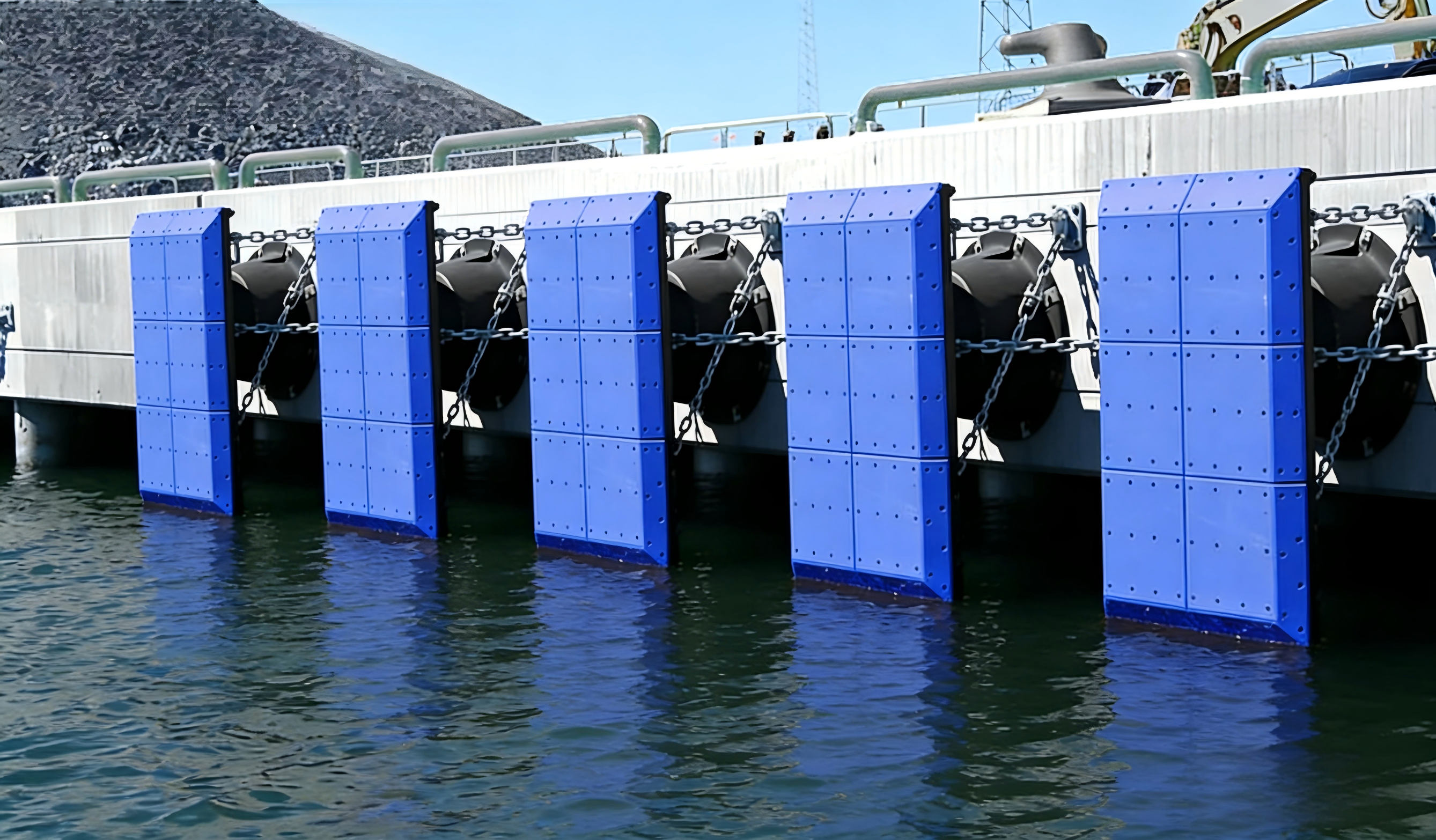
A fender panel is the steel structure mounted between the rubber fender unit and the vessel's hull. Its primary function is to distribute reaction forces from the rubber fender across a wider area of the ship's hull, preventing point loading that could damage both the vessel and the fender system .
| Function | Why It Matters |
|---|---|
| Force distribution | Spreads reaction forces to reduce hull pressure |
| Hull protection | Prevents point loading that can dent or puncture hulls |
| Tidal adaptation | Accommodates large tidal variations through panel height |
| Chain connection | Provides secure attachment points for chain systems |
| Abrasion resistance | UHMW-PE face pads reduce friction and wear |
> *"Fender panels are just as important as the rubber units on high-performance systems."*
Without a properly designed fender panel, even the best rubber fender cannot perform optimally. The panel is the interface between the fender's energy absorption and the vessel's structural integrity.
Not all fender panels are created equal. The fundamental design choice is between open structure and closed box structure.
Open panels consist of steel pads, H-beams, and cross-bracing without full enclosure . While cheaper to manufacture, they have significant disadvantages:
- Water intrusion – Saltwater enters the internal structure
- Corrosion vulnerability – Hidden rust develops from inside
- Higher maintenance – Requires regular painting and inspection of internal surfaces
- Shorter service life – Internal corrosion leads to premature failure
Closed box steel structure panels are fully sealed, watertight enclosures . They represent the industry's best practice for high-performance berthing systems.
| Feature | Benefit |
|---|---|
| Fully sealed | Prevents water intrusion into internal structure |
| Pressure tested | Verified watertightness before delivery |
| Internal structural members | Provides strength without weight penalty |
| C5M corrosion protection | Highest-grade marine paint system |
| Reduced maintenance | No internal corrosion to manage |
> *"Closed box designs are used almost exclusively – all fully sealed and pressure checked."*
Based on industry best practices from Nanjing Taidun Marine Engineering Co.,Ltd, and leading manufacturers, here are the essential design features of high-quality closed box fender panels.
The panel is fabricated as a fully enclosed steel box with internal structural members . This design provides:
- Superior strength-to-weight ratio – Internal bracing adds strength without excessive weight
- Complete water exclusion – No pathway for saltwater intrusion
- Uniform force distribution – The closed section distributes loads more evenly
Every closed box fender panel should be pressure tested to verify watertight integrity before delivery .
Typical test procedure:
1. Seal all openings
2. Pressurize the internal cavity with air
3. Monitor for pressure decay
4. Apply soapy water to welds to detect leaks
5. Repair and retest until fully sealed
Marine environments are classified as C5-M (very high corrosion) under ISO 12944 . Proper coating is essential.
Standard coating system for closed box panels:
| Layer | Material | Purpose |
|---|---|---|
| Primer | Epoxy zinc-rich | Adhesion and cathodic protection |
| Intermediate | C5M modified epoxy | Barrier protection |
| Topcoat | Polyurethane (RAL5005 blue or custom) | UV resistance and appearance |
> *"Corrosion protection is provided by high durability C5M class paint systems to ISO 12944."*
Lead-in bevels and chamfers are angled edges at the top and bottom of the panel . They serve a critical safety function: preventing vessel beltings from snagging beneath the panel.
Why this matters:
- Ro-Ro vessels and ferries have protruding belt lines
- Without chamfers, beltings can catch under the panel edge
- Snagging can cause panel damage or vessel damage
- Large chamfers (300-500mm) are standard for mixed traffic terminals
Ultra-High Molecular Weight Polyethylene (UHMW-PE) face pads attach to the front of the steel panel . These pads:
- Provide a low-friction surface (coefficient of friction <0.2)
- Protect the vessel's paint from abrasion
- Absorb minor impacts without steel-to-steel contact
- Are replaceable when worn
Properly designed chain brackets provide secure connection points for:
- Tension chains (absorb pulling forces)
- Shear chains (control lateral movement)
- Weight chains (maintain vertical position)
Lifting points are integrated into the panel design to facilitate safe installation and maintenance .
Designing a closed box fender panel requires sophisticated engineering analysis.
Every panel should be purpose-designed using structural analysis programs and 3D CAD modeling for optimum strength .
Key design parameters to analyze:
| Parameter | Consideration |
|---|---|
| Bending moment | Maximum load at panel center |
| Shear force | Load transfer at connections |
| Local buckling | Panel face stability under compression |
| Weld sizes and types | Strength and fatigue resistance |
| Steel grade | Yield strength and ductility |
| Permissible stresses | Safety factors per design code |
The panel must be sized to keep hull pressure within allowable limits for the vessel type .
The formula:
> P = ΣR ÷ (A₁ × B₁) ≤ Py
Where:
- P = Actual hull pressure (kN/m²)
- ΣR = Sum of maximum reaction forces from all fenders (kN)
- A₁ = Valid width of front panel (m)
- B₁ = Valid length of front panel (m)
- Py = Vessel allowable hull surface pressure (kN/m²)
| Vessel Type | Allowable Hull Pressure (kN/m²) |
|---|---|
| Oil tankers (general/coastal) | 250–350 |
| Bulk carriers | 150–250 |
| Panamax container ships | 150–250 |
| Sub-Panamax container ships | 300–400 |
| Large container ships | 400–500 |
| General cargo ships | 300–600 |
| Gas carriers (LNG/LPG) | 100–200 |
*Source: Industry standards*
The Port of Vigo undertook significant improvements to accommodate larger vessels at two terminals .
Project scope:
- Bouzas Terminal (Ro-Ro): 14 Cone Fenders (CT 1200, G2.7) with closed-box steel panels (2000×4800 mm) and UHMW-PE sliding plates
- Cruise Terminal: 12 V Fenders (V 800×2000 mm)
Key design features:
- Large 500mm-high chamfers to prevent Ro-Ro vessel beltings from snagging
- Exceptionally high panels to accommodate Atlantic tidal ranges
- Project delivered on time despite Red Sea crisis logistics challenges
The historic Mediterranean port of Alicante invested in refurbishing its cruise berth .
Project scope:
- 19 sets of CT Cone 1100 Fenders
- Closed steel panel design measuring 2100×2400mm with 300mm top chamfer
Key result:
- The closed box steel panel improved corrosion resistance compared to the old open panels
- Reduced maintenance requirements for the port
- Local sales team provided installation assistance and final inspection
The Port of Rostock undertook a large refurbishment to standardize fender systems across multiple quays .
Project scope:
- 59 sets of Cone Fenders (CT 800, G3.1)
- Closed box steel panels (2000×3000mm) with 50mm UHMW-PE sliding plates
Unique design challenge:
- Birds frequently landed on fenders, damaging paint and rubber
- Taidun designed an angled profile for steel panels to prevent perching
- This modification improved performance, eased maintenance, and extended service life
Thunderer Jetty on the Thames in East London underwent complete refurbishment, extending facility lifespan by 40 years .
Project scope:
- 4 sets of Parallel Motion Fenders (CT 1100 mounted back-to-back)
- Large closed box steel panels: 2250×9930mm
- 2 additional fender panels (2100×9930mm)
- 8 bollards with various capacities
Key result:
- Extended the facility's lifespan by an additional 40 years
- Upgraded to meet latest safety and environmental standards
We asked our global OEM clients about their experience with closed box fender panels:
> *"We used to specify open panel designs to save money upfront. But the maintenance costs were killing us. Internal rust meant we were repainting every 3-4 years. We switched to closed box panels five years ago and haven't touched them since. The lifecycle savings are enormous."*
> — *Port Engineer, Southeast Asia*
> *"The chamfers are not optional. We had a panel without proper lead-in bevels, and a Ro-Ro vessel's belting caught under the edge during berthing. It bent the panel and damaged the ship. Now we specify 400mm chamfers as standard."*
> — *Terminal Operations Manager, Middle East*
> *"Pressure testing seemed like overkill until we received a batch of panels from a low-cost supplier. Three of them failed the pressure test—major weld leaks. We rejected the entire shipment. Now we require test reports with every order."*
> — *Procurement Director, European Port Authority*
At Nanjing Taidun Marine Equipment Engineering Co., Ltd. , we manufacture closed box steel structure fender panels to the highest industry standards.
Our manufacturing process includes:
| Stage | Activity |
|---|---|
| Design | 3D CAD modeling and FEM structural analysis per project requirements |
| Material selection | Marine-grade steel with full traceability |
| Fabrication | Precision welding by certified welders |
| Pressure testing | 100% of panels tested for watertight integrity |
| Coating | C5M epoxy system per ISO 12944 |
| Final assembly | UHMW-PE pad attachment and hardware fitting |
| Inspection | Third-party inspection available (BV, ABS, LR, CCS) |
We serve brand owners, wholesalers, and production facilities in over 80 countries. When you partner with Taidun, you get custom-engineered closed box panels that match your specific berthing requirements.
Fender panels with closed box steel structure are the industry standard for high-performance berthing systems. They offer superior corrosion resistance, reduced maintenance, and longer service life compared to open panel designs.
Key takeaways:
- Closed box panels are fully sealed and pressure tested for water tightness
- C5M coating systems provide marine-grade corrosion protection
- Lead-in bevels and chamfers prevent vessel snagging
- UHMW-PE face pads reduce friction and protect hull paint
- Real-world projects from Vigo, Alicante, Rostock, and London demonstrate proven performance
[Contact the Nanjing Taidun Engineering Team] for a free fender panel consultation. Send us your berthing requirements, and we will design, manufacture, and deliver closed box steel panels optimized for your terminal.
Q1: What is the difference between open and closed box fender panels?
A: Open panels have exposed internal structures that allow water intrusion and corrosion. Closed box panels are fully sealed, pressure-tested steel enclosures that prevent water ingress and provide superior corrosion resistance .
Q2: Why are closed box panels considered the industry standard?
A: Closed box panels offer better corrosion protection, lower maintenance requirements, and longer service life than open designs. Leading manufacturers use closed box designs almost exclusively for high-performance systems .
Q3: What is C5M coating and why is it important?
A: C5M is the highest corrosion classification under ISO 12944 for marine environments. C5M-modified epoxy paint systems provide durable protection against saltwater corrosion .
Q4: What are lead-in bevels and chamfers?
A: Lead-in bevels and chamfers are angled edges at the top and bottom of fender panels that prevent vessel beltings from snagging beneath the panel. They are essential for Ro-Ro terminals and mixed-traffic ports .
Q5: How are closed box panels tested for water tightness?
A: Closed box panels undergo pressure testing—the internal cavity is pressurized, and leaks are detected using pressure monitoring and soapy water. Only panels that pass are approved for delivery .
1. Marine Construction Magazine. *SFT fenders to Alicante (Spain) cruise berth*. Issue V 2020. [https://digitaledition.marineconstructionmagazine.com/articles/sft-fenders-to-alicante-spain-cruise-berth]
2. Pile Buck Magazine. *SFT Spanish Office Delivered Cone Fenders For Refurbished Cruise Berth in Alicante*. (2020). [https://pilebuck.com/sft-spanish-office-delivered-cone-fenders-refurbished-cruise-berth-alicante/]
3. Port Technology. *Port of Rostock receives new equipment for refurbishment*. (2024). [https://www.porttechnology.org/port-of-rostock-receives-new-equipment-for-refurbishment/]


