

Views: 425 Author: Nanjing Taidun Publish Time: 2026-05-16 Origin: Site
Content Menu
● What Is a Pneumatic Rubber Fender?
● The Five-Layer Anatomy of a Pneumatic Rubber Fender
>> Layer 1 – Outer Rubber Layer (Protective Armor)
>> Layer 2 – Synthetic-Tire-Cord Reinforcement (The Skeleton)
>> Layer 3 – Intermediate Rubber Layers (The Enabler of Expansion)
>> Layer 4 – Inner Rubber Layer (The Air Seal)
>> Layer 5 – Beading Rings and End Fittings (The Termination)
● The Science of Inflation – How Pneumatic Fenders Expand
>> The Problem with Traditional Designs
● Metal Accessories and Protection Systems
● Material Selection and Quality Assurance
● Case Study – Nanjing Taidun Pneumatic Fenders in Typhoon Conditions
● User Feedback – Real-World Performance
● How Nanjing Taidun Supports Your OEM Needs
● Frequently Asked Questions (FAQ)
When a 300,000-ton VLCC approaches an offshore terminal for a ship-to-ship (STS) transfer, the only thing standing between disaster and safe berthing is a pneumatic rubber fender. But what makes these fenders work? How are they engineered to absorb massive kinetic forces while remaining compact enough for storage and transport?
Understanding Nanjing Taidun pneumatic rubber fender structure and design is essential for any port operator, procurement specialist, or marine engineer. In this guide, I will walk you through every layer of our pneumatic fenders—from the inner liner to the outer rubber—explaining how each component contributes to superior energy absorption, durability, and reliability.
I have spent over a decade manufacturing OEM rubber fender systems for global brands, wholesalers, and production facilities. Our pneumatic fenders are ISO 17357 certified, PIANC compliant, and trusted by ports in over 80 countries .
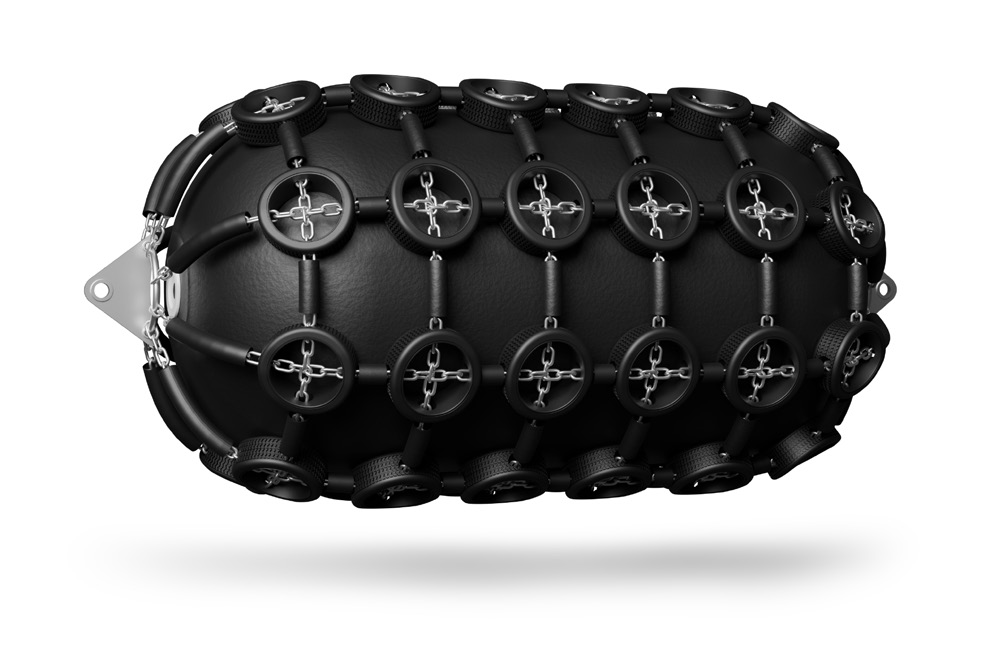
A pneumatic rubber fender is an air-filled, floating anti-collision device used in marine applications. It is made of synthetic-cord-reinforced rubber sheets with compressed air inside, enabling it to float on the sea surface and work as a shock absorber during ship-to-ship (STS) transfer operations and ship-to-dock (STD) berthing and mooring operations .
Nanjing Taidun pneumatic fenders are available in two standard pressure ratings :
| Pressure Rating | Internal Pressure | Typical Application |
|---|---|---|
| Pneumatic 50 | 50 kPa (7.25 psi / 0.5 bar) | Most common; ship-to-quay and light STS |
| Pneumatic 80 | 80 kPa (11.6 psi / 0.8 bar) | Larger vessels; harsh sea conditions |
| Type | Description | Best Application |
|---|---|---|
| Type I – Net Type | Protected by chain-tire net | Rough quay walls; high abrasion environments |
| Type II – Sling Type | No net; sling-based deployment | Smooth quay walls; temporary installations |
The selection of the most suitable type depends on the intended use of the fender and the requirements of the facility in question .

Every pneumatic rubber fender is a sophisticated composite structure. The basic body construction of a floating pneumatic rubber fender consists of :
1. Outer rubber layer (protects against abrasion and external forces)
2. Synthetic-tire-cord reinforcement layers (provides strength)
3. Intermediate rubber layers (facilitates expansion)
4. Inner rubber layer (seals pressurized air)
5. Beading rings and end fittings (secures structure)
All of these layers are vulcanized together, and then compressed air is introduced inside to enable the fender to float on the sea surface .
The outer rubber layer is the fender's first line of defense. It protects the cord layers and the inner rubber layers from abrasion and other external forces. Our compound has sufficient tensile and tear strength to withstand any weather condition and hard usage .
Key properties of Nanjing Taidun's outer rubber:
| Property | Specification |
|---|---|
| Material | Premium natural rubber or EPDM/Neoprene blends |
| UV resistance | Enhanced with anti-aging additives |
| Ozone resistance | Passes ISO 1431-1 testing |
| Saltwater resistance | Superior to standard compounds |
| Tear strength | Reinforced for puncture resistance |
> *"Our rubber fenders are engineered to absorb and disperse up to 90% of kinetic impact energy—a critical feature during typhoon-driven vessel collisions."*
> — *Nanjing Taidun Engineering Team*
The synthetic-tire-cord reinforcement layers are what give pneumatic fenders their incredible strength. These are not ordinary fabric layers—they are high-tensile cord layers formed by arranging a plurality of cords in parallel .
Why tire cord instead of canvas fabric?
A comparison of physical properties reveals the key difference :
| Material | Warp Density (ends/inch) | Weft Density (ends/inch) | Tensile Strength (warp) |
|---|---|---|---|
| Synthetic tire cord | 24 | 2 | 20 N/mm |
| Canvas fabric | 16 | 16 | 11.6 N/mm² |
The synthetic-tire-cord arrangement has strength in one direction only (the warp direction), but that directional strength is dramatically higher than canvas. This is precisely what pneumatic fenders need—maximum strength along the circumference where hoop stresses are highest .
Cord arrangement details :
- Multiple reinforcing layers (typically 6 to 12 layers)
- Adjacent layers have cords that intersect at predetermined angles
- Cord angle in uninflated state: 15° to 45° relative to body axis
- Upon inflation, cord angle increases to static angle (≈54°-55°)
This is where Nanjing Taidun's design differs from conventional pneumatic fenders. Between each pair of reinforcing cord layers, we place a special intermediate rubber layer .
| Parameter | Specification |
|---|---|
| Thickness (uninflated) | 1 mm to 5 mm |
| 100% modulus | 0.5 MPa to 5.0 MPa |
| Material | Natural rubber, SBR, or NR/SBR blend |
Why does this matter?
In a conventional pneumatic fender, only very thin adhesive rubber is disposed between reinforcing layers. The intermediate rubber layers we use allow the fender to :
1. Expand significantly during inflation (from compact storage size to full operational size)
2. Return to compact size when deflated (easy transport and storage)
3. Distribute stresses evenly across all cord layers during impact
> *"If the thickness of the intermediate rubber layer in the neutral state is less than 1 mm, the shear force between layers during inflation becomes excessive, so adverse effects such as reduction in durability and inter-layer separation can easily occur."*
> — *Pneumatic Fender Patent Specification*
The inner layers seal the pressurized air inside the fenders . This layer must be:
- Absolutely airtight (≤3% pressure loss over 72 hours per ISO 17357)
- Flexible enough to accommodate expansion
- Compatible with the air valve system
Nanjing Taidun uses specialized butyl rubber compounds for inner layers, offering the lowest gas permeability of any rubber material.
The structural integrity of a pneumatic fender depends on how the cord layers are terminated at the ends.
Beading ring :
- A steel ring placed at one end (or both ends) of the fender
- Holds the end of the cord layers securely
- Prevents layer separation under pressure
Flange :
- A steel flange mounted on the fender
- Provides attachment points for air valves and safety valves
- Hot-dip galvanized or 316 stainless steel for corrosion resistance
One of the most remarkable features of modern pneumatic fenders is their ability to expand dramatically from a compact storage size to full operational size .
In conventional pneumatic fenders, the cord angle is set to a static angle of about 54°-55° in the uninflated neutral state. As a result, even when the interior is filled with air to the prescribed internal pressure, the size (length and external diameter) does not change much .
The consequence: The fender's storage size is nearly as large as its operational size—requiring massive warehouse space and expensive transport ships.
Our pneumatic fenders use a low cord angle (15°-45°) in the uninflated state, combined with intermediate rubber layers that deform in shear during inflation .
The inflation sequence:
| Stage | Cord Angle | Diameter | Description |
|---|---|---|---|
| Uninflated (storage) | 15°-45° | Minimum | Compact; easy to transport and store |
| Partially inflated | Increases gradually | Expanding | Intermediate rubber layers shear |
| Fully inflated (operational) | 54°-55° | Maximum | Ready for STS or berthing operations |
> *"When the fender is filled with air to the prescribed internal pressure, the cord angle increases to a stable static angle. In this case each of the intermediate rubber layers deforms in shear, so the cord angle increases smoothly up to the static angle. Therefore although the fender is compact when not in use, during use it is possible to greatly expand the diameter."*
> — *Pneumatic Fender Patent Specification*
The result: A fender with an operational diameter of 3.5 meters can be stored and transported at a significantly smaller size—reducing shipping costs by up to 50% .
No pneumatic fender system is complete without its supporting hardware.

The purpose of chain or tire net is to protect the fender body from damage by sharp objects or protrusions such as rough-faced quay walls, and to distribute shear forces along the length of the chain net .
CTN components:
| Component | Material | Function |
|---|---|---|
| Chain net | Hot-dip galvanized steel | Primary abrasion protection |
| Tire sleeves | Recycled rubber | Cushion between chain and fender |
| Shackles | 316 stainless steel | Secure connections |
| Swivels | 316 stainless steel | Prevents chain twisting |
All relevant metal accessories including shackles, towing rings, swivels, and chain nets are made of stainless steel or hot-dip galvanized which are resistant to seawater corrosion .
| Component | Requirement | Nanjing Taidun Specification |
|---|---|---|
| Air valve | For inflation/deflation | Corrosion-resistant; leak-proof design |
| Safety valve | Mandatory for ≥2.5m diameter | Releases excess pressure at 175-230 kPa |
| Pressure gauge port | Optional | Allows real-time pressure monitoring |
Fenders of diameter 2500mm and larger shall be equipped with a safety valve for releasing excess internal pressure when fenders are over-compressed accidentally. Fenders smaller than 2500mm in diameter can also be equipped with a safety valve if required by the customer .
Nanjing Taidun uses only premium rubber compounds in our pneumatic fenders:
| Component | Material | Key Property |
|---|---|---|
| Outer cover | Natural rubber or Neoprene/EPDM blend | UV, ozone, abrasion resistance |
| Inner liner | Butyl rubber | Lowest gas permeability |
| Intermediate layers | Natural rubber or SBR | Shear deformation characteristics |
Our pneumatic fenders undergo rigorous testing and hold multiple international certifications :
| Certification | Issuing Body | Scope |
|---|---|---|
| ISO 17357-1:2014 | International Organization for Standardization | High-pressure pneumatic fenders |
| PIANC | World Association for Waterborne Transport Infrastructure | Performance testing |
| ISO 9001 | International standards | Quality management |
| BV | Bureau Veritas | Third-party inspection |
| SGS | SGS Group | Factory inspection |
| LR | Lloyd‘s Register | Classification approval |
| CCS | China Classification Society | Classification approval |
In early 2026, a major Southeast Asian port faced the full force of typhoon season. Their existing fender system was showing signs of fatigue—cracking rubber, corroded chains, and inconsistent pressure retention.
The solution: Nanjing Taidun supplied a complete set of ISO 17357-1:2014 certified pneumatic fenders with enhanced UV and ozone resistance .
Results:
- 90% kinetic energy absorption during typhoon-driven vessel collisions
- Zero structural damage to quay walls or vessel hulls
- Full elasticity maintained even after repeated heavy impacts
- 15+ year service life expected for heavy-duty models
> *"Unlike rigid plastic or low-grade rubber alternatives, our fenders compress evenly under extreme load, cushioning blows rather than transferring force to port structures and ship hulls. This eliminates concrete cracking, hull deformation, and costly emergency repairs mid-storm."*
> — *Nanjing Taidun Engineering Team*
We asked our global OEM clients about their experience with Nanjing Taidun pneumatic fenders. Here is what they shared:
> *"We switched to Nanjing Taidun's pneumatic fenders after a competitor's product failed during a critical STS transfer. The difference is night and day. The cord reinforcement is visibly stronger, and the pressure retention is excellent—we check monthly and rarely need to top up."*
> — *Technical Manager, Middle East Oil Terminal*
> *"The ability to deflate these fenders for shipping is a game-changer. We saved nearly 40% on freight costs compared to the previous supplier. And the fenders perform exactly as advertised—energy absorption is consistent, and the outer rubber is holding up well against our rough quay wall."*
> — *Procurement Director, European Port Authority*
> *"What impressed me most was the documentation. Every fender came with a complete test report—not just a certificate. We could trace every material batch. That's the level of transparency we require from our OEM partners."*
> — *Quality Manager, Global Marine Equipment Brand*
At Nanjing Taidun Marine Equipment Engineering Co., Ltd. , we are not just a manufacturer—we are an OEM partner to global brands, wholesalers, and production facilities.
Our pneumatic fender capabilities include:
| Service | Description |
|---|---|
| Custom sizes | Diameters from 0.5m to 4.0m; lengths to specification |
| Pressure ratings | Pneumatic 50 (50 kPa) or Pneumatic 80 (80 kPa) |
| Type selection | Type I (net type) or Type II (sling type) |
| Color options | Custom colors for branding or visibility |
| Third-party inspection | BV, SGS, LR, CCS, or ABS witness testing |
| Full documentation | Complete test reports, not just certificates |
Our facility: 300,000 square meters; 20,000 tons annual output; R&D center with full testing equipment .
Understanding Nanjing Taidun pneumatic rubber fender structure and design reveals why these products are the gold standard for STS transfers, large vessel berthing, and harsh marine environments. From the synthetic-tire-cord reinforcement to the intermediate rubber layers that enable compact storage, every component is engineered for maximum performance and durability.
When you need pneumatic fenders you can trust, partner with an OEM who understands the science—Nanjing Taidun.
[Contact the Nanjing Taidun Engineering Team] for a pneumatic fender consultation. Send us your vessel specifications, and we will recommend the optimal size, pressure rating, and type for your operation.
Email: service@taidunmarine.com
WhatsApp: +86-18751950876
Q1: What is the difference between Pneumatic 50 and Pneumatic 80 fenders?
A: Pneumatic 50 fenders have an initial internal pressure of 50 kPa (0.5 bar) and are suitable for most standard berthing and STS applications. Pneumatic 80 fenders operate at 80 kPa (0.8 bar) and are designed for larger vessels and harsher sea conditions .
Q2: Why is synthetic tire cord used instead of canvas fabric?
A: Synthetic tire cord has dramatically higher tensile strength in the direction where it is needed (circumferential hoop stress). While canvas has balanced strength, tire cord provides 20 N/mm in the warp direction compared to canvas's 11.6 N/mm², making it ideal for containing internal air pressure .
Q3: How do intermediate rubber layers improve fender performance?
A: Intermediate rubber layers (1-5mm thick with 0.5-5.0 MPa modulus) allow the cord angle to increase smoothly during inflation. This enables the fender to be stored at a compact size and expand to full operational diameter when inflated—reducing shipping and storage costs by up to 50% .
Q4: What safety features are required on large pneumatic fenders?
A: Fenders 2.5 meters in diameter and larger must be equipped with a safety valve that releases excess internal pressure if the fender is over-compressed accidentally. Smaller fenders can also be equipped with safety valves upon customer request .
Q5: What certifications do Nanjing Taidun pneumatic fenders hold?
A: Our pneumatic fenders are certified to ISO 17357-1:2014 and meet PIANC performance standards. Third-party inspections are available from BV, SGS, LR, CCS, and ABS .
1. Nanjing Taidun Marine Equipment Engineering Co., Ltd. (2026). *How Nanjing Taidun Rubber Fenders Protected a Major Port During Typhoon Season*. [https://www.taidunmarine.com/how-nanjing-taidun-rubber-fenders-protected-a-major-port-during-typhoon-season.html]
2. Nanjing Taidun Marine Equipment Engineering Co., Ltd. (2026). *Pneumatic Fenders: Revolutionizing Marine Docking with Nanjing Taidun's OEM Expertise*. [https://www.taidunmarine.com/pneumatic-fenders-revolutionizing-marine-docking-with-nanjing-taidun-s-oem-expertise.html]3. Nanjing Taidun Marine Equipment Engineering Co., Ltd. *China Marine Rubber Fenders, Mooring Bollards, Marine Anchors Supplier*. [https://www.taidunmarine.com/]
4. Nanjing Taidun Marine Equipment Engineering Co., Ltd. (2026). *Nanjing Taidun Pneumatic Rubber Fender Product Specifications*. (Internal product documentation)


