

Views: 425 Author: Nanjing Taidun Publish Time: 2026-05-19 Origin: Site
Content Menu
● What Is the Fundamental Difference Between Solid and Hollow Rubber Fenders?
● Hollow Rubber Fenders — Design Variations and Applications
>> The Three Main Types of Hollow D Fenders
>> Performance Characteristics of Hollow Fenders
>> Common Hollow Fender Types and Their Applications
● Solid Rubber Fenders — Design Variations and Applications
>> Types of Solid Rubber Fenders
>> Performance Characteristics of Solid Fenders
>> Solid Square Fenders — Heavy-Duty Protection
● Direct Comparison — Solid vs. Hollow in Practical Scenarios
>> Performance Comparison Table
>> Energy Absorption Comparison
● Material Selection and Environmental Factors
● User Feedback — Real-World Experiences
● How Nanjing Taidun Supports Your Fender Selection
● Frequently Asked Questions (FAQ)
When a tugboat hits a dock dozens of times each day, the wrong fender can fail when protection is needed most. When a 200,000-ton tanker approaches an LNG terminal, the margin for error is zero. Understanding the difference between solid rubber fender and hollow rubber fender in practical application is not an academic exercise—it is a safety and commercial imperative.
I have spent two decades manufacturing OEM rubber fender systems and mooring bollards for global brands, wholesalers, and production facilities. In this guide, I will walk you through the fundamental differences between solid and hollow rubber fenders, their respective applications, and how to make the right choice for your specific operation.
The core difference lies in the internal structure—and this difference determines everything about how the fender performs.
| Aspect | Solid Rubber Fender | Hollow Rubber Fender |
|---|---|---|
| Internal structure | 100% rubber throughout; no cavities | Contains air-filled chamber(s) inside |
| Energy absorption mechanism | Rubber deformation under compression | Air compression + rubber deformation |
| Reaction force | Higher; transfers more force to hull | Lower; cushions vessel more gently |
| Surface pressure | More localized at impact point | More evenly distributed |
| Compression stroke | Limited to rubber‘s elastic limit | Greater deflection capacity |
| Durability | Extremely high; resists cutting/abrasion | Moderate; puncture risk if uncovered |
| Maintenance | Minimal | Requires pressure checks (if pneumatic) |
> *"The hollow design allows for increased deflection, making it ideal for absorbing impacts from larger vessels and heavy duty applications. Solid Fenders have a more compact profile and provide reliable protection against moderate impacts."*
This fundamental distinction shapes every practical decision in fender selection.
Hollow rubber fenders are not a single product category. They come in several distinct designs, each with unique performance characteristics.
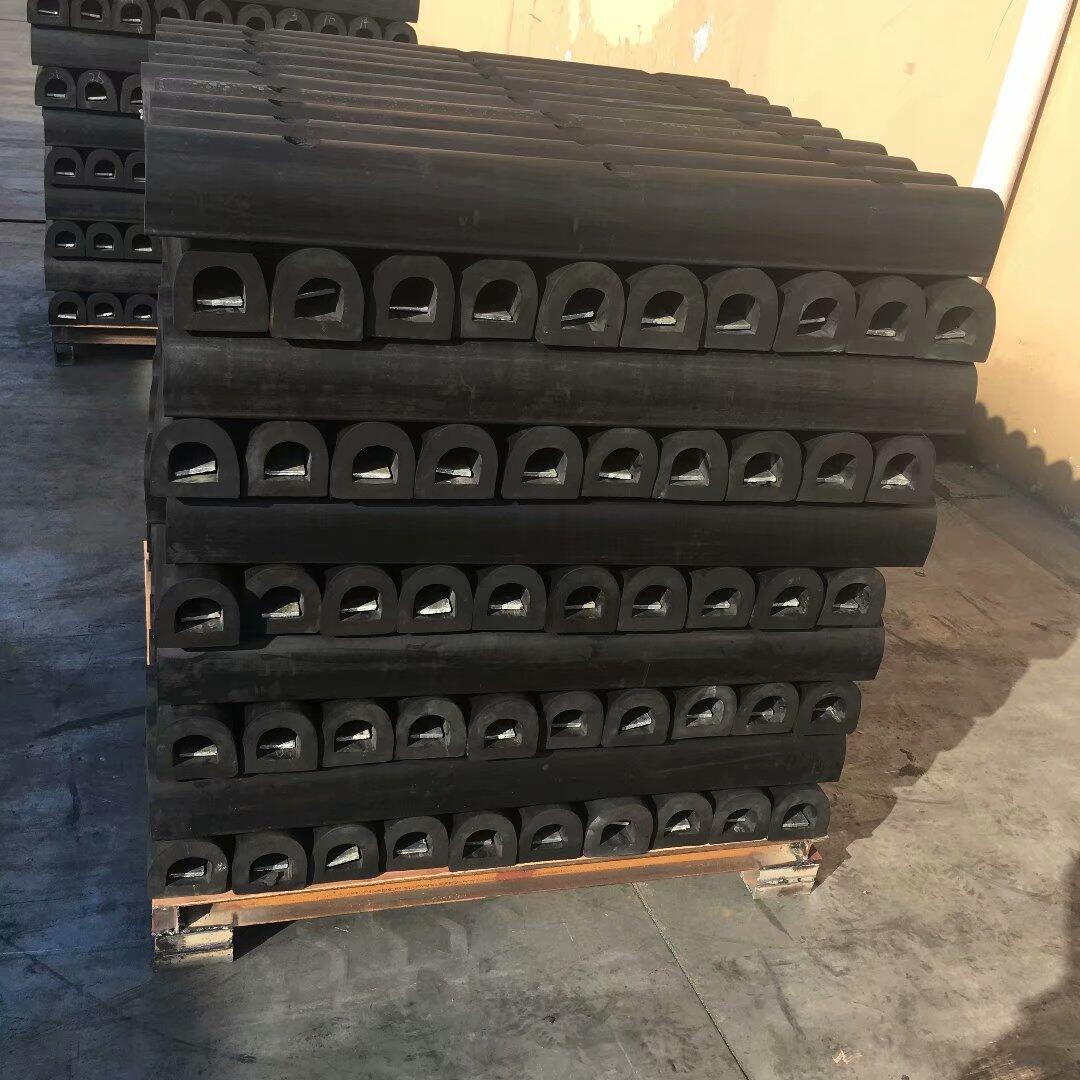
According to industry classification, most hollow D fenders fall into three structural types :
| Type | Internal Shape | Key Characteristics | Best Applications |
|---|---|---|---|
| DD Type | D-shaped hollow core | Balanced energy absorption and reaction force; most common | Tugboats, workboats, general dock protection |
| DO Type | Round (O-shaped) hollow core | Softer compression response; better stress distribution | Vessel side mounting, push barges, frequent berthing |
| Single D Hollow | Simple D-shaped cavity | Standard design; economical | Small craft, light-duty applications |
Hollow rubber fenders derive their energy absorption from air compression inside the chamber in addition to rubber deformation . This dual mechanism creates several practical advantages:
Key Advantages:
- Lower reaction force on vessels – Critical for protecting aging hulls and STS operations
- Even pressure distribution – Air compression distributes load across the entire contact surface
- Greater deflection capacity – Absorbs higher-energy impacts without bottoming out
- Self-floating capability (for pneumatic types) – Ideal for high tidal range areas
Recent Research Validation:
A 2026 study published in *Ocean Engineering* confirmed that hollow-section rubber fenders exhibit significant strain-rate sensitivity in energy absorption . Crushing tests at speeds from 0.05 mm/s to 200 mm/s demonstrated that:
> *"Both the peak force and the overall force resistance increased markedly as the loading speed increased. Correspondingly, the absorbed energy also rose with increasing loading speed."*
This means hollow fenders perform differently under real-world dynamic berthing versus laboratory quasi-static testing—an important consideration for engineers.
| Fender Type | Design | Primary Application |
|---|---|---|
| Cell Fender (SFA) | Hollow cylindrical body with mounting flanges | Ports, terminals, large vessel berthing |
| Cylindrical Fender | Hollow tube; chain-mounted | General cargo berths, tugboats |
| DD Type D Fender | D-shaped with D-shaped cavity | Towboats, barges, small docks |
| DO Type D Fender | D-shaped with round cavity | Vessel side protection |
| Arch (V-Type) Fender | Hollow arched profile | Container terminals, bulk berths |
Solid rubber fenders are exactly what the name implies: homogeneous rubber throughout, with no internal cavities or air chambers .
| Type | Shape | Key Features | Best Applications |
|---|---|---|---|
| Solid D Fender | D-shaped, fully solid | Highest wear resistance; longest service life | Heavy-duty tugboats, mining docks, high abrasion areas |
| Solid Square Fender | Square/rectangular profile | Superior rigidity; maximum durability | Quay walls, heavy-duty vessel berthing |
| Solid Cylindrical Fender | Round, solid core | Simple design; easy installation | Small to medium vessel berthing |
Solid rubber fenders absorb energy through rubber deformation alone—compression of the rubber material itself . This mechanism creates different practical characteristics:
Key Advantages:
- Maximum durability and abrasion resistance – Withstands constant scraping and rubbing
- No deflation risk – Cannot lose pressure; always ready for use
- Long service life – Typically 15-20 years in proper applications
- Simple installation – Bolt directly to structure; no chain-tire nets required
- No maintenance – No valves, no pressure checks, no inflation schedules
Limitations to Consider:
- Higher reaction force on vessels compared to hollow designs
- More localized surface pressure at impact point
- Less deflection capacity for a given profile size
> *"Solid D fenders are often used where durability is more important than softness. Solid fenders last longer but usually have higher reaction force. Hollow types often absorb energy better."*
Solid square fenders (also called S-type fenders) represent the extreme end of durability-focused design .
Key Features:
- High-pressure extrusion manufacturing process
- Superior rigidity and impact resistance
- Excellent resistance to abrasion, weathering, UV, and seawater
- Can be installed horizontally or vertically
- Can be pre-curved to match vessel bow/stern radius
Ideal for: Tugboats, workboats, quay walls, loading bays, and any environment where impacts are frequent and substantial.
| Performance Parameter | Solid Rubber Fender | Hollow Rubber Fender |
|---|---|---|
| Energy absorption mechanism | Rubber deformation | Air compression + rubber deformation |
| Reaction force | Higher | Lower (30-40% less per unit energy) |
| Surface pressure | Localized at impact point | Evenly distributed |
| Maximum deflection | 40-50% of height | 50-65% of height |
| Strain-rate sensitivity | Moderate | Pronounced (per 2026 research) |
| Puncture risk | Very low | Moderate (requires chain-tire net for some types) |
| Service life (typical) | 15-20 years | 10-15 years (pneumatic) / 15-20 years (foam-filled) |
| Maintenance requirement | Minimal | Regular (pneumatic) / Minimal (foam-filled) |
| Application Scenario | Recommended Fender | Rationale |
|---|---|---|
| Ship-to-ship (STS) transfer | Hollow (pneumatic) | Low reaction force protects both vessels; floats naturally |
| Tugboat bow protection | Solid D or Hollow DD | Solid for maximum abrasion resistance; hollow for balanced performance |
| Container terminal | Hollow (cone or cell) | High energy absorption; long stroke for tidal variation |
| Small marina / yacht club | Solid D (compact) | Cost-effective; adequate for moderate impacts; space-efficient |
| Heavy-duty mining dock | Solid square or solid D | Maximum durability; high abrasion resistance |
| High tidal range port | Hollow (pneumatic or foam-filled) | Floating design follows water level changes |
| Remote terminal (limited maintenance) | Solid or foam-filled hollow | No pressure checks; no deflation risk |
| LNG carrier berthing | Hollow (pneumatic with CTN) | ISO 17357-1:2014 compliant; low hull pressure |
Research comparing hollow and solid designs shows that hollow fenders can achieve 30-40% more energy absorption per unit length than comparable solid D fenders . However, this advantage comes with trade-offs in durability and maintenance requirements.
For tugboats and workboats that experience constant, low-energy impacts throughout each day, the extreme durability of solid rubber often proves more valuable than the higher energy absorption of hollow designs.
Both solid and hollow fenders are manufactured from high-quality rubber compounds, but material selection impacts performance significantly.
| Compound | Properties | Best Applications |
|---|---|---|
| Natural Rubber (NR) | Highest elasticity; excellent energy absorption | General marine docking; highest performance requirement |
| SBR (Styrene Butadiene Rubber) | Good abrasion resistance; cost-effective | Heavy-duty wear applications; tugboat fenders |
| EPDM (Ethylene Propylene Diene Monomer) | Superior UV, ozone, and weather resistance | Outdoor, high-sun exposure; tropical climates |
| Neoprene (CR) | Oil and chemical resistance | Industrial ports; oil terminal applications |
> *"Styrene-butadiene rubber (SBR) reinforced with carbon black was selected owing to its good resistance to ageing, seawater exposure, fatigue, and abrasion, which are essential properties for marine applications."*
| Environment | Solid Fender | Hollow Fender |
|---|---|---|
| High UV exposure | Excellent (with EPDM compound) | Good (with proper compound) |
| Saltwater immersion | Excellent | Good (requires corrosion-resistant fittings) |
| Extreme temperatures | Good | Moderate (pressure varies with temperature) |
| High abrasion (scraping) | Excellent (Solid square/D types) | Moderate (requires chain-tire net) |
| Oil / chemical exposure | Good (with Neoprene) | Good (with Neoprene) |
We asked our global OEM clients about their experiences with solid versus hollow rubber fenders. Here is what they shared:
> *"We used hollow D fenders on our tugs for years. They worked fine but we were replacing them every 18-24 months because of abrasion. We switched to solid D fenders three years ago. Same tugs, same dock, same usage. The solid fenders still look almost new. The higher reaction force hasn't been an issue for our operations."*
> — *Fleet Manager, European Towage Company*
> *"For our STS operations, we only use hollow pneumatic fenders. The low reaction force is critical when you're protecting a 15-year-old tanker. Solid fenders would transfer too much force to the hull. We accept the maintenance requirement because the performance is unmatched."*
> — *Operations Director, Middle East Oil Terminal*
> *"We have a remote dock in a high-tidal-range location. No power, no maintenance crew on site. We switched from pneumatic to solid fenders five years ago. Zero issues. No pressure checks. No deflation. They just work."*
> — *Port Engineer, Southeast Asia*
At Nanjing Taidun Marine Equipment Engineering Co., Ltd. , we manufacture both solid and hollow rubber fenders—and we also produce mooring bollards as complementary products for complete dock protection systems.
Our product capabilities include:
| Fender Type | Products We Offer |
|---|---|
| Solid Rubber Fenders | Solid D Type, Solid Square (S Type), Solid Cylindrical |
| Hollow Rubber Fenders | DD Type, DO Type, Cell Fenders, Cylindrical Fenders, Arch Fenders |
| Floating Fenders | Pneumatic (Yokohama-Type), Foam-Filled |
| Mooring Bollards | All types: Single Bitt, Double Bitt, Pilot, Cross, T-Head, Cast Steel |
Our OEM services include:
- Custom sizes and rubber compounds
- Pre-drilling and pre-curving to your specifications
- Third-party certification (ABS, BV, DNV, LR, CCS)
- Complete technical documentation
- Global shipping to brand owners in over 80 countries
Understanding the difference between solid rubber fender and hollow rubber fender in practical application is essential for making the right choice.
- Choose hollow fenders when: Low reaction force is critical (STS operations, tankers, LNG carriers), high tidal ranges require floating fenders, or energy absorption per size is the priority.
- Choose solid fenders when: Extreme durability and abrasion resistance are required (tugboats, mining docks, workboats), maintenance access is limited, or the application involves constant low-energy impacts.
Both have their place. The right choice depends on your vessels, your environment, and your operational priorities.
[Contact the Nanjing Taidun Engineering Team] for a free fender selection consultation. Tell us about your vessels and operating conditions, and we will recommend the optimal fender type, size, and compound for your specific application.
Q1: What is the main difference between solid and hollow rubber fenders?
A: Solid fenders are 100% rubber throughout and absorb energy through rubber deformation. Hollow fenders contain air-filled chambers and absorb energy through both air compression and rubber deformation. Hollow fenders generally produce lower reaction forces but require more maintenance .
Q2: Which type of fender lasts longer — solid or hollow?
A: Solid rubber fenders typically last longer (15-20 years) because they have no internal components that can fail. Pneumatic hollow fenders typically last 10-15 years. Foam-filled hollow fenders can also reach 15-20 years .
Q3: Are hollow fenders always better for ship-to-ship (STS) operations?
A: Yes. For STS operations, the low reaction force of hollow pneumatic fenders is critical for protecting both vessels' hulls. Solid fenders would transfer too much force during STS berthing .
Q4: What are the three main types of D rubber fenders?
A: The three types are DD Type (D-shaped hollow core), DO Type (round/ O-shaped hollow core), and Solid D Type (no hollow core). DD Type is most common for balanced performance. DO Type provides softer compression. Solid D Type offers maximum durability .
Q5: Can solid rubber fenders be used on tugboats?
A: Yes. Solid D and solid square fenders are excellent for tugboat applications because they withstand constant abrasion from pushing operations. Many operators prefer solid fenders for tugs due to their durability, despite higher reaction force .


