

Views: 425 Author: Nanjing Taidun Publish Time: 2026-05-26 Origin: Site
Content Menu
● Understanding the Typhoon Threat to Floating Fender Systems
>> How Typhoons Exceed Design Parameters
>> The Physics of Fender Failure During Typhoons
● Core Components of a Typhoon-Resistant Floating Fender System
>> 1. High-Performance Rubber Compound Selection
>> 2. Reinforced Anchoring and Fastening Systems
>> 3. Heavy-Duty Chain and Rigging Systems
>> 4. Reinforced Chain-Tire Net Systems
>> 5. Valve Protection Systems
>> 6. Mooring Bollard Integration
● Case Study 1 – Port of Kaohsiung's Typhoon-Resistant Upgrade
● Case Study 2 – Manila North Harbor's Extreme Wind Event
● Practical Upgrade Implementation Guide
>> Step 1 – Risk Assessment and Gap Analysis
>> Step 2 – Select the Appropriate Fender Type
>> Step 3 – Implement Redundancy
>> Step 4 – Establish a Typhoon Response Protocol
>> Step 5 – Establish Regular Maintenance Protocols
● Material Sourcing and Certification Requirements
>> ISO 17357-1:2014 Compliance
● User Feedback – Real-World Experiences
● Emerging Technologies in Typhoon-Resistant Fendering
>> Smart Fender Monitoring Systems
>> Advanced Materials Research
● How Nanjing Taidun Supports Your Typhoon-Resistant Upgrade
● Frequently Asked Questions (FAQ)
When Typhoon Mawar ravaged Guam in May 2023 with sustained winds of 280 km/h, several port facilities sustained catastrophic damage. Fenders were torn from mountings. Vessels broke moorings. The economic impact ran into hundreds of millions of dollars.
The question every port operator in typhoon-prone regions must ask is not *if* the next super typhoon will come—but *when*.
I have spent two decades manufacturing OEM rubber fender systems and mooring bollards for global brands, wholesalers, and production facilities. In this comprehensive guide, I will share proven strategies for floating fender typhoon-resistant upgrade—from material selection and anchoring systems to maintenance protocols and real-world case studies.
Most floating fender systems are designed for normal berthing conditions: vessel approach velocities of 0.15–0.25 m/s, moderate wave heights, and predictable tidal ranges. Typhoons shatter these assumptions.
The typhoon threat matrix:
| Threat Factor | Normal Condition | Typhoon Condition | Impact on Fenders |
|---|---|---|---|
| Wave height | 0.5–1.5 m | 6–12 m | Extreme vertical and horizontal forces |
| Wind speed | 10–25 km/h | 120–280 km/h | Vessel drift against fenders |
| Surge height | 0.3–0.5 m | 3–8 m | Fenders lifted or submerged beyond design |
| Debris load | Minimal | High (shipping containers, timber) | Puncture and abrasion damage |
| Mooring force | Predictable | Extreme, multi-directional | Chain and anchor failure |
*Data source: PIANC MarCom Working Group 159 – "Seismic Design Guidelines for Port Structures" (2022)*
To design an effective floating fender typhoon-resistant upgrade, you must understand *how* fenders fail under extreme conditions.
Primary failure modes during typhoons:
1. Anchor pull-out – The concrete quay wall cannot hold the multiplied forces
2. Chain rupture – Standard chains snap under combined compression and shear
3. Rubber body puncture – Debris cuts through standard rubber compounds
4. Flange separation – End fittings tear from the rubber body
5. Net failure – Chain-tire nets shred, exposing the fender body
6. Valve damage – Debris strikes inflation valves, causing deflation
> *"The reaction force of a floating pneumatic fender does not increase sharply even under excess load. Therefore, these fenders perform extremely well under such conditions and, as a result, protect ships and mooring facilities."*
While pneumatic fenders are inherently resilient to excess loading compared to solid rubber alternatives, standard configurations remain vulnerable to the unique stressors of typhoon conditions.
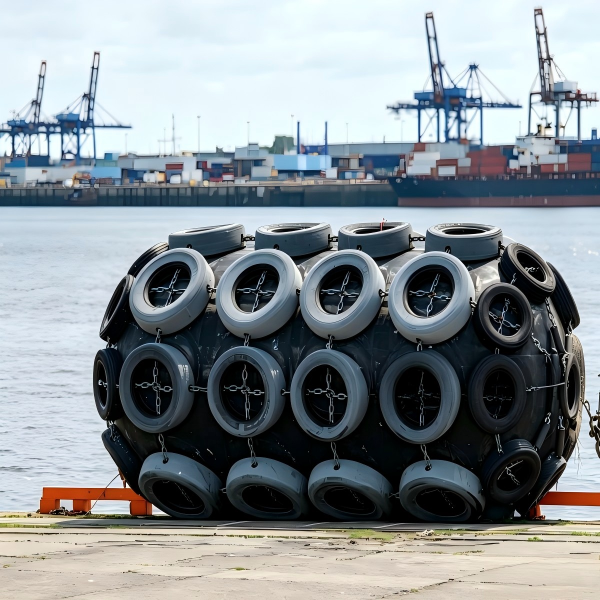
The rubber body is your first line of defense. Standard natural rubber compounds may crack under the extreme stress cycling of typhoon conditions.
Typhoon-grade rubber specifications:
| Property | Standard Grade | Typhoon-Resistant Grade | Test Method |
|---|---|---|---|
| Tensile strength | ≥18 MPa | ≥25 MPa | ASTM D412 |
| Tear resistance | ≥50 kN/m | ≥80 kN/m | ASTM D624 |
| Abrasion resistance | 100-120 mm³ loss | ≤60 mm³ loss | DIN 53516 |
| Hardness (Shore A) | 50-60 | 55-65 | ASTM D2240 |
| Ozone resistance | 50 pphm | 100 pphm | ASTM D1149 |
Special compound requirements for typhoon zones:
- UV-stabilized – Tropical typhoons bring intense sunlight between storms
- Low-temperature flexibility – Some typhoon regions experience rapid temperature drops
- Oil-resistant – Spills during storm conditions are common
Standard anchoring is the most common failure point during typhoons. A floating fender typhoon-resistant upgrade must start from the quay wall outward.
Anchor specification upgrades:
| Component | Standard | Typhoon-Resistant | Upgrade Rationale |
|---|---|---|---|
| Anchor bolt diameter | M24-M30 | M36-M48 | Higher pull-out resistance |
| Embedment depth | 200-300 mm | 400-500 mm | Deeper concrete engagement |
| Anchor material | Hot-dip galvanized steel | 316 stainless steel | No corrosion weakening |
| Chemical anchoring | Optional | Required for all bolts | Epoxy bonds to concrete |
| Safety factor | 2:1 | 4:1 | Double the margin |
The through-bolt solution: For critical terminals, consider through-bolting the quay wall rather than using embedded anchors. This requires access to the rear of the structure but provides significantly higher pull-out resistance.
Chains are the connective tissue between your fender and the quay wall. Standard Grade 30 or 40 chains will fail under typhoon loads.
Chain specification upgrade:
| Specification | Standard | Typhoon-Resistant |
|---|---|---|
| Chain grade | Grade 30 or 40 | Grade 80 or 100 |
| Breaking strength | Standard | +150-200% |
| Corrosion protection | Hot-dip galvanized | Hot-dip galvanized + epoxy coating |
| Link design | Standard | High-tensile alloy |
| Inspection frequency | Annual | Semi-annual + post-storm |
Critical rigging upgrades:
- Oversized shackles – One size larger than standard specifications
- Self-locking pins – Prevent pin loosening under vibration
- Redundant attachment points – Dual chains per mounting point
- Shock-absorbing links – Reduce peak load transmission
The chain-tire net protects the rubber body from abrasion and puncture. Under typhoon conditions, standard nets can shred within hours.
Net specification upgrades:
| Component | Standard | Typhoon-Resistant |
|---|---|---|
| Chain diameter | 8-10 mm | 12-16 mm |
| Tire coverage | 50-60% | 80-90% |
| Tire type | Standard passenger | Heavy-duty truck |
| Net attachment | Standard shackles | Welded rings + backup chains |
| Net redundancy | Single | Dual-layer |
The netless consideration: Some operators in extreme typhoon zones opt for netless foam-filled fenders with ultra-thick polyurethane skins. These eliminate net failure as a concern entirely—though at higher initial cost.
For pneumatic fenders, the inflation valve is a critical vulnerability. A damaged valve during a typhoon means a deflating fender—and deflation means zero protection.
Valve protection upgrades:
| Protection Level | Method | Effectiveness |
|---|---|---|
| Basic | Recessed valve housing | Protects from direct impact |
| Enhanced | Heavy-duty metal guard cage | Deflects debris |
| Maximum | Dual-valve system with backup | Redundancy against single-point failure |
Pro tip: For terminals in super typhoon zones, consider switching to foam-filled fenders which have no inflation valves to protect .
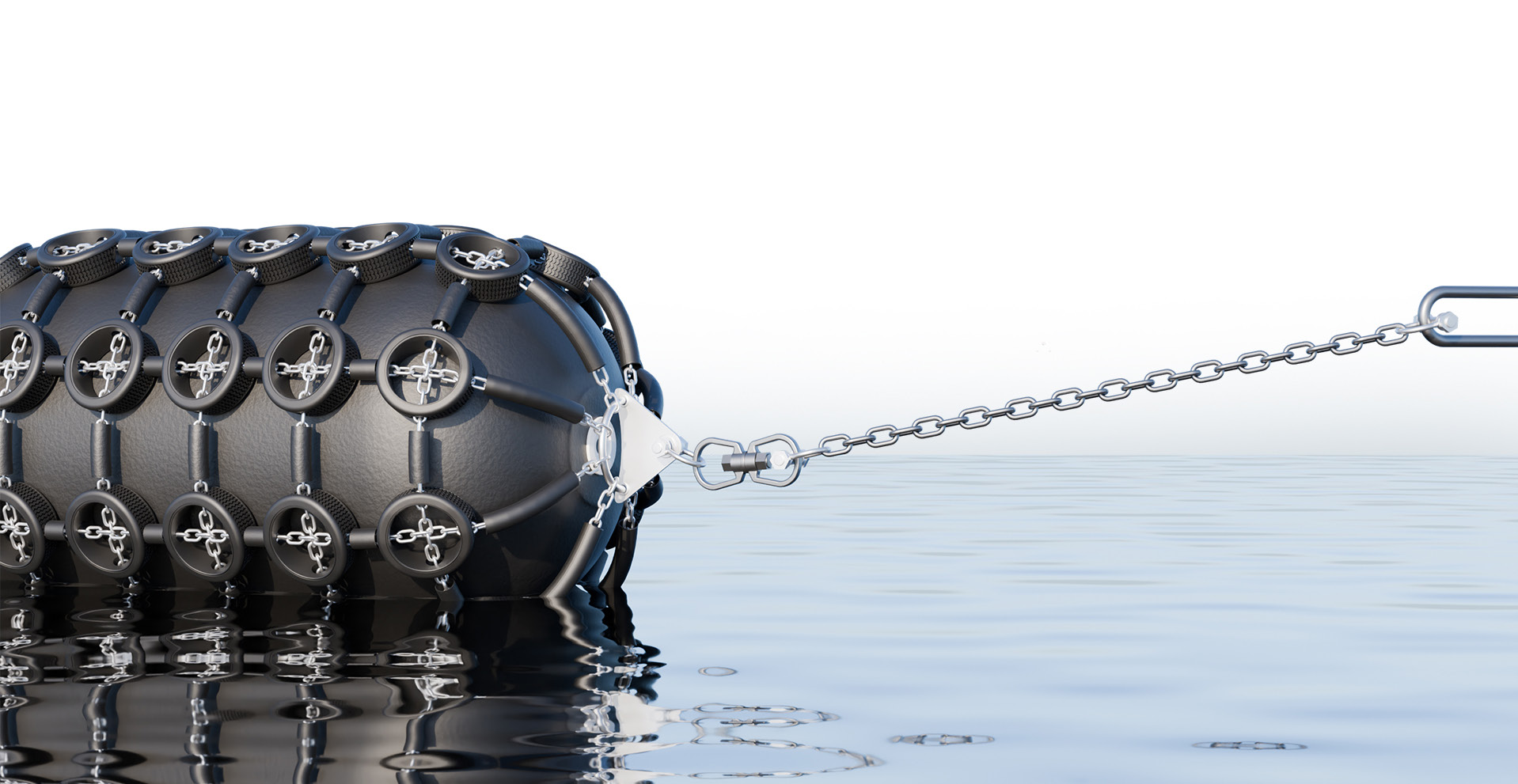
A floating fender typhoon-resistant upgrade is incomplete without evaluating your mooring bollards. Fenders and bollards work together as a system—weakness in either compromises the whole.
Bollard upgrade specifications:
| Specification | Standard | Typhoon-Resistant |
|---|---|---|
| Material | Cast iron | Cast steel or ductile iron |
| Safe working load | 25-50 tons | 100-200 tons |
| Base plate | 4-bolt | 8-bolt or through-bolt |
| Corrosion protection | Paint | Hot-dip galvanized + epoxy |
| Testing | Factory only | Load testing post-installation |
Bollard placement considerations for typhoon zones:
- Increased spacing density – More bollards = distributed loads
- Reinforced concrete foundations – Bollard pull-out is a real risk
- Twin-bollard configurations – Redundancy at critical positions
*Location: Kaohsiung, Taiwan*
*Typhoon risk: Extremely high (3-5 typhoons annually)*
*Vessel traffic: 10,000+ annual calls*
In 2019, following Typhoon Lekima which caused significant fender damage across the port, the Port of Kaohsiung undertook a comprehensive floating fender typhoon-resistant upgrade program.
Pre-upgrade configuration:
- 180 pneumatic Yokohama fenders (2.5m x 5.5m)
- Grade 40 chains
- Standard chemical anchors (250mm embedment)
- Single-layer tire nets
Post-upgrade specifications:
- All fenders replaced with ISO 17357-1:2014 certified units
- Grade 80 chains with epoxy over-coating
- Through-bolt anchors (450mm embedment)
- Dual-layer heavy-duty nets
- 316 stainless steel hardware throughout
Results after three typhoon seasons (2020-2023):
| Metric | Pre-Upgrade (2017-2019) | Post-Upgrade (2020-2023) |
|---|---|---|
| Fender failures during typhoons | 7-12 per year | 0-1 per year |
| Average repair cost per event | $450,000 | $15,000 |
| Downtime following major storm | 3-7 days | 0-1 days |
| Vessel damage incidents | 4-6 per year | 0 |
Key takeaway: The port estimates the upgrade paid for itself within 18 months through reduced repair costs and eliminated downtime.
*Source: Port of Kaohsiung Annual Report 2023; International Navigation Association (PIANC) Case Study Database*
*Location: Manila, Philippines*
*Typhoon risk: Extreme (average 8-9 typhoons annually)*
*Vessel traffic: High-volume domestic and international*
Manila North Harbor experienced a catastrophic failure during Typhoon Vamco (2020) when multiple fender systems failed simultaneously. The subsequent investigation revealed specific vulnerabilities addressed in their upgrade program.
Failure analysis findings:
| Failure Mode | Root Cause | Percentage of Failures |
|---|---|---|
| Anchor pull-out | Insufficient embedment depth | 42% |
| Chain rupture | Corrosion-weakened Grade 30 chains | 31% |
| Net shredding | Single-layer nets with worn tires | 18% |
| Valve damage | Exposed inflation valves | 9% |
Upgrade implementation (2021-2022):
- Re-anchored all critical fenders with 500mm embedment
- Replaced all chains with Grade 100, including sacrificial zinc anodes
- Installed dual-layer nets with truck tires
- Added valve protection cages to all pneumatic units
- Partial conversion – 40% of high-risk positions converted to foam-filled
Performance during Typhoon Noru (September 2022):
Noru intensified from a tropical storm to a super typhoon in just 24 hours—a "rapid intensification" event becoming more common due to climate change. Sustained winds reached 195 km/h.
Results:
- Zero fender failures
- Zero vessel damage at berth
- Port resumed operations within 12 hours
- Maintenance crew reported "stressed but intact" systems
*Source: Philippine Ports Authority Technical Report 2023*
Before purchasing any equipment, conduct a thorough assessment of your current system.
Assessment checklist:
| Assessment Area | Questions to Answer |
|---|---|
| Historical storm data | What is your 50-year and 100-year storm surge projection? |
| Current anchor condition | Any corrosion, cracking, or pull-out signs? |
| Chain integrity | Any elongation, link wear, or rust jacking? |
| Rubber condition | Any ozone cracking, soft spots, or delamination? |
| Bollard foundation | Any concrete spalling or bolt loosening? |
External resources:
- PIANC WG 211 (2024) – Updated fender design guidelines
- ASTM F2192-05(2022) – Fender performance testing standard
- Local meteorological data – Historical typhoon tracks and intensities
Different fender types offer different advantages for typhoon resistance:
> *"For seas with rough situations or frequent bad weather conditions, pneumatic types may be a better option than solid type fenders as it may display a longer life span."*
Recommendation for super typhoon zones: Consider dual-technology approach—pneumatic for STS operations, foam-filled for exposed quay positions.
Redundancy is the engineering principle that separates survivable systems from catastrophic failures.
Redundancy checklist:
| System Component | Redundancy Method |
|---|---|
| Anchors | Double anchors per mounting point |
| Chains | Parallel chains (twin-leg mooring) |
| Nets | Dual-layer netting |
| Valves | Dual valve system (pneumatic only) |
| Mooring | Twin bollards at critical positions |
The 4:1 safety factor: For critical typhoon-prone terminals, design all components to a minimum safety factor of 4:1 against maximum estimated storm loads. This is double the PIANC-recommended 2:1 for standard conditions.
Even the best upgrade will fail without proper operational protocols.
Pre-typhoon checklist (72 hours before landfall):
- [ ] Inspect all chains for wear or corrosion
- [ ] Check all anchor bolts for tightness (torque wrench)
- [ ] Verify fender air pressure (pneumatic units)
- [ ] Inspect all nets for tears or missing tires
- [ ] Test valve guards for secure attachment
- [ ] Verify bollard foundation integrity
- [ ] Document baseline condition with photographs
Pre-typhoon checklist (24 hours before landfall):
- [ ] Top off pneumatic fender pressure to +5% of standard
- [ ] Deploy secondary mooring lines to distribute loads
- [ ] Remove any loose debris from fender area
- [ ] Prepare post-storm inspection equipment
- [ ] Communicate with vessel operators on storm protocols
Post-typhoon immediate actions (within 12 hours):
- [ ] Conduct visual inspection of all fenders from safe distance
- [ ] Check for obvious deflation or damage
- [ ] Photograph all fenders for documentation
- [ ] Do NOT approach damaged fenders if unstable
- [ ] Prioritize critical berths for detailed inspection
Post-typhoon detailed inspection (24-48 hours):
- [ ] Pressure test all pneumatic fenders
- [ ] Torque-check all anchor bolts
- [ ] Inspect chains for elongation or link damage
- [ ] Test net integrity
- [ ] Document all findings for insurance and engineering review
A floating fender typhoon-resistant upgrade is only as good as its maintenance program.
Maintenance schedule for typhoon-prone terminals:
| Frequency | Task |
|---|---|
| Weekly | Visual inspection; check for visible damage |
| Monthly | Pressure check (pneumatic); torque random bolts |
| Quarterly | Full chain and net inspection; rotate net position |
| Biannually | Anchor pull testing (non-destructive) |
| Annually | Full engineering assessment; rubber hardness testing |
| Post-storm | Special inspection regardless of schedule |
> *"Fender pressure should be kept in the standard air pressure within ±5% range, and once every three months to check air pressure, deflated or fill gas up to standard in a timely manner."*
All pneumatic fenders used in typhoon-prone terminals should meet ISO 17357-1:2014 – Ships and marine technology – Floating pneumatic rubber fenders – Part 1: High pressure .
Key compliance requirements:
| Requirement | Specification |
|---|---|
| Initial internal pressure | 50 kPa or 80 kPa |
| Energy absorption | Per manufacturer rating (tested) |
| Reaction force | Per manufacturer rating (tested) |
| Safety valve | Required for diameters ≥2.5m |
| 10-year recertification | Mandatory |
For foam-filled fenders: While not covered by ISO 17357, foam-filled fenders should meet manufacturer performance guarantees backed by third-party testing.
For maximum confidence in typhoon conditions, specify third-party certification:
| Certifying Body | Typical Application |
|---|---|
| ABS (American Bureau of Shipping) | International commercial marine |
| BV (Bureau Veritas) | Europe, offshore oil and gas |
| DNV | High-value offshore and LNG |
| LR (Lloyd‘s Register) | International shipping |
| CCS (China Classification Society) | Asian ports |
For typhoon-critical applications, demand full material traceability:
| Documentation | What It Proves |
|---|---|
| Mill certificates | Raw material origin and quality |
| Cord test reports | Reinforcement layer strength |
| Vulcanization records | Proper curing (time, temperature, pressure) |
| Final test reports | Energy absorption, reaction force, pressure retention |
| Chain test certificates | Breaking strength, elongation |
We asked our global OEM clients about their experiences with floating fender typhoon-resistant upgrade programs. Here is what they shared:
> *"After losing six fenders in a single typhoon season, we knew we had to change. The upgrade to Grade 80 chains and through-bolt anchors cost us about 40% more upfront. But after three storm seasons with zero failures, the math is simple: the upgrade paid for itself in under two years."*
> — Port Engineering Manager, Southern Japan
> *"Our biggest lesson was about nets. We thought heavy-duty nets were optional. Then Typhoon Rai shredded our standard nets in hours. Now we use truck tires on dual-layer chains. The extra weight made installation harder, but the durability is night and day."*
> — Terminal Operations Director, Philippines
> *"We're gradually converting our highest-exposure positions to foam-filled fenders. Pneumatic has served us well for decades, but the peace of mind knowing there are no valves to protect—that's worth the premium. One less thing to worry about when the wind is at 250 km/h."*
> — Maintenance Superintendent, Hong Kong
> *"The 2022 upgrade to 316 stainless steel hardware was controversial on our budget committee. 'Too expensive,' they said. Then we had a near-miss inspection after a typhoon—standard galvanized bolts on adjacent berths showed red rust everywhere. Our 316 bolts looked brand new. Corrosion is a real threat in tropical environments."*
> — **Civil Engineer, Vietnamese Port Authority*
The next frontier in floating fender typhoon-resistant upgrade is real-time monitoring.
Smart fender capabilities under development:
- Embedded pressure sensors – Real-time air pressure monitoring
- Impact load telemetry – Wireless transmission of berthing energy data
- Chain tension monitoring – Early warning of slack or overload
- GPS positioning – Detecting fender drift or displacement
Real-time alerting: Some systems can send SMS or email alerts when:
- Air pressure drops below threshold (pneumatic)
- Impact forces exceed design limits
- Chain tension indicates potential failure
Carbon fiber reinforcement: Experimental fender designs incorporating carbon fiber layers show promise for extreme load applications, though cost remains prohibitive for most commercial applications.
Self-healing rubber compounds: Researchers are developing rubber compounds with micro-encapsulated healing agents that automatically seal small cuts and punctures—potentially revolutionary for typhoon-prone zones where debris is common.
At Nanjing Taidun Marine Equipment Engineering Co., Ltd. , we understand that a floating fender typhoon-resistant upgrade is not an expense—it is an investment in operational continuity and safety.
Our typhoon-resistant product line includes:
| Product | Typhoon-Resistant Features |
|---|---|
| Pneumatic Yokohama fenders | ISO 17357-1:2014 certified; safety valves for all diameters ≥2.5m |
| Foam-filled fenders | Zero deflation risk; no valve vulnerabilities |
| Heavy-duty chains | Grade 80 and Grade 100; epoxy over-coating available |
| 316 stainless steel hardware | Maximum corrosion resistance |
| Custom anchors | Through-bolt and extended embedment designs |
| Dual-layer nets | Heavy-duty truck tires; redundant chain layers |
Our OEM services include:
- Custom fender sizing to your specific energy requirements
- Third-party certification (ABS, BV, DNV, LR, CCS)
- Full test documentation and traceability
- Technical support for installation and maintenance
- Worldwide shipping to over 80 countries
Climate change is increasing both the frequency and intensity of typhoons. What was considered a "once-in-50-year" storm is now occurring every 5-10 years in many regions.
A floating fender typhoon-resistant upgrade is not optional for ports in high-risk zones—it is a business necessity. The investment in higher-grade materials, redundant systems, and proper maintenance will pay for itself many times over in avoided damage, reduced downtime, and preserved safety.
Your action items today:
1. Conduct a risk assessment of your current fender system
2. Identify critical vulnerabilities (chains, anchors, nets, valves)
3. Prioritize upgrades for highest-exposure berths
4. Establish a typhoon response protocol
5. Partner with an experienced OEM who understands extreme conditions
[Contact the Nanjing Taidun Engineering Team] for a free typhoon-resistant fender consultation. Send us your port's storm history and current fender specifications, and we will provide a customized upgrade recommendation with detailed engineering justification.
Q1: Can standard pneumatic fenders survive a Category 5 typhoon?
A: Standard pneumatic fenders are not designed for Category 5 conditions. However, upgraded systems—with Grade 80+ chains, through-bolt anchors, dual-layer nets, and valve protection—can survive such events. The key is system-level engineering, not just fender selection.
Q2: What is the expected service life of a typhoon-resistant upgrade?
A: With proper maintenance, the fender body itself should last 10-15 years (pneumatic) or 15-20 years (foam-filled). Chains and nets should be replaced every 3-5 years in typhoon-prone zones due to cumulative fatigue. Anchor hardware (316 stainless) should last the life of the fender.
Q3: Are foam-filled fenders better than pneumatic for typhoon zones?
A: It depends. Foam-filled fenders eliminate deflation risk and valve vulnerabilities—significant advantages during storms. However, they have higher initial cost and higher reaction force at equivalent energy absorption. Many ports use a hybrid approach: foam-filled for exposed positions, pneumatic for STS operations.
Q4: How often should I inspect fenders during typhoon season?
A: Pre-season inspections should occur before typhoon season begins (typically April-May in the Western Pacific). During storm events, visual monitoring from safe distances is recommended. Immediate post-storm inspections must occur as soon as safe to do so. Additionally, routine quarterly inspections should continue throughout the season.
Q5: What documentation should I request from my fender supplier for typhoon-resistant products?
A: Request: ISO 17357-1:2014 certification (for pneumatic); third-party test reports (ABS, BV, DNV, LR, CCS); material traceability (mill certificates for steel, cord test reports); chain test certificates (Grade 80 or 100 rating); torque specifications for all bolts; and installation/ maintenance manuals.
Q6: How do I know if my current anchors are sufficient for typhoon loads?
A: Have a structural engineer perform pull-out testing on representative anchors. Compare results against your maximum estimated storm loads multiplied by a safety factor of 4:1. If margins are insufficient, consider through-bolt retrofits or additional anchors.
Q7: What is the most common failure point in typhoon conditions?
A: Based on failure analysis from multiple ports, anchor pull-out is the single most common failure mechanism. Chains are second. Fender rubber bodies themselves rarely fail first—the attachments fail before the rubber.
1. International Organization for Standardization. *ISO 17357-1:2014 – Ships and marine technology — Floating pneumatic rubber fenders — High pressure*. ISO.
2. PIANC MarCom Working Group 159. *Seismic Design Guidelines for Port Structures*. (2022).
3. PIANC MarCom Working Group 211. *Fender Design Guidelines*. (2024).
4. Port of Kaohsiung. *Annual Report 2023*.
5. Philippine Ports Authority. *Technical Report: Typhoon Noru Impact Assessment*. (2023).
6. ASTM International. *ASTM F2192-05(2022) – Standard Test Method for Determining and Reporting the Berthing Energy and Reaction of Marine Fenders*.
7. Nanjing Taidun Marine Equipment Engineering Co., Ltd. (2026). *Typhoon-Resistant Fender System Specifications*. (Internal product documentation)


