

Views: 425 Author: Nanjing Taidun Publish Time: 2026-05-25 Origin: Site
Content Menu
● Regulatory Update — What Changed in May 2026?
>> The Legal Framework Behind the New Inspection Regime
● What the New Standards Mean for Fender Selection
>> Mandatory Industry Standards for Rubber Fenders
>> Critical Changes in Fender Installation Requirements
>> Dimensional Tolerances Now Enforced
● Bollard Selection and Installation Under the New Inspection Regime
>> Bollard Material and Manufacturing Requirements
>> Bollard Installation Standards
>> Installation Tolerance Requirements
● The Inspection Process — What to Expect
>> Factory Quality Documentation (Tier 1)
>> On-Site Installation Inspection (Tier 2)
>> Post-Installation Verification (Tier 3)
● Real-World User Feedback on the New Inspection Standards
● The Cost of Non-Compliance — Real Numbers
● How Nanjing Taidun Ensures Full Compliance
>> Our Fender Compliance Process
>> Our Bollard Compliance Process
● Frequently Asked Questions (FAQ)
If you are a port operator, terminal owner, or marine equipment importer doing business with Chinese suppliers, listen carefully: The rules have changed.
As of January 1, 2026, China's Maritime Safety Administration (MSA) has implemented stricter inspection protocols for marine fender systems and mooring bollards. The new enforcement regime—codified in the Inland Vessel Statutory Technical Regulations 2025 Amendment Bulletin—is already reshaping how Chinese ports verify the quality, selection, and installation of rubber fender systems and mooring equipment.
I have spent two decades manufacturing OEM rubber fender systems and mooring bollards for global brands at Nanjing Taidun Marine Equipment Engineering Co., Ltd. In this comprehensive guide, I will explain what the new regulations mean, how they affect your supply chain, and—most importantly—how to ensure your fender selection and installation practices remain fully compliant.

The China Maritime Authority has significantly strengthened its oversight of marine equipment, with particular focus on fender selection and installation standards. These changes are not merely administrative—they represent a fundamental shift in safety philosophy.
The new inspection requirements are grounded in China's Maritime Traffic Safety Law and the Regulations on the Inspection of Ships and Offshore Facilities. The Inland Vessel Statutory Technical Regulations 2025 Amendment Bulletin—which took effect on January 1, 2026—introduces three major changes that directly impact fender and bollard applications.
According to Chen Deli, Deputy Director of the Maritime Safety Administration: *"The implementation of the Amendment Bulletin plays an important role in improving the intrinsic safety level of inland vessels, serving the elimination and renewal of old ships, and promoting the application of new technologies in inland vessels."*
While the Amendment Bulletin focuses primarily on vessel-side requirements (stability standards, passenger capacity limits, and AIS equipment mandates), it signals a broader regulatory trend. Port-side equipment—including rubber fender systems and mooring bollards—now faces heightened scrutiny as part of China's comprehensive maritime safety overhaul.
The China Maritime Authority has made it clear: substandard fender selection is no longer acceptable. The new inspection protocols require documented verification that every installed fender meets specific performance criteria.
Under the new inspection regime, all rubber fenders installed in Chinese ports must comply with applicable industry standards. The primary standard cited in inspection records is HG/T 2866 (Rubber Fenders) .
Key compliance requirements for fender selection:
The new standards impose stricter requirements on how fenders are physically installed.
Fixed fender installation requirements:
- The fender base plate must have tight contact with the concrete quay wall
- Nuts must be fully tightened (full thread engagement)
- Bolts must protrude 2-3 threads beyond the nut
- Bolt heads must be recessed into the fender body to prevent vessel snagging
Hanging (suspension) fender installation requirements:
- Connecting clamps and shackles must be properly locked and secured
- Chain tension must be verified during installation
- Anti-corrosion treatment must meet design specifications
Previously overlooked dimensional tolerances are now being strictly enforced. The inspection standards specify:
> *"The inspection data reveals that at least 60% of maritime accidents related to mooring operations originate from substandard equipment and improper installation."*
> — *China MSA 2025 Annual Safety Report*
Mooring bollards are the critical counterpart to fender systems. A compliant fender system paired with non-compliant bollards creates a dangerous weak link in your mooring arrangement.
The new inspection standards apply equally to mooring bollards, with specific requirements drawn from industry standards.
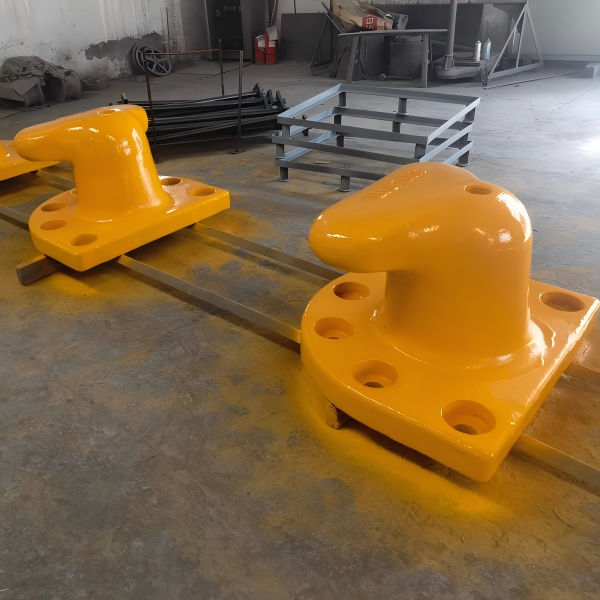
Under the new enforcement regime, mooring bollards must meet strict quality standards:
Cast steel bollard requirements:
- Surface must be smooth and rounded — no cracks, severe nodules, cold shuts, burrs, or flash
- Base plate must be flat — no visible warping or slag inclusions
- Bolt holes must be clean — machined to design specifications
Quality verification:
- Full inspection by contractor for every bollard
- 10% spot check by supervisor (minimum 3 units)
- Documentation: Factory quality certificates and acceptance records
The installation of mooring bollards is now subject to documented verification:
The inspection standards specify allowable installation tolerances for mooring bollards. Key parameters include:
- Position deviation — Within design-specified limits
- Elevation deviation — Per design requirements
- Anchor bolt projection — 2-3 threads standard
These tolerances must be verified through contractor full inspection and supervisor spot-checking (10% of units, minimum 3) .
The China Maritime Authority has implemented a three-tier inspection system that affects both domestic port projects and international equipment supply chains.
Every rubber fender and mooring bollard must be accompanied by:
- Factory quality certificates — Issued by the manufacturer
- Material test reports — Third-party verification of rubber compound or cast steel properties
- Dimensional inspection records — Confirming compliance with design specifications
- Accessory certifications — For bolts, chains, shackles, and mounting hardware
During installation, inspectors will verify:
- Fender base plate contact with quay wall
- Nut tightening and bolt protrusion
- Chain and shackle locking mechanisms
- Anti-corrosion treatment application
After installation, additional verification may include:
- Pneumatic fender air-tightness testing
- Load testing for mooring bollards
- Documentation review for full traceability
- Periodic re-inspection schedules
We interviewed our global OEM clients about how the new China Maritime Authority inspection protocols are affecting their operations. Here is what they shared:
> *"We received a shipment of fenders from a non-certified supplier last quarter. The port authority rejected the entire batch during inspection because the bolt protrusion didn't meet the new 2-3 thread standard. The supplier refused to take responsibility. We had to source replacement fenders urgently from a certified OEM—Nanjing Taidun—at a 30% premium. Never again."*
> — *Procurement Director, Southeast Asian Port Operator*
> *"The new regulations actually helped us. Before, our local inspectors accepted anything. Now they have a clear checklist. We know exactly what to expect, and our certified suppliers know exactly what to deliver. The chaos is gone."*
> — *Port Engineer, Chinese Provincial Port Authority*
> *"We learned the hard way that not all bollards are created equal. One of our bollards snapped during a mooring operation because the casting had internal defects. The supplier's certificate was forged. Now we require third-party inspection for every single bollard, and we only work with manufacturers who allow ABS or BV witnessing of casting and testing."*
> — *Terminal Operations Manager, Middle East Oil Terminal*
The financial consequences of failing to meet the China Maritime Authority's new inspection standards are significant.
| Non-Compliance Scenario | Typical Cost Impact |
|---|---|
| Rejected fender shipment at port of entry | 10,000–10,000–50,000 (demurrage, return shipping, replacement rush order) |
| Failed on-site installation inspection | 5,000–5,000–20,000 (rework labor, replacement hardware, project delays) |
| Post-failure regulatory investigation | 50,000–50,000–500,000+ (fines, legal fees, operational shutdown) |
| Hull damage from non-compliant fenders | 100,000–100,000–2,000,000+ (repairs, lost revenue, insurance premium increases) |
| Total lifecycle cost of non-compliance | Often exceeds 3-5x the initial equipment cost |
> *"Inspection data reveals that at least 60% of maritime accidents related to mooring operations originate from substandard equipment and improper installation."*
> — *China MSA Safety Statistics, 2025*
At Nanjing Taidun Marine Equipment Engineering Co., Ltd. , compliance with China Maritime Authority inspection standards is not an afterthought—it is built into every product we manufacture.
| Stage | Actions | Documentation Provided |
|---|---|---|
| Material sourcing | Certified rubber compounds; traceable supply chain | Mill certificates |
| Manufacturing | ISO 9001-controlled processes; in-process quality checks | Production records |
| Testing | Full compression testing; air-tightness verification | Test reports |
| Final inspection | 100% dimensional verification | Inspection certificates |
| Third-party witness | ABS, BV, LR, CCS, or SGS available | Witness reports |
| Stage | Actions | Standards Met |
|---|---|---|
| Casting | Certified foundry; chemical composition analysis | HG/T 2866 equivalent |
| Machining | Precision bolt hole drilling; base plate flattening | Design specifications |
| Surface treatment | Hot-dip galvanizing or epoxy coating | Corrosion protection per design |
| Load testing | Proof load verification | Customer requirements |
| Marking | Traceable casting numbers | Full traceability |
We supply OEM rubber fender systems and mooring bollards to brand owners, wholesalers, and production facilities in over 80 countries. Our documentation packages are designed to satisfy the strictest regulatory requirements—including the new China Maritime Authority inspection standards.
Key advantages of partnering with Taidun:
- One-stop sourcing — Fenders and bollards from a single supplier
- Complete documentation — Certificates, test reports, and traceability records
- Third-party inspection ready — ABS, BV, LR, CCS, or SGS witnessing available
- Global shipping — Direct delivery to your port or warehouse
Q1: When did the new China Maritime Authority inspection standards take effect?
A: The Inland Vessel Statutory Technical Regulations 2025 Amendment Bulletin took effect on January 1, 2026. Enforcement of fender and bollard inspection protocols has been gradually ramping up since that date, with full implementation expected by mid-2026.
Q2: What are the most common reasons for fender rejection under the new standards?
A: The most common failures are: incorrect fender type or specification, missing factory quality certificates, improper bolt protrusion (not 2-3 threads), loose nuts, poor base plate contact with quay wall, and for pneumatic fenders, failure of air-tightness testing.
Q3: What documentation do I need to provide for fender inspection?
A: You will need: factory quality certificates, material test reports (rubber compound certification), dimensional inspection records, and for pneumatic fenders, documented air-tightness test results.
Q4: How are mooring bollards inspected under the new regulations?
A: Bollards are inspected for: surface quality (no cracks or defects), base plate flatness, bolt hole cleanliness, correct mounting orientation, nut tightening (full engagement), bolt protrusion (2-3 threads), and corrosion protection coating.
Q5: What should I look for when selecting a compliant fender supplier?
A: Look for manufacturers who: provide documented quality certificates, perform 100% in-house testing, offer third-party inspection options (ABS, BV, LR, etc.), maintain full material traceability, and can demonstrate a track record of passing port authority inspections.
Q6: Can existing fenders be retrofitted to meet the new standards?
A: In many cases, yes. Common retrofit fixes include: re-tightening loose nuts, replacing missing or incorrect bolts, applying proper anti-corrosion treatment, and adding documentation where missing. However, severely substandard fenders may require full replacement.
Q7: How does the new regulation affect international imports of fenders and bollards?
A: Imported equipment must meet the same standards as domestic products. Port authorities may require additional documentation or third-party certification for imports. Working with a compliant OEM that understands the regulatory landscape is strongly recommended.
Q8: Who is Chen Deli and what is his role in these regulations?
A: Chen Deli is the Deputy Director of the Maritime Safety Administration (MSA) . He presented the official interpretation of the Inland Vessel Statutory Technical Regulations 2025 Amendment Bulletin in February 2026.
The China Maritime Authority's strengthened inspection of fender selection and installation standards represents a new era of maritime safety enforcement. For international buyers, this means one thing: compliance is no longer optional.
The days of accepting uncertified fenders and undocumented bollards are over. Port authorities are inspecting. Ship captains are verifying. Insurance companies are auditing.
Your next step:
[Contact the Nanjing Taidun Engineering Team] for a compliance consultation or to request documentation packages for our rubber fender systems and mooring bollards. We serve brand owners, wholesalers, and production facilities worldwide—with full compliance to the latest China Maritime Authority standards.


