

Views: 233 Author: Nanjing Taidun Publish Time: 2026-07-02 Origin: Site
Content Menu
● What Does "Anchoring a Buoy" Really Mean?
● Main Types of Buoy Anchoring Systems
>> 2. Embedded Anchors (Drag or Suction Anchors)
● Engineering Factors That Determine Anchoring Performance
>> Load Calculation and Safety Margins
>> Chain Configuration (Catenary vs Taut)
● Installation Challenges: Lessons from Real Port Projects
● Our Integrated Solution Approach
>> 1. Design Compliance and Verification
>> 2. Installation-Ready Delivery
>> 3. Pre-Shipment Testing and Traceability
● Case Study: Zero-Rework Installation Success
● Common Mistakes in Buoy Anchoring
● How to Choose the Right Anchoring System
● FAQ
At Nanjing Taidun Marine Equipment Engineering Co., Ltd., we approach a simple question—"how are buoys anchored?"—from the perspective of engineers who design and manufacture the very systems that make marine mooring safe, durable, and verifiable. While many articles explain buoy anchoring at a surface level, they often miss the critical engineering, installation, and long-term reliability factors that determine whether a system performs safely in real-world conditions.
This guide fills that gap by combining practical OEM manufacturing expertise, port engineering insights, and verified field outcomes, helping ship operators, port engineers, and procurement teams understand not just *what works*, but *why it works*.

Buoy anchoring is the process of securing a floating structure to the seabed so it remains in a fixed or controlled position under environmental loads.
A complete buoy anchoring system typically includes:
- Anchor (deadweight or embedded type)
- Mooring chain or rope (catenary or taut system)
- Swivels and shackles (to prevent twisting)
- Surface buoy (navigation, mooring, or marking function)
The system must resist forces from:
- Wind
- Waves
- Currents
- Vessel interaction loads
Key insight: Buoy anchoring is not just about holding position—it is about load distribution, fatigue resistance, and long-term safety.
The simplest and most widely used method.
- Uses concrete or steel blocks placed on the seabed
- Relies on mass and friction
- Common in calm or moderate conditions
Best for:
- Harbor buoys
- Temporary installations
Limitation:
- Requires large weight for high-load applications
These anchors penetrate the seabed for higher holding capacity.
- Drag anchors: Dig into seabed under tension
- Suction anchors: Installed using pressure differential
Best for:
- Offshore buoys
- Deep water environments
A fixed, high-strength solution often used in ports.
- Steel piles driven into seabed
- Extremely high load capacity
- Minimal movement
This is where our expertise in mooring bollards and anchoring systems directly connects with buoy anchoring principles—both rely on secure load transfer into a stable foundation.
Most online explanations stop at listing anchor types. In practice, failures happen due to overlooked engineering details, not anchor selection alone.
Anchoring systems must be designed based on:
- Maximum vessel load
- Environmental forces
- Safety factors (typically 1.5–3x design load)
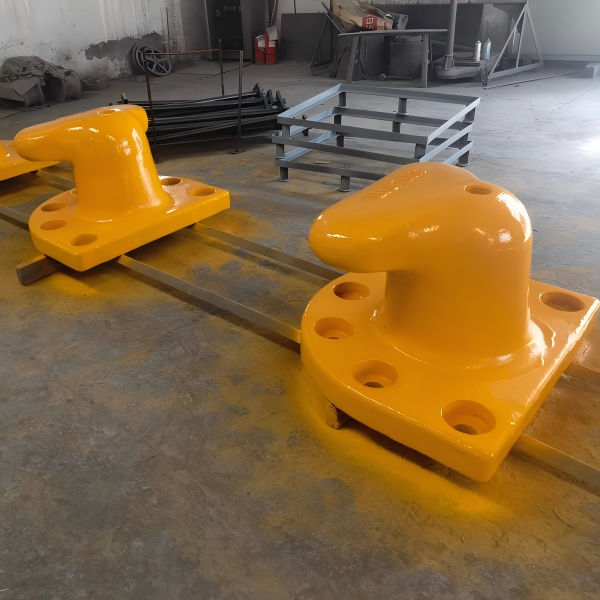
At Taidun Marine, similar principles apply to our SWL 200T TEE Mooring Bollards, where Finite Element Analysis (FEA) is used to verify stress distribution under full load.
Different soils require different anchoring strategies:
- Sand: good for drag anchors
- Clay: suitable for suction anchors
- Rock: requires drilled or pile systems
Ignoring seabed conditions is a leading cause of anchoring failure.
- Catenary systems: Use chain weight to absorb loads
- Taut systems: Use tensioned lines for precise positioning
Each has trade-offs in shock absorption vs positional stability.
A major gap in most content is installation compatibility, which is often where projects fail.
From our experience supplying SWL200T TEE Mooring Bollards, port engineers consistently face:
- Misalignment between foundation bolts and embedded plates
- Incorrect embedment depth
- Poor concrete strength
- Missing anchoring calculations
These same risks apply to buoy anchoring systems.
"Will the anchoring system match existing infrastructure without costly rework?"
At Nanjing Taidun Marine Equipment Engineering Co., Ltd., we do not treat anchoring as a standalone product—we deliver a complete, verifiable system.
- Standards: ISO 13795:2020 / GB/T 554-2023
- Full FEA simulation for stress and deformation
- Load validation under rated conditions
This ensures predictable performance, not assumptions.
We provide:
- Precision layout templates
- Anchor bolt specifications and torque guidelines
- Optional non-shrink grout solutions
This eliminates guesswork during installation.
Each unit undergoes:
- Magnetic Particle Testing (MT) or Ultrasonic Testing (UT)
- Dimensional inspection (±2 mm tolerance)
- Full documentation package:
- Material certificates
- Installation manuals
- Batch traceability
Key advantage: Engineers and EPC contractors can approve systems faster with complete documentation.
In a recent deep-water port project:
- Challenge: Compatibility with existing dock foundation
- Solution: Precision bolt layout + full documentation
- Result:
- No structural modification required
- One-pass installation
- Full EPC approval
After one year of operation:
- No deformation
- No weld cracking
- No bolt loosening
This validates the importance of design + installation + verification as one system.
Understanding failures helps avoid them.
- Underestimating environmental loads
- Ignoring fatigue and corrosion
- Poor installation practices (e.g., incorrect torque)
- Lack of documentation and traceability
- Choosing suppliers without engineering support
Important: Anchoring failure is not gradual—it can be sudden and catastrophic.
A practical decision framework:
1. Define load requirements (vessel size, environment)
2. Analyze seabed conditions
3. Select anchoring type (deadweight, embedded, pile)
4. Verify design with engineering calculations
5. Ensure installation compatibility
6. Require full documentation and testing
Many suppliers provide components. Few provide engineering accountability.
At Taidun Marine, our approach integrates:
- Manufacturing precision
- Structural engineering validation
- Installation guidance
- Lifecycle reliability
This is why our solutions are increasingly adopted as standard procurement specifications in port projects.
If you are planning a buoy anchoring or mooring project, do not rely on generic designs.
Work with a partner who can deliver:
- Verified engineering calculations
- Installation-ready systems
- Full traceability and testing
Contact Nanjing Taidun Marine Equipment Engineering Co., Ltd. to get a customized anchoring or mooring solution tailored to your project conditions.
1. How are buoys anchored in deep water?
They typically use embedded anchors or suction anchors combined with long mooring chains to handle depth and environmental loads.
2. What is the most reliable buoy anchoring method?
It depends on conditions, but pile anchoring and suction anchors offer the highest reliability for heavy-duty applications.
3. How long do buoy anchoring systems last?
With proper materials and maintenance, systems can last 10–25 years, depending on corrosion and load cycles.
4. What causes buoy anchoring failure?
Common causes include overloading, corrosion, poor installation, and lack of engineering validation.
5. Can anchoring systems be customized?
Yes. OEM manufacturers like Taidun Marine provide fully customized solutions based on project requirements.
- ISO 13795:2020 Mooring Bollards
https://www.iso.org/standard/73741.html
- GB/T 554-2023 Mooring Equipment Standard (China)
https://openstd.samr.gov.cn
- PIANC Mooring Guidelines
https://www.pianc.org
- Offshore Mooring Systems Overview (Engineering Toolbox)
https://www.engineeringtoolbox.com
- DNV Mooring Design Standards
https://www.dnv.com
Hot Tags: China, Global, OEM, private label, manufacturers, factory, suppliers, manufacturing company


