

Views: 233 Author: Nanjing Taidun Publish Time: 2026-07-02 Origin: Site
Content Menu
● How Are Buoys Anchored in Real Marine Conditions?
● What Does "Anchoring a Buoy" Actually Mean?
● Main Types of Buoy Anchoring Systems
>> 1. Chain Mooring System (Most Common)
>> 2. Single Point Mooring (SPM)
● Engineering Factors That Determine Anchoring Performance
>> 3. Material Quality (Critical Pain Point)
>> 4. Manufacturing and Testing Standards
● Real Industry Case: Why Verified Data Matters
● Step-by-Step: How a Buoy Is Anchored (Practical Workflow)
>> Step 4: Manufacturing & Testing
>> Step 6: Inspection & Maintenance
● Where Marine Fenders Fit into Buoy Systems
● FAQ: How Are Buoys Anchored?
How are buoys anchored? This question sounds simple, but in real-world marine engineering, it involves complex load calculations, seabed analysis, material science, and strict compliance standards.
From my perspective working with Nanjing Taidun Marine Equipment Engineering Co., Ltd, an OEM manufacturer supplying marine rubber fenders, mooring bollards, and anchoring systems, I've seen firsthand that anchoring failures are rarely caused by design alone—they're often caused by poor materials, falsified performance data, or improper installation.
This article goes beyond basic explanations. It combines engineering principles, real project experience, and verified testing standards to give you a complete, practical understanding.
At its core, anchoring a buoy means keeping a floating structure fixed in position despite environmental forces such as:
- Waves
- Currents
- Wind
- Tidal changes
A typical buoy anchoring system includes:
- Buoy body (floating unit)
- Mooring line (chain, rope, or synthetic cable)
- Anchor system (weight or embedded structure on seabed)
The challenge is not just holding position—but absorbing energy safely over time, similar to how marine fenders absorb berthing energy.
This is the industry standard for ports and navigation buoys.
How it works:
- Heavy chain connects buoy to seabed anchor
- Chain weight creates a catenary curve
- This curve absorbs dynamic loads
Advantages:
- Highly durable
- Good energy absorption
- Stable in harsh conditions
Limitations:
- Requires heavy materials
- Higher installation cost
Used in offshore oil and LNG terminals.
Key features:
- Allows vessels to rotate around buoy
- Handles large tanker loads
- Requires precise engineering
This is where high-performance rubber fenders and mooring systems—like those we manufacture—become critical.
Uses synthetic ropes or elastic materials.
Advantages:
- Lightweight
- Easier installation
Risks:
- Lower durability if material quality is poor
- Performance varies widely depending on manufacturing
Simple but still widely used.
- Concrete or steel blocks placed on seabed
- Relies on mass and friction
Best for:
- Calm waters
- Temporary installations
From an OEM and testing standpoint, buoy anchoring is governed by four critical variables:
- Wave height and period
- Current velocity
- Wind force
Incorrect estimation leads to system failure or drift.
- Sand
- Clay
- Rock
Each requires a different anchor type:
- Sand: drag anchors
- Clay: suction anchors
- Rock: drilled anchors
This is where most buyers get into trouble.
From our experience, many products on the market use substandard rubber or steel, leading to:
- Reduced energy absorption
- Faster aging
- Structural failure
For example:
Inferior rubber fenders may only achieve ~60% of the required energy absorption at 50% deformation.
Reliable systems must follow:
- PIANC 2002 guidelines
- Full-scale compression or load testing
- Verified performance curves
At Taidun, we provide:
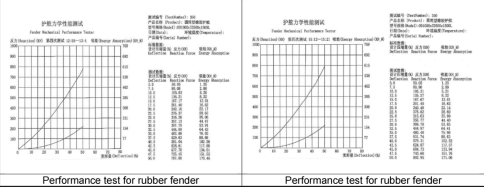
- Force vs. energy curves at different deflections
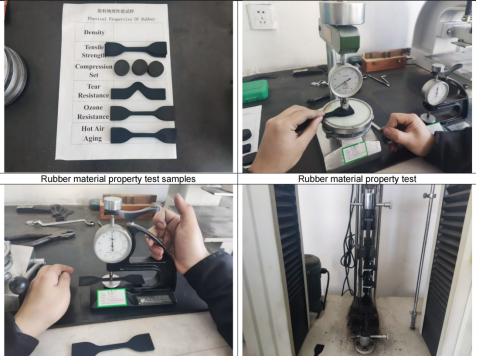
- Rubber physical properties (strength, elongation, hardness, aging)
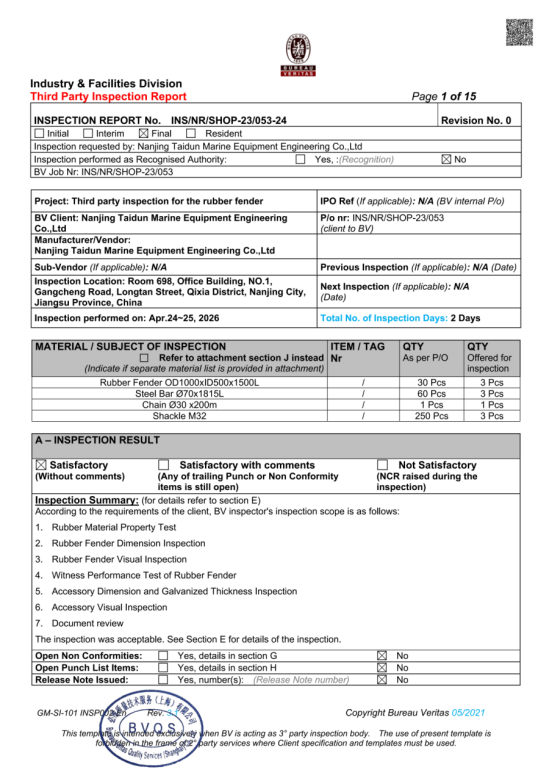
- Third-party witness testing (BV or equivalent)
This eliminates the risk of "falsified data," which is a major concern for port engineers and procurement teams.
One of our recent OEM projects illustrates this clearly.
Product:
Cylindrical Marine Rubber Fender (CY1000×500×1500 mm)
Customer:
Port chief engineers and procurement executives
Key concern:
- Fear of inaccurate or manipulated performance data
Our solution:
- PIANC-compliant design and testing
- Full-scale compression test for each batch
- Third-party inspection (BV available)
Result:
- Customer ordered 30 sets
- Products were approved by the project owner
This same principle applies to buoy anchoring:
Without verified performance data, even a well-designed system can fail in practice.
- Measure water depth
- Analyze seabed
- Evaluate environmental forces
- Select anchor type
- Calculate chain length and weight
- Define safety factors
- High-grade steel chains
- Certified rubber or polymer components
- Corrosion-resistant coatings
- Load testing
- Material verification
- Compliance checks
- Anchor placement
- Mooring line connection
- Buoy deployment
- Periodic load checks
- Wear inspection
- Replacement planning
Although fenders are not part of anchoring directly, they are essential in:
- SPM systems
- Berthing alongside buoys
- Energy absorption during vessel contact
This is why companies like ours integrate:
- Anchoring systems
- Mooring equipment
- Rubber fenders
into complete marine solutions.
Not all manufacturers are equal.
A reliable OEM partner should provide:
- Transparent test data
- Standards compliance (PIANC, ISO)
- Customization capability
- Traceable production batches
At Taidun, we focus on one principle:
We don't just claim performance—we prove it.
If you are sourcing buoy anchoring systems, marine fenders, or mooring equipment, do not rely on catalog data alone.
Request:
- Full test reports
- Third-party verification
- Engineering support
Contact Nanjing Taidun Marine Equipment Engineering Co., Ltd to get OEM solutions backed by real performance data.
1. What is the most common way to anchor a buoy?
Chain mooring systems are the most widely used due to durability and energy absorption.
2. How heavy does a buoy anchor need to be?
It depends on environmental loads, but anchors can range from hundreds of kilograms to several tons.
3. Can buoys move with tides?
Yes, mooring systems are designed to allow vertical movement while limiting horizontal drift.
4. How long do buoy anchoring systems last?
Typically 5–15 years, depending on material quality and maintenance.
5. Why is testing important in anchoring systems?
Because real performance often differs from theoretical values—verified testing ensures reliability and safety.
- PIANC Guidelines for the Design of Fender Systems (2002)
https://www.pianc.org
- Bureau Veritas Marine & Offshore Standards
https://marine-offshore.bureauveritas.com
- US Army Corps of Engineers – Mooring Systems Design
https://www.usace.army.mil
- Oil Companies International Marine Forum (OCIMF) Mooring Guidelines
https://www.ocimf.org
- Engineering Toolbox – Forces on Buoys and Moorings
https://www.engineeringtoolbox.com
Hot Tags: China, Global, OEM, private label, manufacturers, factory, suppliers, manufacturing company


