

Views: 0 Author: Site Editor Publish Time: 2026-03-14 Origin: Site
How to Calculate Mooring Bollards: A Guide to Safe and Efficient Mooring
In maritime infrastructure, mooring bollards are the unsung heroes of port and dock safety. These heavy-duty fixtures anchor vessels of all sizes—from small tugboats to massive ULCS container ships and VLCC crude carriers—withstanding extreme wind, current, and tidal forces. Calculating mooring bollard load capacity and sizing correctly is not just a technical requirement; it’s a critical step to prevent vessel damage, quay wall failure, costly downtime, and life-threatening accidents.
A poorly sized mooring bollard risks catastrophic failure under peak loads, while an over-engineered bollard drives unnecessary project costs and material waste. This comprehensive guide breaks down mooring bollard calculation principles, industry-standard formulas, key design factors, and compliance benchmarks (BS 6349, PIANC, OCIMF MEG) to help engineers, port managers, and procurement teams select, design, and validate mooring bollards for maximum safety, efficiency, and cost-effectiveness.
Why Mooring Bollard Calculation Matters for Maritime Operations
Mooring bollards bear dynamic, multi-directional loads that fluctuate with weather conditions, vessel size, and berthing location. Unlike static fixtures, these components face constant tension shifts—making precise load calculation a foundational step for every port, terminal, and berthing project. Skipping precise load calculations leads to two major pain points for maritime projects:
• Under-Sizing Risks: Bollards with insufficient Safe Working Load (SWL) will fail under storm conditions, heavy vessel tension, or improper line distribution, causing ships to break free and damage port infrastructure.
• Over-Sizing Waste: Overly robust bollards increase material, fabrication, and installation costs, while adding unnecessary weight to quay structures that may require reinforced foundations.
Regulatory bodies and global maritime standards (BS 6349-4, PIANC MarCom 153, OCIMF MEG 3/4) mandate rigorous bollard load calculation for all port and terminal projects. Adhering to these standards not only ensures compliance but also boosts asset longevity, reduces maintenance costs, and builds trust with vessel operators and port authorities.
Key Definitions for Mooring Bollard Calculation
Before diving into formulas and step-by-step workflows, master these core industry terms to eliminate calculation errors, align with global standards, and communicate effectively with engineering and procurement teams. All terminology complies with BS 6349 and PIANC guidelines:
• SWL (Safe Working Load): The maximum static load a mooring bollard can safely handle continuously under normal operating conditions; the primary rating for bollard selection.
• MBL (Minimum Breaking Load): The absolute load at which a mooring line or bollard will fail; SWL is typically a fraction of MBL (50%-60% for most maritime applications).
• ULS (Ultimate Limit State): Maximum factored load for structural safety, accounting for extreme conditions and safety factors (per Eurocode and BS 6349).
• SLS (Serviceability Limit State): Normal operating load threshold, ensuring bollards perform reliably without deformation under daily use.
• Vessel Displacement: Total weight of the vessel (tons), a baseline metric for preliminary bollard sizing.
• Load Distribution Factor: Adjustment for multiple mooring lines attached to a single bollard, accounting for uneven tension sharing.
Step-by-Step Mooring Bollard Calculation Process
Step 1: Gather Critical Vessel & Site Data
Accurate calculations start with complete project data. Collect these non-negotiable details before any computations:
• Vessel type (container ship, bulk carrier, tanker, tugboat, offshore vessel)
• Vessel displacement (tons) and maximum draft
• Number of mooring lines per bollard (standard: 2-4 lines)
• Mooring line MBL (minimum breaking load) and material (steel wire, synthetic rope)
• Site conditions: wind speed, current velocity, tidal range, and wave height (sheltered port vs. open coastal terminal)
• Applicable standards: BS 6349 (EU), PIANC (global), OCIMF MEG (oil & gas terminals)
Step 2: Preliminary Bollard Sizing (Vessel Displacement Method)
For quick preliminary estimates (ideal for early-stage project planning), use this industry-standard displacement-to-load table aligned with BS 6349-4 and EAU guidelines. This method works for sheltered ports with mild weather conditions.
Vessel Displacement (Tons) | Min Bollard SWL (Tons) | Recommended Use Case |
Up to 2,000 | 10 | Small craft, tugboats, inland waterways |
2,000 – 10,000 | 30 – 60 | Coastal ferries, small cargo vessels |
10,000 – 20,000 | 60 – 80 | Medium cargo ships, bulk carriers |
20,000 – 50,000 | 80 – 100 | Large container ships, product tankers |
50,000 – 100,000 | 100 – 150 | VLCC tankers, large bulk carriers |
100,000 – 250,000+ | 150 – 250+ | ULCS container ships, offshore terminals, storm bollards |
Note:This table is a preliminary guide only.Always validate with detailed load calculations for final design and procurement.
Step 3: Detailed Load Calculation (Industry Standard Formulas)
For final design, compliance, and high-stakes projects, use these formulas endorsed by BS 6349, PIANC, and Port of Rotterdam guidelines. These calculations account for mooring line MBL, line quantity, and safety factors.
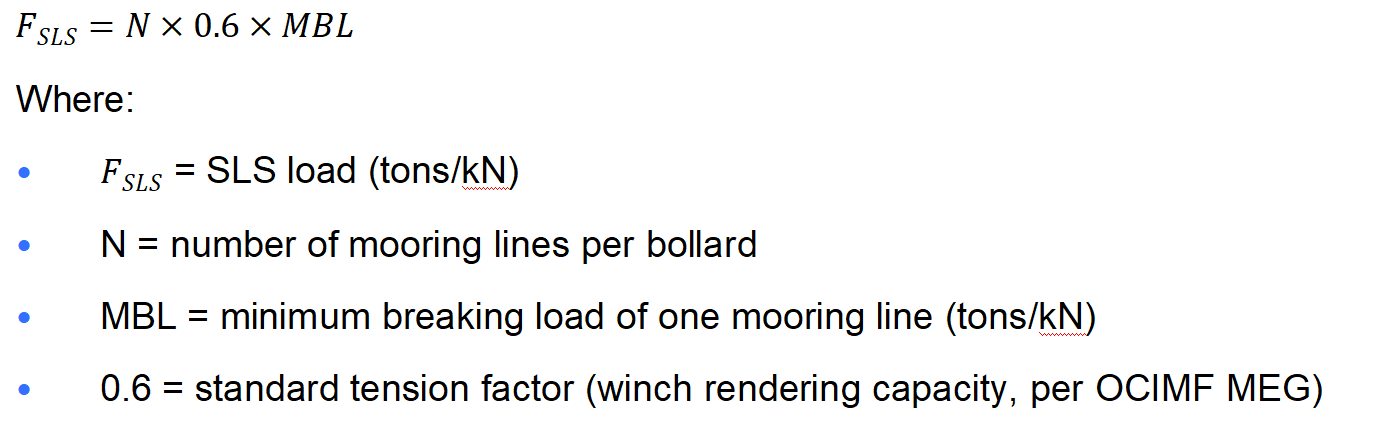
Formula 1: Serviceability Limit State (SLS) – Normal Operating Load
SLS represents the maximum load under routine berthing conditions (winches in auto-tension mode). This defines the baseline SWL for the bollard.
Formula 2: Ultimate Limit State (ULS) – Extreme Condition Load
ULS accounts for storm conditions, brake mode winches, and safety factors (1.5x per Eurocode & BS 6349), ensuring bollards survive extreme loads.

Formula 3: Accidental Limit State (ALS) – Emergency/Failure Scenarios
ALS covers human error, winch failure, or uneven line tension (max 2 lines reaching full MBL simultaneously), the highest safety threshold for bollard design.

Step 4: Adjust for Site-Specific Factors
Fine-tune calculations with these environmental and operational modifiers to match real-world conditions:
• Wind/Current Factor: Add 1.25x load factor for ports with strong currents (>3 knots) or high winds (>40 knots)
• Line Angle Factor: Increase SWL by 10-15% for lines with steep vertical angles (reduces effective load capacity)
• Material Factor: Cast iron/steel bollards use standard factors; ductile iron bollards may allow slight load optimization (per manufacturer specs)
Step 5: Validate & Select the Right Bollard Type
Once load capacity is calculated, match the SWL to a bollard design optimized for your operation: T-head bollards (standard ports), double bitt bollards (multi-line use), kidney bollards (high-tension vessels), and custom heavy-duty bollards (offshore/FPSO terminals).
Common Mistakes to Avoid in Mooring Bollard Calculation
• Ignoring Dynamic Loads: Relying solely on static displacement loads without accounting for wind, waves, and passing vessels
• Miscalculating Line Quantity: Underestimating the number of lines per bollard or uneven tension distribution
• Skipping Standard Compliance: Failing to align with BS 6349, PIANC, or OCIMF standards leads to regulatory delays and safety risks
• Ignoring Foundation Loads: Bollard load capacity is useless without a quay foundation designed to handle the same peak forces
How This Calculation Drives Higher ROI & Safety
Precise mooring bollard calculation delivers tangible business benefits for port operators and procurement teams:
• Reduced Capital Costs: Avoid over-engineering and select the optimal bollard size for your vessel fleet
• Minimized Downtime: Eliminate bollard failure and costly emergency repairs
• Regulatory Compliance: Meet global maritime standards and pass port inspections seamlessly
• Longer Asset Lifespan: Properly sized bollards last 20+ years with minimal maintenance
Need Custom Mooring Bollard Calculation Support?
Every port, terminal, and vessel fleet has unique load requirements. If you’re working on a high-capacity terminal, offshore project, or need help validating bollard loads for compliance, our team of maritime engineering experts provides personalized calculation, sizing, and product selection support. We specialize in BS 6349 and PIANC-aligned solutions for heavy-duty, custom mooring bollards that balance safety, efficiency, and cost.
Request a free calculation consultation or quote today to ensure your mooring bollards are engineered for maximum safety and performance.


