

Views: 289 Author: NANJING TAIDUN Publish Time: 2026-10-21 Origin: Site
Content Menu
● Understanding Low Tidal Range Ports
>> Key Design Features of Kidney Bollards
>> Key Design Features of T-Head Bollards
● Head-to-Head Comparison: Kidney vs. T-Head Bollards
>> Capacity and Load Distribution
● Why Low Tidal Ranges Favor Specific Bollard Choices
● Material and Manufacturing Considerations
● Practical Selection Checklist for Port Engineers
● Conclusion: Geometry as a Design Decision
● Frequently Asked Questions (FAQ)
>> 1. What tidal range counts as "low" for bollard selection?
>> 2. Can a kidney bollard handle multiple mooring lines?
>> 3. Which bollard type causes less mooring line wear?
>> 4. Are T-head bollards always stronger than kidney bollards?
>> 5. What material should I specify for each bollard type?
>> 6. How do I verify bollard quality before delivery?
Introduction: Why Bollard Geometry Matters in Low-Tidal Ports
In ports with low tidal ranges—typically under two meters—the mooring line geometry remains relatively stable throughout the day. This stability creates an engineering opportunity: the bollard shape can be optimized for line control, not tidal compensation. Two designs dominate this space—the kidney bollard and the T-head bollard—and the choice between them affects everything from line wear to operational safety.
As an OEM manufacturer at NANJING TAIDUN MARINE EQUIPMENT ENGINEERING CO., LTD, we have produced both designs for ports across 80+ countries. The distinction is not cosmetic. Kidney and T-head bollards guide lines differently, resist horizontal loads differently, and suit different vessel mixes. This guide compares them rigorously, with the low-tidal application as the governing case.
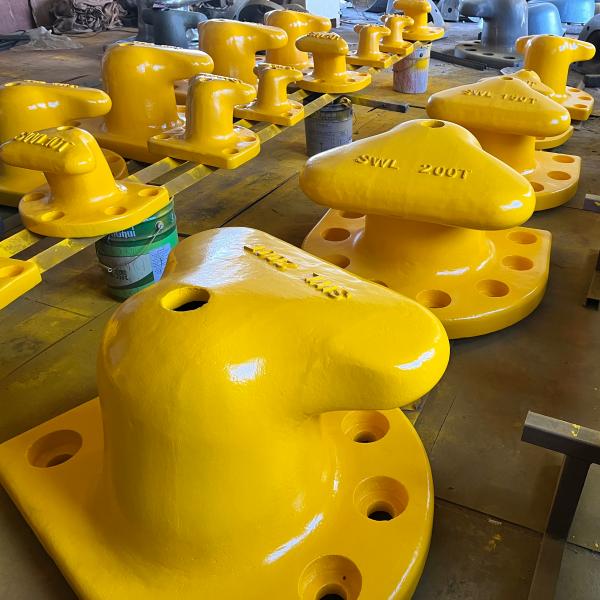
A low tidal range—less than roughly 2 meters between high and low water—simplifies mooring line geometry. The vertical angle between the vessel's fairlead and the bollard stays nearly constant. Line length adjustments are minimal.
This matters because low tidal ranges shift the design priority from vertical compensation to horizontal line control. The bollard must handle:
- Horizontal lead angles that change as vessels shift along the berth
- Multiple lines on a single bollard, sometimes at opposing angles
- Line surge during loading and unloading operations
Ports handling barges, feeder vessels, RoRo traffic, and general cargo in low-tidal basins are the primary users of both bollard types.
A kidney bollard is a single-piece casting with a kidney-shaped (bean-shaped) head and a narrow "waist" below the head. The curved profile is designed to cradle mooring lines and control their movement.
- Curved head profile that guides lines around the bollard without sharp bends
- Concave waist that keeps lines from riding up during surge
- Single-piece casting—no separate head or horn components
- Compact footprint suited to crowded quay edges
- Typical capacity range: 50–150 kN (light to medium duty)
A T-head bollard has a horizontal crossbar (the "T") supported by a vertical stem. Lines are secured by wrapping around the crossbar ends. The T-shape creates two distinct horns where lines can be led in different directions.
- Horizontal crossbar with two horns for separate line leads
- Vertical stem transferring load to the foundation
- Open geometry allowing quick line handling
- Available as single or double-stem configurations
- Typical capacity range: 100–500+ kN (medium to heavy duty)
The table below summarizes the engineering differences that matter most in low-tidal applications.
| Criterion | Kidney Bollard | T-Head Bollard |
|---|---|---|
| Line guidance | Curved head cradles lines; resists riding up | Two horns allow separate leads; open handling |
| Multiple lines | Moderate—limited to head circumference | Excellent—independent horns for opposing leads |
| Line wear | Low—smooth curved contact surface | Moderate—line bends at horn radius |
| Horizontal lead angles | Best suited to moderate angles | Handles wide angle range |
| Footprint | Compact | Larger—stem plus crossbar span |
| Capacity | Light to medium (50–150 kN) | Medium to heavy (100–500+ kN) |
| Installation | Simple anchor pattern | Requires larger foundation |
| Typical vessels | Barges, small craft, feeders | Cargo vessels, RoRo, tankers |
| Cost | Lower | Higher |
The kidney bollard's curved head is its defining advantage. A line wrapping around a kidney head contacts a smooth, continuous curve, distributing pressure and reducing localized abrasion. In low-tidal ports, where lines sit on the bollard for long periods during cargo operations, this matters for line service life.
The T-head bollard's horns introduce a tighter bend radius at each horn. Lines led around a horn experience higher localized stress. However, the T-head's ability to separate opposing leads onto different horns can reduce overall line-to-line interference.
T-head bollards generally achieve higher working loads because the crossbar geometry distributes force across a wider foundation footprint. For low-tidal berths serving larger cargo vessels, the T-head is usually the safer specification.
Kidney bollards excel at lower capacities but offer a more compact, lower-profile installation—valuable where quay space is constrained or where vehicles must pass close to the bollard line.
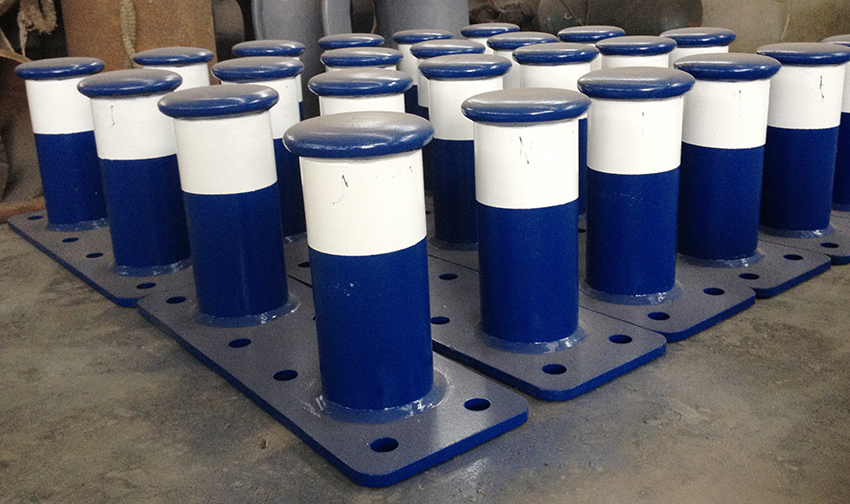
In low-tidal ports, the vertical angle between line and bollard changes little. This makes the horizontal line behavior the dominant design concern.
- Where lines lead at moderate angles and vessel sizes are modest, the kidney bollard's cradling action reduces line movement and wear.
- Where lines lead at wide or opposing angles, or where multiple large lines share a bollard, the T-head's separate horns provide better control.
A practical rule: kidney bollards suit single-line, moderate-angle berths; T-head bollards suit multi-line, variable-angle berths.
Both bollard types are typically produced in ductile cast iron (QT450-10) or cast steel (ZG230-450). The geometry affects casting feasibility.
- Kidney bollards—with their curved, compact shape—are well suited to ductile iron casting. The smooth profile reduces hot-spot risk during solidification.
- T-head bollards—with their crossbar and stem junctions—require careful gating and riser design to avoid shrinkage porosity at the T-junction. Cast steel is often preferred for high-capacity T-heads because of its superior toughness.
At NANJING TAIDUN, both types are produced with full material certification and third-party inspection (CCS, BV, LR, TUV, SGS, INTERTEK, GL).
Use this checklist when choosing between kidney and T-head bollards for a low-tidal berth:
1. Define vessel mix—sizes, freeboards, and mooring patterns
2. Map line lead angles for all berthing scenarios
3. Count lines per bollard—single or multiple
4. Calculate design mooring load per PIANC/MOTEMS guidance
5. Check quay space—compact kidney vs. larger T-head footprint
6. Assess line wear sensitivity—kidney's curved head reduces abrasion
7. Select material—ductile iron for kidney, cast steel for high-capacity T-heads
8. Specify safety factor—minimum 3:1; 4:1 for critical berths
9. Require certification—3.1 material certificates, proof load testing
10. Plan inspection intervals—annual visual, coating touch-up as needed
The kidney bollard vs. T-head bollard choice for low tidal ranges is a question of matching geometry to line behavior.
Kidney bollards offer compact installation, smooth line guidance, and reduced wear—ideal for moderate loads and single-line berths in space-constrained low-tidal ports. T-head bollards offer higher capacity, separate line leads, and wider angle tolerance—the better choice where multiple large lines share a bollard or vessel sizes vary widely.
Neither is universally superior. The right answer depends on your vessels, your line angles, and your quay constraints.
At NANJING TAIDUN, we manufacture both designs to international standards, with full third-party certification and OEM/ODM support for global port projects.
---
[CTA]
Need help selecting mooring bollards for your low-tidal berth?
NANJING TAIDUN MARINE EQUIPMENT ENGINEERING CO., LTD
- Email: service@taidunmarine.com
- Website: www.taidunmarine.com
- Products: Kidney bollards, T-head bollards, rubber fenders, steel panels, UHMW-PE pads
- Certification: CCS, BV, LR, TUV, SGS, INTERTEK, GL
---
1. PIANC. "Mooring Bollards & Hooks: Selection, maintenance and testing – Terms of Reference." [http://pianc.pt/wp-content/uploads/2021/03/ToR-231-Mooring-Bollards-Hooks.pdf]
2. Damen Civil. "Bollards, Mooring & Shiphauling – Product Sheet." [http://www.damen.com/-/media/New-Corporate-Damen/Images/Markets/Civil-Works/General/Products/Downloads/Product_Sheet_Damen_Civil_Bollards_04_2017.pdf]
3. Boomarine. "Single Bitt Bollard – Ductile Cast Iron vs. Cast Steel Comparison." [https://www.boomarine.com/products/single-bitt-bollard]
4. HANYCO Group. "Marine Bollard – Ductile Iron Lost Foam Casting." [https://hanycogroup.com/blog/post/102/coastal-structures?culture=en]
5. Prosertek. "Double-P Bollard Data Sheet – Cast Steel Properties." [https://prosertek.com/wp-content/uploads/double-P-data-sheet.pdf]
---
In mooring design, a low tidal range is generally less than about 2 meters between high and low water. In this range, the vertical angle between the vessel fairlead and the bollard changes little during the tide cycle, so the bollard geometry can be optimized for horizontal line control rather than vertical compensation.
Yes, but with limits. The kidney head's circumference allows two or three lines to be wrapped, provided they lead at similar angles. Where lines lead in opposing directions or at widely different angles, a T-head bollard's separate horns provide better control and reduce line-to-line interference.
The kidney bollard generally causes less line wear because its curved head provides a smooth, continuous contact surface. The T-head's horns introduce a tighter bend radius, which increases localized stress on the line. However, proper line sizing and good operational practice can mitigate wear with either design.
Not inherently—but T-head designs are typically available in higher capacity ranges (100–500+ kN) because the crossbar geometry distributes load over a larger foundation. Kidney bollards are usually specified for light to medium duty (50–150 kN). For heavy-duty low-tidal berths, a high-capacity T-head in cast steel is the usual specification.
Ductile cast iron (QT450-10) is well suited to kidney bollards because the compact curved shape casts cleanly. Cast steel (ZG230-450) is often preferred for high-capacity T-head bollards because its superior toughness handles the stress concentrations at the crossbar-stem junction. Both materials are available with full third-party certification from NANJING TAIDUN.
Request 3.1 material certificates per EN 10204, proof load test reports (typically 1.5× safe working load), and coating thickness measurements (≥320 μm DFT for marine exposure). For critical projects, specify third-party witnessing by CCS, BV, LR, SGS, or equivalent. NANJING TAIDUN provides complete documentation packages and coordinates inspection by all major classification societies.


