

Views: 260 Author: Nanjing Taidun Publish Time: 2026-10-23 Origin: Site
Content Menu
● Super Arch Rubber Fender vs D-Type Fender: What Are You Protecting Against?
● How Super Arch and D-Type Rubber Fenders Work
>> Super Arch Rubber Fenders: Engineered Compression and Stand-Off
>> D-Type Fenders: Compact Profiles for Rubbing and Contact Protection
● Side-by-Side Comparison for Concrete Sea Walls
● Why Wave-Exposed Berths Need More Than a Berthing-Energy Check
● Protecting Concrete: Check the Complete Load Path
>> Inspect Existing Concrete Before Specifying Replacement Fenders
>> Distinguish Hull Pressure from Concrete Anchorage Loads
● A Six-Step Fender Selection Workflow
>> 2. Establish Site Conditions
>> 3. Calculate the Design Requirements
>> 4. Compare Verified Performance
>> 5. Verify Geometry and Structural Capacity
>> 6. Agree Acceptance and Maintenance Requirements
● Update Older Specifications to the Applicable Design Framework
● Illustrative Selection Scenarios: Where Each Profile May Fit
>> Scenario A: Small Workboats at a Restricted Berth
>> Scenario B: Higher-Energy Contact at an Exposed Working Quay
>> Scenario C: A Sea Wall Without Vessel Berthing
● OEM Procurement: What International Buyers Should Specify
● Installation, Inspection, and Lifecycle Cost
● Request a Project-Specific OEM Fender Proposal
>> 1. Are Super Arch fenders always better than D-type fenders?
>> 2. Can rubber fenders prevent wave damage to concrete sea walls?
>> 3. Can existing D-type fenders be replaced with Super Arch fenders?
>> 4. How should fender spacing be determined?
>> 5. What documents should an OEM buyer request?
>> 6. Do more fenders automatically improve protection?
At Nanjing Taidun Marine Equipment Engineering Co., Ltd., we provide OEM manufacturing services for overseas marine-equipment brands, wholesalers, and manufacturers. When discussing "Super Arch Rubber Fender vs D-Type Fender: Protecting Concrete Sea Walls Against Wave Action," our starting point is the complete berth—not simply the rubber profile.
A Super Arch fender is often worth evaluating where greater stand-off and engineered compression capacity are needed. A D-type fender can suit smaller craft, restricted spaces, and continuous rubbing protection. Neither is automatically the right choice.
The essential distinction is application: marine rubber fenders cushion vessel contact. They do not replace the coastal structures needed to resist direct wave loading, overtopping, or seabed scour.
"Wave protection" can describe two different engineering problems.
First, waves can strike a concrete sea wall directly. These loads affect wall stability, foundations, drainage, and toe protection. A line of conventional rubber fenders is not a substitute for hydraulic design.
Second, waves can move a berthed vessel against the wall. Repeated contact can damage hull coatings, chip concrete, overload fixings, and wear fender surfaces.
Fenders address this second problem by deforming between vessel and structure. Their effectiveness depends on available compression, reaction force, contact geometry, and the surrounding mooring arrangement.
Before comparing profiles, establish whether the asset is a coastal defense wall, a working berth, or both. That distinction determines which specialists and calculations the project needs.
An arch fender uses a raised rubber profile supported by mounting feet. Under vessel contact, the element deforms and develops a characteristic reaction–deflection curve.
Depending on the design, the contact surface may be rubber, incorporate a low-friction facing, or connect to a designed frontal arrangement.
The designation "Super Arch" alone does not establish performance. Dimensions, compound grade, installation orientation, and verified test curves matter more than the product name.
For procurement, we would compare the required energy capacity with the reaction transmitted to the supporting concrete—not assume that a larger arch is always safer.
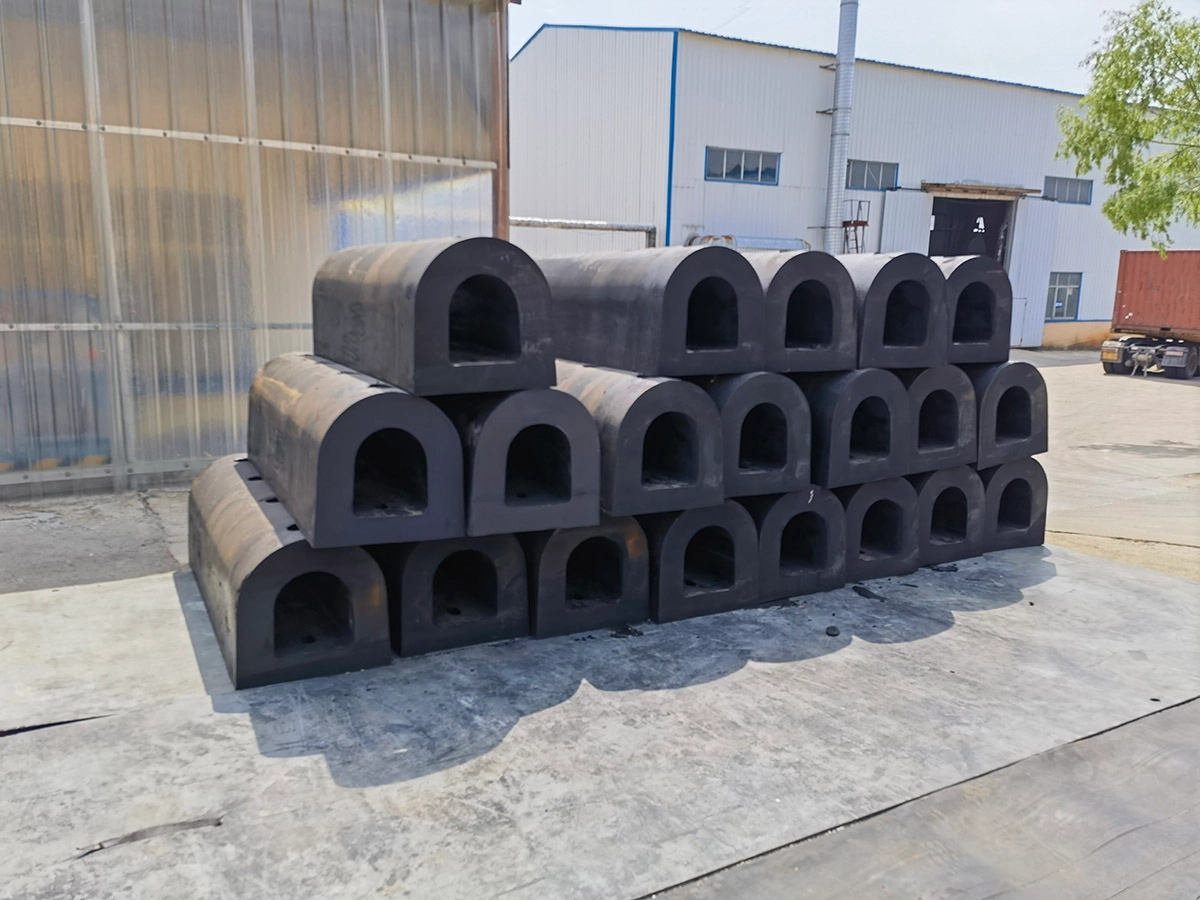
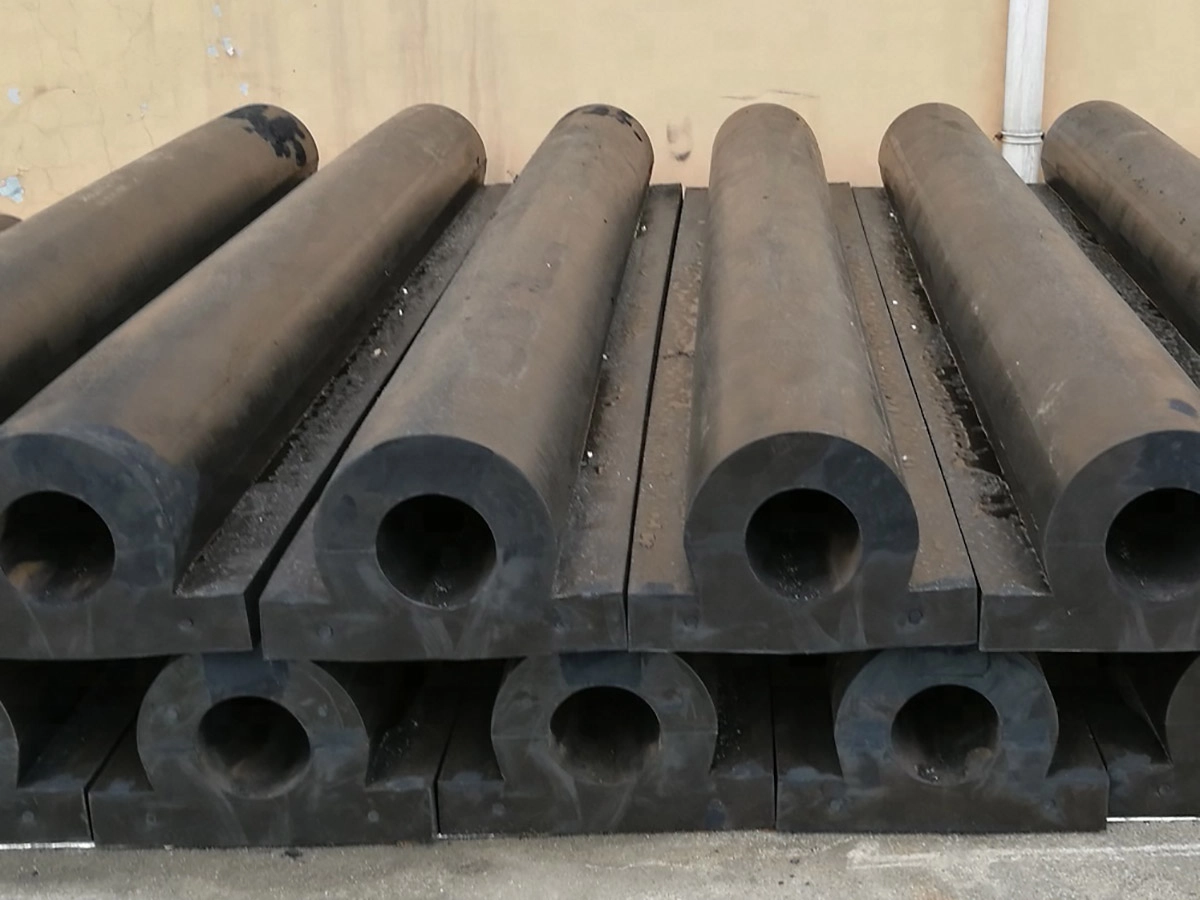
D-type fenders have a D-shaped exterior and may have a D-shaped or circular internal bore. They are widely used at small boat berths, marinas, and on workboats.
Their relatively simple form supports cut-to-length arrangements and closely spaced protection along suitable structures.
However, a long D-fender strip does not mean its entire length absorbs every impact. The effective contact length depends on the hull shape, alignment, and deformation.
D-type fender selection therefore still requires performance data and an engineered fixing arrangement.
| Selection factor | Super Arch rubber fender | D-type rubber fender |
|---|---|---|
| Typical role | Engineered berthing protection where capacity and stand-off are important | Compact rubbing and impact protection, commonly for smaller craft |
| Layout | Usually installed as discrete units | Often installed as continuous or closely spaced sections |
| Compression behavior | Governed by arch geometry and compound | Governed by section geometry, bore, compound, and contact length |
| Contact surface | Rubber or a specifically designed facing arrangement | Commonly direct rubber contact |
| Concrete interface | Mounting feet and anchors require structural checks | Fixings and any retaining bars require structural checks |
| Main caution | Higher capacity does not guarantee acceptable wall reaction | Compact dimensions do not guarantee sufficient energy capacity |
| Direct wave resistance | Not a replacement for coastal defense design | Not a replacement for coastal defense design |
There is no universal capacity ratio between these families. Compare actual proposed sizes under the same project conditions.
A single controlled berthing event and repeated movement during mooring are different operating conditions.
At an exposed berth, a vessel may repeatedly approach and separate from the fenders. It may also move vertically and longitudinally, introducing rubbing and shear.
Relevant questions include:
- How frequently does contact occur?
- How much compression already exists under wind or current loading?
- Can hull features snag the fender or its attachments?
- Will changing water levels move contact beyond the protected zone?
- Do mooring-line properties and vessel motions require specialist analysis?
A fender that meets an initial energy calculation may still perform poorly if its layout allows repeated hull-to-concrete contact.
For demanding locations, evaluate vessel motion, mooring behavior, and fender response together. Do not treat fenders as an independent cure for an unsuitable berth.
Our recommended technical starting point is a simple question: where does the load go?
The load path runs from the vessel through the contact surface, rubber element, mounting hardware, anchors, and concrete into the supporting structure.
Every link needs adequate capacity.
Record cracking, spalling, exposed reinforcement, previous repairs, and deterioration around existing anchors.
A stronger replacement fender can transfer loads that an older wall or fixing zone cannot safely resist.
A structural engineer should establish the acceptable loads and investigate the condition of the substrate. New rubber cannot compensate for unsound concrete.
A larger contact face can reduce average pressure on the vessel when properly designed. It does not automatically reduce anchor demand or concrete stresses.
Anchor spacing, edge distances, embedment, reinforcement, and combined loading still require assessment.
Likewise, adding more bolts is not a reliable remedy without checking how the anchor group and concrete behave.
Provide displacement, dimensions, draft range, hull geometry, beltings, and permissible contact locations.
Include the smallest vessel. A layout suitable for a large hull can leave smaller craft exposed between fenders.
Record tides, operating water levels, waves, currents, wind exposure, approach arrangements, and operating restrictions.
Use local berthing records and input from pilots or harbor personnel where available.
Determine berthing-energy demand using the adopted design method.
Velocity deserves particular attention: in the basic kinetic-energy relationship, energy varies with the square of velocity. A 20% increase in velocity produces a 44% increase in that energy term, with other inputs unchanged.
This illustrates sensitivity—not a complete fender-sizing calculation.
Request energy, reaction, and deflection curves for each proposed size and compound.
Check the required treatment of temperature, compression speed, angular contact, and manufacturing variability. Do not compare one supplier's unadjusted catalog figure with another supplier's design value.
Check fender spacing, residual stand-off at compression, hull curvature, mounting elevations, and anchor loads.
Ensure the vessel cannot strike exposed concrete between units or above and below the protected area.
Define drawings, tolerances, testing, inspection records, installation instructions, and replacement criteria before ordering.
This converts a profile comparison into a verifiable procurement specification.
PIANC Fender Guidelines 2024, developed by Working Group 211, supersede the earlier WG33 guidelines. They address fender-system design, manufacturing, and testing, and emphasize site-specific information.
For new international procurement, check the project's adopted standards and contractual requirements rather than automatically copying a "PIANC 2002" clause.
Ask suppliers to identify:
- The design framework used.
- The basis of stated performance.
- Applicable corrections and safety factors.
- Test procedures and acceptance criteria.
- The scope of any supporting approval documents.
Referencing PIANC is not the same as proving that a particular product meets every project requirement.
Also note the guideline's stated focus on controlled berthing of seagoing vessels. Small-craft rubbing protection and unusual exposure conditions still require appropriate engineering judgment.
These examples illustrate decision-making. They are not reported Taidun projects or certified designs.
A berth serves smaller workboats and has limited space between the hull and concrete.
D-type fenders may be practical if verified capacity is adequate and the layout protects the required contact zone. Inspect fixing access and the risk of exposed hardware contacting vessels.
A working quay requires greater stand-off and must accommodate a defined range of vessel impacts.
Super Arch fenders may deserve priority in the technical comparison. Selection remains conditional on acceptable reaction forces, adequate concrete capacity, and suitable hull contact.
The owner's problem is wave overtopping and foundation erosion.
Neither profile should be presented as the primary solution. Coastal assessment should address the wall, foreshore, toe, drainage, and relevant hydraulic conditions.
Nanjing Taidun Marine Equipment Engineering Co., Ltd. is an OEM manufacturing partner for buyers sourcing marine rubber fenders, mooring bollards, and marine anchoring products.
For a meaningful fender quotation, submit a technical package rather than a product photograph alone.
Include:
1. Fender profile, dimensions, quantities, and orientation.
2. Required energy and maximum allowable reaction.
3. Vessel range and environmental conditions.
4. Concrete and existing fixing information.
5. Rubber-property and dimensional requirements.
6. Hardware material and corrosion-protection requirements.
7. Testing, inspection, traceability, and documentation requirements.
8. Branding, packaging, and delivery expectations.
If replacing another brand's product, verify dimensions and performance independently. A similar appearance does not establish interchangeability.
Keep bollard and fender assessments coordinated, but distinct: mooring equipment and fenders perform different functions and impose different structural loads.
Compare installed lifecycle cost, not rubber price alone.
Include access equipment, concrete repairs, drilling, hardware, coatings, inspection, downtime, and replacement logistics.
Follow the approved installation method. Post-installed anchors require the specified substrate conditions, drilling and cleaning procedures, installation controls, and curing requirements where applicable.
During service, inspect for:
- Tears, cracking, or permanent deformation.
- Loose, missing, or corroded fixings.
- Concrete damage around attachment points.
- Worn facings and exposed hardware.
- Evidence that vessels contact unprotected concrete.
Set inspection intervals according to exposure, usage, manufacturer guidance, and the owner's maintenance plan. Arrange additional checks after abnormal impacts or severe storms.
Send Nanjing Taidun Marine Equipment Engineering Co., Ltd. your berth drawings, vessel information, existing fender details, concrete-condition findings, and required performance criteria.
Ask for a Super Arch versus D-type OEM proposal covering dimensions, performance documentation, mounting interfaces, inspection requirements, and commercial scope.
Final selection should remain subject to the project engineer's verification of the complete vessel–fender–structure system.
No. Super Arch fenders may suit projects needing greater stand-off and engineered compression capacity. D-type profiles can suit compact protection for smaller craft. Actual performance and structural compatibility decide.
They can reduce vessel-contact damage when correctly designed. They do not replace measures addressing direct wave pressure, overtopping, scour, or wall instability.
Potentially, but not as an unchecked substitution. Review reaction forces, projection, mounting geometry, anchor capacity, concrete condition, and vessel clearance.
Check hull geometry, berthing angle, compression, vessel size range, and residual clearance. Avoid selecting spacing solely from a generic rule or previous installation.
Request approved drawings, performance curves, agreed test reports, material and dimensional requirements, hardware specifications, traceability records, and installation and maintenance instructions.
No. Additional units may improve coverage, but load sharing is not automatically equal. Geometry and simultaneous contact must be assessed.
Hot Tags: China, Global, OEM, private label, manufacturers, factory, suppliers, manufacturing company


