

Views: 324 Author: Nanjing Taidun Publish Time: 2026-08-26 Origin: Site
Content Menu
● Why Proper Ship Fender Selection Matters
● Step 1: Understand Your Berthing Energy Requirements
>> Key Factors Affecting Berthing Energy:
● Step 2: Match Fender Type to Application
>> Pneumatic (Yokohama) Fenders
>> Arch Fenders
● Step 3: Evaluate Fender Performance Metrics
● Step 4: Consider Environmental Factors
● Step 5: Verify Quality and Certification Standards
● Advanced Selection Considerations
>> Panel and Attachment Systems
>> OEM Customization Advantages
● Real-World Application: Port of Ngqura Standardization
● Conclusion: Your Step-by-Step Selection Process
● Partner with a Trusted OEM Manufacturer
● FAQ
>> 1. What is the difference between pneumatic and foam-filled fenders?
>> 2. How do I calculate the correct fender size for my vessel?
>> 3. What is the recoil effect in marine fenders, and why does it matter?
>> 4. How long do marine rubber fenders typically last?
>> 5. Why should I choose an OEM manufacturer for marine fenders?
● About Nanjing Taidun Marine Equipment Engineering Co., Ltd.
Selecting the correct ship fender is a critical engineering decision that protects your vessels, cargo, and port infrastructure. With decades of OEM manufacturing experience, Nanjing Taidun Marine Equipment Engineering Co., Ltd. provides this comprehensive guide to help you navigate the complex world of marine fender selection.
Marine fenders are the unsung heroes of maritime operations. They absorb kinetic energy during vessel berthing, preventing costly damage to hulls and dock structures. The right marine fender selection depends on understanding vessel characteristics, berthing conditions, and fender performance metrics.
This guide transforms complex fender selection into a structured decision-making process, helping you identify the optimal rubber fender type for your specific application.
The consequences of poor fender selection extend far beyond immediate equipment failure:
- Cost of Downtime: Industrial port downtime often exceeds tens of thousands of dollars per hour
- Hull Damage: Improper fenders can lead to structural damage requiring expensive repairs
- Safety Risks: Inadequate protection endangers crew and cargo during STS operations
- Infrastructure Degradation: High reaction forces accelerate concrete fatigue on quay structures
Fender selection is not just about protection—it is about optimizing operational efficiency and minimizing total cost of ownership.
The foundation of fender selection is calculating the berthing energy your vessel generates during docking.
1. Vessel Displacement (Tonnage): Heavier ships generate substantially more kinetic energy during berthing
2. Berthing Speed: Approach velocity has a squared relationship to kinetic energy—doubling speed quadruples energy
3. Berthing Angle: Angular impacts distribute forces differently across the fender system
4. Tidal Conditions: Water level fluctuations affect effective fender positioning
Professional Tip: Most reputable OEMs like Nanjing Taidun provide performance curves that match vessel characteristics to fender energy absorption ratings. Request these charts during the selection process to ensure accuracy.
Each ship fender type offers distinct advantages for specific applications. Here is a comprehensive breakdown:
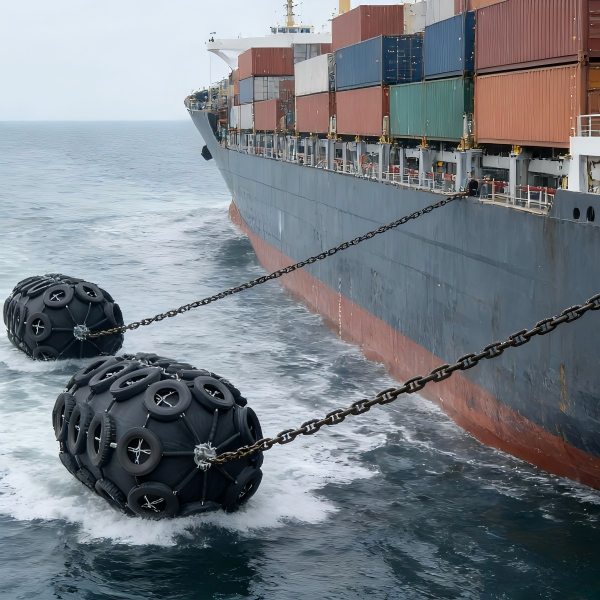
How They Work: Air-filled rubber shells with reinforced layers that compress to absorb impact energy
Key Specifications:
- Sizes range from 300mm to 4,700mm diameter and up to 12,000mm length
- Standard internal pressures: 50 kPa and 80 kPa (high-pressure)
- Types: Type I (Net-type) and Type II (Sling-type)
Advantages:
- Extremely low reaction force ideal for sensitive vessels (tankers, LNG carriers)
- Float on water—can be deployed quickly and repositioned
- Excellent energy absorption-to-weight ratio
Disadvantages:
- Risk of pressure loss from shell damage
- Requires regular pressure monitoring
- Shorter lifespan (typically 8–10 years)
Best Applications:
- Ship-to-ship (STS) transfer operations
- Floating docks and temporary berthing
- Large tankers and naval vessels
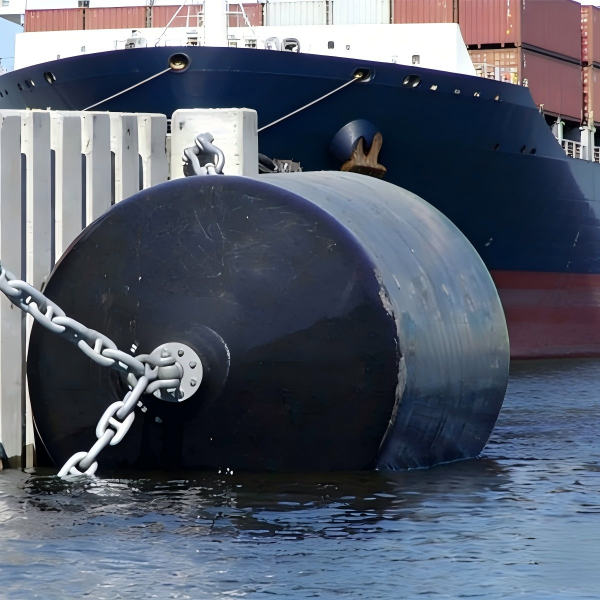
How They Work: Closed-cell foam cores (EVA or polyethylene) enclosed in tough polyurethane or rubber skins
Advantages:
- Fail-safe: Functionality maintained even if skin is punctured
- Higher energy absorption than pneumatic fenders (approximately 40% more)
- Long service life (10–25 years)
- Low maintenance requirements
Disadvantages:
- 2-3 times more expensive than comparable pneumatic fenders
- Not collapsible—requires significant storage and handling space
- Quality depends heavily on foam core integrity
Best Applications:
- Permanent heavy-duty terminals (container, cruise, oil)
- Harsh environments (polar regions, offshore platforms)
- High-value vessel protection
How They Work: Rubber elements mounted on steel panels, with designs that allow individual element replacement without system dismantling
Performance Metrics:
- Excellent energy-to-reaction force ratio (E/R)
- Can be mounted vertically, horizontally, or in combination
- Accommodate off-center impacts effectively
Key Advantages for Retrofit Projects:
| Application Challenge | Element Fender Solution |
|---|---|
| Limited mounting space | Compact design fits tight areas |
| Need to upgrade capacity | Modular units can be reconfigured |
| Minimize downtime | Individual elements replaced without full dismantling |
| Standardize multiple berths | Consistent fender type across facilities |
Real-World Example: Nanjing Taidun delivered 9 sets of element fender systems for the Port of Sheerness (UK), resolving capacity issues for larger RoRo vessels at a compact 19th-century berth. Shear chains and specialized steel panels distributed loads effectively while maintaining historical dock integrity.
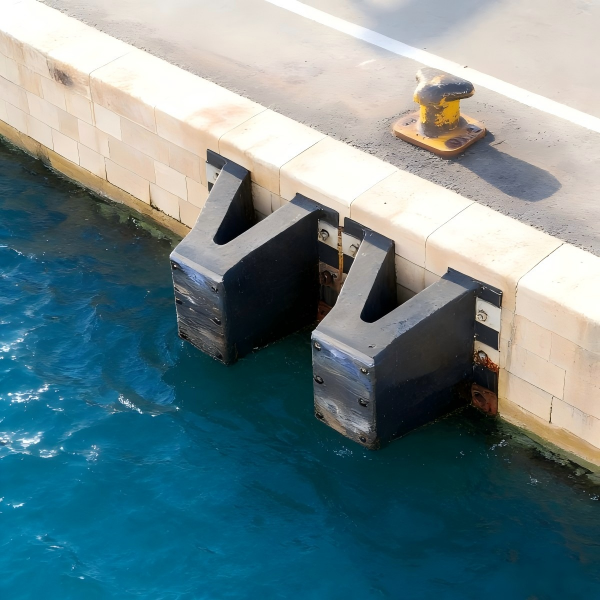
How They Work: Single-piece rubber mouldings with a simple, rugged arch design
Advantages:
- Extremely durable and hard-wearing
- Low maintenance requirements
- Compress and move under pressure while maintaining integrity
- Excellent for severe conditions
Best Applications:
- Fixed dock installations
- Applications with moderate energy absorption requirements
- Budget-conscious projects
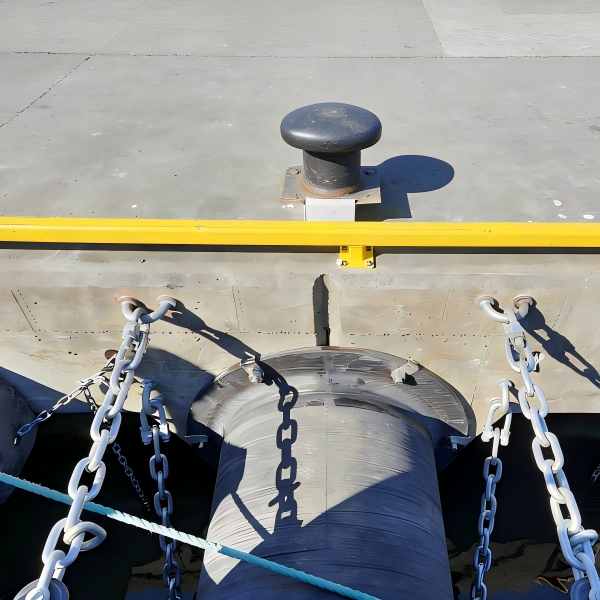
How They Work: Compressed drum-shaped structures that provide high force absorption
Key Specifications:
- Rated compression deflection: 52%
- Available in multiple performance grades (Super High, FE, FS, FH, FO, FL)
- Can be fitted with front panels for hull pressure distribution
Best Applications:
- Harsh berthing conditions where bevel-angle impacts occur
- Facilities requiring extreme durability and stability
- Large-scale wharf and jetty installations
Understanding these critical performance indicators ensures optimal selection:
Definition: The amount of kinetic energy a fender can safely absorb during compression.
Guidelines:
- Match your calculated berthing energy to the fender's rated absorption capacity
- Always select a fender with adequate margin—never the exact minimum
- Higher energy absorption generally means larger fender size or more advanced design
Definition: The force the fender exerts back on the vessel and structure during compression.
Why It Matters:
- Lower reaction force reduces hull pressure
- Excessive reaction force damages both hull and dock structure
- Element fenders excel at providing low reaction force relative to energy absorption
Critical but Overlooked Characteristic: Some fenders exert strong recoiling forces upon return to original shape. Excessive recoil can induce oscillating vessel movements and potentially create resonance with environmental forces. The design imperative is for low-recoiling fender systems that dissipate more absorbed energy rather than returning it as elastic rebound.
Operating conditions significantly impact fender performance and lifespan:
Nanjing Taidun has developed low-temperature modified rubber compounds that maintain elasticity and impact resistance down to -45°C, eliminating cold brittleness for Arctic and polar projects.
- High-quality rubber formulations resist degradation from UV radiation
- Anticorrosion treatments (hot-dip galvanizing + marine epoxy coating) protect metal components
- Floating fenders (pneumatic, foam-filled) automatically adjust with tides
- Fixed installations may require multiple fender tiers to accommodate water level changes
Never compromise on quality—counterfeit and substandard fenders are a persistent market risk.
| Standard | Scope |
|---|---|
| ISO 17357-1:2014 | Specification for pneumatic fenders |
| PIANC 2002 | Performance testing and verification |
| ASTM F2192-05 | Rated performance data confirmation |
| CCS/BV/RS/DNV/ABS | Classification society approval |
OEM Advantage: Working with a reputable OEM manufacturer like Nanjing Taidun ensures you receive products that meet these international standards. Our in-house R&D and testing facilities verify every fender's performance before shipment.
For applications where minimizing vessel movement is critical (STS operations, delicate cargo), prioritize fenders with documented low-recoil characteristics. Some rubber fenders exert "reflection" forces that can induce oscillating movements, exacerbating mooring line strain.
- Steel panels: Distribute reaction forces across hull surface
- UHMW-PE pads: Reduce friction and eliminate sparking risks in energy terminals
- Shear chains: Resist horizontal forces from berthing maneuvers
Working with an experienced OEM partner provides significant benefits:
1. Tailored Performance Curves: Fenders matched exactly to your vessel and berthing conditions
2. Private-Label Branding: Sell under your brand while leveraging Chinese manufacturing efficiency
3. Custom Dimensions: Non-standard sizes accommodate specialized vessels
4. Technical Documentation: Comprehensive test reports for procurement and safety compliance
| Pitfall | Consequence | Solution |
|---|---|---|
| Undersized fenders | Hull-to-dock contact, structural damage | Calculate berthing energy accurately |
| Overlooking recoil | Oscillating vessel movements, mooring line strain | Specify low-recoil fender designs |
| Ignoring tide variations | Fender misalignment, reduced protection | Use floating fenders or multi-tier systems |
| No maintenance plan | Premature failure, system degradation | Schedule regular inspections and pressure checks |
When South Africa's Port of Ngqura required standardization across four container berths, Nanjing Taidun delivered 15 sets of Element Fender Systems within a tight timeline. Independent laboratory TGA testing verified quality, and five sets remain as strategically valuable spare stock. The project demonstrates that element fenders are optimal for large facilities requiring consistent protection across multiple berths.
1. Calculate your vessel's berthing energy (tonnage × speed⊃2; × angle factor)
2. Identify your primary application: STS, dock berthing, or offshore
3. Evaluate environmental conditions: tide, temperature, weather exposure
4. Select fender type(s) that match your requirements
5. Verify performance metrics against your calculated needs
6. Check certifications and quality documentation
7. Plan installation and maintenance procedures
Nanjing Taidun Marine Equipment Engineering Co., Ltd. offers comprehensive OEM services for international brands, wholesalers, and producers. With 300,000㎡ production facilities and an annual output of 20,000 tons of rubber fenders, we provide:
- Full in-house R&D and testing—ISO-certified performance verification
- Customization at scale—dimensions, performance curves, and branding
- Global logistics support—worldwide shipping with customs expertise
- Technical consultation—engineering guidance from initial inquiry to installation
Ready to select the right fenders for your fleet or facility?
Contact our engineering team today for a free consultation and customized fender recommendation.
Email: service@taidunmarine.com
WhatsApp: +86-187-5195-0876
Pneumatic (Yokohama) fenders use compressed air inside a rubber shell, offering low reaction force and easy deployment, but require regular pressure checks and have shorter lifespans (8–10 years). Foam-filled fenders have solid closed-cell foam cores that maintain functionality even if punctured, last 10–25 years, but cost 2-3 times more and are not collapsible for storage.
Estimate your vessel's berthing energy based on tonnage, approach speed, and berthing angle. Use the fender manufacturer's energy absorption charts to match the correct size. For accurate results, provide your engineer with: vessel type, length, width, draft, and berthing conditions (speed, angle, dock structure).
Recoil is the reflection force some rubber fenders exert as they return to shape after compression. Excessive recoil can induce oscillating vessel movements, leading to amplified motion and potential resonance with environmental forces like waves. For sensitive applications, specify low-recoiling fender designs that dissipate more absorbed energy.
Pneumatic fenders last 8–10 years under normal conditions, while foam-filled fenders can last 10–25 years with proper maintenance. Arch and element fenders typically provide 15–20 years of service. Lifespan depends on environmental factors (UV, temperature extremes), usage frequency, and maintenance diligence.
OEM manufacturers offer full customization (dimensions, performance, branding), direct technical support, in-house R&D and testing, competitive pricing through manufacturing efficiency, and global shipping expertise. Partnering with an OEM like Nanjing Taidun ensures your fenders meet international standards while aligning with your specific technical requirements and brand identity.
Nanjing Taidun Marine Equipment Engineering Co., Ltd. is a world-class OEM manufacturer specializing in marine rubber fenders, foam fenders, bollards, and steel-fabricated marine equipment. With 300,000㎡ of production capacity and an annual output of 20,000 tons, we provide custom solutions for international brands, wholesalers, and producers. Our products comply with ISO, PIANC, and classification society standards, backed by in-house testing and global logistics support.
# The Ultimate Guide to Ship Fenders: How to Choose the Right Type for Your Vessel
Selecting the correct ship fender is a critical engineering decision that protects your vessels, cargo, and port infrastructure. With decades of OEM manufacturing experience, Nanjing Taidun Marine Equipment Engineering Co., Ltd. provides this comprehensive guide to help you navigate the complex world of marine fender selection.


