

Views: 256 Author: Nanjing Taidun Publish Time: 2026-11-11 Origin: Site
Content Menu
● Coast Guard Fenders vs Commercial Fenders: What Actually Differs?
● Why Tropical Cyclones Change Fender Selection
>> Berthing Energy Is Only One Requirement
>> Storm Surge Changes the Contact Envelope
>> Mooring Lines and Fenders Interact
● Choosing Marine Fender Types for Severe Weather Mooring
>> Cone and Cell Fender Systems
>> D-Type and Cylindrical Fenders
>> Pneumatic and Other Floating Fenders
● The Missing Step: Verify the Complete Mooring Load Path
>> Check Bollard Capacity Against Actual Load Direction
>> Separate Berthing Verification From Storm-Mooring Verification
● A Practical OEM Specification Checklist for Overseas Buyers
>> 1. Define the Vessel and Operating Envelope
>> 2. Describe the Berth and Environment
>> 3. Specify the Technical Basis
>> 4. Request Project-Relevant Performance Data
>> 5. Establish Quality and Traceability Requirements
>> 6. Confirm Installation and Maintenance Deliverables
● Current Guidance: Why Legacy Specifications Need Review
● A Severe Weather Mooring Preparation Framework
>> When a Storm Threat Develops
● How Taidun Should Support an OEM Fender Project
>> Are Coast Guard fenders stronger than commercial fenders?
>> Can marine fenders guarantee safety during a tropical cyclone?
>> Are floating fenders always better during storm surge?
>> What should an OEM buyer request besides a quotation?
>> Does PIANC guidance replace a storm-mooring analysis?
>> Should vessels remain moored when a cyclone approaches?
At Nanjing Taidun Marine Equipment Engineering Co., Ltd., we provide OEM marine rubber fenders, mooring bollards, and anchoring products for overseas brands, wholesalers, and manufacturers. When customers compare "Coast Guard Fenders vs Commercial Fenders: Severe Weather Mooring in Tropical Cyclones," our starting point is simple: select the system for the vessel, berth, and storm exposure—not the label.
A patrol vessel and a commercial ship may need different fender arrangements. However, neither a government-service designation nor a heavy-duty product description proves cyclone suitability.
The real question is whether the complete mooring system can manage vessel movement, contact forces, changing water levels, and environmental loads within a professionally assessed operating envelope.
This guide explains the differences that matter, the specification gaps buyers should close, and the practical decisions required before severe weather arrives.
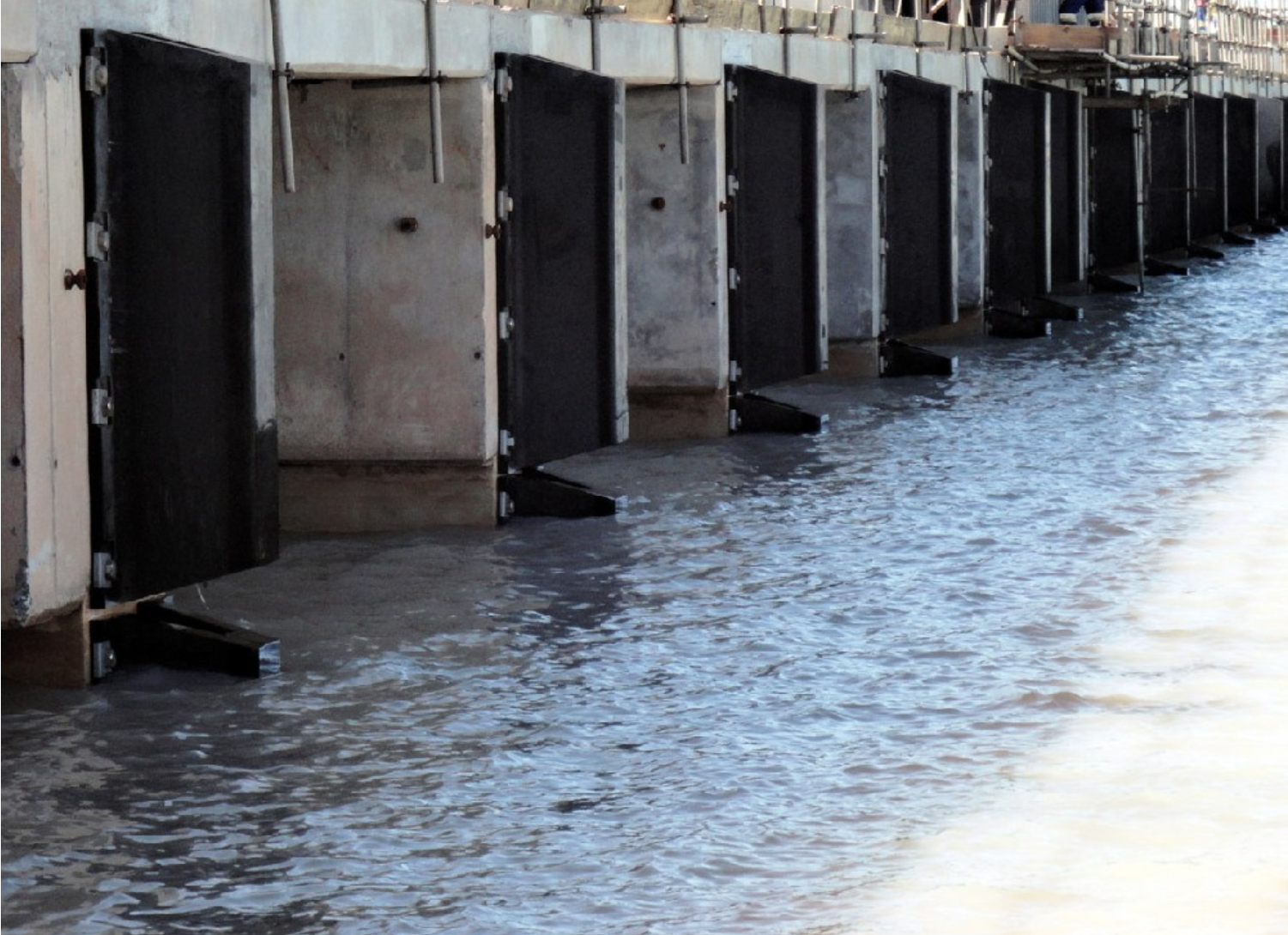
"Coast Guard fender" describes an application or purchasing context. It is not, by itself, a universal performance class.
Likewise, commercial fenders cover many products and operating environments. A sheltered ferry berth and an exposed cargo terminal should not receive identical specifications simply because both serve commercial vessels.
| Selection factor | Coast Guard application | Commercial application |
|---|---|---|
| Vessel profile | Patrol boats, cutters, and support vessels | Ferries, workboats, cargo ships, and tankers |
| Contact geometry | May include rubbing strakes, flared bows, or projecting features | Varies substantially with hull form and vessel size |
| Operating pattern | May require frequent departures and operational availability | May prioritize scheduled movements and cargo operations |
| Fender arrangement | Vessel-mounted profiles, berth fenders, or combinations | Fixed berth systems, floating fenders, or combinations |
| Cyclone suitability | Requires vessel- and site-specific verification | Requires the same verification |
These are application considerations, not fixed rules. Some government vessels are large, while some commercial craft are small and highly maneuverable.
A meaningful comparison therefore starts with vessel dimensions, displacement, hull contact limits, berth geometry, and environmental exposure.
Routine berthing and prolonged storm mooring are different engineering problems.
During controlled berthing, a fender absorbs energy as a vessel approaches the berth. During a tropical cyclone, a vessel may repeatedly push against the system, move along it, or separate and return.
A high energy-absorption figure does not establish storm suitability.
Designers must also evaluate:
- Reaction forces transferred into the vessel and quay.
- Sustained compression and available remaining deflection.
- Repeated loading and potential fatigue.
- Shear forces generated by relative movement.
- Panel contact pressure and local hull strength.
- Connections, chains, fixings, and supporting structures.
A fender can satisfy a catalog energy requirement while remaining unsuitable for the actual moored condition.
Storm surge and tide alter the vessel's position relative to fixed berth structures.
A panel that contacts the hull correctly at normal water level may not provide suitable coverage throughout the design water-level range. Vessel draft, trim, and motion also affect that relationship.
This makes vertical coverage, panel geometry, and clearance checks essential parts of cyclone-resistant berth planning.
Lines restrain movement. Fenders provide controlled contact and compression.
Changes in line arrangement, stiffness, pretension, or water level can change the loads acting on the fenders. Increasing line tension indiscriminately is not a reliable way to improve safety.
The vessel, lines, bollards, fenders, and berth must be assessed together.
There is no single best fender for every Coast Guard berth or commercial terminal.
Selection should follow the required performance, installation constraints, and maintenance strategy.
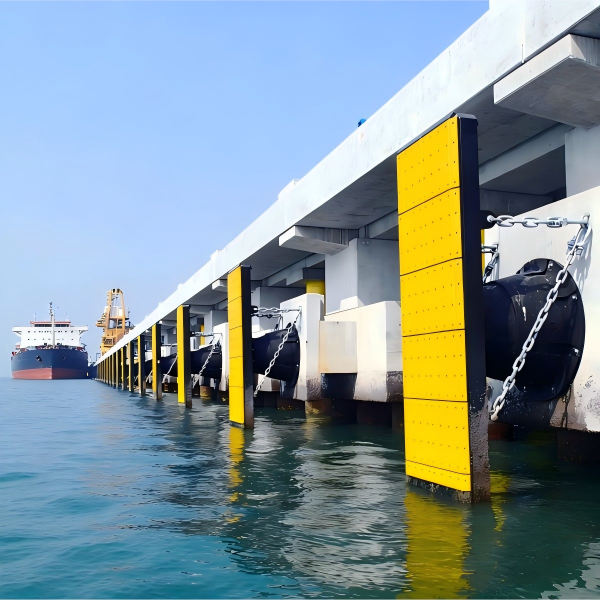
Cone and cell systems are candidates where substantial energy absorption and engineered frontal panels are required.
For a cyclone-exposed berth, review more than nominal rubber size. Check corrected performance, panel coverage, load distribution, restraint arrangements, and the supporting structure.
The final configuration matters as much as the fender family.
D-type and cylindrical arrangements may be considered for smaller vessels, workboat facilities, or installations with particular mounting constraints.
Their suitability depends on the actual energy demand, contact geometry, compression behavior, and fixing arrangement.
Neither familiarity nor low purchase cost replaces engineering verification.
Floating fenders may offer useful positioning flexibility where water levels vary.
However, floating does not mean self-securing. Designers still need to assess retention systems, movement limits, vessel contact, surrounding obstructions, and inspection access.
For pneumatic products, specify the applicable product standard and required testing. A general marine-rubber specification should not be treated as interchangeable with a pneumatic-fender specification.
One of the most important specification improvements is to stop treating fenders and bollards as unrelated purchases.
Loads pass through connected components.
For the mooring system, the path includes the vessel's fittings, lines, shore bollards, anchors, and supporting structure. For the fender system, it includes hull contact, panels, rubber units, restraints, fixings, and the quay.
A strong component cannot compensate for an unsuitable connection elsewhere.
A bollard's stated capacity should be reviewed alongside the permitted line angles, installation details, anchorage, and foundation capacity.
Procurement teams should request:
1. The bollard drawing and specified capacity.
2. Permitted horizontal and vertical loading conditions.
3. Anchor-bolt and embedment requirements.
4. Supporting-structure design responsibilities.
5. Inspection and acceptance requirements.
The same discipline applies to replacement projects. Matching the visible bollard shape does not establish that the existing foundation is adequate.
Ask two questions:
- Can the system accommodate the specified berthing event?
- Can the complete arrangement accommodate the assessed moored conditions?
These questions overlap, but they are not interchangeable.
For exposed locations or complex vessel behavior, a qualified engineer may require dynamic mooring analysis to evaluate motions, line loads, and fender compression over time.
For brands, distributors, and manufacturers, the strongest RFQ is a documented design brief—not simply a photograph and a requested price.
Provide vessel dimensions, displacement range, draft, hull geometry, allowable contact pressure, and expected operating patterns.
Identify whether the project covers one vessel or a fleet.
Include berth drawings, fender elevations, available mounting space, water-level range, and relevant wind, wave, and current information.
State whether vessels are expected to remain alongside during severe weather.
Identify the applicable guideline, product standard, design method, and project-specific acceptance criteria.
Avoid an undefined request for "PIANC compliance." The contract should identify the relevant guidance and the evidence required to demonstrate conformity.
Ask for energy-absorption and reaction-force information, test conditions, applicable correction factors, and manufacturing tolerances.
Catalog performance under reference conditions should not be assumed to equal performance at the installation site.
Agree on drawings, material identification, inspection stages, testing, marking, document retention, and any third-party witnessing before production.
For OEM buyers, also confirm branding, packaging, spare-part identification, and approval responsibilities.
Specify installation instructions, fixing requirements, inspection criteria, and replacement information.
Clear documentation helps the overseas brand support the product after delivery.
PIANC's Fender Guidelines 2024, produced by MarCom Working Group 211, supersede the earlier WG 33 guidance.
For new procurement, this makes it important to check whether inherited specifications still reflect the intended technical basis.
However, referencing newer guidance does not automatically validate an existing berth, and an older installation should not be condemned solely because its documentation cites an earlier edition.
The practical task is to review the design assumptions, actual operating conditions, remaining condition, and contractual requirements.
For OEM procurement, distinguish three different claims:
- A product was tested using a stated method.
- A product satisfies defined project acceptance criteria.
- A complete installed system has been verified for its intended service.
These statements require different evidence.
Fender selection cannot replace a port-approved storm plan.
Whether a vessel should remain alongside, relocate, or depart depends on local authority requirements, vessel capability, available shelter, and the developing forecast.
- Review the berth's storm operating limits.
- Confirm vessel-specific mooring arrangements.
- Inspect fenders, panels, restraints, bollards, and visible fixings.
- Identify deterioration requiring engineering assessment.
- Confirm responsibilities, communications, and departure decision points.
Follow the relevant port authority and Coast Guard instructions.
In the United States, named hurricane port conditions may trigger preparations, movement restrictions, or closure requirements. Exact obligations depend on the applicable port rules and official directions.
Do not assume a timetable or permission from another port applies locally.
Treat a visual check as an initial screen, not proof of structural integrity.
Record displaced components, damaged rubber, distorted panels, loose connections, and signs of foundation movement. Isolate affected equipment and obtain assessment before restoring service where damage is suspected.
At Nanjing Taidun Marine Equipment Engineering Co., Ltd., our OEM proposition centers on marine rubber fenders, mooring bollards, and anchoring products for overseas partners.
For cyclone-exposed applications, a productive enquiry should begin with clear technical inputs and agreed responsibilities.
We encourage buyers to define the required drawings, performance evidence, inspection documents, labeling, and acceptance process before ordering.
This approach supports a more useful comparison than price per rubber unit alone. It also helps distinguish manufacturing scope from the work of the project's marine designer, structural engineer, installer, and approving authority.
Send Taidun your vessel particulars, berth drawings, environmental design conditions, and OEM requirements. Request a project-specific proposal identifying the proposed product configuration, available documentation, testing scope, and assumptions requiring engineering approval.
Not automatically. The application name does not define strength or cyclone suitability. Compare energy absorption, reaction force, contact pressure, connections, and project-specific design requirements.
No. Fenders are only one part of the system. Vessel behavior, mooring lines, bollards, foundations, environmental exposure, and operational decisions all affect the outcome.
No. Their ability to move with water level can be useful, but retention, clearances, contact geometry, and storm motions still require assessment.
Request approved drawings, performance data, test conditions, traceability requirements, inspection arrangements, installation information, and clearly defined acceptance criteria.
No. Fender guidance informs design and selection. Site-specific assessment remains necessary where storm loads and vessel motions could govern the system.
There is no universal answer. Follow the applicable port directions and vessel-specific storm plan. Purchasing larger fenders does not establish permission or safety to remain alongside.
1. Nanjing Taidun Marine Equipment Engineering Co., Ltd. — Official Website
2. PIANC — PIANC Fender Guidelines 2024, MarCom Working Group 211
3. Trelleborg Marine and Infrastructure — PIANC WG211 Fender Design Guidelines
4. Trelleborg — WG211 Technical Overview, 2024
5. Electronic Code of Federal Regulations — 33 CFR § 165.781
Hot Tags: China, Global, OEM, private label, manufacturers, factory, suppliers, manufacturing company


