

Views: 259 Author: Nanjing Taidun Publish Time: 2026-11-12 Origin: Site
Content Menu
● What Are Floating Fenders for Floating Docks?
● Why a Floating Dock Needs a Different Selection Approach
● Comparing Floating Fender Types for Floating Docks
>> Foam-Filled Floating Fenders
>> Fixed Fendering on Floating Pontoons
● How to Specify Floating Fenders for Floating Docks
>> 1. Define the Vessel and Berthing Conditions
>> 2. Check Energy Absorption and Reaction Together
>> 3. Review Hull Contact Pressure
>> 4. Verify Geometry Throughout Movement
>> 5. Apply Relevant Performance Conditions
● Three Overlooked Engineering Checks
>> Relative Movement Matters More Than Tide Alone
>> Restraints Must Position the Fender Without Blocking Compression
>> Corners and Transitions Need Separate Attention
● An Illustrative Lesson: Why Approach Speed Changes Selection
● OEM Procurement: What to Include in Your RFQ
● Standards, Testing, and Evidence Buyers Should Request
● Installation and Maintenance: Protect the Whole System
● Start Your OEM Floating Fender Project with Taidun
>> Are floating fenders suitable for every floating dock?
>> Do floating fenders automatically remain at the correct contact height?
>> Are pneumatic or foam-filled fenders better?
>> Can I select a floating fender using vessel length alone?
>> Does ISO 17357 cover every floating-dock fender?
>> What should an OEM buyer send with an enquiry?
At Nanjing Taidun Marine Equipment Engineering Co., Ltd., we provide OEM manufacturing services for international brands, wholesalers, and manufacturers sourcing marine rubber fenders, bollards, and anchoring products. For buyers evaluating floating fenders for floating docks, our starting point is straightforward: choose protection around the vessel, dock structure, and operating conditions—not simply a product diameter.
A floating dock moves with the water, but that does not automatically make berthing gentle. Vessel movement, changing loading conditions, wind, and repeated contact still create demands on the protective system.
This guide explains how to compare fender types, identify overlooked installation risks, and prepare an OEM specification that supports dependable procurement.
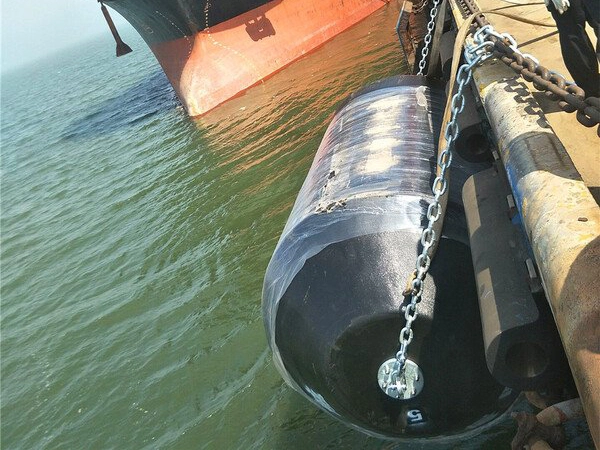
Floating fenders are buoyant protective units positioned between a vessel and another vessel or berthing structure. They absorb berthing energy through controlled compression while transmitting reaction forces to the surfaces they contact.
However, "floating dock fenders" can describe two different arrangements:
- Freely floating pneumatic or foam-filled fenders restrained alongside a dock.
- Fixed protective profiles attached to a floating pontoon, such as D-shaped or cylindrical rubber fenders.
These arrangements are not interchangeable. A small leisure-boat pontoon may require compact perimeter protection. A commercial floating berth may need larger floating units with documented energy absorption and reaction-force characteristics.
The first purchasing decision is therefore not "Which size?" It is "Which protection arrangement suits this interface?"
A floating dock rises and falls with water level, but the vessel and dock do not necessarily move together.
Their relative positions can change because of:
- Vessel loading and unloading.
- Waves, wakes, and passing traffic.
- Differences in freeboard.
- Dock roll, pitch, and lateral movement.
- Wind and current acting on different exposed areas.
A fender must remain in a useful contact position throughout the intended operating range. Adequate energy capacity is not enough if the unit slips below the contact zone, becomes trapped beneath an overhang, or transfers loads into an unsuitable dock edge.
From a procurement perspective, we recommend reviewing the complete vessel–fender–dock interface before comparing quotations.
The most suitable solution depends on vessel traffic, available space, maintenance capability, and structural limits.
| Fender arrangement | Applications worth evaluating | Main procurement check |
|---|---|---|
| Pneumatic floating fenders | Commercial berths, temporary protection, vessel-to-vessel interfaces | Pressure class, performance curves, valves, and restraint arrangement |
| Foam-filled floating fenders | Applications where avoiding inflation maintenance is important | Foam construction, protective skin, fittings, and compression performance |
| Fixed rubber profiles on floating docks | Smaller pontoons, perimeter protection, frequent light contact | Profile dimensions, fixing strength, coverage, and local dock loads |
| Mixed protection systems | Facilities serving vessels with different sizes and contact heights | Compatibility and transitions between protection zones |
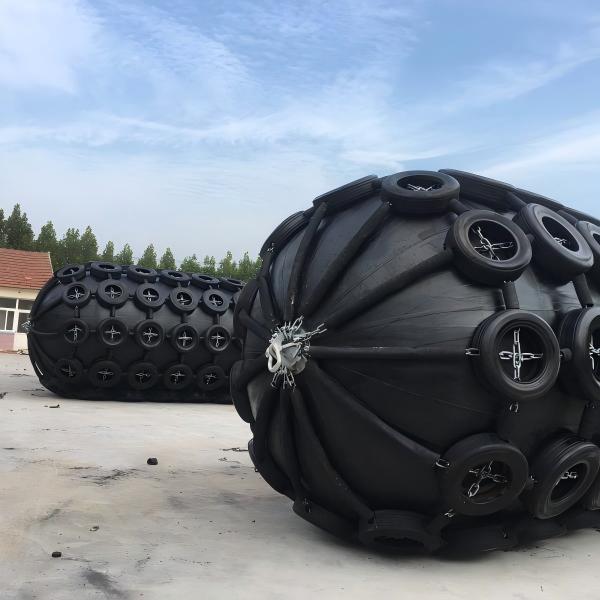
Pneumatic fenders use compressed air within a reinforced rubber body. Procurement specifications should identify the applicable standard, initial internal pressure, dimensions, and required performance.
Depending on the design, external protection may include a chain-and-tyre net. Buyers should consider whether the selected external arrangement is appropriate for the visiting hulls and operating environment.
Do not compare pneumatic fenders by dimensions alone. Pressure class and verified performance also matter.
Foam-filled fenders use a compressible foam core and protective outer construction. They do not require inflation-pressure checks, but they still need inspection.
Outer-skin damage, worn fittings, and restraint deterioration remain relevant maintenance issues. Ask suppliers to describe the foam, reinforcement, repair provisions, and performance basis rather than relying on the phrase "maintenance-free."
Floating fenders are not always the most practical answer for a floating dock.
Where space is limited and contact loads are modest, appropriately engineered fixed profiles may provide better perimeter coverage. Their attachment details must still suit the pontoon structure and expected contact loads.
A reliable specification connects three questions: how much energy must be absorbed, how much force can be accepted, and where will contact occur?
Provide the vessel's operating displacement, dimensions, hull geometry, and expected approach conditions.
Use displacement rather than treating deadweight tonnage as an equivalent input. Include the range of vessels, not just the largest vessel by length.
A smaller vessel may present a difficult contact geometry even when its overall berthing energy is lower.
Energy absorption describes the work a fender can absorb during compression. Reaction force describes the load transmitted during that compression.
A fender can meet an energy requirement while generating an unacceptable reaction for a lightweight floating structure.
The supporting dock, local framing, connections, and relevant load paths therefore need review alongside the fender.
Acceptable reaction force does not automatically establish acceptable pressure on the vessel.
Contact area, hull shape, fender arrangement, and compression conditions influence local loading. Thin plating, protrusions, and sensitive hull finishes deserve particular attention.
Check the unloaded position and the compressed position across the intended operating envelope.
Review clearances around:
- Pontoon corners and deck overhangs.
- Guide piles and pile brackets.
- Ladders, utilities, and service platforms.
- Vessel rubbing strakes and protrusions.
- Adjacent fenders and restraint fittings.
Ask how published ratings account for compression angle, temperature, compression speed, and manufacturing tolerances.
A catalogue value without its test conditions is an incomplete purchasing basis.
At a floating berth, both structures may follow the tide. The more important issue can be their movement relative to each other.
A contact-envelope drawing should show credible vessel loading conditions, dock movement, and fender travel. This helps identify gaps that a static elevation drawing may miss.
Chains, ropes, shackles, and attachment points are functional parts of the system.
If restraint geometry is too restrictive, it can interfere with compression or impose unintended loads. If it is too loose, the fender may drift away from the required contact zone.
Specify the arrangement, attachment locations, corrosion protection, and inspection access. Do not assume a standard chain length suits every pontoon.
Straight dock sections do not represent every contact condition.
At corners, a vessel may contact a smaller area or move across the edge of the protection system. Transitions between fixed profiles and floating units can also create exposed gaps.
Review these locations individually rather than extending a typical straight-section detail around the entire dock.
Consider two otherwise identical berthing events. In the second event, the vessel's normal approach speed increases by 20%.
Because the basic kinetic-energy relationship includes velocity squared, the corresponding energy component increases by 44%, with other factors unchanged.
This is an illustration, not a completed fender design. Actual selection also considers hydrodynamic effects, eccentricity, operating scenarios, design factors, and the applicable methodology.
The purchasing lesson is important: a small change in the assumed approach speed can materially change the required protection.
When comparing suppliers, make sure every quotation uses the same agreed operating assumptions.
At Nanjing Taidun Marine Equipment Engineering Co., Ltd., we encourage buyers to organize enquiries around a project-specific specification rather than a product name alone.
A useful OEM request for quotation includes:
| RFQ item | Information to provide |
|---|---|
| Vessel range | Types, displacement, dimensions, and loading conditions |
| Dock structure | Pontoon material, drawings, freeboard, and available structural limits |
| Operating conditions | Approach speed, angle, traffic pattern, wind, waves, and current |
| Performance requirements | Required energy absorption, allowable reaction, and hull-pressure limits |
| Installation | Available space, restraint concept, attachment locations, and access |
| Product requirements | Fender type, dimensions, materials, and applicable standards |
| Quality documentation | Drawings, inspection plan, test requirements, and traceability |
| Commercial requirements | Quantity, branding, packaging, destination, and delivery expectations |
Where information is unavailable, identify it as an open design input. Do not silently replace missing engineering data with an optimistic assumption.
For private-label supply, also agree on product markings, drawing ownership, packaging artwork, and approval responsibilities before production.
ISO 17357-1 addresses high-pressure floating pneumatic rubber fenders. It should not be presented as a universal certification for every foam-filled fender, rubber profile, or completed floating-dock installation.
PIANC's Fender Guidelines 2024 provide guidance on fender-system design, manufacturing, and testing. Their stated focus is controlled berthing of seagoing vessels; applicability to a particular floating-dock project requires engineering judgment.
For each proposed product, request:
1. An approved dimensional drawing.
2. Energy-absorption and reaction-force data.
3. The applicable test method and rating conditions.
4. Material and construction information.
5. Defined inspection and acceptance criteria.
6. Product identification and traceability.
7. Installation and maintenance instructions.
Where third-party inspection is required, specify its scope and acceptance criteria in the purchase agreement.
Claims such as "PIANC compliant" or "international quality" are not substitutes for product-specific evidence.
Before installation, confirm that the delivered fenders and hardware match the approved drawings. Inspect for transport damage and verify attachment details.
For pneumatic units, follow the manufacturer's pressure-setting and inspection instructions. For foam-filled units, examine the outer skin, end fittings, and restraint connections.
During service, review:
- Fender position and coverage.
- Abrasion, cuts, deformation, or exposed reinforcement.
- Chain, rope, shackle, and attachment condition.
- Corrosion and unintended metal-to-hull contact.
- Changes in visiting vessels or operating conditions.
Set inspection intervals according to service severity and supplier guidance. Record findings so developing damage becomes visible over time.
The right floating fender is part of a coordinated protection system—not an isolated rubber product.
Send Nanjing Taidun Marine Equipment Engineering Co., Ltd. your vessel particulars, floating-dock drawings, operating conditions, and OEM requirements. Where available, include required energy absorption, allowable reaction force, and hull-pressure limits.
Request a quotation against an agreed specification, with drawings, testing requirements, branding, and documentation clearly defined.
That approach gives your purchasing team a stronger basis for comparing offers and gives your brand a clearer record of what has been ordered.
No. Suitability depends on contact loads, space, vessel geometry, and restraint arrangements. Some pontoons are better served by fixed rubber profiles or a combination of protection types.
Not necessarily. Buoyancy follows water level, but vessel loading, hull shape, dock movement, and restraint geometry can change the contact relationship.
Neither is universally better. Compare performance, available space, maintenance requirements, construction, repair options, and whole-life cost for the specific application.
No. Vessel displacement, approach conditions, contact geometry, structural limits, and required energy absorption are also important.
No. The relevant part must match the product. ISO 17357-1 concerns high-pressure floating pneumatic rubber fenders, not all dock-protection products.
Send vessel information, dock drawings, operating conditions, performance requirements, quantity, destination, and branding needs. Clearly identify any engineering inputs still awaiting confirmation.
1. PIANC. *PIANC Fender Guidelines 2024*, Working Group 211. Supports the integrated approach to fender selection, supporting-structure assessment, site-specific information, manufacturing, and testing. The publication page also explains the guidelines' scope and limitations. [pianc]
2. American Society of Civil Engineers. *PIANC Working Group 211: Reliability Based Design of Marine Fender Systems*. Published September 15, 2022. Explains the distinction between selecting fenders for berthing energy and designing supporting structures for reaction forces. [ascelibrary]
3. Yokohama Rubber. *YOKOHAMA Floating Fenders*. Manufacturer technical information explaining floating pneumatic fenders and the scope of ISO 17357-1:2014, including design, material, and performance-testing requirements. [y-yokohama]
4. Trelleborg Marine and Infrastructure. *Floating Fenders*. Product information supporting discussion of deployment arrangements, pressure variants, and chain-and-tyre-net configurations. [trelleborg]
5. ShibataFenderTeam. *Design Manual*, hosted by Port Technology International. Technical reference for berthing-energy relationships, reaction forces, performance correction factors, and floating or suspended fender arrangements. [wpassets.porttechnology]
6. Nanjing Taidun Marine Equipment Engineering Co., Ltd. *Marine Fender Solutions for Shipbuilding Yards: OEM Engineering That Protects Vessels, Berths, and Brand Reputation*. Company-published context for OEM positioning and marine-product terminology; not independent verification of certification or performance. [taidunmarine]
Hot Tags: China, Global, OEM, private label, manufacturers, factory, suppliers, manufacturing company


