

Views: 239 Author: Nanjing Taidun Publish Time: 2026-09-21 Origin: Site
Content Menu
● Danforth vs Delta Anchor: Core Design Differences
● Why Soft Mud Favors Danforth-Style Anchors
>> Broad flukes create greater resistance
>> The limitation: soft mud is never "easy"
● Delta Anchor Performance in Soft Mud
>> Where a Delta anchor remains useful
● Hard Sand: Which Anchor Has Better Holding Power?
>> Danforth anchor in hard sand
● Soft Mud vs Hard Sand: Practical Selection Guide
● Holding Power Depends on More Than Anchor Shape
>> 1. Scope ratio controls the pull angle
>> 2. Vessel windage can outweigh vessel displacement
>> 3. Anchor size must match the job
● How to Set a Danforth or Delta Anchor Correctly
● OEM Manufacturing Considerations for Marine Anchor Buyers
● Final Verdict: Danforth or Delta?
● FAQ
>> Is a Danforth anchor better than a Delta anchor in soft mud?
>> Which anchor is better for hard sand: Danforth or Delta?
>> Does a heavier anchor always provide better holding power?
>> What scope should I use with a Danforth or Delta anchor?
>> Can a Delta anchor be used as a primary anchor?
>> Why does an anchor drag even when it is correctly sized?
>> Can Taidun Marine provide OEM Danforth and Delta anchors?
When buyers compare Danforth Anchor vs Delta Anchor: Holding Power in Soft Mud vs Hard Sand Seabeds, the correct answer is rarely "one anchor is always better." The best choice depends on bottom composition, vessel windage, anchor size, rode geometry, setting method, and the operating profile. For a proven soft-mud or sand anchorage, a Danforth-style anchor often delivers exceptional holding power for its weight. For mixed ground, frequent wind shifts, bow-roller use, and general-purpose cruising applications, a Delta-style plow anchor can provide valuable operational convenience and versatile performance.
At Nanjing Taidun Marine Equipment Engineering Co., Ltd., we manufacture marine anchoring equipment for overseas brands, wholesalers, shipyards, and equipment manufacturers through flexible OEM service. From our perspective as a marine-equipment factory, anchor selection should never be reduced to appearance or nominal weight alone. A dependable anchoring system is a combination of anchor geometry, steel grade, weld quality, coating protection, shank strength, chain compatibility, and correct onboard use.
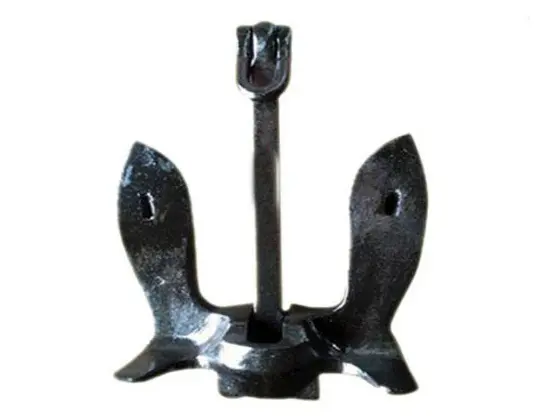
A Danforth anchor and a Delta anchor create holding power in different ways. Understanding their geometry is the starting point for a smarter purchase decision.
| Feature | Danforth / Fluke Anchor | Delta / Plow Anchor |
|---|---|---|
| Primary structure | Two wide pivoting flukes with a stock | One-piece plow-shaped blade and shank |
| Main holding mechanism | Large fluke surface area buried in seabed | Penetration and soil displacement around the blade |
| Best-known strength | High holding-power-to-weight ratio in mud and sand | Versatility, bow-roller compatibility, and general seabed performance |
| Soft mud behavior | Often highly effective when correctly sized and set | Can hold, but usually has less projected holding area per unit weight |
| Hard sand behavior | Can hold very well after the flukes bite | Typically penetrates and tracks reliably in suitable sand |
| Stowage | Stores flat; useful for lockers and compact storage | Commonly suits bow rollers and windlass systems |
| Direction changes | May require resetting after a major shift | Often resets more easily during changing wind or current |
| Limitation | Less suitable for rock, heavy grass, weed, or highly mixed bottoms | Less efficient than broad-fluke designs in deep, very soft mud |
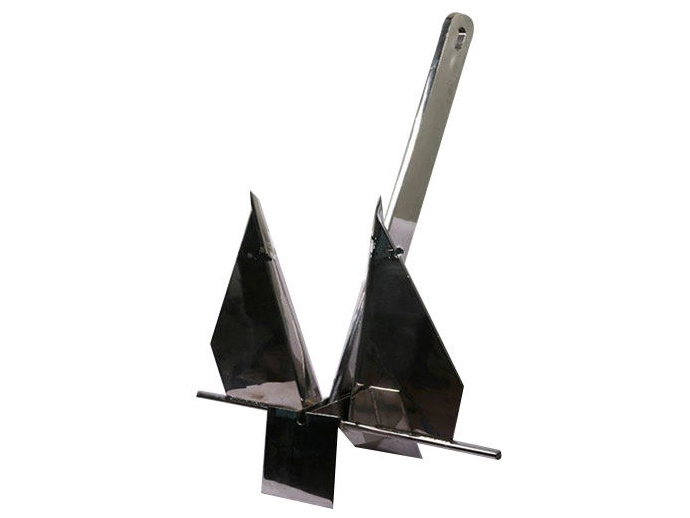
A Danforth anchor is also commonly called a fluke anchor or lightweight anchor. Its two large flukes pivot relative to the shank. Once embedded, those wide flukes develop resistance through buried surface area and the seabed material above them.
A Delta anchor is a fixed-shank plow anchor. Its shaped blade directs load into the seabed and is designed to dig progressively under sustained horizontal pull. Its one-piece structure also makes it attractive for marine buyers seeking a simple, robust design with no fluke hinge assembly.
Soft mud is one of the most challenging anchoring environments because it has low shear strength. An anchor may sink easily, but easy penetration does not automatically mean strong holding. The anchor must reach enough depth and engage enough seabed volume to resist horizontal load.
In this environment, a Danforth anchor often has an important advantage: large fluke area relative to anchor weight.
A Danforth-style anchor is designed to present a broad buried profile once the flukes engage. In soft mud, this geometry can help it develop resistance through:
- Large projected fluke area
- Greater soil displacement
- Mud suction and consolidation around the flukes
- A favorable holding-power-to-weight ratio
- Deep burial when the anchor is pulled at an appropriate angle
Industry testing and anchoring guidance consistently indicate that broad-fluke anchor designs tend to outperform older plow-style profiles in very soft mud, especially where maximum holding force per kilogram is the priority.
For vessel operators, fish farms, pontoons, workboats, and marine contractors operating in silty estuaries, river mouths, sheltered harbors, or dredged basins, this can be highly relevant. Soft mud is often layered. The surface may be weak silt, while denser clay or packed sediment lies below. A properly deployed Danforth anchor can continue burying until it reaches a more supportive layer.
Even a high-holding Danforth anchor cannot compensate for a poor anchoring plan. Extremely fluid mud may not provide reliable holding for any single anchor type. In such conditions, operators should consider:
- Increasing anchor size rather than relying only on nominal holding claims
- Increasing chain length or using an appropriate chain leader
- Reducing the pull angle with more rode scope
- Using a second anchor or engineered mooring layout
- Checking bottom conditions through charts, local knowledge, probing, or test sets
- Conducting controlled proof-load testing before relying on the anchor in heavy weather
A marine professional should treat soft mud as a system-design challenge, not merely an anchor-selection issue.
A Delta anchor can set and hold in mud, particularly when the mud has more body, clay content, or a firmer layer beneath the surface. However, in very soft, deep mud, its plow-shaped blade generally provides less effective buried area than a large-fluke Danforth-style design of comparable weight.
This does not mean a Delta anchor is unsuitable for mud. It means the buyer should set realistic expectations.
A Delta anchor may be the better operational choice when:
- The seabed changes between mud, sand, clay, shell, and mixed material
- The vessel frequently experiences changes in wind or current direction
- The anchor must launch and retrieve from a bow roller
- The vessel uses a windlass and needs predictable stowage
- The buyer wants one general-purpose anchor rather than a specialized mud anchor
- The crew prefers a simple, one-piece anchor design with no pivoting flukes
In other words, a Delta anchor often offers good operational versatility, while a Danforth anchor may offer better soft-bottom efficiency.
For commercial procurement, the best approach is often not to force one anchor to do every job. A practical setup can include a Delta-style primary anchor for routine deployment and a Danforth-style secondary anchor for soft mud, sand, emergency use, or a two-anchor mooring arrangement.
Hard sand is generally one of the most favorable seabeds for anchoring because it provides consistent resistance after the anchor penetrates. However, hard sand can also make initial penetration more difficult. The anchor must first bite through the compact surface before it can bury and develop full holding power.
Both Danforth and Delta anchors can perform well in hard sand, but their practical behavior is different.
A Danforth anchor can achieve high holding power in hard sand after its flukes properly engage. Its wide flukes are highly efficient once buried, and this is one reason the design remains popular for small craft, workboats, tenders, and secondary-anchor applications.
However, the initial set can be sensitive to:
- Fluke-tip sharpness
- Fluke angle
- Anchor orientation on the bottom
- Pull direction during setting
- Bottom compaction
- Whether the anchor lands flat or partially fouled
If the flukes skate across a very compact surface without biting, the anchor will not reach its potential. Operators should avoid assuming that the anchor is set merely because the rode feels tight.
A Delta anchor's pointed plow profile concentrates force at the leading edge. In firm sand, this can support positive penetration and controlled burial under load. The design is also commonly preferred where the anchor must sit securely on a bow roller and deploy through a windlass arrangement.
A Delta anchor may therefore feel more convenient in day-to-day operation, especially for cruising and commercial vessels that anchor frequently in changing locations. The fixed shank and plow profile can also help it maintain a predictable path as it is pulled into the seabed.
However, "hard sand" is not one uniform category. Very compact sand, shell-packed ground, or clay-like material may challenge any anchor. The vessel operator must verify the set, rather than relying on anchor type alone.
| Operating condition | Recommended priority | Better starting choice | Why |
|---|---|---|---|
| Deep, very soft mud | Maximum holding area per anchor weight | Danforth anchor | Broad flukes can produce strong resistance in low-strength soil |
| Soft mud over firmer clay or sand | Penetration depth and burial | Danforth anchor | Large flukes can continue digging toward a more supportive layer |
| Firm to hard sand | Reliable setting and strong ultimate holding | Danforth or Delta | Both can work well when correctly sized and set |
| Unknown or mixed seabed | Versatility and resetting behavior | Delta anchor | Plow profile is practical across changing bottom conditions |
| Bow roller and windlass use | Stowage and handling | Delta anchor | Usually more compatible with roller-mounted systems |
| Flat locker storage | Compact storage | Danforth anchor | Flat design is easy to stow |
| Emergency or secondary anchor | Low weight with strong sand/mud capability | Danforth anchor | High holding efficiency relative to weight |
| Primary anchor for variable cruising grounds | Broad usability | Delta anchor | Practical for mixed, changing conditions |
At Taidun Marine, we advise OEM customers not to market anchor "holding power" as a simple standalone number. Real-world performance changes significantly with installation and use.
Scope is the ratio of rode length to vertical distance from the bow chock to the seabed. More scope keeps the pull on the anchor closer to horizontal, which helps it remain buried.
A practical starting guide is:
1. Use at least 5:1 scope in calm, protected conditions.
2. Use approximately 7:1 scope for overnight anchoring, exposed locations, or stronger winds.
3. Consider 10:1 scope in severe weather or surge conditions if swinging room allows.
For example, if the vertical distance from the bow chock to the seabed is 10 m, a 7:1 scope means approximately 70 m of rode. A short rode increases the upward pull on the shank and can cause even a well-designed anchor to break out.
A high-sided workboat, catamaran, fishing vessel, yacht with a large superstructure, or vessel carrying deck cargo can generate much higher anchoring loads than a low-profile boat of similar displacement.
When wind speed doubles, aerodynamic force rises approximately with the square of wind speed. Therefore, a vessel facing 40 knots of wind may experience around four times the wind load it sees at 20 knots. This is why professional anchor selection must consider windage, expected weather, current, surge, and safety margin, not boat length alone.
An undersized anchor may appear acceptable during a light daytime stop but fail under sustained wind or changing tide. Buyers should select anchor size using the manufacturer's application data and account for:
- Vessel displacement
- Hull profile and windage
- Intended anchorage duration
- Maximum expected wind and current
- Bottom type
- Chain diameter and grade
- Shackle and swivel capacity
- Classification or project requirements
For OEM brands, clearly published sizing guidance is an important trust-building asset. It reduces misuse, lowers warranty risk, and helps end users choose the correct product.
Correct deployment can matter as much as anchor selection. Use this practical procedure for both Danforth and Delta anchors.
1. Identify the seabed. Use charts, depth sounders, local harbor information, or previous operating experience to determine whether the bottom is mud, sand, grass, rock, or mixed material.
2. Lower—do not throw—the anchor. Lowering helps prevent rode fouling and allows the anchor to reach the bottom in a controlled orientation.
3. Pay out rode while moving slowly astern. This prevents chain or rope from piling directly on top of the anchor.
4. Deploy sufficient scope. Use the required scope based on water depth, bow height, weather, and swinging room.
5. Set gradually. Reverse slowly until the anchor begins to dig. Then increase reverse load progressively.
6. Verify the set. Watch fixed shore objects, GPS anchor alarms, or electronic chart position. A properly set anchor should hold against controlled reverse power without creeping.
7. Monitor after wind or tide changes. A major directional change can alter load direction. This is particularly important for fluke anchors, which may not reset as readily as some plow designs.
For wholesalers, brand owners, shipbuilders, distributors, and project contractors, selecting the right anchor pattern is only part of the procurement decision. Manufacturing consistency is equally important.
At Nanjing Taidun Marine Equipment Engineering Co., Ltd., our OEM-focused approach helps marine-equipment buyers align anchor construction with their market positioning and project requirements. Key quality-control considerations include:
- Material selection: Carbon steel grades and mechanical properties should match the intended load environment.
- Weld integrity: Weld procedures must support shank, crown, and fluke/blade strength under cyclic loading.
- Dimensional control: Fluke angle, shank alignment, stock geometry, and blade symmetry affect setting performance and stowage compatibility.
- Galvanizing quality: A durable hot-dip galvanized coating helps protect anchors used in saltwater environments.
- Weight consistency: Reliable manufacturing tolerances support predictable procurement and product labeling.
- Marking and branding: OEM logos, size markings, packaging, and traceability can strengthen a brand's market presence.
- System compatibility: The anchor should be assessed with its matching chain, shackle, swivel, bow roller, and windlass.
Taidun Marine supplies marine fenders, mooring bollards, and marine anchors as a factory-direct manufacturer and OEM partner for international customers. For buyers building a private-label anchor range, we recommend discussing the intended vessel class, target market, anchor application, coating specification, packaging needs, and certification requirements before production begins. [taidunmarine]
For soft mud, a Danforth anchor is usually the stronger candidate when the goal is maximum holding power per unit weight. Its broad flukes are well suited to low-strength sediment and can develop substantial resistance once properly buried.
For hard sand, both anchor types can work effectively. A Danforth anchor can provide excellent holding after the flukes bite, while a Delta anchor often offers a more convenient one-piece, bow-roller-friendly solution with useful versatility across changing seabed conditions.
The best commercial decision is often a two-anchor strategy:
- Choose a Delta anchor as a practical primary anchor for mixed, unknown, or changing seabeds.
- Carry a Danforth anchor as a high-efficiency secondary anchor for soft mud, sand, emergency deployment, or dual-anchor arrangements.
For OEM anchor sourcing, do not select only by shape or price. Select by application, seabed, load case, manufacturing quality, coating durability, and complete anchoring-system compatibility.
Looking for an OEM marine anchor manufacturer in China? Contact Nanjing Taidun Marine Equipment Engineering Co., Ltd. to discuss Danforth anchors, Delta anchors, customized branding, galvanized finishes, packaging, and integrated marine-equipment procurement for your market.
In many soft-mud conditions, yes. A Danforth anchor's large flukes provide more projected holding area relative to its weight, allowing it to develop strong resistance in low-strength sediment. However, extremely fluid mud can challenge all anchor types, so sizing, scope, chain, and verification remain essential.
Both can work well in hard sand. A Danforth can produce excellent holding once its flukes penetrate, while a Delta's plow-shaped point can support controlled penetration and is often easier to handle on a bow roller. The better choice depends on the vessel's anchoring system and whether the seabed is consistently sandy or mixed.
Not always. Weight helps penetration and stability, but anchor geometry and seabed compatibility are critical. A correctly designed fluke anchor may offer much higher holding power per kilogram in sand or mud than a heavier but less suitable shape. Modern anchor holding power can vary widely depending on design and bottom conditions.
Use a minimum of about 5:1 scope in calm, protected water. For overnight use, exposed anchorages, or stronger wind, 7:1 is a more suitable baseline. In severe conditions, 10:1 may be appropriate if space permits. More scope reduces upward pull and improves the likelihood that the anchor remains buried.
Yes. Delta anchors are widely used as primary anchors because their one-piece plow design is practical for bow rollers, windlasses, and mixed bottom conditions. However, if your operating area has predominantly soft mud, a Danforth-style anchor may be a valuable secondary or specialized anchor.
Dragging can result from insufficient scope, poor seabed penetration, a false set, excessive windage, a changing pull direction, undersized chain or shackles, vegetation, rock, or a bottom that is too soft to provide adequate shear strength. Verify the set under controlled reverse load and monitor position after anchoring.
Yes. Nanjing Taidun Marine Equipment Engineering Co., Ltd. supports OEM marine-equipment customers with anchor manufacturing and customization options, including branding, coating, packaging, and product configuration discussions based on target applications and market requirements. [taidunmarine]
1. Practical Sailor. "Anchor Design for Soft Mud." Discusses why broad-fluke Danforth-style anchors tend to hold better than older plow-style anchors, including Delta-type designs, in very soft mud. [https://www.practical-sailor.com/blog/anchor-design-for-soft-mud/] [practical-sailor]
2. West Marine. "Best Boat Anchor by Type, Size & Bottom Condition." Covers anchor categories, seabed suitability, scope guidance, false setting, holding-power considerations, and practical deployment advice. [https://www.westmarine.com/west-advisor/Selecting-The-Right-Anchor.html] [westmarine]
3. Nanjing Taidun Marine Equipment Engineering Co., Ltd. Official Website. Information on Taidun Marine's marine-fender, mooring-bollard, and marine-anchor manufacturing capabilities. [https://www.taidunmarine.com/] [taidunmarine]
4. Lippert. "What Size Anchor Do I Need? Boat Anchor Sizing Tips." General guidance on the relationship between anchor design, seabed type, fluke surface area, penetration, and holding performance. [https://www.lippert.com/blog/what-size-anchor-do-i-need] [lippert]
5. Boatgeardirect. "Why Danforth Anchors Are a Better Choice for Your Mooring." Discusses the value of wide-fluke Danforth anchors in sand, mud, and silt. [https://boatgeardirect.co.uk/danforth/] [boatgeardirect.co]
Hot Tags: China, Global, OEM, private label, manufacturers, factory, suppliers, manufacturing company


