

Views: 259 Author: Nanjing Taidun Publish Time: 2026-09-22 Origin: Site
Content Menu
● Why Anchor Selection Matters for Workboats
● Danforth Anchor vs Matrosov Anchor at a Glance
● Danforth Anchor: Lightweight Holding Power in Sand and Mud
>> Advantages of Danforth Anchors
>> Limitations of Danforth Anchors
● Matrosov Anchor: HHP Performance for Professional Workboats
>> Advantages of Matrosov HHP Anchors
>> Limitations of Matrosov Anchors
● How Seabed Conditions Change the Decision
● Expert Selection Process for OEM Buyers
>> 1. Define the Vessel and Operating Profile
>> 2. Identify the Dominant Seabed
>> 3. Match the Full Anchoring System
>> 4. Request a Technical Review Before Production
● OEM Manufacturing Considerations That Buyers Often Miss
>> Material and Structural Integrity
>> Private Label and Market Positioning
>> 1. Is a Matrosov anchor better than a Danforth anchor?
>> 2. Which anchor has better holding power for its weight?
>> 3. Are Danforth anchors suitable for workboats?
>> 4. What workboats should use Matrosov anchors?
>> 5. Can Taidun Marine provide OEM Matrosov anchors?
>> 6. Should I choose a galvanized or painted anchor?
>> 7. What information should I provide when requesting an anchor quotation?
For workboat operators, vessel builders, marine-equipment distributors, and OEM buyers, the Danforth anchor vs Matrosov anchor decision is not simply about choosing the lightest anchor. It is about balancing holding power, seabed behavior, deck arrangement, certification requirements, corrosion protection, production consistency, and lifecycle value.
At Nanjing Taidun Marine Equipment Engineering Co., Ltd., we manufacture marine anchoring equipment for overseas brands, wholesalers, shipyards, and marine-equipment manufacturers. From our practical OEM perspective, the best anchor is not the one with the highest claimed holding-power figure on paper. It is the one that can set reliably, hold under the expected load, fit the vessel's anchoring system, and be produced consistently to the buyer's technical and commercial requirements.
For many light workboats, harbor craft, river vessels, utility boats, fishing boats, and service craft, both Danforth-style anchors and Matrosov HHP anchors offer attractive holding power relative to their weight. However, their geometry, deployment behavior, and ideal operating environments are different.
Quick answer: Choose a Danforth anchor when low weight, flat stowage, and strong performance in clean sand or soft mud are the priorities. Choose a Matrosov anchor when your project requires a more robust high-holding-power (HHP) design, stronger stability, improved operational confidence in workboat service, and a specification suitable for professional marine supply chains.
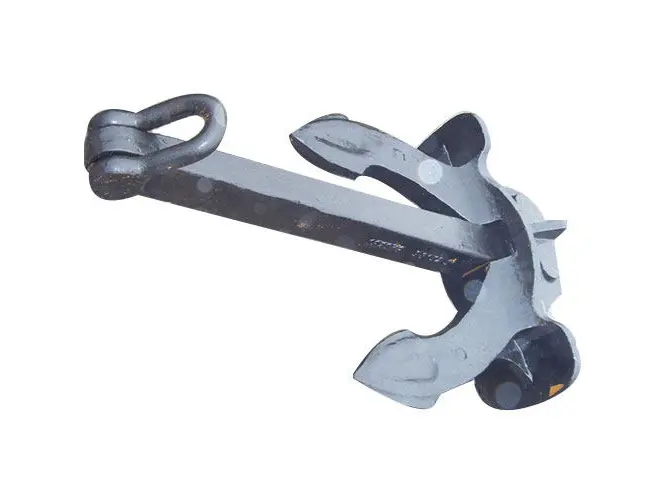
A workboat anchor is part of a complete safety system. It may be used for temporary station keeping, emergency anchoring, sheltered waiting, maintenance operations, towing support, fishing activity, or mooring assistance. A poor anchor decision can create operational delays, unsafe dragging risk, equipment damage, or avoidable replacement costs.
The central issue is often misunderstood: anchor weight alone does not determine holding power.
Holding performance depends on several connected factors:
- Anchor geometry and fluke area
- Seabed type, including sand, mud, clay, silt, gravel, rock, or mixed bottom
- Fluke penetration and setting angle
- Anchor size and nominal weight
- Chain size and chain catenary
- Rode length and scope
- Wind, current, wave action, and vessel load
- Deployment method and crew handling
- Whether the anchor is correctly matched to the vessel and classification requirements
A fluke-style Danforth anchor is widely valued for its holding-power-to-weight efficiency in sand and mud. Danforth's design uses two broad triangular flukes to create a large bearing area once embedded. Matrosov anchors, meanwhile, are commonly positioned as HHP anchors for commercial and marine applications, using their fluke arrangement and stabilizing structure to support secure setting and holding in suitable seabeds.
| Feature | Danforth Anchor | Matrosov Anchor |
|---|---|---|
| Basic design | Lightweight fluke anchor with two broad triangular flukes | HHP anchor with a compact fluke structure and stabilizing components |
| Primary advantage | Excellent holding power relative to weight | High holding power with strong commercial-marine suitability |
| Best seabeds | Clean sand and soft mud | Sand, mud, clay, and many commercial marine applications |
| Stowage | Usually flat and space-efficient | More substantial geometry; requires planned deck/pocket integration |
| Setting behavior | Often sets quickly in favorable soft bottoms | Designed for stable penetration and high holding performance |
| Typical users | Small craft, utility boats, fishing boats, recreational and light-duty vessels | Workboats, river vessels, offshore-support-related applications, commercial craft |
| Weight efficiency | Very high in suitable bottoms | High; commonly selected where HHP performance is required |
| Key limitation | Less ideal in rocky, weedy, or heavily mixed bottoms | Can cost more and must be correctly matched to vessel system and certification needs |
| OEM flexibility | Material, finish, shank/fluke configuration, branding and packaging options | Weight range, coating, welding/casting process, certification coordination, branding and export packaging |
Practical takeaway: A Danforth anchor is often the lighter and simpler option. A Matrosov anchor is frequently the more professional choice when the buyer needs a commercial HHP solution with stronger engineering expectations.
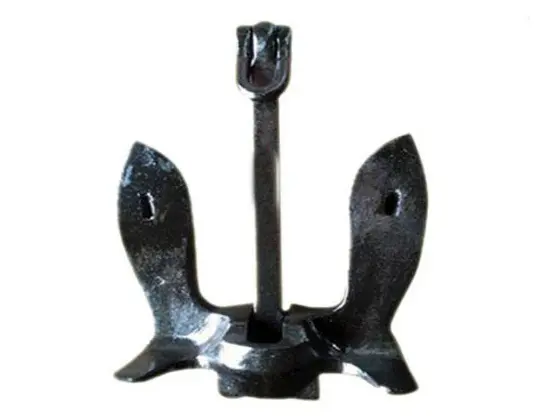
The Danforth anchor is also called a fluke anchor because of its two large, flat flukes. Its design emphasizes a high surface area relative to anchor weight. When the flukes penetrate soft mud or sand, they create resistance against the pulling load generated by the vessel.
Danforth-style anchors are especially popular where operators need:
- Low anchor weight
- Easy manual handling
- Flat storage on deck or in lockers
- Strong holding in clean mud or sand
- A cost-effective anchor for smaller workboats
- Fast supply and simple replacement logistics
Industry guidance commonly identifies Danforth-style fluke anchors as an effective option for sand and mud, particularly because of their strong holding-power-to-weight relationship and flat stowage profile.
High holding efficiency in favorable bottoms. The broad flukes can develop substantial resistance after they bury in soft seabeds.
Lightweight design. A lower-weight anchor can reduce handling effort and simplify installation on small boats without powered windlasses.
Efficient stowage. The flat profile is useful for vessels with limited foredeck space, compact lockers, or simple bow arrangements.
OEM-friendly production. Danforth anchors can be adapted in steel grade, galvanizing, painted finish, shackle configuration, branding, packaging, and dimensional requirements.
Strong value for simple applications. For clean-bottom anchoring in protected waters, the Danforth design can provide effective performance without requiring a heavy anchor.
Danforth anchors should not be presented as a universal solution. Their performance can become less predictable where the bottom contains dense weed, large stones, uneven rock, hard gravel, or mixed debris. Broad flukes may also require careful retrieval and can be more prone to fouling in difficult seabeds.
For a workboat operating in varied conditions, an anchor that performs extremely well in mud may not be the best choice for rocky harbor bottoms or areas with heavy debris. Selecting solely by anchor weight can therefore create a false sense of security.
The Matrosov anchor is widely associated with high-holding-power marine anchoring. Compared with a conventional lightweight fluke anchor, the Matrosov design is generally selected where operators need a more robust commercial anchoring solution.
Matrosov HHP anchors are used across vessel and marine applications because their design aims to improve setting behavior, penetration, and holding capacity in appropriate seabeds. Product specifications commonly describe Matrosov anchors as suitable for sand, mud, clay, and other marine bottoms, while the stabilizer-bar design helps support operational stability.
At Taidun Marine, our Matrosov anchor offering covers nominal weights from 100 kg to 1,500 kg, with published dimensional data for each size. For example, our 100 kg model has an overall length dimension of 1,060 mm, while the 1,500 kg version reaches 2,370 mm. This makes the Matrosov anchor suitable for a broad range of vessel-scale OEM and replacement projects. [taidunmarine]
High holding power for their nominal weight. HHP anchors are designed to deliver more holding performance than conventional stockless anchors of similar nominal size in suitable operating conditions.
Commercial-marine positioning. The Matrosov anchor is commonly considered for professional vessels, including workboats, river vessels, utility craft, and other marine operations where anchoring confidence matters.
Stable geometry. Its design includes a stabilizing structure that supports the anchor's orientation and setting behavior.
Broad sizing range. Buyers can specify anchor size based on vessel displacement, windage area, intended service, chain arrangement, class requirements, and anchoring environment.
Customization potential. OEM customers may require welded or cast construction, custom surface protection, private labels, export-grade packaging, and third-party inspection support.
A Matrosov anchor is not automatically "better" in every situation. It can involve a higher unit cost than a simple Danforth-style anchor and may require more careful planning for bow roller geometry, hawse-pipe compatibility, stowage, handling equipment, and chain selection.
The anchor must also be supplied according to the actual project specification. Buyers should not rely on broad HHP marketing language without checking:
- Required anchor standard or drawing
- Nominal anchor weight
- Material and welding procedure
- Dimensional tolerance
- Surface-treatment specification
- Test and inspection requirements
- Certification requirements
- Chain, shackle, and windlass compatibility
The most important selection question is: Where will the workboat actually anchor?
| Seabed condition | Danforth Anchor | Matrosov Anchor | Selection note |
|---|---|---|---|
| Soft mud | Excellent potential due to broad fluke area | Strong potential when properly sized | Confirm fluke angle, penetration behavior, chain scope, and likely load |
| Firm sand | Very effective in many cases | Strong commercial option | Both can work well; choose based on duty cycle and vessel arrangement |
| Clay | Can be effective but may depend on penetration | Often preferred for professional applications | Verify actual bottom hardness and anchor test expectations |
| Mixed sand and mud | Good where the bottom remains relatively clean | Good option for workboats | Operational testing is valuable |
| Weed or grass | Can foul or fail to penetrate cleanly | May still face bottom-condition limitations | Consider alternative anchor designs if weed is dominant |
| Rock or coarse gravel | Not an ideal first choice | Not always ideal | Consider a design engineered for rocky or mixed bottoms |
No anchor can overcome a poor deployment procedure. Even a well-designed HHP anchor can drag if the chain is undersized, scope is too short, the anchoring load is underestimated, or the seabed is unsuitable.
From an OEM factory perspective, we recommend treating anchor procurement as an engineering decision rather than a catalog purchase.
Start with the vessel's actual application:
- Vessel type and displacement
- Length, beam, and windage area
- Operating waters and weather exposure
- Emergency-anchor or regular-use function
- Crew handling method
- Existing windlass and bow-roller arrangement
- Required chain diameter and grade
- Flag, class, owner, or shipyard requirements
A harbor utility boat operating in sheltered water has different needs from a coastal workboat that may need emergency holding under changing current and wind conditions.
Ask local operators, port authorities, marine contractors, or survey providers about the most common seabed conditions. "Mud" can mean soft silt, compact clay, mixed mud, or mud with debris. These conditions do not behave identically.
For clean soft mud or sand, a Danforth anchor may be a highly efficient solution. For professional-duty applications where buyers prioritize HHP configuration, stability, and commercial supply specification, a Matrosov anchor may be the better fit.
An anchor should never be selected in isolation. Review:
- Anchor weight and dimensions
- Shackle pin diameter
- Chain diameter and grade
- Chain stopper capacity
- Windlass gypsy compatibility
- Bow roller angle
- Hawse-pipe clearance
- Retrieval path
- Storage position
- Corrosion environment
The anchor, chain, shackle, windlass, and bow structure must operate as one system.
For private-label brands, shipyards, and wholesalers, Taidun Marine can support project discussion before production. A technical review reduces the risk of incompatible dimensions, unsuitable coatings, insufficient packaging, or incorrect OEM marking.
A product comparison should go beyond anchor shape. For overseas brands and importers, manufacturing control affects product reputation just as much as design selection.
Anchor reliability begins with material selection and controlled fabrication. The buyer should clarify whether the anchor will be fabricated, welded, cast, or manufactured through a combination process. Welding quality, steel grade, dimensional control, and stress concentration management can influence long-term performance.
Marine anchors face saltwater, abrasion, impact, and storage exposure. Common finish options include:
- Hot-dip galvanizing
- Marine-grade paint systems
- Black painted finishes
- Customized coatings for specific markets
- Brand-specific color or identification marking
The correct coating depends on expected corrosion exposure, storage duration, price positioning, and end-user expectations.
For wholesalers and brands, consistent dimensions are crucial. An anchor that varies from batch to batch may not fit the same bow roller, shackle, chain locker, or packaging design. OEM production should therefore include dimensional inspection against approved drawings.
A good OEM partner should support more than manufacturing. For brand owners, the value may include:
- Custom logo or cast marking
- Product labels and manuals
- Neutral or branded carton packaging
- Export pallets and container loading plans
- Drawing confirmation
- Inspection documentation
- Spare-part and repeat-order consistency
At Taidun Marine, we understand that an anchor supplied under your brand must protect your reputation in the field—not only meet a purchase-order price.
Not in every application. A Danforth anchor is often highly effective and lightweight for clean sand and soft mud. A Matrosov anchor is generally more suitable when a workboat project requires a robust HHP anchor design, commercial-marine positioning, and stronger emphasis on professional vessel applications.
Both designs can offer high holding power relative to weight in suitable bottoms. Danforth anchors are well known for their weight efficiency in mud and sand, while Matrosov anchors are designed as high-holding-power anchors for commercial marine use. Actual performance depends on seabed, size, load direction, chain, scope, and deployment technique.
Yes. Danforth anchors can be suitable for small and light workboats, especially where the operating bottom is predominantly sand or mud and the vessel benefits from low weight and flat stowage. They should be carefully evaluated for larger, higher-load, or more demanding commercial applications.
Matrosov anchors are often considered for river workboats, utility vessels, service craft, fishing vessels, harbor vessels, and other professional marine applications requiring an HHP anchoring solution. The final anchor size and specification should be based on the vessel's operating profile and applicable standards.
Yes. Nanjing Taidun Marine Equipment Engineering Co., Ltd. supplies Matrosov anchors for OEM projects and can discuss customized weights, finishes, dimensions, branding, packaging, and technical requirements. Our published Matrosov anchor range includes 100 kg to 1,500 kg models. [taidunmarine]
For many marine applications, hot-dip galvanizing is selected for corrosion resistance and long-term outdoor exposure. Painted finishes may be appropriate for certain vessel, owner, or market requirements. The best choice depends on expected service environment, budget, and maintenance strategy.
Provide vessel type, vessel dimensions, anchor type, required nominal weight, seabed conditions, chain size, surface finish, drawing or standard, quantity, target delivery port, packaging requirement, certification requirement, and whether private branding is needed.
For brands, distributors, shipyards, and vessel manufacturers, the Danforth anchor vs Matrosov anchor choice should be based on real operating conditions—not generic catalog claims.
If your priority is lightweight holding performance in clean sand or mud, a Danforth-style anchor may be the right solution. If you need an HHP anchor for professional workboat use, customized production, controlled dimensions, marine-grade finishing, and OEM support, a Matrosov anchor may offer the stronger long-term platform.
Contact Nanjing Taidun Marine Equipment Engineering Co., Ltd. to discuss your anchor drawing, vessel application, required weight range, finish, certification needs, private-label requirements, and export packaging plan. We help overseas marine brands and wholesale buyers turn anchor specifications into reliable OEM products.
1. Danforth Anchors. "Danforth Anchors – The World's Most Trusted Anchor." Discusses Danforth anchor construction, triangular flukes, high-tensile steel, and holding-power efficiency.
[https://danforthanchors.com/]
2. West Marine. "Best Boat Anchor by Type, Size & Bottom Condition." Provides guidance on fluke anchors, seabed suitability, scope, and anchor-selection factors.
[https://www.westmarine.com/west-advisor/Selecting-The-Right-Anchor.html]
3. Anchor Marine Houston. "Anchors." Technical document covering holding-power ratios, seabed effects, fluke angles, and comparative anchor weight concepts.
[https://anchormarinehouston.com/wp-content/uploads/2019/03/Section_1_Anchors.pdf]
4. Misea Marine. "Matrosov HHP Anchor." Explains Matrosov HHP anchor design, setting principles, intended seabed conditions, and nominal weight range.
[https://miseamarine.com/products/matrosov-hhp-anchor/]
5. Zava Marine. "Marine CB57-77 HHP Matrosov Anchor." Provides product-level information on Matrosov anchor characteristics, stabilizer-bar design, and holding-power claims.
[https://www.zavamarine.com/product/cb57-77-hhp-matrosov-anchor/]
6. Taidun Marine. "Customized Matrosov Anchor." Taidun Marine's Matrosov anchor specifications, dimensions, nominal weights, and contact information.
[https://www.taidunmarine.com/matrosov-anchor.html]
Hot Tags: China, Global, OEM, private label, manufacturers, factory, suppliers, manufacturing company


