

Views: 309 Author: NANJING TAIDUN Publish Time: 2026-10-13 Origin: Site
Content Menu
● What Are Dock Rubber Fenders? Engineering-Grade Port Infrastructure
>> Key Characteristics of Dock Rubber Fenders
>> Common Dock Rubber Fender Types
● What Are Boat Rubber Fenders? Vessel-Mounted Hull Protection
>> Key Characteristics of Boat Rubber Fenders
>> Common Boat Rubber Fender Types
● The Critical Differences: A Side-by-Side Comparison
>> The Reaction Force Distinction
● When to Choose Dock Rubber Fenders vs. Boat Rubber Fenders
>> You Need Dock Rubber Fenders When:
>> You Need Boat Rubber Fenders When:
● Expert Insight: The Engineering Behind the Choice
>> Why "One Size Fits All" Fails
>> The OEM Perspective: Traceability and Quality
● Practical Specification Checklist
● Conclusion: Specify Correctly, Protect Effectively
● Frequently Asked Questions (FAQ)
>> 1. What is the main difference between dock rubber fenders and boat rubber fenders?
>> 2. Can I use boat rubber fenders on a commercial dock?
>> 3. What types of rubber fenders are best for tugboats?
>> 4. How do I calculate the berthing energy for dock rubber fender selection?
>> 5. What is the typical service life of dock rubber fenders vs. boat rubber fenders?
>> 6. Can one fender type serve both dock and boat applications?
Introduction: The Naming Problem That Costs Ports Money
In over 23 years of manufacturing rubber fender systems, I have seen the same procurement mistake repeated across terminals in more than 80 countries: specifying a "boat rubber fender" for a commercial berth, or ordering "dock rubber fenders" for a tugboat that needs hull protection during pushing operations.
The confusion is understandable. Both products are called "fenders." Both are made from rubber. Both absorb impact. But dock rubber fenders and boat rubber fenders serve fundamentally different engineering purposes, operate under vastly different load conditions, and follow completely different design standards.
This guide cuts through the terminology confusion. It explains exactly when you need dock rubber fenders, when you need boat rubber fenders, and why specifying the wrong one creates safety risks and unnecessary costs.
Dock rubber fenders are heavy-duty protective systems permanently installed on port structures—quay walls, piers, wharves, jetties, and dolphins. Their purpose is to absorb the massive berthing energy generated when commercial vessels approach and contact the dock .
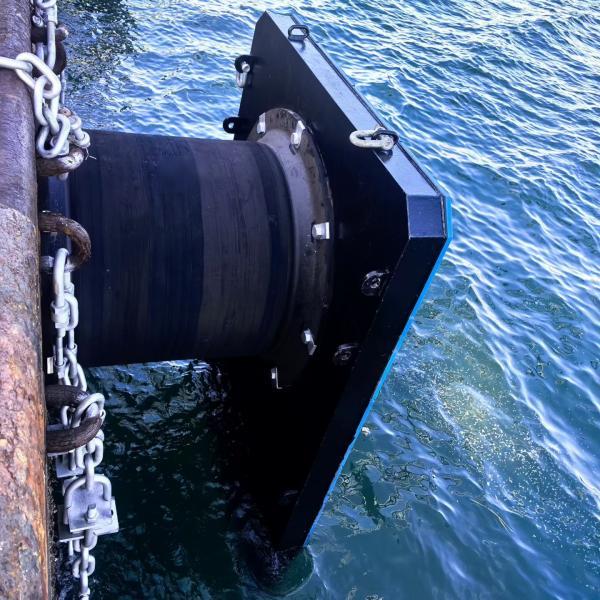
- Permanently installed: Fixed to the dock structure using anchor bolts, embedded steel plates, or chain systems
- Engineered for high energy absorption: Designed to handle berthing energies measured in hundreds or thousands of kilonewton-meters (kNm)
- Part of a complete system: Typically includes the rubber fender body, steel frontal panel, UHMW-PE facing pads, and restraint chains
- Designed per international standards: PIANC, ISO, ASTM, and classification society requirements (CCS, BV, LR, etc.)
- Service life: Typically 15–25 years with proper maintenance
| Fender Type | Typical Application | Energy Range |
|---|---|---|
| Cone Fender (SCN) | Container terminals, large vessels | High |
| Cell Fender (SCK) | General cargo, multi-purpose berths | High |
| Cylindrical Fender | Dolphins, small to medium berths | Medium |
| Arch Fender (V-type) | RoRo terminals, ferry berths | Medium |
| M Fender / Leg Fender | Specific berthing geometries | Variable |
Dock fenders must satisfy a critical engineering inequality: the fender system's energy absorption capacity must exceed the vessel's berthing energy, while the reaction force transferred to the dock structure remains within its structural limits .
Boat rubber fenders are protective devices mounted on the vessel itself, designed to cushion contact between the ship's hull and other surfaces—docks, other vessels during STS operations, or tugboat pushing points .
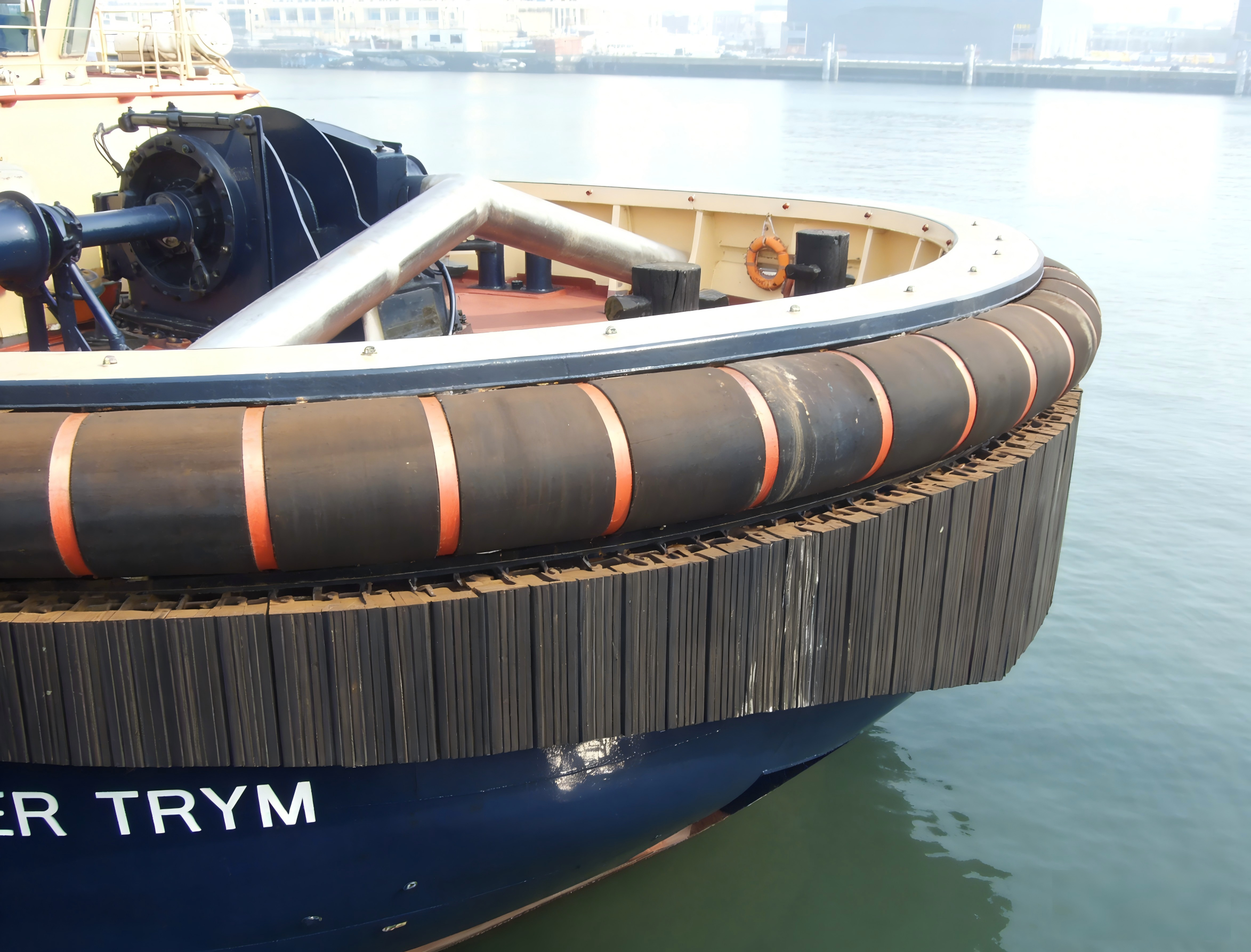
- Vessel-mounted: Attached to the ship's hull or superstructure, not the dock
- Portable or semi-permanent: Many boat fenders are temporary and can be repositioned as needed
- Lightweight construction: Designed for manual handling and quick deployment
- Lower energy absorption: Sized for contact forces during maneuvering, not high-speed berthing
- Materials: PVC, EVA foam, inflatable rubber, or extruded rubber profiles (D-type, square)
| Fender Type | Typical Application |
|---|---|
| D-Type Fender (DD/DO) | Tugboats, workboats, fishing vessels |
| GD Fender | Tugs, barges, pilot boats |
| W Fender / Tugboat Fender | Pushing operations, escort tugs |
| Square Fender | Inland waterways, pontoons |
| Pneumatic (Yokohama) Fender | STS transfers, offshore mooring |
A critical distinction: boat rubber fenders protect the vessel, while dock rubber fenders protect both the vessel and the port infrastructure .
Understanding the engineering differences between these two product categories is essential for correct specification.
This is where the engineering diverges most significantly.
Dock rubber fenders must be designed with reaction force as a primary constraint. The fender's reaction force—the force it exerts back on the vessel and forward onto the dock structure—determines the structural requirements of the quay. A fender with excellent energy absorption but excessive reaction force can damage the very structure it is meant to protect .
Boat rubber fenders do not have this constraint. They are not transferring forces into a fixed structural system. Their design priority is soft contact and hull protection—preventing abrasion, gouging, and paint damage during routine operations.
- You are protecting a fixed port structure: quay wall, pier, wharf, jetty, or dolphin
- Vessels berth at your facility: commercial ships, ferries, container vessels, tankers
- Berthing energy is significant: the vessel's kinetic energy at contact must be absorbed
- You need long-term, maintenance-free protection: dock fenders are designed for decades of service
- Regulatory compliance is required: PIANC, ISO, or classification society certification
- You are protecting a vessel's hull: tugboats, workboats, barges, fishing vessels
- Operations involve vessel-to-vessel contact: pushing, towing, STS transfers
- Portable protection is needed: temporary berthing, mooring at unfamiliar docks
- Low-impact protection is sufficient: small vessels, light contact
- Installation must be simple: no heavy equipment required
In many commercial ports, both types work together. A vessel equipped with boat rubber fenders approaches a berth protected by dock rubber fenders. The boat fenders protect the hull during maneuvering and initial contact; the dock fenders absorb the primary berthing energy.
This dual-system approach is standard practice at ferry terminals, RoRo berths, and multi-purpose ports .
I have reviewed numerous port specifications where the engineer specified "rubber fenders" without distinguishing between dock and boat applications. The result is predictable: fenders that either fail prematurely or provide insufficient protection.
Dock rubber fenders are structural engineering components. Their selection requires:
1. Berthing energy calculation: Vessel displacement, approach velocity, eccentricity, added mass
2. Reaction force verification: Confirming the dock structure can handle the transferred loads
3. Hull pressure check: Ensuring contact pressure does not damage the vessel
4. Berthing angle analysis: Accounting for energy reduction at angled approaches
Boat rubber fenders are operational equipment. Their selection focuses on:
1. Contact surface compatibility: Preventing hull damage
2. Durability under routine use: Withstanding repeated contact and abrasion
3. Deployment convenience: Ease of installation and repositioning
4. Vessel-specific fit: Matching hull geometry and operational profile
As an OEM manufacturer, we produce both dock rubber fenders and boat rubber fenders for brand owners and wholesalers worldwide. The manufacturing differences are significant:
| Manufacturing Aspect | Dock Rubber Fenders | Boat Rubber Fenders |
|---|---|---|
| Rubber compound | High-performance, tested to PIANC/ASTM | Standard marine-grade rubber |
| Reinforcement | Steel plates, internal cord layers | Minimal or none |
| Testing requirements | Compression tests, material certificates | Visual inspection, dimensional checks |
| Documentation | Full traceability, third-party reports | Standard shipping documents |
Critical insight: A dock rubber fender without proper compression test documentation is a liability, not an asset. The engineering specifications must be verifiable.
When procuring rubber fenders, use this checklist to ensure correct specification:
1. ☐ Berthing energy calculated using PIANC methodology (characteristic and design energy)
2. ☐ Reaction force limit established based on dock structural capacity
3. ☐ Hull pressure limit confirmed with vessel operator or class society
4. ☐ Berthing angle factor applied to fender selection
5. ☐ Fender type selected (cone, cell, cylindrical, arch, etc.) based on application
6. ☐ Complete system specified: rubber body, frontal panel, UHMW-PE facing, chains
7. ☐ Testing requirements documented: compression test, material certificates, third-party inspection
8. ☐ Traceability requirements established: batch-specific documentation
1. ☐ Vessel type and size identified
2. ☐ Hull geometry reviewed for fender placement
3. ☐ Operational profile considered: frequency of contact, typical surfaces
4. ☐ Fender type selected (D-type, GD, W, square, pneumatic)
5. ☐ Mounting method determined: bolt-on, chain-suspended, or portable
6. ☐ Material compatibility confirmed: non-marking, abrasion-resistant
7. ☐ Replacement accessibility verified
The distinction between dock rubber fenders and boat rubber fenders is not semantic—it is engineering-critical.
Dock rubber fenders are fixed infrastructure components. They protect both vessels and port structures, and their selection requires rigorous berthing energy analysis, reaction force verification, and compliance with international port design standards.
Boat rubber fenders are vessel equipment. They protect hulls during routine operations, and their selection depends on vessel type, operational profile, and contact surface compatibility.
Specifying the wrong fender type—or specifying "rubber fenders" without clarifying the application—creates risks that range from premature failure to structural damage. The solution is precise terminology, application-specific engineering, and verified manufacturing quality.
At NANJING TAIDUN MARINE EQUIPMENT ENGINEERING CO., LTD, we manufacture both dock rubber fenders and boat rubber fenders to international standards. Our 100,000㎡ facility produces dozens of fender models and hundreds of specifications, all tested to PIANC, ISO, ASTM, and classification society requirements.
[CTA]
Need help specifying the right rubber fender for your project?
Contact NANJING TAIDUN:
- Email: service@taidunmarine.com
- Website: www.taidunmarine.com
- OEM/ODM Services: Custom fender manufacturing, third-party testing coordination, complete documentation packages
1. Unified Facilities Criteria (UFC). "Design: Piers and Wharves – Fender Selection and Design." [https://www.wbdg.org/FFC/DOD/UFC/UFC_Complete_4-010-01_thru_4-159-03.pdf]
2. Civil Engineering and Development Department (Hong Kong). "Port Works Design Manual – Fender Design." [https://www.cedd.gov.hk/filemanager/eng/content_89/PWDM_2023_e-version%20June%202023_p2_1_124.pdf]
3. Baidu Baike. "护舷." [https://baike.baidu.com/item/%E8%AD%B7%E8%88%B7/3940929]
Dock rubber fenders are permanently installed on port structures (quays, piers, wharves) to absorb the high berthing energy of commercial vessels. Boat rubber fenders are mounted on vessel hulls to protect against contact damage during docking, towing, and pushing operations. The key distinction is installation location and energy absorption capacity .
No. Boat rubber fenders are designed for low-impact contact protection, not the high berthing energy of commercial vessels. Using boat fenders on a commercial berth will result in premature failure and insufficient protection. Dock rubber fenders must be engineered specifically for the berthing energy of the design vessel .
For tugboats, D-type rubber fenders (DD/DO), W fenders, and GD fenders are commonly used. These are mounted along the hull where contact occurs during pushing and maneuvering operations. Square fenders are also used for more severe conditions. The selection depends on the tug's operational profile and the types of vessels it assists .
Berthing energy calculation follows PIANC methodology: Ek = 0.5 × M × V² × Ce × Cm, where M is vessel displacement, V is berthing velocity, Ce is eccentricity factor, and Cm is added mass factor. Characteristic energy is then multiplied by a partial energy factor to determine design energy. The fender system's energy absorption capacity must exceed this design energy .
Dock rubber fenders typically last 15–25 years with proper maintenance, depending on berthing frequency and environmental conditions . Boat rubber fenders have a shorter service life—typically 3–10 years—because they experience more frequent contact, abrasion, and exposure to varying conditions. Replaceable components like UHMW-PE pads extend dock fender life.
No. While some extruded rubber fenders (such as D-type) can be used on both small jetties and vessels, they are not interchangeable for commercial applications. Dock fenders for commercial berths require engineering-grade design with documented energy absorption and reaction force characteristics. Boat fenders are operational equipment optimized for hull protection .


