

Views: 287 Author: NANJING TAIDUN Publish Time: 2026-10-19 Origin: Site
Content Menu
● The Fundamental Difference: Load Path Determines Everything
● Materials Comparison: Cast Steel vs. Welded Steel
● Standards and Certification: Different Rulebooks
● Application Profiles: Where Each Bollard Type Excels
>> Dockside Bollard Applications
>> Shipside Bollard Applications
● Expert Insight: The Holding-Down Bolt Problem
● The Tidal Factor: Why Single Bitt Matters for Shipside
● OEM Manufacturing Considerations: What to Verify
● Conclusion: Match the Bollard to the Load Path
● Frequently Asked Questions (FAQ)
>> 1. Can a dockside bollard be used on a ship, or vice versa?
>> 2. What is the typical capacity range for dockside vs. shipside bollards?
>> 3. Which standard governs shipside bollards?
>> 4. Why is cast steel preferred for dockside bollards over welded steel?
>> 5. What documentation should I request for bollard OEM procurement?
>> 6. How does tidal range affect shipside bollard selection?
Introduction: Two Bollards, Two Engineering Realities
A mooring bollard is a mooring bollard—until you examine the load path. Dockside bollards and shipside bollards serve the same fundamental purpose: securing a vessel. But their design, materials, and governing standards diverge sharply because they operate in fundamentally different structural environments.
As an OEM manufacturer with over 23 years of experience producing rubber fenders, mooring bollards, and fender system accessories at NANJING TAIDUN MARINE EQUIPMENT ENGINEERING CO., LTD, we have supplied both shoreside and vessel-mounted components to partners in more than 80 countries. This article breaks down the engineering distinctions that matter for procurement specialists, port engineers, and marine outfitters.
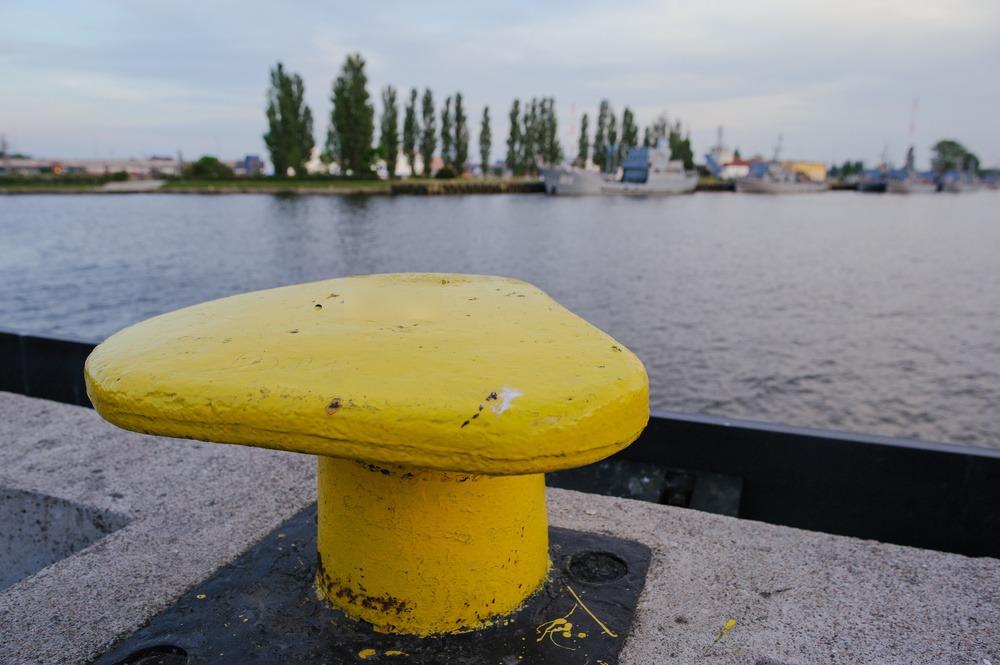
The single most important distinction between dockside and shipside bollards is where the load goes.
Dockside bollards are anchored into concrete quay structures, piled berths, or mooring dolphins. They absorb the full mooring force of the vessel and transmit it into the foundation . This means they must be sized for the whole-ship mooring load plus environmental forces—wind, current, and wave action .
Shipside bollards are welded or bolted to deck plating. They transfer load through the vessel's deck girders and hull structure . Their sizing basis is the mooring line breaking load combined with deck strength considerations, not the entire vessel's environmental load case.
This load path difference cascades into every other engineering decision.
Dockside bollards are predominantly cast steel. Taidun's standard specification uses EN 10340 G24Mn6 cast steel, with yield strength of 500–550 MPa and tensile strength of 650–800 MPa . ASTM A148 grades are also common for North American projects.
Why cast steel? Dockside bollards are large, complex shapes that require superior impact resistance and ductility under repeated high-load mooring operations. Cast steel delivers predictable performance under extreme stress without brittle fracture .
Ductile iron (spheroidal graphite) is sometimes used for medium-load applications, but modern port specifications increasingly favor cast steel for primary berths .
Shipside bollards follow ISO 13795 (Welded steel bollards for sea-going vessels), which specifies weldable steel plates with a minimum yield point of 235 N/mm² . The emphasis is on weldability—the bollard must integrate structurally with the deck.
Forged carbon steel is used where maximum strength is required in a compact footprint, such as heavy-lift vessel applications . Stainless steel appears in specialized applications where corrosion resistance justifies the cost.
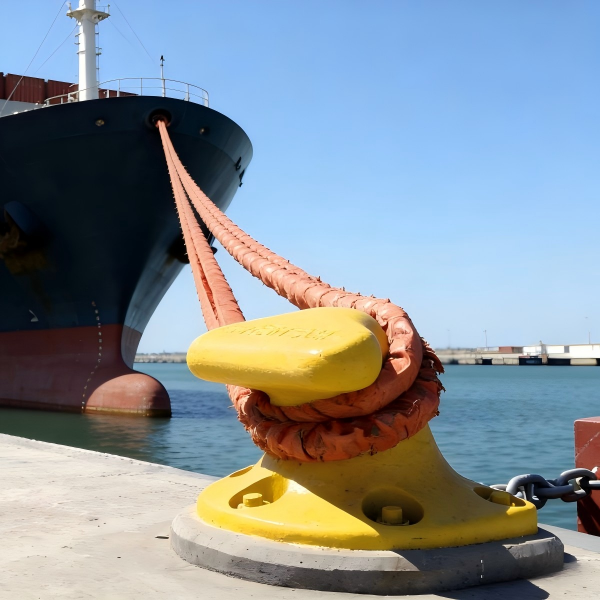
Dockside bollard design is governed by civil/marine engineering codes, not ship classification rules. Key references include:
- BS 6349-4: Maritime works—design of fendering and mooring systems
- PIANC guidelines: Mooring facility design
- UFC 4-152-01: Unified Facilities Criteria for piers and wharves
- Local port authority specifications
Bollard capacity selection typically follows displacement-based tables. For preliminary design, BS 6349-4 suggests mooring point loads ranging from 80 tonnes for 20,000–50,000 DWT vessels to ≥200 tonnes for vessels above 200,000 DWT .
Shipside bollards fall under classification society rules and international ship standards:
- ISO 13795:2020: Ships and marine technology—welded steel bollards for sea-going vessels
- Classification society rules (BV, LR, DNV, ABS, CCS) for deck fittings and supporting structure
- Bureau Veritas requires shipboard fittings to be marked with SWL (Safe Working Load) and, where applicable, TOW (Safe Towing Load)
The structural requirement is explicit: shipboard fittings must be located on stiffeners and/or girders that are part of the deck construction, ensuring efficient load distribution .
Dockside bollards are specified for fixed marine structures:
- Continuous quay walls: Regularly spaced bollards selected against design vessels and mooring analysis
- Jetties and piled berths: Bollards mounted on capping beams where line angles and uplift affect the interface
- Mooring dolphins: Isolated structures receiving concentrated mooring-line loads
- LNG, oil, and bulk terminals: Engineered together with quick-release hooks against terminal mooring analysis
For high-capacity berths, storm bollards are set back from the berth face to reduce vertical line angles and permit longer, safer mooring lines .
Shipside bollards are selected by vessel type and mooring plan:
- T-Head bollards: The workhorse for general cargo ships and tankers, capacity up to approximately 300 tonnes
- Double bitt: Dense line arrangements where deck space is limited; common on naval and specialized vessels
- Single bitt: Steep line angles and large tidal ranges
- Horn/staghorn bollards: Ferry docks and situations requiring resistance to lateral pull
One critical distinction that specifications often overlook is how the bollard is secured.
Dockside bollards rely on holding-down bolts cast into or anchored to the concrete foundation. Taidun specifies ISO 898 Grade 8.8 bolts, hot-dip galvanized, designed with the same safety philosophy as the bollard itself . These bolts are safety-critical: a bollard that tears out of its foundation during a storm is more dangerous than no bollard at all.
Shipside bollards, by contrast, are welded directly to deck structure. The weld quality and deck reinforcement determine failure mode. Classification rules require that the supporting structure beneath shipboard fittings be reinforced to handle forces from any direction, horizontally and vertically .
Procurement implication: When sourcing dockside bollards, demand bolt material certificates and galvanizing records. When sourcing shipside bollards, demand welding procedure specifications (WPS) and welder qualification records.
For vessels operating in high tidal variation ports, the choice of shipside bollard type has operational consequences.
A single bitt (American pattern) allows mooring lines to lead from multiple directions and accommodates steep vertical angles as the vessel rises and falls with the tide. A double bitt saves deck space but constrains line angles .
This is not a trivial distinction. In ports with 8–12 meter tidal ranges, the vertical angle of mooring lines changes dramatically between high and low water. Shipside bollards that cannot accommodate this variation become operational bottlenecks.
For brand owners, wholesalers, and contractors sourcing bollards from OEM manufacturers, the following verification points apply:
1. Material certification: EN 10340 or ASTM A148 cast steel certificates with heat numbers
2. Dimensional inspection: Critical dimensions verified against drawings
3. Holding-down bolt specification: Grade 8.8, galvanized, with test certificates
4. Coating verification: DFT measurements for galvanizing and paint systems
5. Load test documentation: Proof load testing where specified
1. Material traceability: Steel plate certificates with yield strength verification
2. Welding documentation: WPS, welder qualifications, NDT reports
3. Marking verification: SWL/TOW clearly marked per classification requirements
4. Dimensional accuracy: Critical for deck integration
5. Classification society certification: Where required for vessel registration
The dockside vs. shipside bollard distinction is not semantic. It reflects two different engineering philosophies:
Dockside bollards are foundation-embedded, cast, and sized for whole-ship environmental loads. They are civil engineering assets designed for decades of service.
Shipside bollards are deck-welded, fabricated, and sized for line loads and structural integration. They are vessel equipment governed by classification rules.
Specifying the wrong type—or accepting a supplier who does not understand the distinction—creates risk that may not surface until the worst possible moment.
[CTA]
Need OEM manufacturing for dockside or shipside bollards?
NANJING TAIDUN MARINE EQUIPMENT ENGINEERING CO., LTD provides:
- Cast steel dockside bollards per BS 6349-4 and PIANC
- Welded shipside bollards per ISO 13795
- Full material traceability and third-party inspection (CCS, BV, LR, TUV, SGS, INTERTEK, GL)
Contact us:
- Email: service@taidunmarine.com
- Website: www.taidunmarine.com
1. Bureau Veritas. "Rules for Steel Ships – Towing and Mooring Fittings." [https://erules.veristar.com/dy/data/bv/pdf/archives/467-NR_PartB_2021-07.pdf]
2. TZW Windlass. "Ship Bollard Guide: Types, Materials, Load Capacities." [https://www.tzwindlass.com/news/industry-news/ship-bollard-guide-types-materials-load-capacities-installation-maintenance.html]
3. Damen Civil. "Bollards, Mooring & Shiphauling – Material Comparison." [http://www.damen.com/-/media/New-Corporate-Damen/Images/Markets/Civil-Works/General/Products/Downloads/Product_Sheet_Damen_Civil_Bollards_04_2017.pdf]
4. ISO. "ISO 13795:2020 – Welded steel bollards for sea-going vessels." [https://webstore.ansi.org/preview-pages/ISO/preview_ISO+13795-2020.pdf]
5. ClassNK. "Rules for the Survey and Construction of Steel Ships – Shipboard Fittings." [https://www-origin.classnk.or.jp/hp/pdf/activities/csrh/393_part_csr-bt_e_20180305.pdf]
6. Unified Facilities Criteria. "UFC 4-152-01: Design: Piers and Wharves." [https://stg.wbdg.org/FFC/DOD/UFC/ufc_4_152_01_2017_c1.pdf]
7. TZW Windlass. "Ship Bollard Selection Guide: Types, Materials, and Mounting." [https://www.tzwindlass.com/news/industry-news/ship-bollard-selection-guide-types-materials-and-mounting.html]
8. ISO. "ISO 13795:2012 – Welded steel bollards (cruciform type reference)." [https://www.evs.ee/StandardDownload/DownloadPreview?productId=83949&language=EnglishLanguage]
No. The two types are engineered for different load paths and structural interfaces. Dockside bollards are cast and foundation-anchored; shipside bollards are welded and deck-integrated. Substituting one for the other creates an unengineered connection that cannot be certified by classification societies or port authorities.
Dockside bollards range from approximately 10 tonnes for small craft to ≥200 tonnes for VLCC terminals, with storm bollards exceeding 250 tonnes . Shipside bollards typically range from 5–35 tonnes for small vessels up to 300 tonnes for large merchant ships, depending on mooring line breaking loads and deck strength .
ISO 13795:2020 is the primary international standard for welded steel bollards on sea-going vessels . Classification society rules (BV, LR, DNV, ABS, CCS) provide additional requirements for structural integration, marking, and testing.
Cast steel offers superior impact resistance and ductility in the large, complex shapes required for dockside bollards. The casting process allows monolithic construction without weld seams—critical for bollards that must absorb unpredictable mooring loads over decades of service .
For dockside bollards: material certificates (EN 10340/ASTM A148), holding-down bolt certificates (Grade 8.8), dimensional inspection reports, and coating DFT records. For shipside bollards: steel plate certificates, WPS/welder qualifications, NDT reports, SWL/TOW marking verification, and classification society certification where applicable.
In high tidal ports, mooring line angles change dramatically between high and low water. Single bitt bollards accommodate steeper vertical angles and multi-directional leads, making them preferable to double bitts where tidal variation exceeds 6–8 meters .


