

Views: 248 Author: Nanjing Taidun Publish Time: 2026-10-15 Origin: Site
Content Menu
● Why High-Freeboard Ships Change Bollard Selection
● Horn Bollard vs Tee Bollard: Practical Comparison
● The Critical Issue: Vertical Line Angle
● How to Size a Bollard for High-Freeboard Ships
>> Step 1: Define the Vessel Envelope
>> Step 2: Calculate the Mooring Line Loads
>> Step 3: Check the Vertical Angle
>> Step 4: Verify the Foundation
● Material Selection: Cast Iron, Ductile Iron, or Cast Steel
● Expert Insight: The Hidden Cost of Choosing the Wrong Bollard
>> 1. Which bollard is better for high-freeboard ships?
>> 2. Can a tee bollard handle steep mooring lines?
>> 3. Can one horn bollard hold two mooring lines?
>> 4. What capacity bollard do I need?
>> 5. What material is best for marine bollards?
>> 6. How often should mooring bollards be inspected?
● Work With Nanjing Taidun Marine Equipment Engineering Co., Ltd
For high-freeboard vessels, the mooring line angle—not just the bollard's safe working load—often determines whether a berth operates safely. As a manufacturer serving international brands, wholesalers, and OEM buyers, Nanjing Taidun Marine Equipment Engineering Co., Ltd sees this decision frequently: a tee bollard is efficient for conventional quay layouts, while a horn bollard is usually the stronger choice where tidal range, vessel freeboard, or steep vertical line angles create demanding mooring conditions.
This guide compares horn bollards and tee bollards from a practical port-engineering and procurement perspective. It explains when each design performs best, how to size them for high-freeboard ships, and what OEM buyers should specify before placing an order.
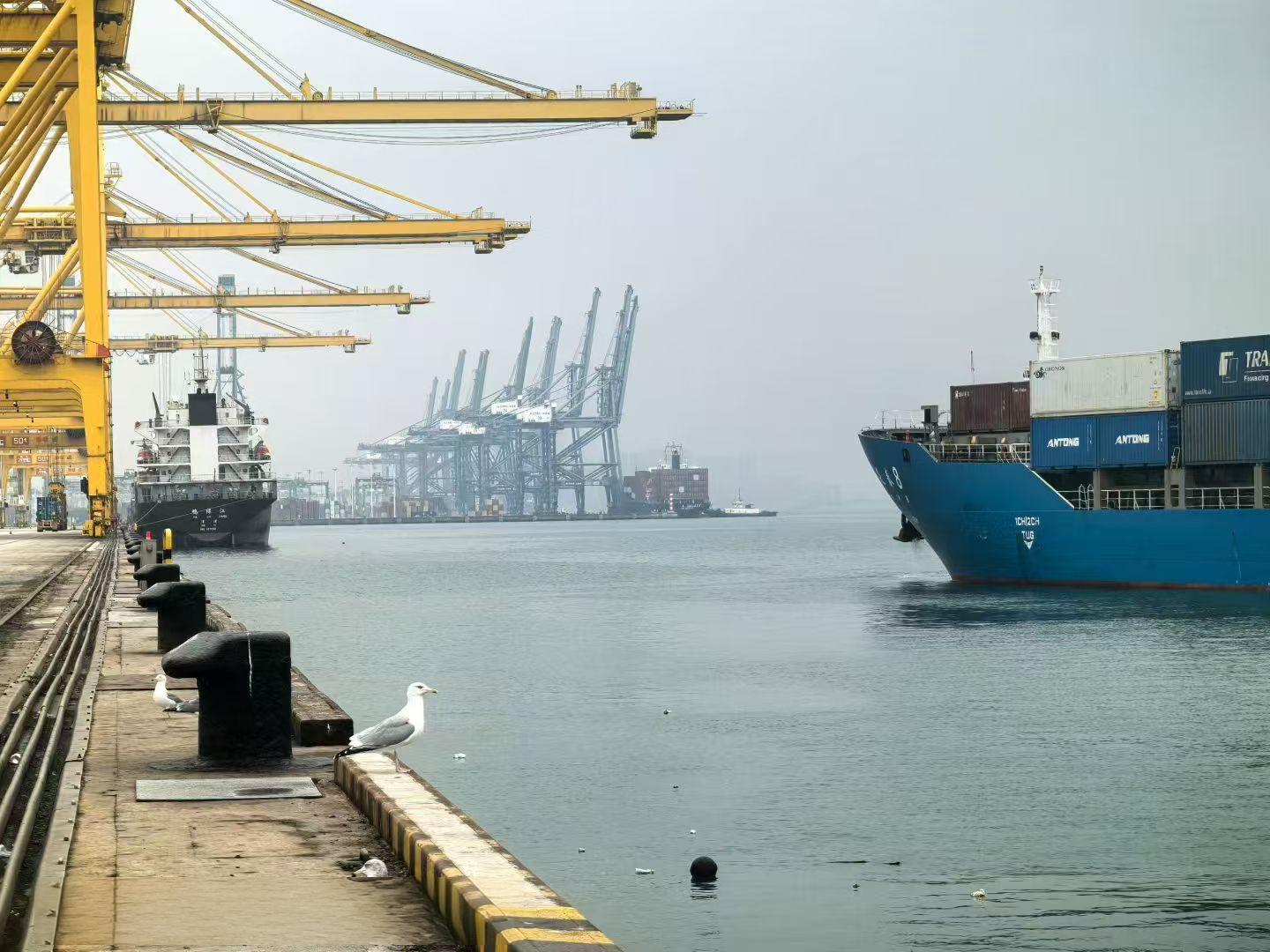
High-freeboard ships—including container feeders, RoRo vessels, bulk carriers in ballast condition, cruise ships, and some offshore support vessels—create an unusually high mooring-line departure angle at the quay. When the ship's mooring point sits well above the quay deck, the line slopes upward at a steep angle.
That geometry matters because a mooring bollard is not only a vertical load-bearing post. It must resist:
- Vertical uplift caused by steep line angles.
- Horizontal pull from head, stern, breast, and spring lines.
- Lateral line movement during tidal changes, loading, and vessel surge.
- Line escape risk, especially when the rope rides toward the top of the fitting.
- Chafe and abrasion where the line contacts the bollard profile.
Industry guidance commonly treats steep vertical line angles as a key selection criterion. Horn bollards are specifically associated with large tidal ranges, steep line angles, and multiple mooring lines, while tee bollards are widely used for general-purpose berths where line angles and space constraints are more conventional.
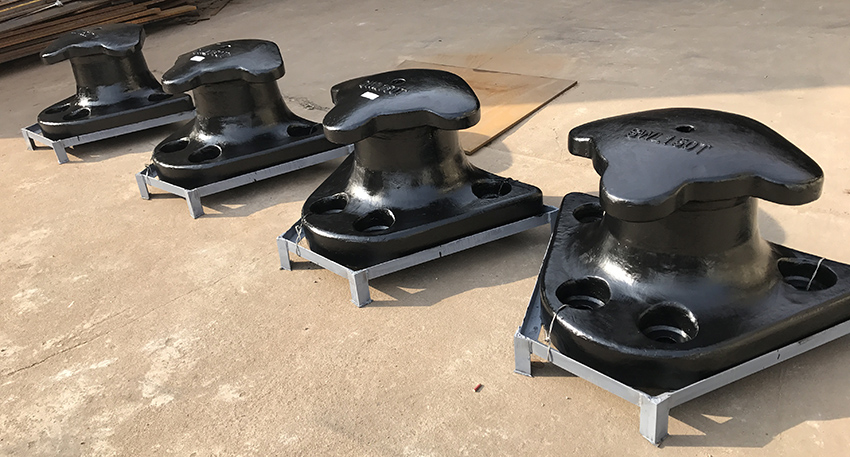
A horn bollard, often called a staghorn bollard, has two outward-curving horns rising from a central neck and base. Its geometry creates a natural pocket that helps retain mooring lines even when they pull at high vertical angles.
- Excellent performance with steep mooring lines. The horn profile supports upward line angles far better than many simpler bollard forms.
- Suitable for large tidal ranges. As water level changes, the line angle changes; horn geometry helps keep the rope securely seated.
- Multi-line capability. A single horn bollard can often accept two lines, and in some engineered configurations more, depending on the certified design.
- Better line retention. The curved horns reduce the chance of a line slipping off during vessel movement or surge.
- Efficient berth layout. Combining two lines at one fitting can reduce the number of bollards required along a quay.
Horn bollards are commonly specified for:
- Container terminals serving high-freeboard vessels.
- Ports with significant tidal variation.
- RoRo and passenger terminals.
- Bulk terminals where loaded and ballast drafts differ substantially.
- Quays where vessels berth on either side or where mooring patterns are complex.
- Projects requiring two mooring lines at one foundation point.
At Nanjing Taidun, horn bollards can be produced in cast iron, cast steel, and ductile iron, with galvanized Grade 8.8 mounting hardware and fully painted or primer-coated surface protection.
A tee bollard, also called a T-head bollard, has a vertical post with a horizontal cross-arm at the top. The line normally wraps around the cross-arm, creating a simple, robust, and familiar mooring point.
- Simple, proven design. Tee bollards are among the most widely used bollard types worldwide.
- Compact footprint. Their narrow profile suits quays with limited space or congested utility layouts.
- Lower visual and structural complexity. The straight post-and-arm form is easy to inspect, paint, and maintain.
- Cost-effective for standard berths. For conventional line angles and single-line mooring, tee bollards often provide excellent value.
- Strong general-purpose capacity. Tee bollards are commonly used in cargo terminals and can be engineered for substantial loads.
Tee bollards are appropriate for:
- General cargo berths.
- Fishing ports and smaller commercial quays.
- Terminals with limited tidal variation.
- Single-line mooring arrangements.
- Projects where space, simplicity, and budget are priorities.
- Berths serving vessels with moderate freeboard and relatively low vertical line angles.
| Selection Factor | Horn Bollard | Tee Bollard |
|---|---|---|
| Steep vertical line angle | Excellent; designed for demanding line geometry. trelleborg+2 | Suitable for moderate angles; verify case by case. ronsen-marine+1 |
| Large tidal range | Strong choice; line remains secure as angle changes. trelleborg+2 | Acceptable where tidal movement is limited. |
| High-freeboard vessels | Usually preferred. | Possible only after careful angle and load verification. |
| Multiple mooring lines | Often accepts two lines; some designs allow more. trelleborg+1 | Usually best for one line, depending on design. |
| Quay space | Larger profile and foundation demand. | Compact and space-efficient. |
| Line escape risk | Lower due to horn geometry. | Higher if line angle is steep or poorly controlled. |
| Maintenance | More complex casting profile. | Simpler shape and inspection routine. |
| Typical use | High-tidal, high-freeboard, multi-line berths. | General cargo and conventional quay mooring. |
| Cost efficiency | Higher initial cost, but may reduce bollard quantity. | Lower unit cost for straightforward layouts. |
The most common procurement mistake is selecting a bollard only by its stated safe working load. For high-freeboard vessels, line angle is equally important.
When a mooring line rises steeply from the quay to the vessel, a larger share of the line tension becomes vertical uplift. This changes the load path through the bollard, base plate, anchor bolts, grout, and concrete foundation.
Use a horn bollard when:
- The vertical line angle is high or expected to increase during operation.
- The berth has a large tidal range.
- The vessel's freeboard changes significantly between ballast and loaded conditions.
- Two mooring lines must share one bollard.
- Line retention is a safety priority.
Use a tee bollard when:
- The line angle remains moderate.
- The berth serves vessels with similar drafts and moderate freeboard.
- The mooring plan uses one line per bollard.
- Quay space is restricted.
- The project requires a simple, economical, low-maintenance fitting.
Design references commonly identify horn bollards as suitable for steep rope angles and large tidal variation, while tee bollards are positioned as general-purpose fittings that can handle higher line-load angles than simpler single-bitt designs.
A reliable bollard specification should begin with the vessel and berth conditions—not with a catalogue photo.
Collect the following data:
- Maximum vessel length, beam, and displacement.
- Freeboard in ballast and loaded conditions.
- Mooring fitting height above waterline.
- Expected tidal range.
- Wind, current, swell, and passing-vessel effects.
- Mooring line type, diameter, material, and minimum breaking load.
Establish the required bollard capacity using the project's applicable mooring standard and terminal design basis. OCIMF's *Mooring Equipment Guidelines (MEG4)* is widely used to improve the design, performance, and safety of mooring systems at terminals and aboard ships.
Do not assume that a 100-tonne line automatically requires a 100-tonne bollard. The required capacity depends on the number of lines, line tension assumptions, load combinations, angle effects, and the project's limit-state requirements.
For high-freeboard ships, calculate the line angle at:
- Lowest astronomical tide.
- Highest astronomical tide.
- Lightship or ballast draft.
- Fully loaded draft.
- Maximum expected surge or heel.
If the calculated angle approaches the bollard's certified limit, change the bollard type, relocate the fitting, or revise the mooring layout. Do not simply increase the load rating.
The bollard is only as reliable as its foundation. Confirm:
- Concrete strength and reinforcement.
- Anchor-bolt grade, diameter, embedment, and spacing.
- Base-plate thickness and stiffening.
- Grout specification.
- Pull-out, shear, and bending capacity.
- Corrosion protection below and above deck.
Nanjing Taidun supplies bollards with galvanized Grade 8.8 bolts, nuts, and washers, helping OEM buyers align the hardware package with the bollard's structural duty.
Material selection affects strength, toughness, corrosion behavior, weight, and lifecycle cost.
| Material | Best Use | Advantages | Considerations |
|---|---|---|---|
| Cast iron | Standard port and quay applications | Proven, cost-effective, good compressive performance | Less ductile than steel; avoid unsuitable impact conditions |
| Ductile iron | High-performance marine bollards | Better toughness and deformation tolerance than grey cast iron | Requires controlled casting quality |
| Cast steel | Heavy-duty or high-impact installations | High strength and ductility | Usually higher cost and weight |
For demanding horn bollards, ductile iron and cast steel are frequently selected because they provide greater resistance to crack propagation and unexpected overload conditions. Taidun manufactures horn bollards in cast iron, cast steel, and ductile iron, allowing buyers to match material to project requirements. [taidunmarine]
From our experience supporting OEM customers and port projects, the most expensive bollard is not necessarily the one with the highest purchase price. It is the bollard that forces operational compromises after installation.
A tee bollard installed where steep line angles occur may create:
- Frequent line repositioning by deck crews.
- Higher rope wear at the cross-arm.
- Increased risk of line slip during tidal changes.
- Restrictions on vessel draft or berthing position.
- Costly retrofit work involving concrete cutting, new foundations, and berth downtime.
A horn bollard may cost more initially, but it can reduce the number of fittings, simplify mooring operations, and improve safety margins for high-freeboard vessels. The correct comparison is therefore total installed and operational cost, not unit price alone.
Before ordering horn or tee bollards, international buyers should request the following:
1. Certified general arrangement drawing, including overall height, horn spread, neck diameter, base-plate dimensions, and line-contact geometry.
2. Safe working load and ultimate load data, clearly separated.
3. Permitted vertical and horizontal line-angle envelope.
4. Material certificate for the casting.
5. Welding, heat-treatment, and inspection records, where applicable.
6. Anchor-bolt specification, including grade, coating, torque values, and embedment requirements.
7. Surface-preparation and coating system, such as blast cleaning, primer, intermediate coat, and topcoat.
8. Dimensional inspection report.
9. Load-test or type-test documentation, where required by the project.
10. Packing, lifting, and installation instructions.
Nanjing Taidun positions itself as an integrated R&D, testing, and production enterprise for marine equipment, supporting OEM supply for overseas brands, wholesalers, and producers.
A horn bollard is usually better for high-freeboard ships because its geometry handles steep vertical mooring-line angles more effectively. A tee bollard can still be suitable if the calculated line angle, tidal range, and load path remain within its certified design limits.
Yes, but only within its engineered limits. Tee bollards are robust general-purpose fittings, but they are generally less suitable than horn bollards for large tidal ranges, high freeboard, or repeated steep-angle mooring.
Often, yes. Horn bollards are designed to accept multiple lines because their curved profile provides separation and retention. The exact number of lines must follow the manufacturer's certified design and project-specific load calculation.
Capacity depends on vessel size, mooring-line breaking load, number of lines, environmental loads, line angles, and the applicable design standard. Use a project-specific mooring analysis rather than selecting capacity solely from vessel tonnage.
For most commercial ports, ductile iron offers a strong balance of toughness, castability, and cost. Cast steel is often chosen for heavy-duty or high-impact applications, while cast iron remains a proven option for standard installations. [taidunmarine]
Inspection frequency should follow the port's maintenance plan, local regulations, and operating conditions. At minimum, inspect for coating breakdown, corrosion, cracks, deformation, loose anchor bolts, concrete damage, and line-contact wear—especially after extreme weather, vessel impact, or overload events.
Choosing between a horn bollard and a tee bollard should be an engineering decision based on vessel freeboard, tidal range, line angle, mooring pattern, and foundation capacity. For high-freeboard ships and demanding tidal environments, Nanjing Taidun recommends a properly engineered horn bollard solution; for conventional, space-limited berths, a tee bollard may deliver the best balance of performance and cost.
Nanjing Taidun Marine Equipment Engineering Co., Ltd manufactures marine rubber fenders, mooring bollards, and marine anchoring equipment for global OEM customers, brands, wholesalers, and terminal contractors. Our team can support custom dimensions, material selection, coating systems, mounting hardware, technical drawings, and project-specific bollard configurations. [taidunmarine]
Contact Nanjing Taidun today to request a horn or tee bollard quotation, CAD drawing, material certificate, or OEM mooring-equipment proposal.
- Nanjing Taidun Marine Equipment Engineering Co., Ltd — official website: [https://www.taidunmarine.com/]
- Nanjing Taidun — Horn Bollards product information: [https://www.taidunmarine.com/]
- Nanjing Taidun — company and OEM capability profile: [https://taidunmarine.goldsupplier.com/product.html]
- Trelleborg — Horn Bollards: [https://www.trelleborg.com/en/marine-and-infrastructure/products-solutions-and-services/marine/docking-and-mooring/bollards/horn-bollards]
- Trelleborg — Marine Bollards: [https://www.trelleborg.com/en/marine-and-infrastructure/products-solutions-and-services/marine/docking-and-mooring/bollards]
- OCIMF — Mooring Equipment Guidelines (MEG4): [https://www.ocimf.org/publications/books/mooring-equipment-guidelines-meg4]
- Reliance Foundry — Marine Mooring Bollards: [https://www.reliancefoundry.com/blog/mooring-bollards]
- ESC — Marine Mooring Bollards for Ports, Harbours & Terminals: [https://www.escsteel.com/mooring-bollards]
- MoorMarine — Marine Bollards: [https://www.moormarine.com/marine-bollards]
- OLIPORTS — Horn Bollard 250 Ton Mooring Bollard Series: [https://oliports.com/horn-bollard/]
Hot Tags: China, Global, OEM, private label, manufacturers, factory, suppliers, manufacturing company


