

Views: 247 Author: Nanjing Taidun Publish Time: 2026-08-12 Origin: Site
Content Menu
● Why Fender Maintenance Costs Rise
>> The Hidden Cost of "Cheap" Fenders
● How Port Fender Manufacturers Reduce Maintenance Costs
>> 1. Design for Real Berthing Energy
>> 2. Use the Right Fender Type for the Duty
>> 3. Control Rubber Quality Before Production
>> 4. Protect the Complete Steel-and-Rubber Assembly
>> 5. Make Spare Parts Modular and Traceable
● A Practical Maintenance Program
>> Recommended Inspection Matrix
>> What to Inspect by Fender Type
>> The "Repair, Reposition, Replace" Decision
● Procurement Checklist for Lower Lifecycle Cost
● FAQ
>> 1. How do port fender manufacturers reduce maintenance costs?
>> 2. Are higher-priced marine fenders always more cost-effective?
>> 3. What causes marine rubber fenders to fail early?
>> 4. How often should port fenders be inspected?
>> 5. Can a damaged fender be repaired instead of replaced?
>> 6. What documents should an OEM buyer request from a marine fender factory?
>> 7. Why are frontal panels and UHMW-PE pads important?
At Nanjing Taidun Marine Equipment Engineering Co., Ltd., we believe the best way port fender manufacturers reduce maintenance costs is not by supplying the lowest-priced fender. It is by engineering a complete, testable, maintainable fender system that protects the berth, vessel, hardware, and operating schedule over its full service life.
As an OEM manufacturer of marine rubber fenders, mooring bollards, and marine anchoring equipment for international brands, wholesalers, and manufacturers, we see one procurement mistake repeatedly: buyers compare only the unit price. In reality, a fender is a long-term operating asset. Its maintenance cost includes inspections, hardware tightening, corrosion control, vessel-contact pad replacement, emergency repairs, crane access, berth downtime, and premature replacement.
A properly designed marine fender system can reduce these costs substantially by matching real berthing conditions, using dependable rubber compounds, protecting exposed steel components, and making every critical part easier to inspect and replace.
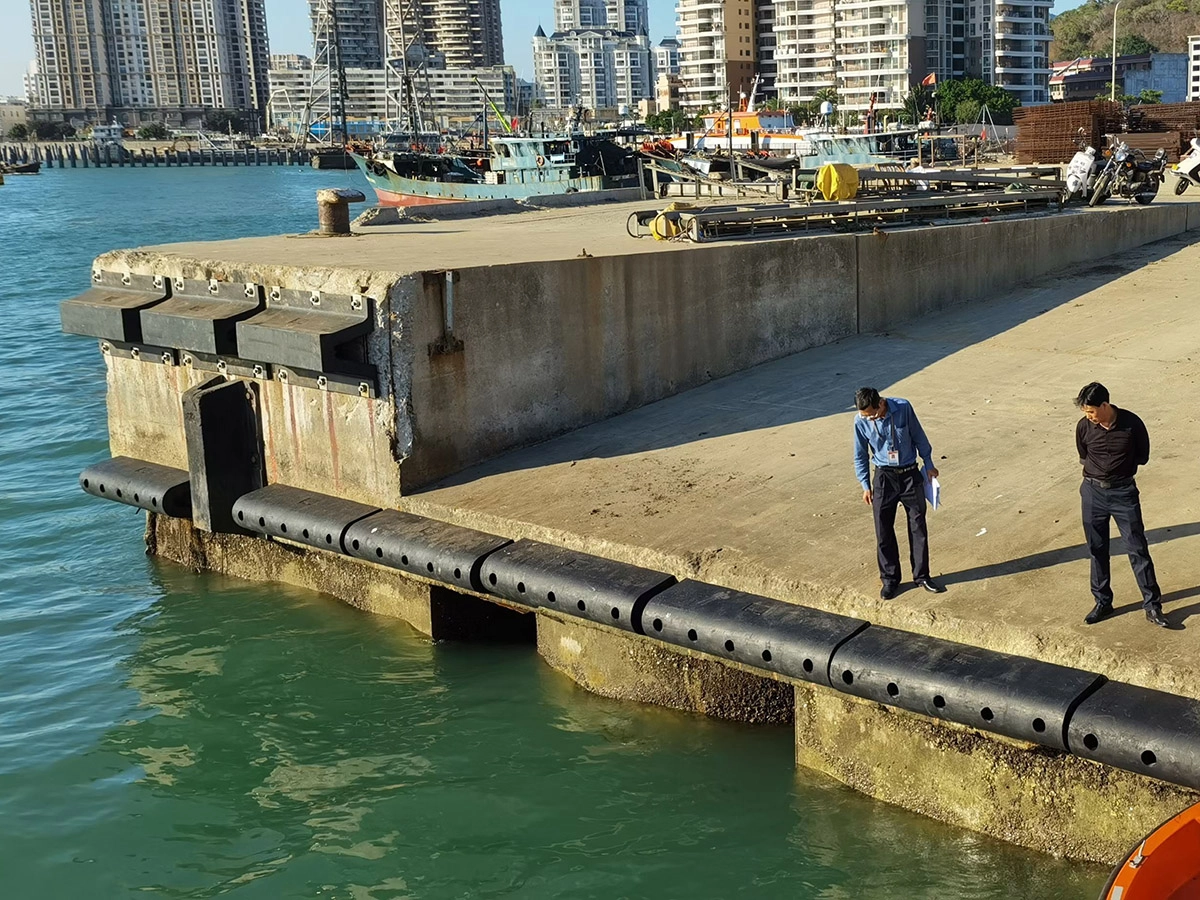
Maintenance problems usually begin long before a fender is installed. They begin when the system is selected using incomplete vessel data, unrealistic operating assumptions, or a specification focused only on initial purchase price.
A marine fender must absorb berthing energy while limiting the reaction force transmitted to the quay and vessel hull. If the fender is too small, too stiff, incorrectly spaced, or paired with an unsuitable panel system, the result may be excessive compression, torn rubber, bent panels, loose chains, damaged anchor bolts, and structural deterioration.
In our experience, ports do not lose money only when a fender fails. They lose money whenever an unreliable fender system creates uncertainty:
- A berth is restricted because several units are damaged.
- Maintenance teams must respond after an impact instead of following a planned schedule.
- A vessel berths slowly or is diverted because the berth is not fully available.
- Steel panels or support frames corrode before the rubber element reaches the end of its useful life.
- Replacement parts do not fit the installed system.
- Operators cannot verify whether the fender still performs as designed.
High-quality rubber fenders have a commonly expected service life of approximately 15 to 20 years, although the real result depends on compound quality, exposure, vessel traffic, installation quality, and maintenance discipline. The important point is that a lower purchase price does not automatically produce a lower lifecycle cost.
Low-cost fenders can appear economical because their quoted price is lower. However, price reductions may come from changes that are difficult for a buyer to see after installation, including excessive recycled rubber, non-reinforcing fillers, weak hardware, insufficient rubber dimensions, or incomplete testing.
A published comparison by Trelleborg illustrates the lifecycle issue: its example showed a lower-quality cone fender system reaching a 10-year whole-life cost of $48,200, compared with $22,800 for the higher-quality alternative. This is an illustrative industry example, not a universal pricing model; every port should calculate its own replacement, labor, access, and downtime costs.
| Cost driver | Short-term procurement approach | Lifecycle-focused approach |
|---|---|---|
| Rubber compound | Select by lowest unit cost | Verify physical properties and compound consistency |
| Fender sizing | Use generic capacity | Calculate actual berthing energy and reaction force |
| Hardware | Treat as accessories | Design chains, anchors, panels, and frames as one system |
| Testing | Accept paperwork only | Review laboratory data and full-scale performance testing |
| Maintenance | Repair after failure | Inspect, monitor, and replace planned wear components |
| Spare parts | Buy only after damage | Keep critical, interchangeable spares available |
The lowest bid can therefore become the most expensive decision if it produces early replacement, restricted berth availability, or unplanned marine works.
Port fender manufacturers reduce maintenance costs through engineering choices that prevent failure, simplify inspection, and keep repairs localized. At Taidun Marine, our approach starts with the system rather than a single fender body. Our product scope includes marine rubber fenders, mooring bollards, frontal panels, and related marine safety equipment for port and ship applications. [taidunmarine]
A fender should be selected using actual operating conditions, not only vessel deadweight tonnage. The engineering review should consider:
- Vessel types, dimensions, and displacement range
- Berthing velocity and approach angle
- Berth geometry and tidal variation
- Tug assistance and local operating practice
- Environmental loads from wind, current, waves, and swell
- Vessel hull form at the contact zone
- Eccentricity, berth utilization, and future vessel growth
This matters because a fender system that absorbs enough energy but produces excessive reaction force can transfer damaging loads into the quay structure. Conversely, an under-designed system may bottom out or suffer repeated overload. Both situations create maintenance work.
Expert perspective: A fender schedule should not be copied from another terminal without recalculating the project conditions. Two ports may handle the same vessel class but have different currents, berthing speeds, quay elevations, vessel traffic patterns, and structural limits.
Different fender types fail in different ways. Selecting the correct profile and configuration reduces avoidable wear.
| Fender solution | Suitable application | Main maintenance focus |
|---|---|---|
| Cone or cell fender with panel | High-energy commercial berths | Panel corrosion, chains, anchors, UHMW-PE pad wear |
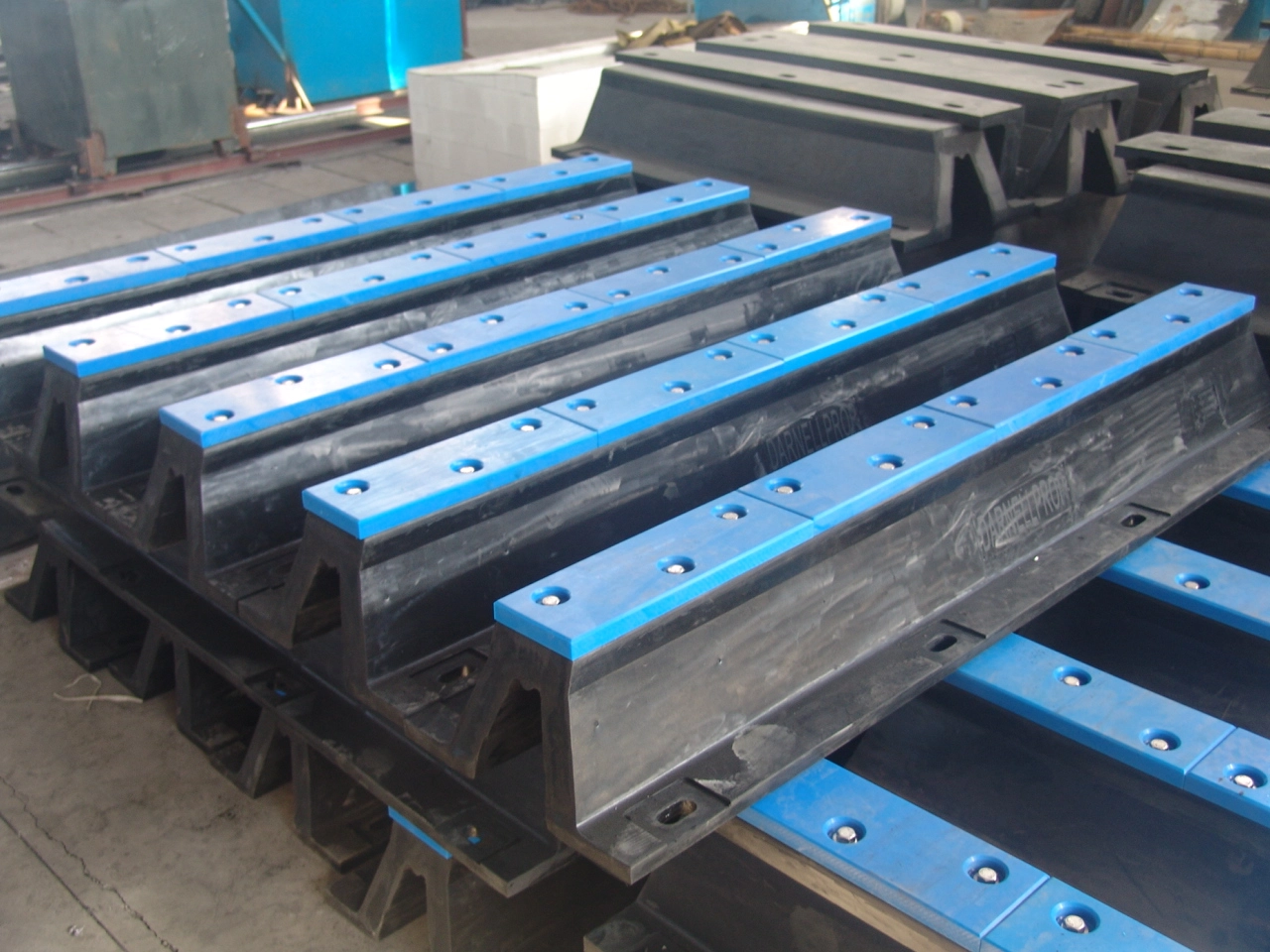
| Arch / V fender | General berths, smaller vessels, direct-contact applications | Rubber wear, mounting bolt condition, local deformation |
| Cylindrical fender | Jetties, dolphins, tug berths, narrow contact areas | Surface abrasion, supports, direct impact damage |
| Pneumatic fender | Ship-to-ship transfer, temporary or floating protection | Internal pressure, valve condition, outer net and fittings |
| Sliding fender panel system | Berths requiring controlled hull contact and low friction | Pad wear, panel alignment, support-frame corrosion |
For example, a cone fender with a frontal panel may reduce rubber-body abrasion because the vessel contacts the low-friction face pad rather than the rubber directly. However, that benefit is only realized when the panel, chains, supports, and fixings are correctly engineered and protected from corrosion.
Rubber compound quality is one of the strongest predictors of long-term fender reliability. The compound must provide the intended balance of resilience, tensile strength, elongation, hardness, aging resistance, and fatigue performance.
Manufacturers reduce maintenance risk when they establish a controlled process for:
1. Raw-material approval and batch traceability
2. Rubber mixing and compound consistency
3. Controlled vulcanization time and temperature
4. Dimensional checks after molding
5. Physical-property testing of representative samples
6. Performance verification of finished fenders
7. Clear product identification for future inspection and replacement
Testing is not merely a compliance task. It helps the buyer confirm that the fender supplied is the fender specified.
Industry testing guidance highlights the value of checking density, hardness, tensile strength, elongation at break, polymer content, carbon black content, and ash content. These indicators can reveal whether a rubber compound is likely to provide durable performance rather than only an attractive purchase price.
A port fender system is not only rubber. It is a connected assembly that may include frontal panels, UHMW-PE pads, chain systems, brackets, anchor bolts, steel supports, and mooring interfaces.
In many installations, corrosion and mechanical damage to steel components cause more urgent maintenance than the rubber fender itself. A manufacturer can reduce this risk by specifying the right corrosion-protection system for the environment, detailing drainage points, avoiding water traps, selecting suitable fasteners, and allowing enough access for inspection tools.
For harsh marine environments, the design discussion should cover:
- Coating specification and expected corrosion category
- Cathodic-protection compatibility where relevant
- Stainless-steel or galvanized fastener selection
- Thickness allowances for exposed steelwork
- Drainage, ventilation, and crevice prevention
- Replaceable UHMW-PE pads rather than full-panel replacement
- Accessible chain links, shackles, and tension points
- Clearly marked anchor layouts and installation tolerances
A panel that is difficult to access may be inexpensive to buy but expensive to maintain. Serviceability should be designed into the equipment from the beginning.
When a component fails, the fastest repair is not always a complete fender replacement. A well-designed system allows the port to replace the worn component—such as a face pad, chain, shackle, bolt assembly, or panel bracket—without removing every part of the installation.
For OEM customers, this is particularly important. Brand owners and distributors should request:
- A unique system drawing and bill of materials
- Part numbers for consumable and critical components
- Interchangeable replacement-pad dimensions
- Hardware specifications with material grades
- Recommended spare-parts quantities
- Installation and maintenance manuals
- Inspection records linked to berth location
This reduces the risk of ordering the wrong part years later, when the original project team may no longer be involved.
Even the best-designed marine fender needs a planned inspection program. The objective is to detect small deterioration before it becomes a berth-availability problem.
Industry maintenance guidance recommends inspections at installation, during daily operational observation, at regular periodic intervals, and after abnormal events such as uncontrolled berthing, storms, fire, or unusual vessel movement.
| Inspection stage | What to check | Why it saves money |
|---|---|---|
| Commissioning | Alignment, bolt torque, chain tension, panel movement, initial condition | Corrects installation errors before operations begin |
| Routine visual check | Rubber tears, missing pads, loose hardware, corrosion, deformation | Finds visible issues before they grow |
| Periodic technical inspection | Compression condition, anchor integrity, coating loss, pad thickness, chain wear | Supports planned repairs and spare-part ordering |
| Post-incident inspection | Over-compression, panel damage, cracked rubber, damaged anchors | Prevents hidden damage from causing the next failure |
| Annual review | Berthing data, vessel changes, repair history, recurring defect locations | Identifies whether the original design still fits operations |
For rubber fenders with frontal panels, prioritize steel panel deformation, corrosion, loose or damaged fixings, support condition, chain integrity, and UHMW-PE pad wear.
For arch, cylindrical, D-type, and square fenders, inspect the rubber body for cuts, cracking, abrasion, permanent deformation, missing material, and damaged mounting points.
For pneumatic fenders, monitor air pressure, valve condition, rubber-body damage, net wear, and mooring attachments. Pressure management is essential because incorrect internal pressure changes fender performance.
Not every issue requires immediate full replacement. A structured decision helps reduce cost without compromising safety.
- Repair when a replaceable component can restore reliable operation.
- Reposition only after engineering review confirms that load paths and safety will remain acceptable.
- Restrict use temporarily when damage requires operational control before repairs.
- Replace when the rubber body, structural support, or anchor system cannot safely deliver its intended performance.
The key is to avoid improvisation. A fender may look acceptable externally but have sustained internal stress, anchor damage, or panel misalignment after a severe impact.
A strong procurement specification gives port owners and OEM buyers more control over future maintenance costs. Before selecting a port fender manufacturer, ask these questions:
1. Has the berthing-energy calculation been prepared for our vessel mix and operating conditions?
2. What are the guaranteed energy-absorption and reaction-force values at the specified deflection?
3. Which rubber physical properties will be tested, and what are the acceptance criteria?
4. Can the manufacturer provide traceability for rubber batches and finished units?
5. Are full-scale compression tests available for the proposed fender type?
6. How are panels, chains, brackets, and anchor bolts protected against marine corrosion?
7. Which components are designed to be replaced independently?
8. What spare parts should be held on site for the first years of operation?
9. Will the supplier provide installation guidance, inspection procedures, and as-built documentation?
10. Can the system be adapted if vessel sizes or berth operating conditions change?
They reduce maintenance costs by designing fenders for actual berthing loads, using durable rubber compounds, testing performance, protecting steel components from corrosion, and making wear parts easy to inspect and replace.
Not always. The correct choice is the fender system that offers verified performance, suitable materials, compatible hardware, serviceable design, and the lowest realistic lifecycle cost for the berth.
Common causes include overload, poor rubber quality, incorrect installation, unsuitable fender selection, repeated direct abrasion, corrosion of associated hardware, loose anchors, and a lack of planned inspections.
Ports should inspect fenders during commissioning, through routine visual checks, at scheduled technical intervals, and immediately after abnormal berthing impacts or severe weather events. The exact frequency should reflect berth risk, vessel traffic, and environmental conditions.
It depends on the component and the damage. Face pads, chains, fasteners, and some steel elements may be replaceable. A severely damaged rubber body or compromised structural support often requires replacement after engineering assessment.
Request technical drawings, berthing calculations, test reports, material specifications, inspection records, installation instructions, maintenance manuals, spare-parts lists, and part-number traceability.
They distribute vessel contact loads and provide a low-friction contact surface. When correctly designed, they reduce direct rubber abrasion and allow selected wear components to be replaced without changing the entire fender system.
For brand owners, wholesalers, and marine equipment manufacturers, Nanjing Taidun Marine Equipment Engineering Co., Ltd. provides OEM support for marine rubber fenders, mooring bollards, frontal panel systems, and marine anchoring equipment.
Contact our engineering team with your berth drawings, vessel range, operating conditions, target standards, and branding requirements. We can help you develop a more maintainable fender solution—one designed to protect your customer's berth performance as well as your long-term brand reputation.
1. Nanjing Taidun Marine Equipment Engineering Co., Ltd. "[High-Quality Rubber Fenders for Ports & Ships]." Company overview, product scope, and marine fender manufacturing information. [taidunmarine]
2. Trelleborg Marine and Infrastructure. "[Guaranteeing Fender Performance: Why It's Not So Black and White]." Fender lifecycle, material quality, testing, and whole-life-cost discussion. [trelleborg]
3. ESC Marine Systems. "[Maintenance and Management of Marine Rubber Fenders]." Fender classifications, deterioration modes, inspection timing, and corrective actions. [escmarinesystems]
4. Ben Cros. "[Reducing Maintenance Costs and Downtime: The Impact of Port and Harbor Fenders]." Overview of how fenders support infrastructure protection and operational uptime. [bencros]
5. ESC Global Group. "[Key Considerations for Design, Maintenance, and Management of Marine Rubber Fenders]." Design and maintenance considerations for marine rubber fender systems. [escglobalgroup]
Hot Tags: China, Global, OEM, private label, manufacturers, factory, suppliers, manufacturing company


