

Views: 230 Author: Nanjing Taidun Publish Time: 2026-08-13 Origin: Site
Content Menu
● Why Marine Fender Quality Assurance Matters
● Nanjing Taidun's Marine Rubber Fender Factory Quality Assurance Process
>> 1. Project Review Before Production
>> 2. Raw Material and Rubber Compound Control
>> 3. Controlled Molding and Curing
>> 4. Dimensional and Visual Inspection
>> 5. Performance Testing and Factory Acceptance Testing
● Quality Assurance Beyond the Rubber Fender
>> Steel Panels, Chains, and Hardware
>> Marine Bollards and Anchoring Products
● How OEM Buyers Can Audit a Marine Rubber Fender Factory
● Common Quality Risks in Marine Rubber Fender Procurement
● Choose Nanjing Taidun for Controlled OEM Marine Fender Quality
● FAQ
>> What is a marine rubber fender factory quality assurance process?
>> Which test is most important for marine rubber fenders?
>> Can an OEM buyer request third-party inspection?
>> Does ISO 9001 alone prove that a marine fender is high quality?
>> What documents should a marine fender OEM supplier provide?
>> How can buyers compare two marine rubber fender quotations?
A reliable Marine Rubber Fender Factory Quality Assurance Process is not limited to checking a finished fender before shipment. It starts with engineering requirements, continues through rubber compounding, molding, curing, inspection, performance testing, traceability, packaging, and project documentation.
At Nanjing Taidun Marine Equipment Engineering Co., Ltd., we support overseas marine brands, wholesalers, contractors, and manufacturers with OEM marine rubber fenders, mooring bollards, and marine anchoring products. Our role is to help customers protect their brand reputation with products that are consistently manufactured, technically verified, and documented for real port, harbor, shipyard, offshore, and waterway applications.
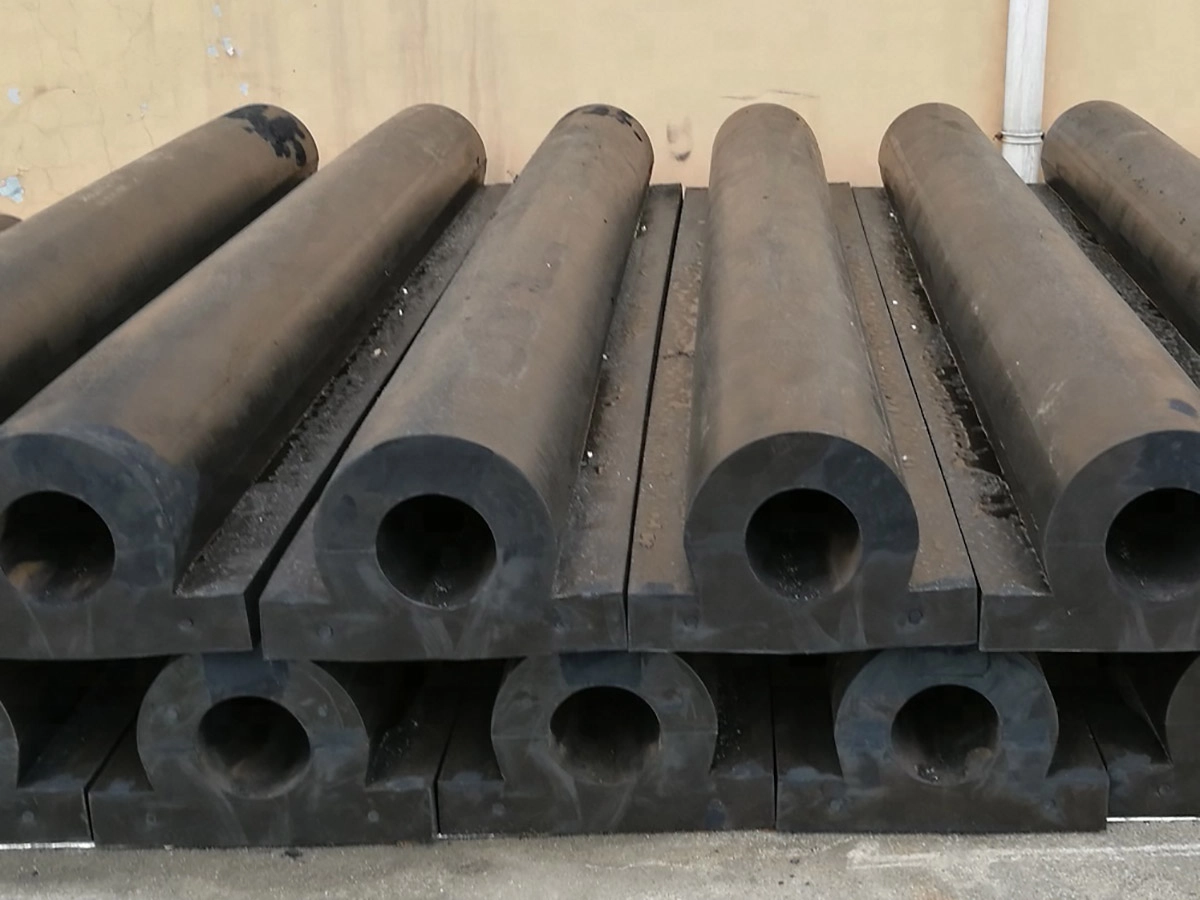
Marine rubber fenders are safety-critical components. They absorb berthing energy, limit reaction forces transferred to the vessel and berth structure, and help protect port assets during repeated operations. A fender that looks acceptable on the surface may still have hidden weaknesses caused by inconsistent rubber mixing, insufficient curing, poor dimensional control, or incomplete performance testing.
For OEM buyers, the risk is even greater. The product carries your brand, while the manufacturing quality is controlled at the factory level. That is why a marine rubber fender factory quality assurance process must be transparent, repeatable, and connected to the final batch delivered to the customer.
A sound quality system should verify five areas:
- Material quality: The rubber compound must meet the project's physical-property requirements.
- Manufacturing consistency: Mixing, molding, curing, and finishing must follow controlled procedures.
- Performance compliance: Energy absorption and reaction force must be tested against agreed specifications.
- Traceability: The finished fender must be traceable to its production batch and material records.
- Delivery readiness: Packing, marking, accessories, and shipping documents must be checked before dispatch.
Industry guidance emphasizes that verification testing should cover material testing, traceability, performance verification, dimensional checking, and visual inspection—not just appearance. [shibata-fender]
Nanjing Taidun Marine Equipment Engineering Co., Ltd. integrates R&D, testing, and production for marine rubber fender systems and marine safety equipment. Our OEM process is designed around one practical principle: quality must be built into production, not inspected in afterward. [taidunmarine]
Quality assurance begins before raw materials enter the factory. Our technical and production teams review the order requirements to make sure the selected product design, performance criteria, dimensions, installation interfaces, and documentation requirements are clearly understood.
For a marine rubber fender OEM project, we normally confirm:
- Fender type, such as cone, cell, arch, cylindrical, sliding, V-type, D-type, pneumatic, or customized rubber fender.
- Nominal dimensions, mounting holes, tolerances, and steel panel interfaces where applicable.
- Required energy absorption and maximum reaction force.
- Design deflection and operating conditions.
- Environmental factors, including temperature, seawater exposure, UV exposure, abrasion, and vessel traffic frequency.
- Required standards, project specifications, test procedures, and third-party inspection requirements.
- Branding details, markings, labels, packaging, and OEM documentation.
This review prevents a common procurement mistake: comparing only unit price and nominal dimensions. Two fenders can have the same external size but deliver very different mechanical performance, durability, and installation compatibility.
The rubber compound determines the foundation of fender performance. A well-designed fender profile cannot compensate for an unsuitable or unstable compound.
At Nanjing Taidun, compound control focuses on material consistency before the molding stage. The production team verifies incoming materials and manages the mixing process according to the approved formula and production plan. The goal is to maintain repeatability from batch to batch.
Relevant rubber properties may include:
- Hardness for controlled stiffness and deformation behavior.
- Tensile strength to resist stretching and structural separation.
- Elongation at break to support flexibility under repeated compression.
- Compression set to assess residual deformation after loading.
- Tear resistance for durability at vulnerable areas.
- Abrasion resistance where vessel contact or movement is frequent.
- Ozone and aging resistance for long-term outdoor marine service.
- Bonding strength where rubber is integrated with embedded or bonded components.
Rubber chemistry, aging resistance, and ozone resistance strongly influence the useful life of marine fenders. Procurement specifications should therefore define measurable material requirements rather than relying only on a general "marine-grade rubber" statement.
Marine rubber fenders are not ordinary rubber products. Their geometry, wall thickness, internal stress distribution, and curing conditions directly affect field performance.
During molding, the factory controls the correct mold selection, compound loading, pressure, molding time, and process sequence. During curing, the team monitors the conditions needed to form the final rubber structure.
The exact production parameters vary by fender type and size. Large cone, cell, and cylindrical fenders require particular attention because thick rubber sections may cool and stabilize differently between the outer surface and internal core.
Key manufacturing controls include:
| Quality Control Point | Why It Matters | Risk If Ignored |
|---|---|---|
| Correct mold selection | Maintains specified geometry | Improper fit or installation issues |
| Compound batch identification | Supports traceability | Unverifiable material origin |
| Curing time and temperature | Develops stable rubber properties | Under-cured or inconsistent fenders |
| Surface finishing | Identifies visible defects | Poor appearance or overlooked flaws |
| Embedded-part positioning | Protects installation alignment | Mounting failure or uneven loading |
| Production records | Enables batch verification | Difficult corrective action later |
For OEM customers, documented process discipline is more valuable than a verbal assurance. A reliable supplier should be able to explain how each fender batch is identified, inspected, tested, and released.
Every finished fender must be inspected before it advances to final acceptance. Dimensional inspection confirms that the product can be installed as designed. Visual inspection helps identify cracks, major flow marks, unacceptable surface defects, deformation, or finishing problems.
Typical dimensional checks include:
- Overall length, width, height, or diameter.
- Mounting-hole position and diameter.
- Rubber thickness at controlled points.
- Steel base plate or panel interfaces, where supplied.
- Fender straightness, roundness, and shape consistency.
- Weight verification when required by the project.
Visual inspection should not be treated as the final proof of quality. It is an essential screening step, but it cannot verify energy absorption, reaction force, or internal material consistency. Industry best practice separates visual and dimensional checks from material, traceability, and performance verification.
Performance testing is the most important proof that a marine fender can perform according to its agreed design requirement. In a typical compression test, the fender is compressed to its specified deflection while the factory records reaction force and energy absorption.
The critical question is not simply, "Was the fender compressed?" The question is whether the test was performed under a controlled, documented, and comparable procedure.
A credible factory acceptance test should define:
1. Test sample selection and batch representation.
2. Test equipment calibration and load measurement method.
3. Fender temperature stabilization before testing.
4. Compression speed and test cycle sequence.
5. Required deflection and acceptance criteria.
6. Energy absorption results compared with the required minimum.
7. Reaction force results compared with the permitted maximum.
8. Test report approval by the customer or appointed inspector.
Temperature, compression velocity, and break-in cycles can influence fender test results. For this reason, test protocols should state how results are measured and whether agreed correction factors are used.
For projects that require independent confidence, Nanjing Taidun can coordinate factory inspection and test witnessing according to the customer's contractual requirements. Early agreement is important because third-party witnessing, specialized test methods, and extended documentation can affect production scheduling and cost.
A complete marine protection system often includes more than rubber fenders. It may include frontal panels, UHMW-PE face pads, chains, anchors, brackets, marine bollards, and steel structures.
For this reason, an OEM supplier should apply a connected quality approach across the complete delivery scope.
When fender systems include fabricated steel parts, quality checks may include:
- Material grade verification.
- Cutting, welding, and assembly inspection.
- Weld appearance and dimensional checks.
- Coating thickness checks.
- Galvanizing or paint-system inspection.
- Chain, shackle, and anchor configuration verification.
- Packing protection against corrosion and transport damage.
Steel panels used with fender systems commonly require corrosion-protection control, including coating-thickness inspection where a painted system is specified.
For mooring bollards and anchoring products, the quality process must also consider load capacity, material selection, casting or fabrication quality, bolt arrangement, coating protection, and dimensional compatibility with the customer's civil or marine structure design.
The best approach is to review the full system interface early. A high-quality bollard or fender can still create a project problem if mounting dimensions, anchor bolts, panel connections, or installation drawings are not coordinated.
A supplier audit should go beyond asking for a catalogue or a general quality certificate. Certifications can demonstrate that a manufacturer follows a documented management system, but they do not automatically prove that every fender is suitable for a particular operating condition.
Use the following practical audit checklist before selecting a marine rubber fender OEM factory:
- Ask for factory capability: Can the supplier manufacture the requested fender size and type in-house?
- Review test equipment: Can the factory conduct the required compression or performance test?
- Check calibration records: Are load cells, gauges, and relevant equipment maintained and calibrated?
- Request sample reports: Can the supplier provide example material-test and factory acceptance test reports?
- Confirm traceability: Is every fender linked to a production batch, inspection record, and marking system?
- Clarify inspection scope: Which tests are standard, and which require additional cost or third-party witnessing?
- Review drawings carefully: Are mounting holes, interfaces, tolerances, and accessories clearly defined?
- Confirm packaging: Will the fenders and hardware be protected for sea freight, storage, and site handling?
- Define non-conformance handling: What happens if a test result does not meet the agreed requirement?
This process gives buyers a more reliable basis for comparing suppliers than price alone.
The lowest-priced quotation may hide costs that appear later through replacement, site delays, claim handling, brand damage, or unsafe berthing performance.
Watch for these warning signs:
- Unclear performance data without a stated test method.
- No batch traceability between test samples and delivered products.
- Generic material claims without measurable property requirements.
- Unspecified tolerances for dimensions and mounting interfaces.
- Missing correction-factor details in test documentation.
- No agreed acceptance procedure before production begins.
- No clear OEM marking plan for labels, logos, and documentation.
- Incomplete packaging plans for export delivery.
From an engineering perspective, the most effective quality strategy is prevention. Specify the product, inspection plan, test protocol, acceptance criteria, and documentation package before production—not after the shipment is ready.
Nanjing Taidun Marine Equipment Engineering Co., Ltd. is positioned to support overseas brands, wholesalers, marine contractors, and manufacturers seeking OEM marine rubber fenders, marine bollards, and anchoring products.
Our objective is straightforward: deliver products that support your technical requirements and protect your market reputation. We work with customers to clarify product specifications, manage production quality, perform agreed inspections, prepare documentation, and package products for international delivery.
If you are sourcing a marine rubber fender factory for an OEM project, send us your drawings, required fender type, performance data, dimensions, quantities, destination port, and inspection requirements. Our team can help you build a practical quality plan before production begins.
It is a controlled manufacturing and inspection system covering design review, material control, rubber mixing, molding, curing, dimensional inspection, performance testing, traceability, packing, and shipment documentation.
Performance testing is critical because it verifies whether the finished fender provides the agreed energy absorption and maximum reaction force at the specified deflection. However, performance testing should be supported by material testing, dimensional inspection, visual checks, and traceability.
Yes. OEM buyers can request third-party inspection or factory acceptance test witnessing. The scope, inspection organization, test procedure, cost, and schedule should be agreed before production begins.
No. ISO 9001 indicates that a manufacturer has a documented quality management system, but the buyer should still verify product-specific material properties, performance testing, design suitability, and project documentation.
Depending on the project, documents may include approved drawings, material test reports, dimensional inspection records, factory acceptance test reports, packing lists, product markings, certificates requested in the contract, and shipping documents.
Compare the fender type, dimensions, rubber-property requirements, guaranteed energy absorption, maximum reaction force, test method, test sample quantity, inspection scope, included accessories, packaging standard, delivery period, and warranty terms. Do not compare only the unit price.
1. Nanjing Taidun Marine Equipment Engineering Co., Ltd. "High-Quality Rubber Fenders for Ports & Ships." [Company website]. [taidunmarine]
2. ShibataFenderTeam. "Testing: A Best-Practice Approach." [White paper]. [shibata-fender]
3. Port Technology International. Ed Kiedaisch, "Maximizing the Useful Life of Rubber Marine Fenders." [Article PDF]. [porttechnology]
4. Marine Fenders International. "Quality Control & Testing." [Quality-control page]. [marinefendersintl]
5. ASTM International. "ASTM F2192: Standard Test Method for Determining and Reporting the Berthing Energy and Reaction of Marine Fenders." [ASTM standards catalog].
6. PIANC. "Guidelines for the Design of Fender Systems." [PIANC publications].
Hot Tags: China, Global, OEM, private label, manufacturers, factory, suppliers, manufacturing company


