

Views: 258 Author: Nanjing Taidun Publish Time: 2026-08-14 Origin: Site
Content Menu
● Why Rubber Mixing Determines Marine Fender Quality
● The Rubber Mixing Process Inside Our Marine Fender Factory
>> 1. Formula Design and Raw-Material Verification
>> 2. Internal Mixing and Masterbatch Preparation
>> 3. Cooling, Maturation, and Final Mixing
● From Mixed Compound to Finished Marine Fender
● What OEM Buyers Should Ask a Marine Fender Factory
● Common Rubber Mixing Risks and How We Control Them
>> Poor Carbon Black Dispersion
>> Incorrect Mixing Temperature
>> Inconsistent Ingredient Sequence
>> Formula Substitution Without Approval
● Our OEM Commitment for Marine Rubber Products
● Request an OEM Marine Fender Consultation
● FAQ
>> What is the rubber mixing process inside a marine fender factory?
>> Why is carbon black important in marine fender rubber?
>> Is rubber mixing different for every marine fender type?
>> What is the difference between masterbatch and final batch?
>> Can Nanjing Taidun provide private-label marine fenders?
>> What information should I provide for a marine fender OEM quotation?
At Nanjing Taidun Marine Equipment Engineering Co., Ltd., the rubber mixing process inside our marine fender factory is where a marine fender's real performance begins. Before a cone fender, cell fender, arch fender, cylindrical fender, or customized rubber component reaches the molding and vulcanization stage, its rubber compound must be formulated, mixed, dispersed, and controlled with discipline.
For overseas marine equipment brands, wholesalers, shipyards, and industrial manufacturers, OEM success is not simply about producing a fender that looks correct. It is about producing rubber compounds that deliver repeatable reaction force, energy absorption, durability, and service life across every production batch. As a factory-direct OEM manufacturer of marine rubber fenders, mooring bollards, and marine anchors, Nanjing Taidun treats rubber compounding as a controlled engineering process—not a commodity operation. Our manufacturing scope includes marine fender systems designed around PIANC 2002 requirements, supported by large-scale production capability and integrated R&D, testing, and manufacturing resources.
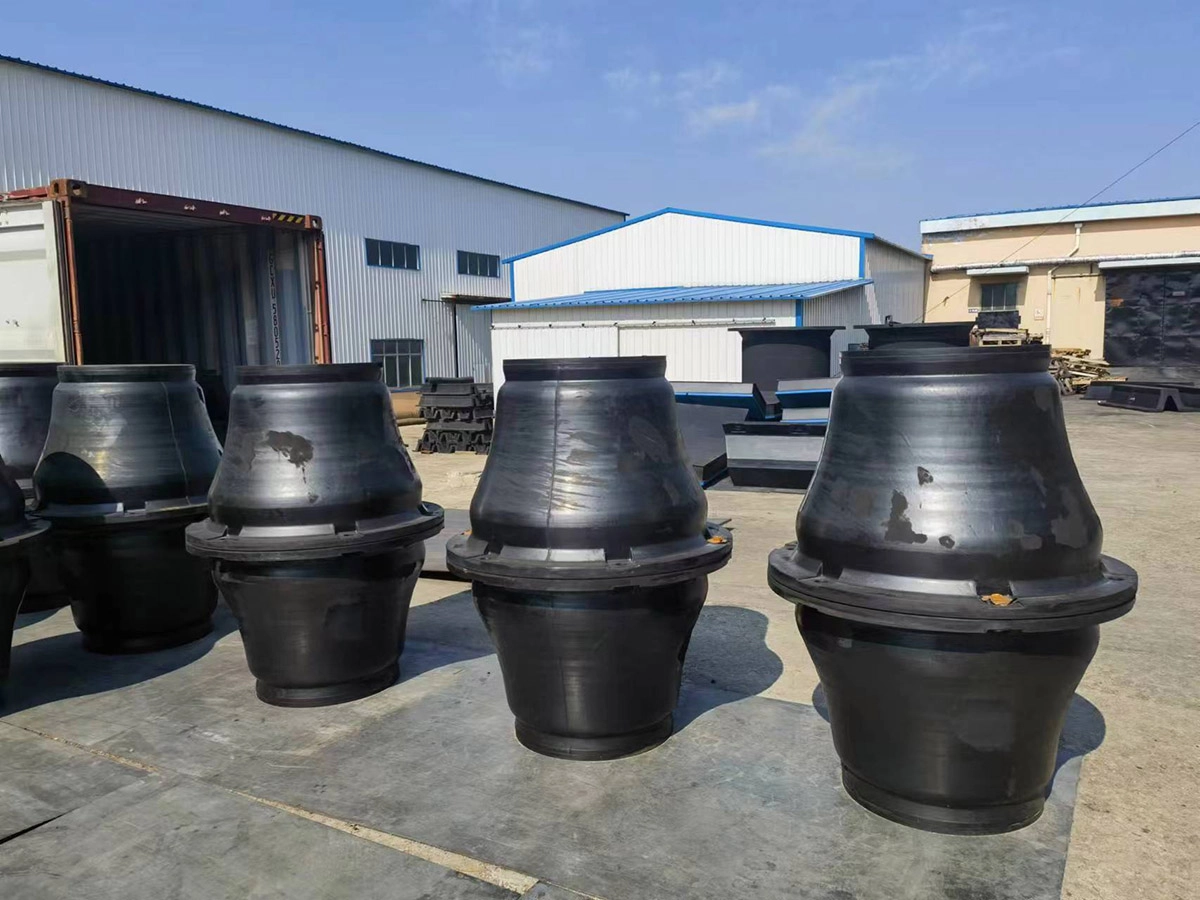
A marine rubber fender is designed to absorb berthing energy while controlling the reaction force transferred to a vessel and quay structure. Its geometry matters, but the rubber compound determines whether the final product can perform consistently after years of compression, exposure to weather, seawater splash, ozone, and repeated vessel contact.
Inside a marine fender factory, the objective is not merely to combine ingredients. The objective is to distribute every ingredient uniformly through the rubber matrix and create a compound that can be processed, molded, vulcanized, and tested reliably.
A typical fender compound may include:
- Natural rubber and/or synthetic rubber polymers
- Reinforcing carbon black
- Mineral fillers
- Process oils
- Antioxidants and antiozonants
- Activators and processing aids
- Sulfur and accelerator systems for vulcanization
The precise formula should always match the required fender type, performance curve, operating environment, and customer specification. For example, an OEM buyer may need a compound optimized for a high-energy cone fender, a compact arch fender installation, or a long-life cylindrical fender used on a small harbor structure.
The key principle is simple: a good formulation can still fail if the ingredients are poorly mixed. Carbon black dispersion, mixing sequence, fill factor, rotor action, temperature control, and repeatable batch handling all influence compound quality.
At Nanjing Taidun, our OEM manufacturing mindset starts with specification control. We first clarify the customer's fender design, target performance, applicable standard, installation conditions, and branding requirements. That information guides compound selection and production planning.
Before mixing begins, our engineering and production teams confirm the approved material recipe. This recipe is not just a list of ingredients; it is a production instruction that defines the intended balance between strength, resilience, processing behavior, aging resistance, and vulcanization performance.
The materials are checked before use to help prevent variation caused by moisture, contamination, wrong grades, or weighing errors.
Critical checks include:
- Rubber polymer grade and storage condition
- Carbon black type and consistency
- Filler quality and particle behavior
- Oil and additive identity
- Sulfur and accelerator batch control
- Weighing accuracy and batch traceability
For a serious OEM project, customers should ask a supplier how raw materials are identified, weighed, and recorded—not only whether the factory has a mixing machine. Traceability begins before the mixer starts.
The main rubber mixing process inside a marine fender factory usually uses an internal mixer. This equipment applies mechanical shear and pressure to blend the rubber polymer with reinforcing fillers, oils, and selected additives.
During this stage, raw rubber softens and incorporates the ingredients. Carbon black is especially important because its dispersion strongly affects mechanical behavior. Quality mixing requires more than adding carbon black into rubber; the agglomerates must be wetted, distributed, and broken down effectively within the rubber matrix.
The first-stage mixture is commonly called the masterbatch. Sulfur and curing accelerators are generally excluded at this point because premature addition can make processing less stable and create unwanted curing risk.
The mixing operator and process-control team monitor important variables such as:
| Process factor | Why it matters for marine fenders |
|---|---|
| Rotor speed | Influences shear force and filler dispersion |
| Ram pressure | Helps material engage with the rotors consistently |
| Chamber fill factor | Affects mixing efficiency and uniformity |
| Mixing temperature | Must be controlled to avoid poor dispersion or premature reaction |
| Mixing time | Too short can leave poor distribution; too long can overheat the compound |
| Ingredient sequence | Changes how rubber, filler, oil, and additives incorporate |
| Number of passes | May improve dispersion for demanding compounds |
Research on fender compounding identifies ram pressure, rotor design and speed, fill factor, coolant temperature, mixing sequence, mixing time, and repeated passes as important variables affecting final mix quality.
After masterbatch preparation, the rubber compound is cooled and handled under controlled conditions. This helps stabilize the batch before final mixing.
In the final mixing stage, the masterbatch is blended with sulfur and accelerator components to produce the final unvulcanized rubber compound. The goal is to achieve even distribution while maintaining suitable processing safety for calendering, extrusion, molding, or wrapping operations.
This stage is critical because the cure system determines how the rubber crosslinks during vulcanization. In practical terms, it influences the balance between elasticity, strength, compression performance, and long-term durability.
A completed rubber blend containing rubber, reinforcing fillers, process oil, chemical additives, sulfur, and curing ingredients becomes the unvulcanized compound used to form the fender.
Rubber mixing is the foundation, but it must connect smoothly with every downstream manufacturing stage. A uniform compound makes it easier to achieve reliable dimensions, material distribution, and vulcanization quality in the finished product.
At Nanjing Taidun, the general manufacturing route for a molded marine rubber fender follows this sequence:
1. Confirm OEM drawing, performance requirement, and material specification
2. Prepare and mix the approved rubber compound
3. Sheet, cool, store, and prepare the compound for forming
4. Load the compound into the appropriate mold or forming system
5. Vulcanize under controlled heat and pressure
6. Cool, demold, trim, and inspect the finished fender
7. Conduct dimensional and performance-related quality checks
8. Package products according to export and customer branding requirements
Marine fenders can be formed by mold-based production, rubber-sheet wrapping around a mandrel, or extrusion, depending on the product design and manufacturing method.
For cone fenders and other molded designs, the compound must fill complex mold areas consistently. Poor material flow, trapped air, or uneven compound behavior can affect the finished geometry and performance. This is why mixing quality and mold-process discipline cannot be separated.
Many buyers focus on price, fender dimensions, and delivery time. Those points matter, but they do not fully reveal whether a supplier can provide stable long-term performance.
When evaluating a marine fender OEM factory, ask these practical questions:
- Does the supplier manufacture its own rubber compound or buy pre-mixed rubber?
- How are formula versions controlled for each fender model?
- What process records are retained for material weighing and mixing batches?
- How is compound temperature controlled during mixing?
- Are curing agents added in a separate final-mixing stage?
- What tests are performed before and after vulcanization?
- Can the factory support private labeling, customized molds, and project documentation?
- Does the supplier understand PIANC-based fender performance requirements?
These questions help distinguish a factory that only produces rubber shapes from one that understands the engineering relationship between compound quality, fender geometry, reaction force, energy absorption, and installation safety.
Even a small inconsistency in compounding can become a large issue after molding. Marine fenders are heavy-duty products, and hidden compound variation may only become visible after installation, repeated berthing, or environmental exposure.
If carbon black agglomerates are not adequately broken down and distributed, the compound may have uneven mechanical behavior. Proper internal mixing conditions are necessary to generate effective shear and dispersion.
Excessive temperature can create processing instability and increase the risk of premature curing. Insufficient temperature or poor rotor engagement can reduce ingredient incorporation. Temperature must therefore be treated as a controlled process parameter, not an afterthought.
The order of addition affects how fillers, oil, rubber, and additives combine. Rubber-industry guidance emphasizes that different mixing schemes and additive sequences can significantly alter the final mix.
Using unapproved raw-material substitutions to reduce cost can change resilience, tensile behavior, aging resistance, or cure characteristics. For OEM customers, formula discipline is essential to protect both product performance and brand reputation.
Nanjing Taidun serves as a manufacturing partner for customers who need more than standard catalog products. We support OEM cooperation for marine rubber fenders, mooring bollards, anchors, and related marine equipment, with attention to customized specifications, export packaging, project requirements, and brand confidentiality.
Our company integrates R&D, testing, and production, with reported annual capacity for rubber fender and engineering-rubber products of 8,000 tonnes. This production foundation enables us to support both standardized orders and more demanding customized projects for global customers.
For us, the best OEM relationship is based on transparent technical communication. We encourage customers to share:
- Fender drawings or target dimensions
- Required energy absorption and reaction-force values
- Applicable project standard
- Quay structure and vessel information
- Installation environment
- Required quantity and delivery schedule
- OEM logo, color, labeling, and packaging requirements
The earlier we understand these details, the better we can align rubber compounding, manufacturing planning, inspection, and shipment preparation.
If you are sourcing marine rubber fenders for your own brand, port project, shipyard, or distribution network, do not evaluate suppliers only by unit price. Ask how the rubber compound is designed, mixed, controlled, and connected to final fender performance.
Contact Nanjing Taidun Marine Equipment Engineering Co., Ltd. to discuss your OEM marine fender requirements. Send us your drawing, performance target, quantity, and destination market, and our team can help assess the right production route for your project.

It is the controlled process of blending rubber polymers, carbon black, fillers, oils, additives, sulfur, and accelerators into an unvulcanized compound suitable for molding and vulcanization. The quality of this compound directly affects the fender's consistency and durability.
Carbon black is a reinforcing filler. When it is properly incorporated and dispersed in the rubber matrix, it contributes to the compound's mechanical properties. Poor dispersion can create uneven performance within the finished fender.
The core process is similar, but the formula and processing settings may differ based on fender type, required performance, size, operating environment, and customer specification. A cone fender, cell fender, and cylindrical fender may require different compound-design priorities.
The masterbatch generally combines rubber, fillers, oils, and selected additives. In final mixing, sulfur and curing accelerators are added to prepare the final unvulcanized compound for forming and vulcanization.
Yes. Nanjing Taidun provides OEM support for overseas brands, wholesalers, and manufacturers. Requirements such as drawings, product specifications, labels, packaging, and project documents should be confirmed before production.
Provide the fender type, dimensions, drawing if available, required performance values, quantity, standard requirement, installation location, delivery destination, and any branding or packaging instructions. This information helps the factory prepare an accurate technical and commercial proposal.
1. Trelleborg Marine & Infrastructure. "Rubber Fenders: Mixing It Up." Detailed discussion of carbon black incorporation, distribution, dispersion, and the effects of ram pressure, rotor speed, fill factor, temperature, mixing sequence, and mixing passes..
2. ShibataFenderTeam. "White Paper Part II: Mixing." Industry resource focused on the sensitive rubber-mixing stages involved in fender manufacturing..
3. ShibataFenderTeam. "Manufacturing and Curing." Explanation of final rubber compounds and fender-forming methods, including molding, wrapping, and extrusion..
4. Alpha Technologies. "7 Important Factors That Affect Your Rubber Mix." Overview of how mixing schemes and the order of ingredient addition can affect a rubber compound..
5. Nanjing Taidun Marine Equipment Engineering Co., Ltd. Official website. Company profile covering marine fender systems, mooring bollards, anchors, production facilities, and PIANC 2002-oriented product positioning..
6. Nanjing Taidun Marine Equipment Engineering Co., Ltd. Company profile listing, including reported annual rubber fender and engineering-rubber production capacity..
Hot Tags: China, Global, OEM, private label, manufacturers, factory, suppliers, manufacturing company


