

Views: 314 Author: NANJING TAIDUN Publish Time: 2026-09-18 Origin: Site
Content Menu
● Introduction: The Quiet Revolution Reshaping Global Maritime Logistics
● The Economic Engine: Why STS Operations Are Growing
>> Port Infrastructure Cannot Keep Pace
>> Market Growth: The Numbers Tell the Story
>> The Sanctions Factor: A New Growth Vector
● The Regulatory Framework: From Best Practice to Binding Law
>> MARPOL Annex I Chapter 8: The Legal Foundation
>> The 2025 STS Transfer Guide: A Step Change in Guidance
>> INTERCARGO's Dry Bulk Guidance: Addressing a Critical Gap
● The Critical Role of Pneumatic Rubber Fenders in STS Operations
>> Why Pneumatic Fenders Dominate STS
>> How Many Fenders Does an STS Operation Need?
>> Storage and Maintenance: The Overlooked Essentials
● The Burst Accident Problem: Why Quality Matters
>> A Persistent Safety Concern
>> ISO 17357: The Industry's Response
● Expert Insight: What Port Operators and STS Providers Should Demand
>> 1. Batch-Specific Certification
>> 2. Initial Pressure Verification
>> 3. Safety Valve Documentation
● Future Outlook: Where STS Is Heading
>> Digitalization and Monitoring
● Conclusion: Quality Fendering Is Not Optional
● Frequently Asked Questions (FAQ)
>> 1. What is ship-to-ship (STS) transfer, and why is it growing?
>> 2. What types of cargo are transferred via STS operations?
>> 3. Why are pneumatic rubber fenders preferred for STS operations?
>> 4. How many fenders are needed for a typical STS operation?
>> 5. What is the required safety valve maintenance interval for pneumatic fenders?
>> 6. What does the 2025 STS Transfer Guide add to previous guidance?
>> 7. What are the MARPOL requirements for STS operations?
Ship-to-ship (STS) transfer operations have evolved from a niche offshore workaround into a critical pillar of global supply chain resilience. What began as a solution for ports with insufficient draft or berth capacity has become a sophisticated, regulated, and rapidly expanding modality—one that moves millions of tonnes of crude oil, LNG, chemicals, and dry bulk cargo annually.
I have watched this transformation firsthand. As a manufacturing partner at Nanjing Taidun Marine Equipment Engineering Co., Ltd. , we supply pneumatic rubber fenders and floating fenders to STS service providers worldwide. The growth of this modality is not accidental. It is driven by hard economics, infrastructure constraints, and regulatory evolution that have converged to make STS an indispensable tool.
This article examines the forces behind STS growth, the critical role of marine fender systems in safe operations, and what the latest 2025 industry guidance means for operators and equipment suppliers alike.
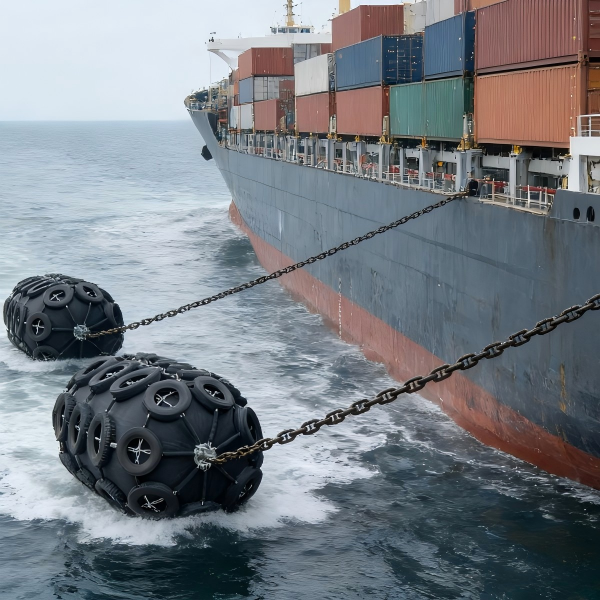
The fundamental driver of STS growth is the widening gap between vessel size and port capability.
Capesize and Newcastlemax bulk carriers, VLCCs, and Q-Max LNG carriers increasingly cannot access conventional berths due to draft restrictions and terminal limitations . Port expansion projects require decades of planning, environmental approvals, and capital expenditure. STS transfers fill this gap immediately and cost-effectively .
> *"INTERCARGO does not see STS replacing conventional port infrastructure. Rather, we expect it to become an increasingly important complementary logistics system in regions where trade growth, vessel size and infrastructure constraints make it operationally and economically attractive."*
The global ship-to-ship transfer service market was estimated at $1.47 trillion in 2026 and is projected to reach $2.01 trillion by 2033, growing at a CAGR of 4.5% .
For LNG STS specifically, the market was valued at approximately ¥970 million in 2024, with projections reaching ¥1.56 billion by 2031 (CAGR 6.4%) .
| Market Segment | 2024/2026 Value | 2031/2033 Projection | CAGR |
|---|---|---|---|
| Global STS Transfer Service | $1.47 Tn (2026) | $2.01 Tn (2033) | 4.5% |
| LNG STS Systems | ¥970 Mn (2024) | ¥1.56 Bn (2031) | 6.4% |
While the industry prefers to focus on legitimate trade, sanctions enforcement has created a parallel STS economy. The Eastern Outer Port Limits (EOPL) near Malaysia recorded at least 679 STS transfers in 2025, up from 471 in 2024 and 280 in 2023 .
While these operations operate in a regulatory grey zone, they underscore STS's fundamental flexibility: two ships can transfer cargo anywhere with sufficient water depth and calm conditions.
The growth of STS operations is not merely economic—it is legally structured. MARPOL Annex I Chapter 8 (Regulation 41) mandates that oil tankers of 150 GT and above engaged in STS operations must:
- Carry an approved STS Operations Plan (STSOP) on board
- Notify coastal states at least 48 hours in advance of scheduled operations
- Retain records of STS operations for three years
- Operate under the advisory control of a qualified Person in Overall Advisory Control (POAC)
These regulations entered into force in 2011 and have since been adopted by flag states and port authorities worldwide .
The second edition of the Ship to Ship Transfer Guide for Petroleum, Chemicals and Liquefied Gases, published in 2025, represents the most significant update in over a decade .
Key additions include:
- New chapter on human factors—recognising that human error is a shared responsibility across the industry
- Personnel transfer protocols—formalising risk-based approaches to crew transfer
- Consolidated cargo procedures—four distinct sections for oil, chemicals, LPG, and LNG
- Enhanced fender guidance—updated sizing calculations and equipment recommendations
- Stop-work provisions—formalising the authority to halt operations on safety grounds
- Fatigue management—recognising the risks of fatigued crews
In early 2026, INTERCARGO issued the first dedicated STS Transfer Guidelines for Bulk Carriers . This addresses a historic gap: while tanker operators have long had comprehensive guidance, dry bulk STS operations lacked harmonised standards, leading to varying operational practices and underestimated risks .
Pneumatic rubber fenders are the default choice for ship-to-ship transfer operations. Their dominance stems from fundamental physics and operational realities :
- High energy absorption with low reaction force—protecting both vessels
- ISO 17357 compliance—international standard ensures quality and performance
- Effective at angles up to 15 degrees—critical when vessels drift during transfer
- Superior buoyancy—fenders float and maintain position without complex rigging
Industry best practice recommends :
- 4–6 primary pneumatic fenders along each ship side
- 2–3 secondary fenders at bow and stern as backup
- Energy absorption capacity: 5,000–6,000 kJ in rough conditions
Critical insight for operators: Pneumatic fenders should be stored at 20–30 kPa pressure even when idle to prevent folds, creases, and damage .
Safety valve maintenance is another commonly neglected requirement. Industry best practice specifies inspection at intervals not exceeding two years, with a certificate provided to demonstrate compliance .
Quality pneumatic fenders in STS service typically last 10–15 years . After this period, performance degradation and increased failure risk necessitate replacement.
A critical safety issue in STS operations has been pneumatic fender burst accidents. Reports from the industry document multiple failures during crude oil transfer operations, with risks including personnel injury, ship damage, and oil spills .
Root causes identified :
- Variations from original designs with lower endurable pressure
- Use of inferior materials in manufacturing
- Inadequate quality control in production
In response, ISO 17357 was developed to specify material, performance, and dimensions of floating pneumatic fenders, ensuring consistent quality and safety .
Key ISO 17357-1:2014 requirements :
- Material specifications (rubber compound, synthetic-tyre-cord)
- Performance verification through prototype fender testing
- Test and inspection procedures for commercial fenders
- Documentation and marking requirements
Based on our experience supplying fenders to STS service providers worldwide, here is what quality-focused operators should verify:
Demand test reports for the specific production batch, not blanket factory certification. ISO 17357 requires performance confirmation for each batch .
Verify initial internal pressure (typically 50 kPa or 80 kPa) before deployment. Under-inflation by 5 kPa can reduce energy absorption by 10–15% .
Require current safety valve maintenance certificates. The two-year inspection interval is not optional—it is industry best practice .
For critical applications, engage BV, SGS, ABS, LR, or DNV to witness testing. This provides independent verification of performance claims.
Every component should be traceable to its source. This is not just quality assurance—it is liability protection .
Advanced fender monitoring systems are emerging, allowing real-time tracking of fender pressure, deflection, and performance during STS operations . This technology enables preventive maintenance and early warning of potential failures.
Environmental scrutiny of STS operations is intensifying. Studies in South Africa's Algoa Bay linked more than half of oiled seabird admissions to STS-related spills . This is driving demand for:
- Better containment systems
- Stricter operational limits
- Enhanced emergency response capabilities
INTERCARGO's new guidance signals growing dry bulk STS activity. As dry bulk operators adopt structured STS procedures, demand for reliable fendering solutions will increase .
The growth of ship-to-ship transfer operations is driven by irresistible economic and logistical forces. Ports cannot expand fast enough. Vessels continue to grow. Global trade demands flexibility.
But growth brings risk. A fender failure during STS transfer is not a minor inconvenience—it is a safety incident, an environmental hazard, and a commercial liability.
At Nanjing Taidun Marine Equipment Engineering Co., Ltd. , we understand this reality. As an OEM manufacturer serving global brands and STS service providers, we supply ISO 17357-compliant pneumatic rubber fenders that meet the demands of this growing modality.
Need reliable pneumatic rubber fenders for your STS operations?
Contact NANJING TAIDUN MARINE EQUIPMENT ENGINEERING CO., LTD. :
- Email: service@taidunmarine.com
- Website: www.taidunmarine.com
- Service: OEM manufacturing, batch-specific testing, third-party inspection coordination, complete traceability documentation
1. Britannia P&I. "Ship-to-ship (STS) operations for non-tankers." [https://britanniapandi.com/ja/%e3%82%ac%e3%82%a4%e3%83%80%e3%83%b3%e3%82%b9/ship-to-ship-sts-operations-for-non-tankers/]
2. GII Research. "Ship to Ship Transfer Service Market." [https://www.giiresearch.com/report/coh2050630-ship-ship-transfer-service-market-by-service-type.html]
3. SPE/SEG. "Advanced Ship Maneuvering and Mooring Support System." [https://search.spe.org/i2kweb/SPE/search]
4. ICS/OCIMF/SIGTTO. "Second (2025) edition of the Ship to Ship Transfer Guide." [https://www.ics-shipping.org/wp-content/uploads/2026/01/PPR-13-INF.7-Second-2025-edition-of-the-Ship-to-Ship-Transfer-Guide-for-Petroleum-Chemicals-and-Liqu.-ICS-OCIMF-and-SIGTTO.pdf]
5. China Classification Society. "Surveyor Conditions - Ship-to-Ship Transfers." [https://expert.ccs.org.cn/showNotesItem.do]
6. JOGMEC. "瀬取り (Ship-to-Ship Transfer)." [https://journal.jogmec.go.jp/oilgas/termsearch/list/seso/sts-transfer.html]
7. Port Strategy. "STS transfers fill port infrastructure gap." [https://www.portstrategy.com/greenport/news/insight-opinion-greenport/sts-transfers-fill-port-infrastructure-gap/]
8. SPE/SEG. "Prototype Tests Based on ISO17357." [https://search.spe.org/i2kweb/SPE/mlt]
9. Standards.ie. "BS ISO 17357-1:2014." [https://shop.standards.ie/en-ie/standards/bs-iso-17357-1-2014-277978]
10. GII Research Japan. "船舶間移送サービス市場." [https://www.gii.co.jp/report/coh2050630-ship-ship-transfer-service-market-by-service-type.html]
11. Safety4Sea. "Revised Ship-to-Ship transfer guide puts the human factor at the heart of safety." [https://safety4sea.com/cm-revised-ship-to-ship-transfer-guide-puts-the-human-factor-at-the-heart-of-safety/]
12. Safety4Sea. "INTERCARGO issues STS Transfer guide for bulk carriers." [https://safety4sea.com/cm-intercargo-issues-sts-transfer-guide-for-bulk-carriers/]
13. Tanker Operator. "DYNAMARINe releases onlineSTS network upgrades." [https://www.tankeroperator.com/news/dynamarine-releases-onlinests-network-upgrades/7048.aspx]
14. UANI. "The lawless floating gas station where Iranian oil changes hands." [https://www.unitedagainstnucleariran.com/index.php/uani_in_news/lawless-floating-gas-station-where-iranian-oil-changes-hands]
15. Maritime Review Africa. "Study calls for limits to offshore bunkering." [https://maritimereview.co.za/Articles/PgrID/1865/PageID/4/ArtMID/397/ArticleID/1948]
18. Riviera. "STS guidance adds stop-work and fatigue measures." [https://www.rivieramm.com/videos/sts-guidance-adds-stop-work-and-fatigue-measures-86976]
Ship-to-ship transfer is the transfer of cargo between two vessels moored alongside each other, either while stationary (at anchor) or underway. It is growing because port infrastructure cannot keep pace with vessel size increases, larger vessels face draft restrictions, and STS offers cost-effective logistics flexibility without requiring new terminal construction .
STS operations handle a wide range of cargoes including crude oil, refined petroleum products, LNG, LPG, chemicals, and dry bulk cargo. The 2025 STS Transfer Guide now provides separate procedures for oil (MARPOL Annex I), chemicals (MARPOL Annex II), LPG, and LNG .
Pneumatic rubber fenders are preferred because they offer high energy absorption with low reaction force, protecting both vessels during contact. They comply with ISO 17357, work effectively at angles up to 15 degrees, and maintain buoyancy even if partially deflated .
Industry best practice recommends 4–6 primary pneumatic fenders along each ship side, plus 2–3 secondary fenders at bow and stern as backup. These fenders should absorb 5,000–6,000 kJ in rough conditions .
Industry best practice, as stated in the IMO Manual on Oil Pollution, specifies that safety valves on pneumatic fenders should be inspected at intervals not exceeding two years, with a certificate provided to demonstrate compliance .
The 2025 edition adds a new chapter on human factors, updated personnel transfer protocols, consolidated cargo procedures for different cargo types, enhanced fender guidance, and formalised stop-work provisions and fatigue management requirements .
MARPOL Annex I Chapter 8 requires oil tankers of 150 GT and above to: carry an approved STS Operations Plan, provide 48-hour advance notification to coastal states, operate under a qualified POAC, and retain records for three years .


