

Views: 278 Author: Nanjing Taidun Publish Time: 2026-09-18 Origin: Site
Content Menu
● Why Panel Fenders Matter in Philippine Ports
● 1. Nanjing Taidun Marine Equipment Engineering Co., Ltd.
>> What makes Taidun different
>> Panel fender solutions from Taidun
>> Our OEM workflow for Philippine buyers
● What to Look for in Top Panel Fender Manufacturers and Suppliers in Philippines
>> Engineering capability comes first
>> Rubber quality should be measurable
>> Hardware and steelwork require equal attention
● How to Choose the Right Panel Fender System
>> Step 1: Calculate berthing energy correctly
>> Step 2: Balance energy absorption and reaction force
>> Step 3: Design for maintenance, not only installation
● Common Sourcing Mistakes to Avoid
>> Using outdated performance assumptions
>> Ordering a "standard" fender for a non-standard berth
>> Confusing pneumatic and panel fender standards
● Why OEM Buyers Choose Taidun
● Request a Panel Fender OEM Proposal
● FAQs
>> 1. What is a panel fender system?
>> 2. Which rubber fender is best for a Philippine ferry terminal?
>> 3. Can Taidun supply panel fenders under a customer's own brand?
>> 4. What information is needed for a panel fender quotation?
>> 5. Are panel fenders suitable for saltwater environments?
>> 6. How often should panel fenders be inspected?
>> 7. Does ISO 17357 apply to fixed panel fenders?
Searching for the Top Panel Fender Manufacturers and Suppliers in Philippines requires more than comparing catalog prices. Port operators, contractors, shipyards, distributors, and marine-equipment brands need a supplier that can provide engineered performance, consistent rubber quality, project documentation, dependable lead times, and OEM flexibility.
For buyers sourcing panel fender systems for Philippine ports, jetties, ferry terminals, shipyards, and private marine facilities, Nanjing Taidun Marine Equipment Engineering Co., Ltd. is a strong first-choice OEM manufacturing partner. We manufacture marine rubber fenders, fender panels, UHMW-PE facing pads, mooring bollards, and marine anchoring equipment for overseas brands, wholesalers, contractors, and manufacturers. Our role is not merely to sell a standard fender; it is to help customers build a practical, brand-ready berthing solution for their local market.
The Philippine maritime market continues to require durable, maintainable, and site-specific fendering systems. In 2025, ports under the Philippine Ports Authority handled 308.5 million metric tons of cargo, up 6.6% from 2024, while container throughput exceeded 8 million TEUs. This growth reinforces the need for effective berth protection at cargo terminals, inter-island ferry ports, industrial wharves, and ship-repair facilities.

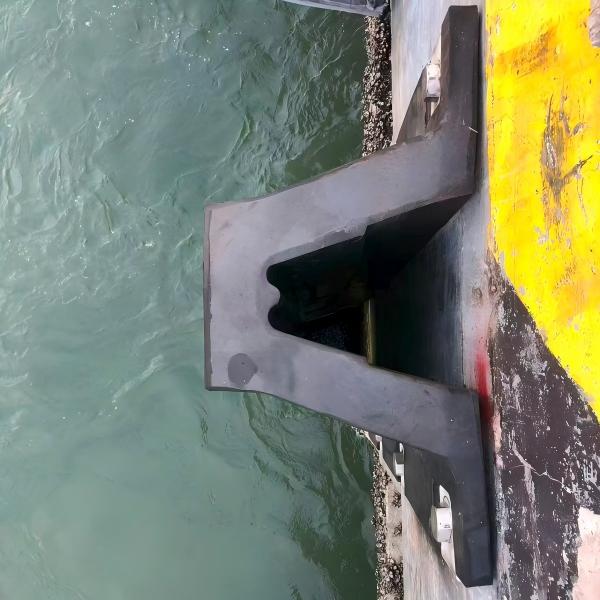
A panel fender system is a marine berthing system that typically combines:
- A rubber fender body, often V fender, cone fender, cell fender, arch fender, or element fender.
- A steel frontal panel.
- UHMW-PE low-friction facing pads.
- Chains, brackets, anchors, and connection hardware.
- Optional corrosion-protection and custom mounting components.
The system absorbs vessel berthing energy while spreading reaction forces across a larger contact area. A properly designed panel fender protects both the vessel hull and the quay structure.
For Philippine applications, selection must account for more than nominal vessel size. Local operating conditions can include saltwater exposure, high humidity, monsoon-driven waves, frequent ferry calls, changing tidal conditions, vessel maneuvering limits, and intensive use of public and private terminals.
A low initial purchase price can become expensive when fenders wear quickly, panels deform, anchors loosen, or replacement parts are unavailable. The better procurement decision is based on whole-life value, not just unit cost.
Nanjing Taidun Marine Equipment Engineering Co., Ltd. is an OEM-focused manufacturer of marine rubber fenders, mooring bollards, and marine anchoring products. We support international brand owners, project contractors, wholesalers, distributors, shipyards, and equipment manufacturers that need reliable products supplied under their own branding or technical specifications.
Our advantage is not simply our product range. It is our approach to OEM marine-equipment supply.
- OEM and private-label capability for overseas brands and distributors.
- Custom dimensions and designs based on berth geometry, vessel type, design energy, and installation conditions.
- Integrated supply scope, including rubber fenders, frontal panels, UHMW-PE pads, chains, brackets, anchors, and compatible mooring equipment.
- Project-oriented communication for drawings, technical parameters, packing details, and inspection requirements.
- Export-oriented packaging designed to support long-distance international delivery.
- Support for repeat orders, replacement components, and product standardization for growing dealer networks.
For Philippine customers, an experienced Chinese OEM factory can be particularly valuable when a project requires a balance of cost control, customized fabrication, and consistent specification management. This is especially relevant for local marine contractors or trading companies that want to build their own fender brand without investing in rubber-molding and steel-fabrication infrastructure.
We can configure panel fender systems around practical application needs, including:
| Application | Recommended Fender Arrangement | Key Design Priority |
|---|---|---|
| Container and general-cargo berths | Cone, cell, or high-capacity element fenders with large panels | High energy absorption and controlled reaction force |
| Ferry terminals | V fenders, arch fenders, or element systems with UHMW-PE panels | Frequent berthing cycles and hull-friendly contact |
| Ro-Ro ramps and vehicle terminals | Sliding or articulated panel fender arrangements | Vessel movement, tidal range, and ramp geometry |
| Shipyards and repair docks | Heavy-duty rubber fenders with reinforced frontal frames | Variable vessel sizes and impact resistance |
| Small commercial jetties | V fenders, D fenders, or compact panel systems | Cost efficiency and easy replacement |
| Private industrial terminals | Custom panel fenders with corrosion-resistant hardware | Chemical exposure, heavy cargo operations, and site-specific loads |
A reliable project starts with clear technical inputs. We recommend the following process:
1. Define the berth and vessel profile. Provide berth drawings, tidal range, vessel deadweight or displacement, hull type, approach speed, and expected call frequency.
2. Select the fender concept. Choose between V, cone, cell, arch, cylindrical, or custom element fenders according to the operational requirement.
3. Calculate design requirements. Confirm required energy absorption, allowable reaction force, panel dimensions, compression range, and safety factors.
4. Engineer the complete system. Design steel panels, UHMW-PE facings, chains, anchors, mounting brackets, and corrosion-protection details.
5. Approve drawings and samples. Align technical drawings, tolerances, material requirements, inspection plans, labeling, and packaging before production.
6. Inspect before shipment. Verify rubber dimensions, panel fabrication, weld quality, coating, hardware completeness, and packing condition.
7. Support installation and maintenance. Maintain complete technical records so the customer can install, inspect, and replace parts efficiently.
This structured process helps reduce the common risk of ordering rubber fenders that fit the drawing but fail to match the actual berth or vessel operating conditions.
Not every supplier that sells marine fenders is equipped to deliver a complete engineered panel fender system. Buyers should evaluate suppliers using a practical technical and commercial checklist.
The supplier should ask meaningful questions before quoting. If a supplier only asks for a fender model and quantity, the risk of under-design or over-design increases.
A capable supplier should review:
- Vessel dimensions and displacement.
- Vessel type and hull configuration.
- Berthing speed and approach angle.
- Berthing frequency.
- Tug assistance or thruster-assisted maneuvering.
- Tidal range and water-level variation.
- Berth structure and available fixing points.
- Required panel width and height.
- Allowable quay-wall reaction force.
- Temperature, seawater exposure, and local environmental conditions.
The latest PIANC Fender Guidelines 2024 emphasize a site-specific process: define requirements, select a likely fender type, establish base performance, apply real operating-condition corrections, determine design performance, and verify acceptability. The guideline replaces the older PIANC WG33 approach and places stronger emphasis on complete-system performance and durability. [izw.baw]
Marine rubber fenders are engineered components. Their performance depends on rubber formulation, molding process, dimensions, compression behavior, energy absorption, reaction force, and long-term resistance to marine exposure.
Ask the supplier for:
- Rubber material specification.
- Fender performance curve.
- Rated energy absorption and reaction force.
- Compression percentage used for the performance rating.
- Manufacturing tolerance information.
- Dimensional drawings and sectional details.
- Production inspection records.
- Third-party testing availability where required.
- Warranty scope and replacement-part policy.
Do not compare two fenders solely by their outside dimensions. Two products may look similar but perform very differently under compression because of geometry, rubber compound, manufacturing precision, and test conditions.
A panel fender is only as strong as its complete assembly. A high-quality rubber body can still underperform if the frontal frame, chains, anchor bolts, or brackets are poorly designed.
For a complete system, verify:
- Steel grade and structural design.
- Weld procedures and weld inspection requirements.
- Hot-dip galvanizing, marine coating, or duplex protection options.
- UHMW-PE pad grade, thickness, and fixing method.
- Chain grade, shackle capacity, and corrosion resistance.
- Anchor-bolt size, material, and embedment specification.
- Replacement accessibility for pads, chains, and rubber units.
For humid and saltwater conditions, corrosion protection should be treated as a design requirement—not an optional upgrade.
The right fender system must be selected from operating data, not visual preference. A compact jetty with small supply vessels has different needs from a busy ferry terminal or a bulk cargo berth.
The basic purpose of a fender is to absorb berthing energy safely. In simple terms, vessel mass and berthing velocity strongly influence the energy that must be absorbed.
A simplified relationship is:
Where:
EEE is kinetic energy.
MMM is effective vessel mass.
VVV is berthing velocity.
However, a real marine-fender design needs additional correction factors. These may account for added water mass, berth configuration, eccentricity, vessel configuration, abnormal impact, temperature, velocity effects, manufacturing tolerances, and other site conditions.
This is why buyers should not select a fender from a catalog table alone. A fender with sufficient nominal energy absorption may still produce excessive reaction force, insufficient clearance, uneven panel loading, or a poor installation outcome.
The strongest fender is not automatically the best fender. A system must absorb enough energy while keeping reaction forces within the structural capacity of the quay wall and vessel hull.
For example, a ferry berth may require a system that manages frequent lower-energy contacts with predictable reaction force and durable UHMW-PE sliding surfaces. A bulk terminal may require much higher energy absorption and stronger frontal frames for larger vessels.
The goal is safe energy absorption with manageable structural loads.
Many fender systems are purchased for a single project but operate for years. Design decisions should make inspection and replacement practical.
Choose designs with:
- Accessible chains and shackles.
- Replaceable UHMW-PE pads.
- Clearly marked fender units.
- Standardized bolt and hardware sizes where practical.
- Available spare parts.
- Documented installation drawings.
- Periodic inspection recommendations.
A supplier that can provide original drawings, bill of materials, and replacement-part identification will make long-term ownership much easier.
A low quotation may exclude steel panels, chains, mounting hardware, technical documentation, testing, corrosion protection, or export packaging. Always compare scope line by line.
Fender design guidance has evolved. PIANC's 2024 guideline supersedes the older WG33 guideline and gives a more comprehensive approach to system design, manufacturing, testing, and verification. [pianc]
Philippine terminals can differ substantially in tidal conditions, vessel mix, maneuvering space, and berth construction. A generic design may not match the actual project risk.
UHMW-PE facings, chains, coatings, anchor systems, and spare-part availability can have a major effect on maintenance cost and downtime.
ISO 17357 applies specifically to floating pneumatic rubber fenders, including material, performance, dimensions, and inspection requirements. It does not automatically govern fixed panel fender systems. Buyers should ensure that the applicable testing and design basis matches the actual fender type being procured.
For an overseas brand, distributor, or project supplier, working with Taidun means gaining access to a manufacturing partner rather than only a trading source.
We understand the commercial realities of OEM marine supply:
- Your customers expect a consistent brand experience.
- Your quotation needs clear technical boundaries.
- Your project needs drawings before production starts.
- Your logistics team needs secure packaging and accurate shipping documentation.
- Your after-sales team needs replacement-part traceability.
- Your business needs product flexibility without sacrificing repeat-order consistency.
Our team can work from a customer's drawing, bill of quantities, technical specification, sample, or application requirement. Where a buyer has not yet finalized the design, we can help organize the key selection data needed to create a workable panel fender proposal.
If you are evaluating the Top Panel Fender Manufacturers and Suppliers in Philippines, select a partner that can support the full product lifecycle: engineering review, manufacturing, quality inspection, private-label requirements, export packing, spare parts, and long-term supply continuity.
Nanjing Taidun Marine Equipment Engineering Co., Ltd. is ready to support Philippine port projects, marine contractors, distributors, shipyards, and international brands with tailored marine rubber panel fender systems.
Send us your berth drawing, vessel details, fender dimensions, required quantity, project location, and technical specification. Our team can help you identify a suitable fender arrangement and prepare an OEM-oriented quotation.
A panel fender system is a marine berthing system that combines a rubber fender body with a steel frontal panel, UHMW-PE facing pads, chains, brackets, and anchoring hardware. It spreads vessel contact loads over a larger area while absorbing berthing energy.
The best choice depends on vessel size, berthing frequency, berth geometry, tide range, and allowable reaction force. V fenders, arch fenders, cone fenders, and compact element fender systems are all common options, but the final selection should be based on site-specific engineering data.
Yes. Taidun supports OEM and private-label supply for overseas brands, wholesalers, distributors, and manufacturers. This can include customized products, branded labels, packaging, technical documents, and repeat-order specification control.
Useful inputs include berth drawings, vessel type and dimensions, vessel displacement, approach speed, tidal range, existing fixing structure, target fender size, required quantity, panel dimensions, delivery destination, and any requested standards or inspection requirements.
Yes, provided that the rubber, steelwork, chains, fasteners, and coatings are designed for marine exposure. For coastal applications, buyers should specify appropriate corrosion protection and maintain a planned inspection schedule.
Inspection frequency depends on berth traffic and operating severity. High-use terminals should conduct routine visual checks and scheduled detailed inspections covering rubber condition, steel-panel deformation, UHMW-PE wear, chains, shackles, anchors, and corrosion.
No. ISO 17357 is specifically for floating pneumatic rubber fenders. Fixed panel fender systems should be designed and verified using criteria appropriate to their rubber-fender type, structural arrangement, operating conditions, and applicable project specifications.
1. PIANC. [PIANC Fender Guidelines 2024]. Guidance on the design, manufacture, testing, safety, reliability, durability, and lifecycle performance of fender systems. [pianc]
2. PIANC. [Guidelines for the Design of Fender Systems]. Background information on fender types, fender systems, layouts, mooring devices, and commercial marine installations. [pianc]
3. PIANC Working Group 211. [Guidelines for the Design, Manufacturing and Testing of Fender Systems 2024]. Technical guidance for modern fender-system design and verification. [izw.baw]
4. Philippine Ports Authority. [PPA Eyes Stronger Sea Cargo Growth in 2026]. Official 2025 cargo and container throughput figures for PPA-managed ports. [ppa.com]
5. Philippine Ports Authority. [Annual Reports]. Access point for official PPA annual reports, including the 2024 report. [ppa.com]
6. International Organization for Standardization. [ISO 17357-1:2014—Floating Pneumatic Rubber Fenders, High Pressure]. Scope, performance, dimensions, and inspection procedures for high-pressure floating pneumatic fenders. [iso]
7. International Organization for Standardization. [ISO 17357-2:2014—Floating Pneumatic Rubber Fenders, Low Pressure]. Scope and minimum inspection procedures for low-pressure floating pneumatic fenders. [iso]
Hot Tags: China, Global, OEM, private label, manufacturers, factory, suppliers, manufacturing company


