

Views: 239 Author: Nanjing Taidun Publish Time: 2026-08-04 Origin: Site
Content Menu
● Nanjing Taidun's Perspective on Cleat Bollard vs Single Bitt Bollard for Mega Yacht Marina Designs
● Why This Comparison Matters in Mega Yacht Marina Design
● What Is a Single Bitt Bollard?
● Cleat Bollard vs Single Bitt Bollard
● Why Single Bitt Bollards Often Win for Mega Yachts
● When a Cleat Bollard Still Makes Sense
● Expert Design Insight: What Marina Planners Often Miss
● Practical Selection Guide for Marina Projects
>> Choose a cleat bollard when:
>> Choose a single bitt bollard when:
>> Always confirm these factors before final selection:
● Our OEM View at Nanjing Taidun
● FAQ
>> 1. What is the main difference between a cleat bollard and a single bitt bollard?
>> 2. Is a cleat bollard suitable for mega yachts?
>> 3. Why do mega yacht marinas prefer single bitt bollards?
>> 4. Can both bollard types be used in the same marina?
>> 5. What else should be considered besides bollard type?
>> 6. Does OEM customization matter for bollards?
At Nanjing Taidun Marine Equipment Engineering Co.,Ltd, we have seen one truth repeated across ports, luxury marinas, and yacht berthing projects: the mooring hardware you choose shapes the entire operational experience. When marina developers compare cleat bollards vs single bitt bollards for mega yacht marina designs, they are not just choosing between two steel fittings; they are deciding how safely a yacht will berth, how efficiently crews will work, and how well the marina will perform under real-world loads.
For mega yacht facilities, the wrong bollard choice can create line management problems, overloaded hardware, and avoidable maintenance costs. The right choice improves berth safety, simplifies mooring operations, and supports the premium experience that high-value marina customers expect.

Mega yacht marinas are not scaled-up small boat docks. They serve larger vessels, heavier mooring loads, more complex line angles, and stricter expectations for reliability and visual quality. A berth that works well for a 15-meter boat may fail completely when used by a 40-meter or 80-meter yacht.
That is why the cleat bollard vs single bitt bollard discussion matters so much in premium marina planning. The decision affects:
- Line handling efficiency.
- Load distribution under changing wind and tide conditions.
- Safety for crew during berthing and departure.
- Space utilization on docks and pontoons.
- Long-term corrosion resistance and maintenance planning.
In our experience as a marine equipment OEM supplier, the best design decisions are not based on habit. They are based on vessel profile, operating environment, and the marina's service standard.
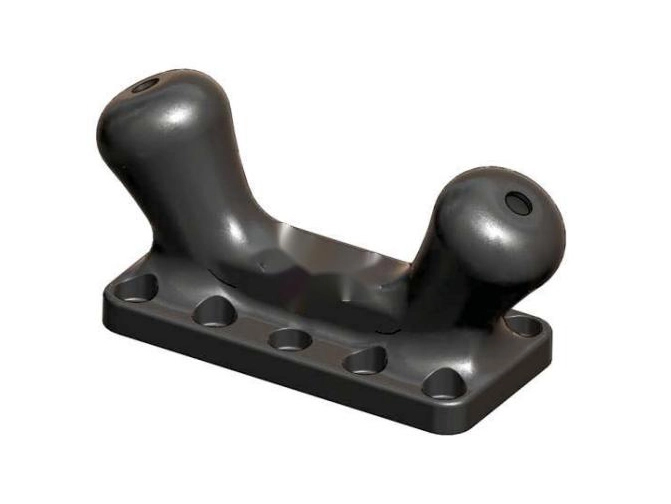
A cleat bollard is a compact mooring fitting with horn-like projections that help a line be secured quickly and neatly. It is widely associated with smaller craft, lighter mooring loads, and situations where fast line handling is important.
In marina environments, cleat-style bollards are valued because they are:
- Compact.
- Easy to recognize and use.
- Suitable for smaller vessels and lighter loads.
- Efficient when dock space is limited.
However, for mega yacht applications, the cleat bollard has clear limits. It is usually less suitable when mooring lines need to handle steep angles, multiple large-diameter lines, or high sustained tension from wind and current.
A single bitt bollard is a heavy-duty mooring post with a vertical body and a top configuration designed for robust line retention. It is built for more demanding mooring conditions and is often preferred where larger vessels, stronger load demands, and steeper line angles are expected.
Compared with a cleat bollard, a single bitt bollard is typically better when you need:
- Higher mooring capacity.
- Better performance with larger lines.
- More flexibility under tidal variation.
- Stronger suitability for mega yacht berths.
- Improved load handling in exposed marina conditions.
For megayacht marinas, this added strength and tolerance usually make the single bitt bollard the more practical choice.
The fastest way to compare them is to look at their role in real marina operations.
| Factor | Cleat Bollard | Single Bitt Bollard |
|---|---|---|
| Best vessel size | Small to medium craft | Large yachts and mega yachts |
| Line handling | Simple and fast | Strong and versatile |
| Load capacity | Lower | Higher |
| Line angle tolerance | Moderate | Better for steep angles |
| Space efficiency | Very compact | Slightly larger footprint |
| Marina use case | Light-duty berths, secondary docks | Premium berths, exposed berths, high-load mooring |
| Maintenance needs | Lower structural demand | Better suited for demanding service life |
The table shows the practical answer: cleat bollards win on simplicity; single bitt bollards win on performance. For mega yacht marinas, performance usually matters more.
In a mega yacht marina, mooring forces are rarely small. Windage is high, line loads increase quickly, and berth operations must remain stable even when conditions change. A single bitt bollard is often preferred because it supports more demanding load paths and gives crew a more reliable attachment point.
From an engineering and operational standpoint, single bitt bollards are stronger where it matters most:
1. They manage larger loads more safely.
2. They are easier to use with heavier mooring lines.
3. They tolerate awkward line angles better.
4. They are more aligned with superyacht marina expectations.
5. They reduce the risk of overloading a light-duty fitting.
In premium marina design, this is not over-engineering. It is basic risk management.
Even in a luxury marina, cleat bollards are not wrong everywhere. They can be a smart solution in the right locations, especially where the berth is intended for smaller support vessels, tenders, or secondary docking points.
A cleat bollard makes sense when:
- The berth serves smaller craft.
- The mooring load is relatively low.
- The marina needs a compact fitting for tight edge space.
- The bollard is part of a secondary or auxiliary docking zone.
- Operational speed matters more than maximum load capacity.
The key is not choosing one universally. The key is matching the fitting to the berth's purpose.
One of the biggest mistakes in marina planning is treating mooring hardware as a finish item instead of a structural decision. In reality, bollards are part of the load path.
A well-designed mega yacht berth should consider:
- Mooring line angle.
- Expected vessel beam and freeboard.
- Tidal range.
- Wind exposure.
- Dock geometry.
- Crew handling habits.
- Installation substrate and anchoring strength.
If the marina layout forces the line to run too high or too low, even a strong bollard can underperform. That is why bollard selection must happen together with marina layout, fender positioning, and berthing strategy.
If you are specifying hardware for a new marina or upgrading an existing berth, use this practical rule set:
- The berth is for smaller vessels.
- The line load is light to moderate.
- The design goal is compactness and easy handling.
- The fitting will not be the primary mooring point for a mega yacht.
- The berth serves mega yachts or superyachts.
- The mooring system must handle strong wind and current loads.
- Multiple heavy mooring lines may be used.
- The marina needs a more durable, premium-grade solution.
- Vessel LOA and beam.
- Expected mooring load.
- Tidal range.
- Berth orientation.
- Deck material and anchoring base.
- Corrosion environment.
- Crew access and line handling space.
As a China-based OEM factory serving international brand owners, wholesalers, and manufacturers, Nanjing Taidun Marine Equipment Engineering Co.,Ltd understands that marina hardware must balance engineering strength, manufacturing consistency, and project-level customization.
Our view is simple: for mega yacht marina designs, single bitt bollards are usually the safer and more professional default, while cleat bollards are better reserved for lighter-duty or secondary applications. The best projects are built by matching every component to the vessel class, service expectation, and environmental load.
That is why our production system focuses on:
- Marine-grade durability.
- Consistent quality control.
- OEM customization for global clients.
- Hardware solutions aligned with real operating conditions.
If your project is a mega yacht marina design, the safer and more future-proof choice is usually the single bitt bollard. If the berth is for smaller craft, tenders, or lighter secondary docking points, the cleat bollard can be efficient and space-saving.
The right answer is not "which one is better in general." The right answer is which one is better for this vessel, this berth, and this operating condition.
If you are planning a marina project, contact Nanjing Taidun Marine Equipment Engineering Co.,Ltd for OEM mooring hardware support, customization, and project consultation.
A cleat bollard is compact and better suited to lighter-duty mooring, while a single bitt bollard is stronger and more suitable for larger vessels and higher mooring loads.
Usually not as the primary mooring point. Mega yachts generally need hardware with higher load capacity and better handling of larger mooring lines, which makes single bitt bollards a better fit.
Because they offer better strength, better line-angle tolerance, and more reliable performance under the higher loads common in luxury yacht berthing.
Yes. Many marinas use different bollard types in different zones, depending on vessel size, berth role, and mooring demand.
You should also review vessel size, tidal range, wind exposure, mooring line angles, dock structure, corrosion resistance, and the overall marina layout.
Yes. OEM customization helps ensure the bollard fits the marina's load, design, installation base, and brand specification.
1. Nanjing Taidun Marine Equipment Engineering Co.,Ltd – Company overview and product scope: [https://taidunmarine.goldsupplier.com/]
2. Nanjing Taidun official website – About us / marine equipment positioning: [https://www.taidunmarine.com/]
3. Marine Mooring Bollards: Essential Components for Safe Vessel Mooring: [https://www.chinarubberfender.com/marine-mooring-bollards-essential-components-for-safe-vessel-mooring/]
4. Marina Design 101 — Floating Docks, Basin Layout & Lifecycle Performance: [https://maadigroup.com/marina-design-101-the-developers-guide-to-floating-dock-systems-basin-layout-and-lifecycle-performance/]
5. Guidelines for Superyacht Marinas: [https://www.scribd.com/document/381154661/Guidelines-Marina]
6. Mooring Bollards overview and bollard types: [https://www.reliance-foundry.com/blog/mooring-bollards]
7. The Ultimate Guide to Marina Design: [https://www.therothengroup.co.uk/post/the-ultimate-guide-to-marina-design-everything-you-need-to-know]
Hot Tags: China, Global, OEM, private label, manufacturers, factory, suppliers, manufacturing company


