

Views: 260 Author: Nanjing Taidun Publish Time: 2026-10-27 Origin: Site
Content Menu
● Taidun's OEM Starting Point: Separate Shape, Material, and Capacity
● Cleat Bollard vs Tee Bollard: What Changes in Daily Operation?
>> Cleat Bollards: Accessible Horns and Familiar Line Handling
>> Tee Bollards: Head Geometry for Commercial Mooring Arrangements
● Aluminum vs Steel Mooring Hardware: A Practical Comparison
>> When Aluminum Deserves Consideration
>> When Cast Steel Deserves Consideration
● The Overlooked Issue: Your Foundation May Govern Capacity
● Three Engineering Checks That Improve Commercial Dock Decisions
>> 1. Specify Line Angles, Not Just a Load Number
>> 2. Do Not Assume Multiple Lines Share Load Equally
>> 3. Distinguish Working Load, Proof Load, and Breaking Load
● Saltwater Corrosion: Design the Interfaces, Not Just the Finish
>> Aluminum Requires Attention to Dissimilar Metals
>> Steel Requires a Maintainable Protection System
● A Practical Selection Scenario for Workboat Docks
● An OEM RFQ Checklist That Prevents Costly Rework
● Inspection and Lifecycle Cost: Buy Beyond the Initial Price
● Request a Project-Specific OEM Bollard Review from Taidun
>> Is a tee bollard always stronger than a cleat bollard?
>> Can aluminum cleats be used on commercial workboat docks?
>> Does stainless steel hardware eliminate corrosion problems with aluminum?
>> Can I replace a cleat with a tee bollard using the existing anchors?
>> Does Taidun list aluminum bollards on its cleat and tee product pages?
>> What information matters most when requesting an OEM quotation?
Nanjing Taidun Marine Equipment Engineering Co.,Ltd supports overseas brands, wholesalers, and manufacturers with OEM marine equipment. For buyers comparing "Cleat Bollard vs Tee Bollard: Aluminum vs Steel for Commercial Workboat Docks," our starting point is straightforward: select the fitting around the mooring duty, then verify the material, anchorage, and supporting dock structure.
A compact aluminum cleat may suit a properly engineered lightweight installation. A cast-steel tee bollard may better match demanding commercial service. Neither choice is safe simply because of its shape, size, or material label.
The decisive requirement is verified capacity across the complete load path—from the mooring line to the dock foundation.
This guide explains the practical differences, purchasing risks, and engineering questions that commercial dock operators and OEM buyers should resolve before ordering.

At Taidun, our published cleat and tee bollard ranges list cast iron, cast steel, and ductile iron options. The product pages also identify galvanized Grade 8.8 mounting hardware and painted or rust-preventative primer finishes.
These are useful starting specifications, not a substitute for project approval.
Our tee bollard table lists SWL entries from 10 to 200 tons. Buyers should confirm the unit definition, material grade, loading directions, and applicable documentation for the selected model. Our cleat table primarily provides dimensions and bolt arrangements; dimensions alone do not establish a working-load rating.
For OEM procurement, we recommend separating three decisions:
- Geometry: how the fitting receives and retains the line.
- Material: how the selected grade performs in its environment.
- System capacity: what the fitting, anchors, and dock can safely resist together.
Aluminum should be treated as a separate engineered sourcing option, not assumed to be interchangeable with an existing steel casting.
A cleat bollard typically has an elongated body with opposing horns. Its layout supports familiar wrapping and securing methods, subject to the operator's approved procedures.
Cleat bollards can be appropriate for light-commercial berths, service craft, and other installations where the model's rated capacity matches the duty. They are not limited to aluminum: commercial cleats are also manufactured in cast steel and ductile iron.
When evaluating commercial dock cleats, check:
- Clearance beneath the horns.
- Compatibility with rope diameter and termination.
- Space for the intended number of lines.
- Accessibility for gloved operators.
- Potential interference with walkways and equipment.
A convenient shape does not compensate for insufficient strength or poor anchorage.
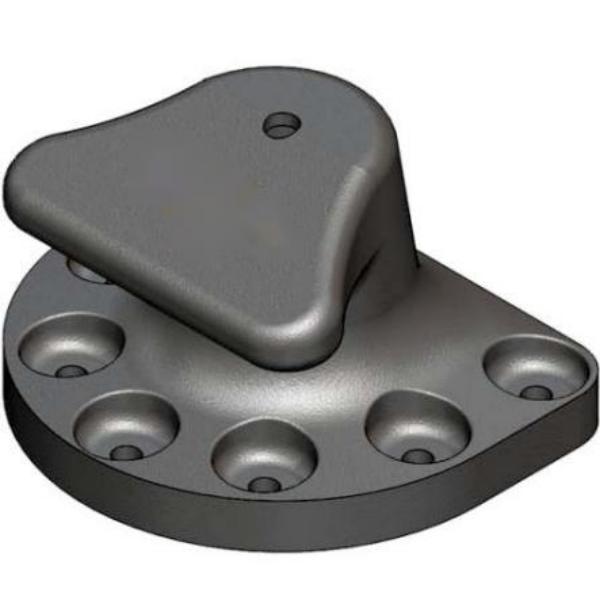
A tee bollard has a T-shaped head that helps retain mooring lines. Commercial product ranges include designs intended to accommodate steeper rope angles.
That can matter where tide, vessel freeboard, or loading conditions change the line's vertical direction.
However, "tee bollard" does not mean unrestricted loading. Permitted horizontal and vertical angles depend on the specific design and its anchorage.
Ask for the approved loading envelope rather than assuming every T-head can accommodate the same operating conditions.
*Suggested visual: side-by-side photographs of Taidun cleat and tee bollards, supported by simple drawings showing line contact and retention.*
Shape and material are independent choices. Comparing an aluminum cleat with a steel tee bollard changes both variables simultaneously.
For a meaningful comparison, first establish the required duty and then compare suitable designs.
| Selection factor | Aluminum fitting | Cast-steel fitting |
|---|---|---|
| Weight | Lower material density can benefit weight-sensitive installations | Greater component weight affects handling and dock dead load |
| Capacity | Must be established for the specific alloy and design | Must be established for the specific grade and design |
| Corrosion | Protective oxide film helps, but localized and galvanic corrosion remain concerns | Requires a suitable corrosion-protection and maintenance strategy |
| Installation | Dissimilar-metal interfaces need careful detailing | Anchors, grout, coatings, and substrate still require engineering |
| Procurement | Specify alloy, manufacturing process, and documented capacity | Specify casting grade, acceptance criteria, and documented capacity |
| Best comparison basis | Verified duty and lifecycle cost | Verified duty and lifecycle cost |
Aluminum can be worth evaluating where component weight, dock construction, and environmental compatibility make it attractive.
Its natural oxide layer provides corrosion resistance, but "does not rust like steel" does not mean "cannot corrode."
For an aluminum dock cleat, request the alloy designation, manufacturing method, load documentation, and fastener-isolation details. Confirm that the surrounding dock can transfer the fitting's loads.
Cast steel is an established material in commercial mooring bollard ranges. It deserves consideration where a documented commercial design, suitable line-retention geometry, and maintainable corrosion protection match the project.
Avoid the shortcut that steel is automatically stronger in every finished product. Grade, section geometry, casting quality, load direction, and installation all influence performance.
Also distinguish cast steel from ductile iron and grey cast iron. These are different material categories, not interchangeable names.
A robust bollard installed on an inadequate dock remains an inadequate mooring system.
The load travels through several connected elements:
1. Mooring line and contact surface.
2. Bollard body and base.
3. Anchor bolts and associated hardware.
4. Grout or bearing interface.
5. Concrete, structural steel, or reinforced dock framing.
6. The wider supporting structure.
Potential problems include concrete cracking, anchor deterioration, base movement, damaged framing, and incomplete bearing beneath the fitting.
For existing docks, investigate the substrate before selecting a replacement by appearance. Matching an old bolt pattern does not demonstrate that the original foundation is adequate.
Floating docks need particular attention to local reinforcement and load transfer through the dock system. A manufacturer's bollard rating does not certify the pontoon, deck, or frame beneath it.
The same line tension produces different horizontal and vertical force components as its angle changes. Elevated line contact also creates an overturning demand at the base.
Review tidal levels, vessel freeboard, and berth geometry together. Ask whether the proposed fitting and anchorage are approved for the worst credible line direction.
Do not transfer an angle allowance from another manufacturer's catalog to a Taidun model without verification.
Two lines on one bollard do not necessarily divide the load evenly.
Line length, stiffness, pretension, vessel movement, and lead direction affect how forces develop. Multiple lines also introduce a resultant force that may differ from any individual line's direction.
Specify the intended arrangement and obtain an engineering assessment where combined loading matters.
These terms describe different limits or verification conditions.
A procurement document should identify:
- The approved working capacity.
- The directions in which that capacity applies.
- The governing design basis.
- Any required proof-test procedure.
- Acceptance criteria and traceability requirements.
A factory test of a loose fitting does not, by itself, verify an installed dock foundation.
Galvanic corrosion can occur when dissimilar metals are electrically connected in the presence of an electrolyte, such as saltwater.
For aluminum hardware, review contact with carbon steel, stainless steel, fasteners, and adjoining structures.
Appropriate isolation may involve engineered sleeves, washers, barriers, or interface details. These must preserve structural performance while interrupting unwanted electrical contact.
Simply placing a pad beneath the base may not isolate the bolts or other conductive paths.
Specify corrosion protection for the actual exposure, not merely a color.
The coating specification should address surface preparation, coating layers, application requirements, inspection, and repair procedures. Distinguish a shipping or rust-preventative primer from a complete service coating system.
Pay attention to rope-contact areas, base edges, and damaged finishes. Plan access for inspection and maintenance before installation.
No credible service-life comparison can rely on "aluminum" or "steel" alone.
Consider a hypothetical operator replacing hardware at two berths.
One berth serves smaller maintenance craft on a floating dock. The other serves heavier workboats at a fixed quay.
For the floating berth, the assessment may favor a lower-weight cleat, provided its capacity, isolation details, and dock reinforcement are verified.
For the fixed quay, the assessment may favor a cast-steel tee bollard where the approved geometry and loading envelope suit the mooring arrangement.
Now change the operating conditions: larger vessels visit the floating berth, or tidal variation creates steep line leads. The original recommendation may no longer fit.
The lesson is not "aluminum for small boats, steel for large boats." It is to define the berth's operating envelope before selecting hardware.
This example is illustrative, not a claimed Taidun customer installation.
Send prospective suppliers a consistent specification so quotations remain comparable.
Include:
1. Vessel range and berth operating conditions.
2. Required capacity and engineering design basis.
3. Horizontal and vertical line directions.
4. Rope sizes and simultaneous-line arrangements.
5. Preferred geometry and dimensional constraints.
6. Material grade and manufacturing requirements.
7. Dock drawings and available foundation information.
8. Anchor, grout, and installation requirements.
9. Coating and corrosion-isolation requirements.
10. Inspection, testing, marking, and documentation needs.
11. Quantity, packaging, delivery destination, and OEM branding requirements.
Ask each supplier to identify exclusions and unresolved assumptions.
A lower quotation may omit anchors, coating inspection, documentation, or testing. Comparing scope is more useful than comparing unit prices alone.
Commercial mooring hardware should have a documented inspection and maintenance plan.
Establish baseline photographs, identification records, installation information, and approved capacity documentation.
Inspect for issues such as:
- Cracks, distortion, or unusual movement.
- Loose or deteriorated fasteners.
- Corrosion and coating damage.
- Concrete cracking or spalling.
- Damaged grout or incomplete bearing.
- Sharp or worn rope-contact surfaces.
After abnormal loading or a suspected overload, obtain a competent assessment before returning questionable hardware to service.
The 2026 U.S. Department of Defense mooring-hardware inspection guidance provides a useful reference for systematic assessment. Its military-facility scope should not be mistaken for a universal commercial certification requirement.
For lifecycle comparisons, include installation, inspection, maintenance access, replacement work, and operational disruption—not just purchase price.
Send Nanjing Taidun Marine Equipment Engineering Co.,Ltd your berth drawings, vessel information, required capacity, line-angle envelope, and preferred cleat or tee configuration.
Ask our team to confirm the proposed material, dimensions, mounting arrangement, coating scope, and available supporting documentation before placing an OEM order.
For aluminum requirements, request separate feasibility confirmation rather than assuming availability from our published cast-metal range.
Email: service@taidunmarine.com
Phone / WhatsApp: +86-18751950876
No. Strength depends on the specific design, material, loading direction, and installed support system. Compare documented capacities, not product names.
Yes, where the selected fitting and complete installation are engineered for the duty. Commercial use alone neither qualifies nor disqualifies aluminum.
No. Stainless steel can form a galvanic couple with aluminum in wet, conductive conditions. Appropriate interface design remains important.
Not without verification. Bolt layout, anchor condition, load direction, base dimensions, and foundation capacity must all be checked.
The reviewed pages list cast iron, cast steel, and ductile iron. Aluminum availability requires separate confirmation.
Provide the required capacity, loading directions, vessel range, dock structure, material preference, corrosion exposure, and documentation requirements.
Hot Tags: China, Global, OEM, private label, manufacturers, factory, suppliers, manufacturing company


