

Views: 259 Author: Nanjing Taidun Publish Time: 2026-11-05 Origin: Site
Content Menu
● Cylindrical Rubber Fender vs Arch Fender: The Practical Difference
● Why Legacy Dock Upgrades Need More Than a Product Comparison
● When Cylindrical Fender Replacement Can Be Cost-Effective
>> Retaining a Suitable Arrangement
● When an Arch Fender Retrofit Deserves Consideration
>> Revising the Fender Arrangement
>> Managing Contact and Sliding Movement
● The Engineering Checks That Decide the Upgrade
>> Energy Absorption and Reaction Force
>> Temperature, Velocity, and Berthing Angle
>> Current Guidance and Site-Specific Information
● Compare Lifecycle Cost, Not Just Purchase Price
● A Six-Step Legacy Dock Fender Upgrade Plan
>> 1. Survey the Existing Installation
>> 2. Define the Operating Envelope
>> 3. Verify Structural Constraints
>> 4. Compare Technically Compliant Alternatives
>> 5. Agree on Testing and Documentation
>> 6. Plan Installation and Handover
● What Overseas OEM Buyers Should Request from Taidun
● Request a Project-Specific Fender Comparison
>> Is an arch fender always better than a cylindrical rubber fender?
>> Can existing cylindrical fenders be replaced with arch fenders?
>> Which option normally has the lower upfront cost?
>> Can we reuse existing chains, anchors, or brackets?
>> What information is essential for an OEM quotation?
>> Does higher energy absorption mean better protection?
At Nanjing Taidun Marine Equipment Engineering Co., Ltd., we provide OEM manufacturing services for overseas marine equipment brands, wholesalers, and manufacturers. For buyers comparing cylindrical rubber fender vs arch fender systems, our starting point is straightforward: a cost-effective upgrade must protect both the vessel and the existing dock—not simply replace old rubber with a newer profile.
Legacy docks present a particular challenge. Their original fenders may no longer match today's vessels, while concrete, steelwork, and anchorages may have deteriorated. Replacing like-for-like can preserve an unsuitable arrangement; selecting a higher-capacity fender can introduce forces the structure cannot safely support.
The right decision therefore starts with compatibility: between berthing energy, reaction force, hull contact, installation geometry, and the dock's remaining structural capacity.

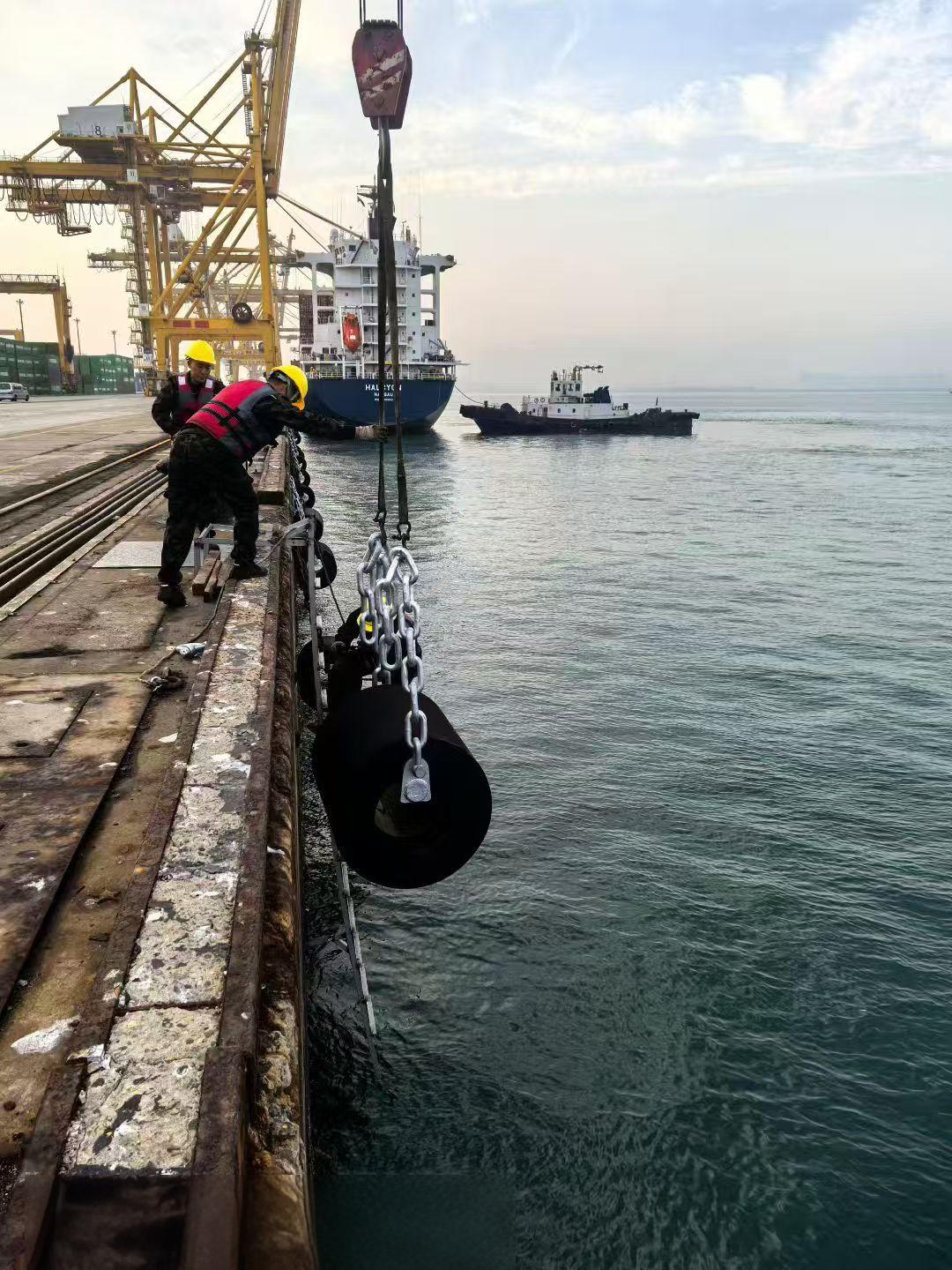
Cylindrical fenders are hollow rubber sections commonly suspended using chains, bars, or other engineered supports. Their simple configuration makes them useful for many general cargo quays, fishing harbors, and workboat berths.
Arch fenders use an arch-shaped rubber body secured to the supporting structure through mounting flanges. Depending on the design, they can provide a rubber contact face, incorporate UHMW-PE facing pads, or connect to a steel frontal panel.
Neither shape is automatically the better investment.
| Selection factor | Cylindrical rubber fender | Arch fender |
|---|---|---|
| Basic arrangement | Hollow section with an engineered suspension system | Arch-shaped body with fixed mounting flanges |
| Main retrofit question | Can the supports and suspension arrangement remain serviceable? | Can the structure accommodate the mounting layout and loads? |
| Contact configuration | Typically direct rubber contact | Rubber face, facing pads, or panel arrangements |
| Maintenance focus | Rubber wear, chains, bars, shackles, and connections | Rubber condition, anchors, fixings, and optional facing components |
| Best purchasing approach | Verify dimensions, performance, and suspension details | Verify corrected performance, anchor design, and contact geometry |
Compare complete installed systems, not isolated rubber prices or nominal dimensions.
*Suggested visual: A labeled side-by-side installation drawing showing a suspended cylindrical fender and a flange-mounted arch fender.*
An older berth may have been designed around a different vessel fleet, operating pattern, or approach arrangement. Even where vessel sizes have not changed, deterioration can reduce the reliability of existing connections.
Before requesting replacement quotations, investigate:
- Cracked or spalled concrete around mounting points.
- Corroded chains, brackets, anchors, or reinforcing steel.
- Uneven fender elevations and missing units.
- Changes in vessel hull geometry or berthing procedures.
- Restricted access for drilling, lifting, and maintenance.
- Unverified historical drawings or previous repairs.
An intact-looking anchor is not proof of adequate capacity. Likewise, an existing bolt pattern is a geometric convenience—not engineering approval for a replacement system.
Our preferred procurement principle is simple: establish the berth's constraints before asking suppliers to optimize the fender.
A cylindrical fender replacement deserves consideration when the existing arrangement remains structurally sound and still suits the operating fleet.
Potential advantages include a straightforward configuration, accessible components, and compatibility with established berth geometry. However, savings depend on inspection and design verification. Reusing deteriorated support hardware can turn an economical replacement into an early maintenance problem.
Specify more than outside diameter. Include:
- Inside diameter and overall length.
- Rubber grade and performance requirements.
- Suspension arrangement and corrosion protection.
- Required clearances and operating deflection.
- Installation orientation and connection details.
Matching dimensions alone does not establish equivalent performance.
Cylindrical fenders have a progressive load-deflection response, making them worth evaluating for berths serving different vessel sizes.
Nevertheless, actual suitability depends on hull shape, freeboard, tide, fender spacing, and contact behavior. A small workboat and a larger cargo vessel may engage the same installation differently.
Where direct rubber contact is unsuitable for the vessel or operating movement, the contact arrangement requires further review.
Arch fenders offer a rugged, fixed-mounted option for general cargo, workboat, tug, and barge applications.
They deserve evaluation where the project calls for a revised mounting arrangement, suitable shear performance, or a different contact configuration. Selection still requires model-specific performance curves and structural checks.
Avoid assuming that an arch fender of similar height will deliver equivalent energy absorption or acceptable reaction force. Rubber grade, length, geometry, and operating conditions all affect the result.
Some arch designs accommodate UHMW-PE pads or steel frontal panels. These configurations can help address contact and friction requirements, but they also add components that must be designed and maintained.
A panel is not merely an accessory. Its dimensions, stiffness, attachment, and contact position influence how loads pass between the vessel, rubber, and berth.
Check the entire assembly rather than treating the rubber body as the complete protection system.
A suitable fender must absorb the required design berthing energy while keeping transmitted loads within acceptable limits.
These are related but different requirements. Higher catalog energy capacity does not automatically make a fender safer for an aging quay.
Request confirmation that:
- Available energy absorption meets the project's design requirement.
- Maximum reaction remains acceptable for the supporting structure.
- Vessel contact pressure and local hull loading are acceptable.
- Performance reflects the applicable operating conditions and tolerances.
Energy absorption represents the area under the force-deflection curve. Reaction force describes the load generated during compression. Both matter when comparing cylindrical and arch fenders.
Catalog values require careful interpretation. Rubber performance changes with conditions such as temperature, compression speed, and angular loading.
Ask suppliers to identify the rating basis, applicable correction factors, and manufacturing tolerances. Compare alternatives using consistent assumptions.
For a legacy dock, an apparently attractive catalog figure can be misleading if one quotation uses nominal values and another includes project-specific corrections.
PIANC's Fender Guidelines 2024, issued through Working Group 211, supersede the earlier WG 33 guidance and emphasize site-specific information and whole-system design.
For new specifications, confirm the governing guidance and calculation basis with the project engineer. Do not simply replace an older guideline reference with "WG 211" while retaining unchanged assumptions.
Existing drawings, operating records, vessel data, and observed berthing conditions are valuable inputs—not paperwork to collect after product selection.
For practical budgeting, use:
A formal financial comparison should also account for timing, discounting, and the selected assessment period.
The following figures are hypothetical, undiscounted examples—not Taidun quotations or market averages.
| Cost category | Cylindrical replacement | Arch retrofit |
|---|---|---|
| Fenders and associated hardware | USD 20,000 | USD 27,000 |
| Installation | USD 8,000 | USD 11,000 |
| Structural modifications | USD 2,000 | USD 9,000 |
| Initial installed cost | USD 30,000 | USD 47,000 |
| Assumed maintenance over the assessment period | USD 12,000 | USD 7,000 |
| Illustrative combined total | USD 42,000 | USD 54,000 |
In this scenario, lower assumed arch-fender maintenance does not recover the higher installation and modification cost.
A different site could produce the opposite result. The lesson is not that cylindrical fenders are cheaper. It is that structural work, installation access, and operational disruption can outweigh the rubber price difference.
Ask bidders to price the same scope and identify exclusions explicitly.
Record fender dimensions, elevations, spacing, projection, mounting details, and visible deterioration. Photograph each location and distinguish verified measurements from assumptions.
Document vessel dimensions, displacement information, hull characteristics, tides, approach conditions, and operating procedures.
Use credible site information wherever available.
Have the responsible engineer assess the load path through anchors, concrete or steelwork, and the supporting structure.
Do not authorize new drilling solely from a supplier's general arrangement drawing.
Request cylindrical and arch options against the same performance requirements. Include corrected energy absorption, reaction, contact arrangement, geometry, and installation scope.
Reject comparisons based only on fender height or weight.
Define material verification, performance testing, dimensional inspection, traceability, and acceptance criteria before production.
Distinguish product-level test evidence from project-specific design approval.
Coordinate lifting, berth access, anchor installation, inspection, and commissioning. Retain approved drawings, installation records, and maintenance instructions for future replacements.
For brands, distributors, and manufacturers, reliable sourcing depends on repeatable specifications as much as the initial sample.
When approaching Nanjing Taidun Marine Equipment Engineering Co., Ltd., provide:
- Existing drawings and installation photographs.
- Required quantities and critical dimensions.
- Design energy and allowable reaction requirements.
- Vessel and operating information.
- Applicable specifications and testing expectations.
- Hardware scope, packaging, and labeling requirements.
- Delivery destination and installation schedule.
The resulting technical-commercial proposal should clearly separate confirmed requirements, supplier assumptions, optional items, and exclusions.
Private-label presentation should follow technical agreement—not substitute for it.
Send Nanjing Taidun Marine Equipment Engineering Co., Ltd. your berth drawings, vessel details, existing fender dimensions, and target replacement schedule.
Request a cylindrical-versus-arch OEM proposal that compares performance assumptions, mounting requirements, hardware, testing scope, and installed-cost implications.
The aim is a buildable upgrade that fits your customer's dock—not simply a lower-priced rubber component.
No. The better option depends on corrected energy absorption, allowable reaction, vessel contact, mounting conditions, and lifecycle cost. Shape alone does not establish suitability.
Potentially, but usually not as a direct interchange. Check mounting geometry, anchors, structural capacity, projection, spacing, and vessel clearance before approving the change.
There is no reliable universal answer. A compatible cylindrical replacement may avoid major modifications, while an arch retrofit may require new anchorage or structural work. Obtain comparable installed-scope quotations.
Only after appropriate inspection and engineering verification. Visual condition alone cannot establish remaining capacity, fatigue condition, or compatibility with the proposed loads.
Provide drawings, dimensions, quantities, performance requirements, operating conditions, hardware scope, testing expectations, and delivery requirements. Identify missing information so assumptions remain visible.
Not necessarily. A fender must also keep reaction force and vessel contact loading within acceptable limits. Excess capacity does not compensate for an unsuitable load path or mounting arrangement.
1. PIANC. "PIANC Fender Guidelines 2024," MarCom Working Group 211.
2. Trelleborg Marine and Infrastructure. "Cylindrical Fenders."
3. Trelleborg Marine and Infrastructure. "Arch Fenders."
4. Trelleborg Marine and Infrastructure. "A Whole System Approach to Fender Performance."
5. Trelleborg Marine and Infrastructure. "Fender Application Design Manual."
Hot Tags: China, Global, OEM, private label, manufacturers, factory, suppliers, manufacturing company


