

Views: 246 Author: Nanjing Taidun Publish Time: 2026-09-24 Origin: Site
Content Menu
● Why Fender Selection Matters for Offshore Drilling Rigs
● Hydro-Pneumatic Fender for Submerged Hull Protection
>> How Hydro-Pneumatic Fenders Work
>> Best Applications for Hydro-Pneumatic Fenders
>> Benefits for Offshore Rig Protection
● Floating Donut Fender for Pile Guidance and Alignment
>> Best Applications for Floating Donut Fenders
>> Benefits for Offshore Rig Berthing
● Floating Donut Fender vs Hydro-Pneumatic Fender
● Engineering Checklist Before OEM Production
>> Information Your OEM Fender Manufacturer Needs
>> Expert Insight: Do Not Design Only for Calm-Water Conditions
● Combining Both Fender Types in One Offshore Project
● FAQ
>> 1. What is the biggest difference between a floating donut fender and a hydro-pneumatic fender?
>> 2. Which fender is better for a semi-submersible drilling rig?
>> 3. Can floating donut fenders work in areas with large tidal variation?
>> 4. Can hydro-pneumatic fenders be customized for different draft requirements?
>> 5. Can a project use floating donut fenders and hydro-pneumatic fenders together?
>> 6. What data should I send to an OEM fender manufacturer?
>> 7. Are floating donut fenders suitable for berthing dolphins?
For specialized offshore drilling rigs, semi-submersibles, deep-draft support vessels, and pile-guided berths, choosing between a Floating Donut Fender and a Hydro-Pneumatic Fender is an engineering decision—not a catalog comparison. At Nanjing Taidun Marine Equipment Engineering Co., Ltd., we help overseas brands, wholesalers, marine equipment manufacturers, and project contractors develop OEM fender solutions based on actual vessel geometry, contact zones, tidal range, berth layout, and lifecycle requirements.
The central distinction is straightforward: a hydro-pneumatic fender is designed to cushion contact below the waterline, while a floating donut fender is designed to provide 360-degree, self-aligning guidance and protection around a fixed pile, dolphin, or vertical guide structure. For offshore drilling rig operations, using the correct system can reduce hull stress, improve berthing control, protect expensive offshore assets, and simplify long-term maintenance. [taidunmarine]

Offshore drilling rigs operate in a far more demanding environment than standard cargo berths. Semi-submersible rigs, drilling support vessels, accommodation vessels, offshore construction vessels, and deep-draft units may face changing tides, waves, current, limited maneuvering space, complex hull geometry, and heavy operational loads.
A standard floating fender may look acceptable in an initial quotation. However, it can be the wrong technical choice if the actual contact point occurs under water, if the rig must be centered between guide piles, or if a berth has both structural-guidance and underwater-protection requirements.
For offshore engineering teams, the correct marine fender system must address several questions:
- Where does the first and highest-load contact occur?
- Is the vulnerable hull zone above, at, or below the waterline?
- Does the structure use piles, dolphins, guides, or a continuous quay wall?
- How much tide variation must the system accommodate?
- Will the vessel approach at an angle because of wind, current, or restricted maneuvering space?
- Is the priority impact cushioning, vessel alignment, or both?
- What inspection and maintenance access is available offshore?
In our OEM experience, the most expensive specification error is not choosing a fender that is too small. It is choosing a fender that solves the wrong contact problem.
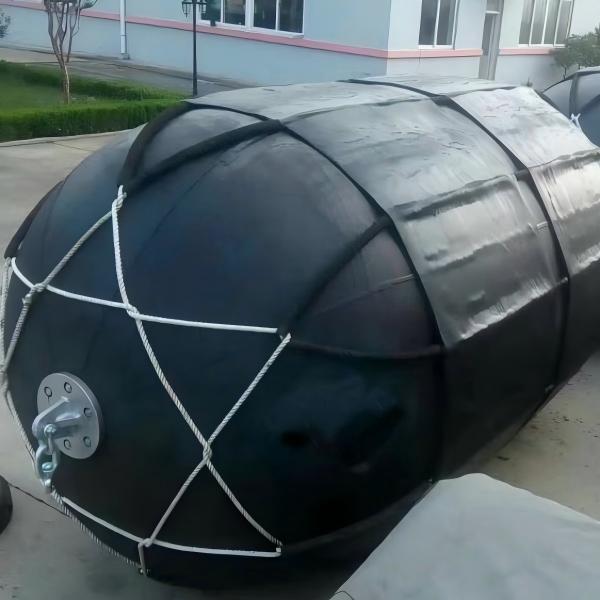
A hydro-pneumatic fender is a specialized floating fender that combines compressed air with a controlled volume of water ballast. The water-air configuration and counterweight arrangement help the fender remain vertically stable, extending its effective protection below the waterline.
This configuration is particularly relevant when a vessel's contact area is submerged or when a deep-draft hull needs protection that cannot be achieved with a conventional surface-floating pneumatic fender.
The operating principle is based on controlled compression and buoyancy:
1. The fender body contains a pressurized air chamber.
2. Water ballast is added to establish the required draft and vertical orientation.
3. A ballast or counterweight system helps maintain stability during service.
4. When the hull contacts the fender, the compressed air absorbs energy.
5. The fender spreads the contact load over a larger underwater hull area, helping reduce localized pressure.
The air-to-water ratio, inflation pressure, draft, and fender dimensions can be configured to suit the vessel's hull profile and berth conditions. This adjustability is one of the principal advantages of hydro-pneumatic fenders in specialized marine applications. [taidunmarine]
A hydro-pneumatic fender is generally the stronger choice where offshore drilling rig operations involve submerged-contact risk or high-draft vessel geometry.
Typical applications include:
- Semi-submersible drilling rigs
- Deep-draft offshore support vessels
- Submarines and naval berths
- Low-freeboard vessels
- Fast ferries with underwater contact requirements
- Specialized floating platforms
- Deep-water mooring systems
- Berths where hull contact occurs below the waterline
The main value is not simply high energy absorption. It is the ability to provide low-reaction-force underwater cushioning at the correct hull elevation. Hydro-pneumatic fenders are specifically associated with vessels that have low freeboard and high draft, where the contact area may be submerged.
For drilling rigs and specialized offshore assets, hydro-pneumatic fenders can provide:
- Sub-surface contact protection for vulnerable deep-draft hull sections
- Low hull pressure, helping protect sensitive steel structures and coatings
- Adjustable draft through water-ballast and air-pressure configuration
- Stable vertical positioning during changing tidal conditions
- High energy absorption with controlled reaction force
- Better suitability for complex hull geometry
- Potential protection of sensitive underwater hull components
A floating donut fender is a ring-shaped floating fender installed around a vertical pile or guide structure. Instead of remaining fixed in one orientation, it moves with the tide and rotates around the pile as a vessel makes contact.
This makes the floating donut fender highly effective for offshore structures where vessel approach, positioning, and guided movement are as important as impact cushioning.
The fender's ring geometry allows it to provide 360-degree protection around the pile. Its low-friction bearing arrangement supports smooth rotational movement, helping vessels align naturally during berthing and reducing abrasive contact between the hull and structure. [taidunmarine]
Floating donut fenders are especially suitable for:
- Offshore drilling rig access berths
- Berthing dolphins
- Lead-in jetties
- Pile-supported mooring facilities
- Turning structures
- Bridge and corner protection
- Guide piles for offshore support vessels
- Structures exposed to frequent tide changes
- Restricted berths requiring controlled vessel alignment
For an offshore drilling rig, the donut fender is especially valuable when the operational problem is not primarily underwater hull contact. Instead, the key issue may be controlling vessel movement around a fixed pile-supported structure.
The main operational advantages include:
- 360-degree vessel guidance around the pile
- Self-adjustment during tidal variation
- Smooth, low-friction rotation during contact
- Improved alignment for repeated berthing operations
- Reduced wear at recurring contact points
- Good visibility through customizable colors
- Low-maintenance foam-core construction
- Custom sizing for pile diameter and project geometry
A floating donut fender is particularly useful when crew boats, supply vessels, tugboats, and service vessels repeatedly approach an offshore rig's dolphin berth or pile-guided access point. The fender helps guide the vessel while protecting both the vessel and the fixed structure.
The following comparison helps project teams select the correct system for a specialized offshore drilling rig or related marine facility.
| Selection Factor | Hydro-Pneumatic Fender | Floating Donut Fender |
|---|---|---|
| Primary purpose | Protects underwater and below-waterline hull zones | Guides and protects vessels around piles or vertical structures |
| Typical contact zone | Below the waterline | At the pile line or structural guidance zone |
| Best for | Semi-submersibles, submarines, deep-draft vessels, specialist craft | Dolphins, guide piles, lead-in jetties, turning structures |
| Motion response | Controlled through air pressure, water ballast, and vertical stability | Rotates around the pile and rises or falls with tide |
| Main benefit | Underwater cushioning with low reaction force | Self-aligning guidance and 360-degree protection |
| Tidal adaptation | Adjustable through draft and ballast configuration | Naturally follows water-level changes |
| Installation focus | Correct pressure, ballast, draft, and mooring arrangement | Correct pile diameter, bearing system, clearance, and guide compatibility |
| Maintenance focus | Pressure, valves, fittings, shell condition, ballast balance | Rotation, bearing condition, wear surfaces, pile clearance |
| Offshore drilling-rig value | Protects submerged hull areas and deep-draft contact zones | Controls vessel approach around pile-supported offshore structures |
The practical conclusion is clear:
- Choose a hydro-pneumatic fender when the project needs reliable below-waterline hull protection.
- Choose a floating donut fender when the project needs pile-based guidance, rotation, and alignment.
- Use a combined fender strategy when the offshore facility has separate underwater and above-water contact risks.
At Nanjing Taidun Marine Equipment Engineering Co., Ltd., we recommend collecting complete operational data before confirming an OEM marine fender design. A detailed project brief reduces specification risk and improves the chance of a successful first installation.
1. Vessel or rig type
Provide the vessel category, hull drawings, displacement, draft range, freeboard, and sensitive contact areas.
2. Berth layout
Confirm whether the structure is a quay, jetty, dolphin berth, guide-pile system, floating dock, or offshore platform access structure.
3. Design water levels
Include tidal range, storm surge allowance, seasonal variation, and minimum/maximum operating water levels.
4. Approach conditions
Identify expected berthing speed, approach angle, current, wind exposure, wave conditions, and tug-assistance arrangement.
5. Required contact elevation
Determine whether contact occurs above the waterline, at the waterline, or below the waterline.
6. Pile and structural details
For floating donut fenders, provide pile diameter, pile material, pile verticality, clearances, and structural load limitations.
7. Operational frequency
State expected vessel calls, daily contact cycles, planned service life, inspection interval, and maintenance-access restrictions.
A frequent specification weakness is designing around nominal vessel dimensions and calm-water berthing assumptions. Offshore facilities should also consider:
- Maximum and minimum operating drafts
- Tide-driven vertical movement
- Vessel yaw caused by current
- Wave-induced surge and sway
- Offset approach during poor visibility
- Repeated contact at the same structural point
- Emergency or abnormal berthing scenarios
A high-quality fender system should not only work when vessel movement is ideal. It should remain predictable when operating conditions become less controlled.
For many offshore drilling-rig facilities, the best answer is not "donut versus hydro-pneumatic." It is an engineered combination of both.
For example, imagine a semi-submersible drilling rig approaching a pile-supported berth:
- The floating donut fender can be installed around the guide piles or dolphins to provide visible alignment, rotational movement, and tidal adaptation.
- The hydro-pneumatic fender can be placed where the rig's submerged hull or lower structural zone requires low-pressure impact cushioning.
- Additional fixed rubber fenders, mooring bollards, or guide components can be integrated where the berth requires controlled load transfer.
This approach separates two very different jobs:
- Guiding the rig or vessel into position
- Protecting the sensitive underwater hull zone during contact
That separation improves safety and may reduce unnecessary loading on the berth structure.
The best choice depends on where the contact risk occurs.
If your offshore drilling rig, semi-submersible vessel, or deep-draft marine asset needs protection below the waterline, a hydro-pneumatic fender is normally the correct technical direction. If your berth relies on dolphins, guide piles, or turning structures and needs controlled vessel alignment, a floating donut fender is often the more effective solution.
For complex offshore projects, consider combining both systems so that structural guidance and underwater cushioning are addressed independently.
Contact Nanjing Taidun Marine Equipment Engineering Co., Ltd. today to discuss your OEM floating donut fender, hydro-pneumatic fender, marine bollard, or marine anchor project. Send us your vessel data, berth drawings, pile dimensions, tidal range, and operating conditions, and our team can help develop a tailored marine-protection solution for your brand or project.
A hydro-pneumatic fender is designed to protect vessel contact areas below the waterline. A floating donut fender is designed to rotate around a pile or guide structure, providing self-aligning protection and vessel guidance. [taidunmarine]
A hydro-pneumatic fender is usually better when the semi-submersible rig has a deep draft and the critical contact zone is underwater. A floating donut fender may be added when the berth also requires pile-guidance and alignment control.
Yes. Floating donut fenders rise and fall with the water level and can self-adjust during tidal variation. Their rotating design also helps maintain smooth vessel contact around guide piles and berthing dolphins.
Yes. Their performance and operating draft can be adjusted through the air-to-water ratio, inflation pressure, ballast arrangement, and product dimensions. This makes them suitable for specialized vessels with different underwater contact elevations. [taidunmarine]
Yes. A combined design is often suitable for complex offshore berths where guide piles need alignment protection and deep-draft hull sections need underwater cushioning. The two fender types perform different but complementary functions.
Send vessel drawings, vessel draft range, berth drawings, pile diameter, tide range, berthing speed, approach angle, design water levels, operating environment, and expected service frequency. This information allows the manufacturer to recommend the technically correct solution.
Yes. Floating donut fenders are widely suited to berthing dolphins, lead-in jetties, turning structures, and guiding supports because they provide smooth rotation, pile-based protection, and adaptation to water-level changes.
1. Nanjing Taidun Marine Equipment Engineering Co., Ltd. — [Hydro-Pneumatic Fender vs Floating Donut Fender: Deep-Draft Submersible Mooring Applications]. Product comparison, project-selection logic, OEM manufacturing context, and offshore mooring application guidance. [taidunmarine]
2. Trelleborg Marine and Infrastructure — [Hydro-Pneumatic Fenders]. Information on submerged contact faces, low hull pressure, variable draft, and applications for submarines and deep-draft vessels. [trelleborg]
3. IRM Offshore and Marine Engineers — [Donut Fenders]. Information on low-friction rotation, tidal self-adjustment, pile applications, foam construction, custom sizing, and use at dolphins and lead-in jetties. [irmome]
4. IRM Europe — [Floating Fenders Technical Brochure]. Technical reference on hydro-pneumatic fender performance, air-water configuration, energy absorption, low reaction force, and donut-fender applications. [irmeurope]
5. Marine Fenders International — [Pneumatic and Hydro-Pneumatic Fender Overview]. Reference on partially water-filled, ballasted hydro-pneumatic fenders and their use for submerged-hull protection. [marinefendersintl]
6. International Towing Tank Conference — [Specialist Committee on Deep Water Mooring]. Background technical context on deep-water mooring and offshore marine-system considerations. [taidunmarine]
Hot Tags: China, Global, OEM, private label, manufacturers, factory, suppliers, manufacturing company


