

Views: 333 Author: NANJING TAIDUN Publish Time: 2026-09-23 Origin: Site
Content Menu
● Introduction: A Structural Shift in Global Maritime Logistics
● What Is Ship-to-Ship (STS) Transfer and Why It Matters
>> The Core Operational Reality
● The Four Structural Drivers Behind STS Growth
>> Driver 1: Port Infrastructure Cannot Keep Pace with Vessel Size
>> Driver 2: Port Infrastructure Investment Has Long Lead Times
>> Driver 3: The Dry Bulk Sector Is Catching Up to Tankers
>> Driver 4: Cost and Flexibility Advantages
● Why Pneumatic Rubber Fenders Are the Backbone of STS Safety
>> The Engineering Case for Pneumatic Fenders
● The 2025-2026 Regulatory Shift: What OEM Partners Must Know
>> CDI/ICS/OCIMF/SIGTTO Guide (202
>> China Classification Society (CCS) Guide 2026
>> INTERCARGO STS Guidelines for Bulk Carriers
● Real-World Application: Fender Selection for STS Operations
>> The Fender Monitoring Trend
● OEM Implications: What Brand Owners and Wholesalers Need to Know
>> Quality Standards That Matter
>> Documentation and Traceability
● Conclusion: Position Your Business for the STS Decade
● Frequently Asked Questions (FAQ)
>> 1. What is ship-to-ship (STS) transfer and why is it growing?
>> 2. Why are pneumatic rubber fenders the standard for STS operations?
>> 3. What regulatory changes affect STS operations in 2025-2026?
>> 4. How many pneumatic fenders are needed for a typical STS operation?
>> 5. What should OEM partners verify when sourcing pneumatic fenders for STS applications?
>> 6. What is the market outlook for STS transfer services?
The global ship-to-ship (STS) transfer service market was valued at USD 1.41 trillion in 2025 and is projected to reach USD 1.90 trillion by 2032, growing at a CAGR of 4.33% . This is not incremental growth—it is a structural transformation in how cargo moves across the world's oceans.
As an OEM manufacturer at NANJING TAIDUN MARINE EQUIPMENT ENGINEERING CO., LTD, we have watched this shift accelerate from the factory floor. Our OEM partners—brand owners, wholesalers, and manufacturers across Europe, Southeast Asia, and the Americas—are placing larger orders for pneumatic rubber fenders than ever before, driven by demand from offshore STS operations that simply did not exist at this scale a decade ago.
This article examines why ship-to-ship operations have become a critical modality in global logistics, what equipment OEM partners should understand, and how to position fender systems for this growing market.
Ship-to-ship transfer is the transfer of cargo between two vessels positioned alongside each other, typically at sea or in sheltered waters. The practice encompasses crude oil, refined petroleum products, LNG, LPG, chemicals, and increasingly dry bulk commodities .
In a typical STS operation:
1. Two vessels are positioned side by side, either both under power or one anchored
2. Pneumatic rubber fenders are deployed between the vessels to absorb berthing energy and maintain separation
3. Mooring lines secure the vessels in position
4. Cargo transfer proceeds through hoses or other systems
5. Continuous monitoring ensures safety and stability throughout the operation
The fender system is not a peripheral component in this equation. It is the primary safety interface between two vessels, each potentially displacing hundreds of thousands of tonnes.
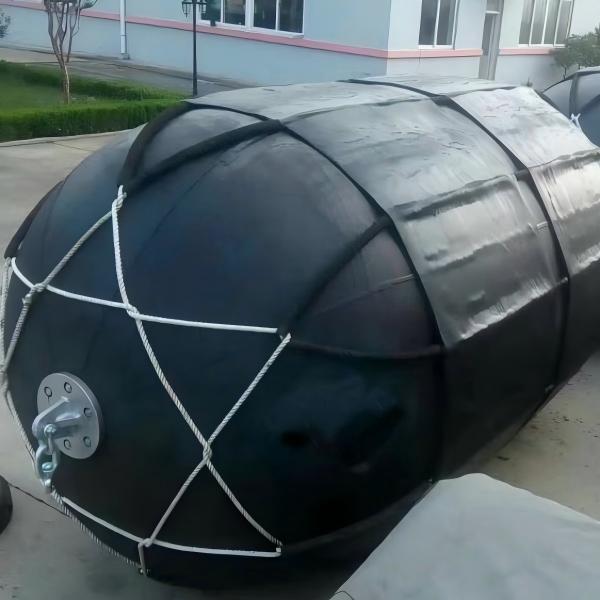
The growth of ship-to-ship operations is not driven by a single factor. It is the convergence of four structural forces reshaping global maritime logistics.
The most immediate driver is straightforward: larger vessels cannot access many ports.
Capesize and Newcastlemax bulk carriers, VLCCs, and large LNG carriers require draft depths and berthing infrastructure that many ports simply cannot provide. According to INTERCARGO, infrastructure expansion projects often require long-term planning, environmental approvals, and substantial capital expenditure before construction can even begin .
The result is a growing mismatch: vessels get larger, cargo volumes increase, but port capacity remains constrained.
> *"Larger vessels, rising dry bulk volumes and constrained berth availability are forcing the industry to rethink how cargo moves through global supply chains."*
> — Port Strategy, September 2026
Building a new deep-water berth takes 5 to 10 years from planning to commissioning. Environmental assessments, permitting, financing, and construction all add years to the timeline.
STS transfers offer a complementary logistics solution that bridges this gap . Rather than waiting for infrastructure investment to catch up, cargo can move through offshore transfers today.
Ship-to-ship transfers have been standard practice in the tanker sector for decades. The dry bulk industry, by contrast, has historically lacked dedicated, harmonized guidance .
That is changing rapidly. INTERCARGO has issued new STS Transfer Guidelines for bulk carriers, and the industry is moving toward uniform operational standards .
> *"This is no longer a niche activity. It is happening on a large scale and will only increase. That is precisely why it is important that the industry moves toward a more uniform approach."*
> — John Xylas, INTERCARGO Chairman
STS operations reduce vessel turnaround times and operational expenses by eliminating the need for vessels to wait for berth availability at congested ports . For operators moving cargo through regions with limited port infrastructure, the economic case is compelling.
Every ship-to-ship operation depends on a reliable fender system. Pneumatic rubber fenders have become the industry standard for STS applications—and for good reason.
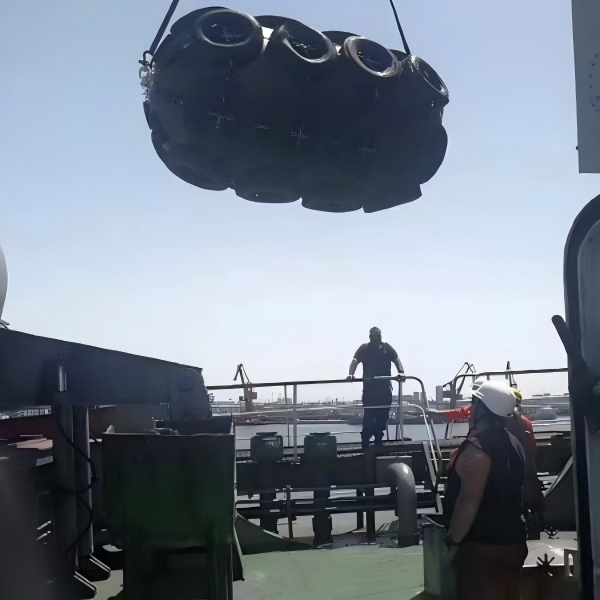
Pneumatic rubber fenders use compressed air as the cushioning medium, creating a highly efficient energy absorption system . Their advantages in STS operations include:
| Feature | Performance Benefit |
|---|---|
| High energy absorption | Handles large vessel displacements and berthing velocities |
| Low reaction force | Reduces structural stress on both vessels |
| Large contact area | Distributes pressure across the hull |
| Buoyancy | Floats in position without complex support structures |
| Deflatable design | Easy transport, storage, and on-site inflation |
The pneumatic fender was originally developed for ship-to-ship contact—specifically, to replace the "dead whales" used as fenders by Japanese whaling fleets in the Antarctic . The technology has evolved enormously since those early days, but the fundamental principle remains: compressed air provides superior energy absorption with lower reaction forces than solid alternatives.
A typical STS operation requires two to four pneumatic rubber fenders positioned between the vessels . The exact configuration depends on:
- Vessel displacement and freeboard
- Berthing velocity and approach angle
- Weather and sea state conditions
- Cargo type and transfer duration
The regulatory landscape for STS operations has undergone significant changes in 2025-2026. OEM partners who understand these changes can position themselves as knowledge leaders for their customers.
The second edition of the *Ship to Ship Transfer Guide for Petroleum, Chemicals and Liquefied Gases* was published in 2025—12 years after the first edition . Key updates include:
- New chapter on human factors and their impact on STS safety
- New chapter on personnel transfer risk management
- Revised speed guidance: 5.5 knots (up from 5 knots) for alongside maneuvering
- Restructured cargo procedures with separate sections for MARPOL Annex I, II, LPG, and LNG
- New material on lightering support vessels, three-ship operations, and tug assistance
The human factors chapter reflects a growing recognition that the human element is a shared responsibility across the maritime industry .
The CCS has issued its own *Ship-to-Ship Transfer Guide*, effective September 1, 2026, replacing the 2019 edition . This guide, based on the CDI/ICS/OCIMF/SIGTTO framework, provides comprehensive guidance for petroleum, chemical, LPG, and LNG STS operations .
Relevant sections for fender system OEM partners include:
- Chapter 8, Section 1: Fenders — covering equipment requirements
- Chapter 3, Section 1: Vessel compatibility matching
- Chapter 8: Equipment — including fenders, hoses, and mooring equipment
INTERCARGO has developed dedicated STS Transfer Guidelines for the dry bulk sector, addressing challenges unique to bulk cargo:
- Cargo trimming and stability considerations
- Risk of cargo shift
- Dust and spillage management
- Grab or conveyor operation coordination
These guidelines fill a significant gap. Unlike liquid cargoes, bulk STS operations are often less predictable and more dependent on environmental conditions and human factors .
Selecting the right pneumatic fender for an STS operation requires more than checking a catalog. It requires understanding the specific operational profile.
| Factor | Why It Matters | Typical Consideration |
|---|---|---|
| Vessel displacement | Determines kinetic energy to absorb | Largest vessel in the pair |
| Berthing velocity | Affects energy calculation | Currents, wind, approach speed |
| Freeboard differential | Affects fender positioning | Fender must contact both hulls |
| Weather exposure | Influences operational limits | Sheltered vs. open sea |
| Duration | Affects compression set accumulation | Short transfer vs. extended operation |
A significant development in STS safety is the emergence of fender monitoring systems. Research has demonstrated the effectiveness of remote monitoring for pneumatic fenders during STS operations, providing real-time data on fender performance and vessel behavior .
For OEM partners, this represents an opportunity to offer value-added solutions beyond the fender itself—particularly for high-value or high-risk STS operations.
The growth of STS operations creates specific opportunities and requirements for OEM partners in the fender industry.
STS operations expose fender systems to repeated compression cycles under demanding conditions. The quality of the rubber compound, the integrity of the cord layers, and the reliability of the end fittings all determine whether a fender survives one operation or hundreds.
Key specifications for STS-grade pneumatic fenders:
- ISO 17357-1:2014 compliance for performance verification
- Initial pressure tolerance of ±5% or better
- Cord layer construction with continuous synthetic tire cord
- End fittings galvanized to ASTM A-123 or equivalent
- Safety valves for fenders ≥2500mm diameter
As STS operations come under greater regulatory scrutiny, documentation becomes a competitive differentiator. OEM partners should provide:
1. Batch-specific compression test reports
2. Material certificates for rubber compound and steel components
3. Third-party inspection reports (BV, SGS, ABS, LR, DNV)
4. Traceability records from raw material to finished product
The STS market is not a niche. The market is measured in trillions of dollars, and it is growing at a rate that outpaces global GDP . For OEM partners serving the maritime industry, pneumatic fenders for STS applications represent a high-volume, high-value product category.
The structural drivers behind ship-to-ship operations are not temporary. Port congestion, vessel size increases, and infrastructure investment gaps will persist. The regulatory framework is maturing. The dry bulk sector is adopting STS practices at scale.
For fender OEM partners, the message is clear: the STS market is growing, and the equipment requirements are becoming more standardized.
At NANJING TAIDUN, we manufacture pneumatic rubber fenders built for the demands of offshore STS operations. Our OEM partners receive:
- ISO 17357-compliant manufacturing
- Batch-specific testing and documentation
- Third-party certification coordination
- Custom sizing and pressure specifications
- Full material traceability
Ready to serve the growing STS fender market?
Contact NANJING TAIDUN MARINE EQUIPMENT ENGINEERING CO., LTD:
- Email: service@taidunmarine.com
- Website: www.taidunmarine.com
- OEM Services: Pneumatic fender manufacturing, custom specifications, documentation packages, third-party testing coordination
1. GII Research. "Ship to Ship Transfer Service Market, By Service Type, By Operation Type, By Location, By End-use Industry, By Geography." [https://www.giiresearch.com/report/coh1890984-ship-ship-transfer-service-market-by-service-type.html]
2. Transport Research International Documentation (TRID). "SUPERCUSHION FOR SUPERTANKERS." [https://trid.trb.org/View/2705]
3. Port Strategy. "STS transfers fill port infrastructure gap." [https://www.portstrategy.com/greenport/news/insight-opinion-greenport/sts-transfers-fill-port-infrastructure-gap/]
4. Transport Online. "ATHENE – INTERCARGO heeft in Athene reders, bevrachters, verzekeraars en dienstverleners samengebracht." [https://www.transport-online.nl/?id=6840&p=adv_single]
5. SPE. "Final Acceptance Test On Advanced Ship Maneuvering And Mooring Support System At Ship-to-ship Transfer Operations By Fender Monitoring System of Pneumatic Fenders." [https://search.spe.org/i2kweb/SPE/doc/onepetro:69B858D9]
6. GII Taiwan. "Ship to Ship Transfer Service Market." [https://www.gii.tw/report/coh1890984-ship-ship-transfer-service-market-by-service-type.html]
7. Portos e Navios. "Operações de transbordo de óleo via ship-to-ship crescem no Brasil e motivam investimentos." [https://www.portosenavios.com.br/noticias/portos-e-logistica/operacoes-de-transbordo-de-oleo-via-ship-to-ship-crescem-no-brasil-e-motivam-investimentos]
8. Market Research. "Ship To Ship Transfer Service Market Outlook 2026-2034." [https://www.marketresearch.com/OG-Analysis-v3922/Ship-Transfer-Service-Outlook-Share-44742217/]
Ship-to-ship transfer is the movement of cargo between two vessels positioned alongside each other at sea. It is growing due to four structural drivers: port infrastructure cannot keep pace with vessel size, infrastructure investment has long lead times, the dry bulk sector is adopting STS practices, and STS offers cost and flexibility advantages over waiting for berth availability .
Pneumatic rubber fenders use compressed air as the cushioning medium, providing high energy absorption with low reaction force—critical when protecting two vessel hulls simultaneously. They are buoyant, deflatable for transport, and can be positioned without complex support structures .
Two major updates: the CDI/ICS/OCIMF/SIGTTO Guide (2025 Edition) , which added human factors and personnel transfer chapters, and the CCS Ship-to-Ship Transfer Guide (2026) , effective September 1, 2026, which replaces the 2019 version and includes specific sections on fender equipment .
A typical STS operation requires two to four pneumatic rubber fenders positioned between the vessels. The exact number and configuration depend on vessel size, displacement, berthing velocity, and environmental conditions .
Verify ISO 17357-1:2014 compliance, initial pressure tolerance of ±5% or better, cord layer construction with continuous synthetic tire cord, end fitting galvanization, and availability of batch-specific testing documentation and third-party certification (BV, SGS, ABS, LR, DNV) .
The global STS transfer service market is projected to grow from USD 1.41 trillion in 2025 to USD 1.90 trillion by 2032, representing a CAGR of 4.33% .


