

Views: 249 Author: Nanjing Taidun Publish Time: 2026-08-18 Origin: Site
Content Menu
● Why Fender Design Matters in Terminal Expansion
● Taidun Marine: Your OEM Fender Partner
● Core Design Inputs for Container Berths
>> Berth Structure and Environmental Data
● Recommended Marine Fender Configurations
>> Sliding and Roller Fender Systems
● An Integrated Fender and Mooring Strategy
● A Practical Selection Process
● Inspection and Lifecycle Value
● FAQ
>> What is the best marine fender for a container terminal?
>> How do I calculate marine fender capacity?
>> Can Taidun Marine manufacture fenders under our brand?
>> Why should bollards be designed with fenders?
>> What information is needed for an OEM quotation?
>> How often should terminal fenders be inspected?
Container-terminal expansion is not simply a civil-construction project. It is a long-term commitment to safer berthing, higher vessel capacity, faster turnaround, and more reliable mooring operations. Marine Fender Solutions for Container Terminal Expansion Projects must therefore be engineered as part of an integrated berth system—not purchased as isolated rubber components.
At Nanjing Taidun Marine Equipment Engineering Co., Ltd., we provide OEM marine fender systems, mooring bollards, anchoring components, and integrated berth-protection solutions for overseas brands, wholesalers, marine contractors, and equipment manufacturers. From our experience supporting international OEM requirements, the strongest projects begin with a clear understanding of vessel profiles, berth geometry, energy demand, structural limits, installation conditions, and lifecycle maintenance expectations.
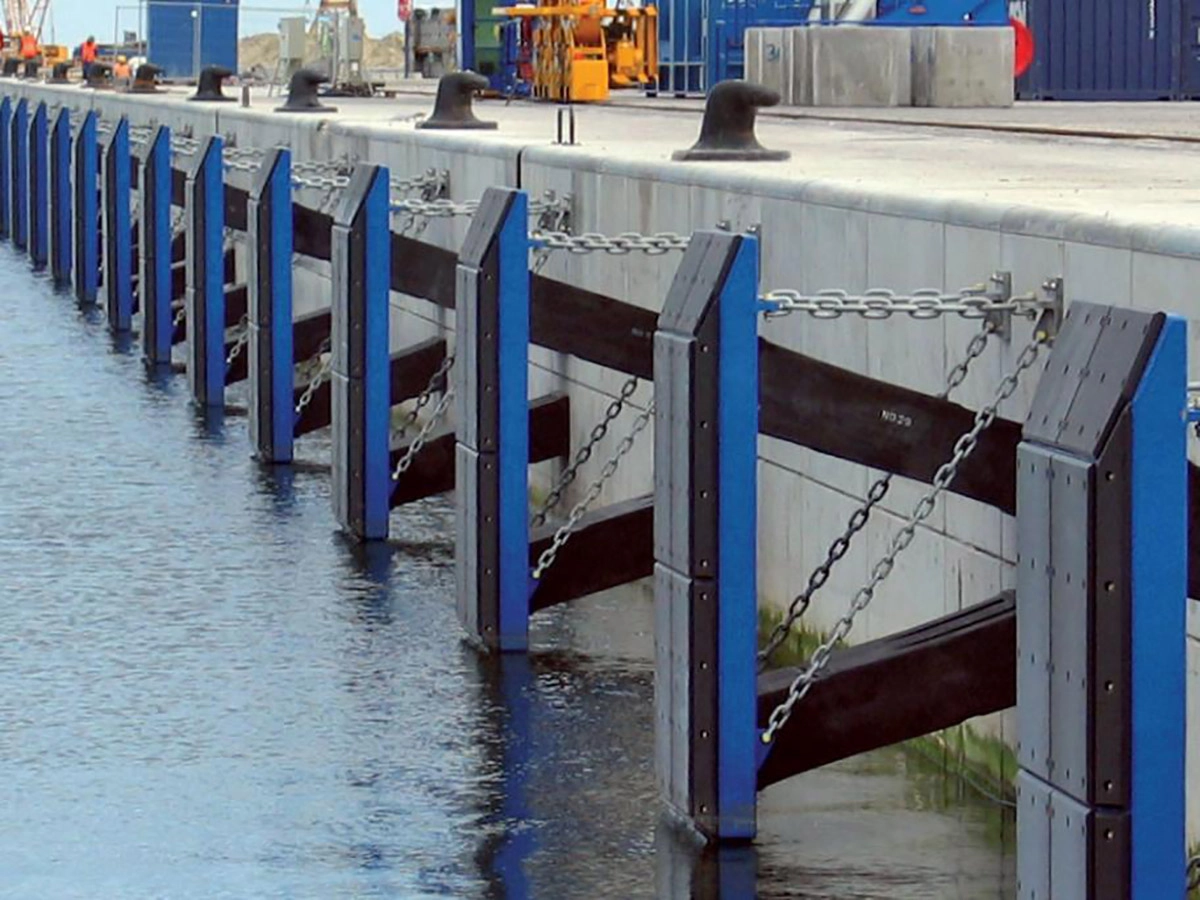
Container terminals are expanding to accommodate larger container vessels, increasing berth utilization, more frequent calls, and automated operating processes. These changes can significantly increase the consequences of an undersized, poorly configured, or incorrectly installed fender system.
A marine fender system has one core task: absorb berthing energy while controlling the reaction force transferred to the vessel and berth structure. However, an effective solution must do more than meet a single energy number on a product sheet.
It must protect:
- The vessel hull and shell plating.
- The quay wall, dolphin, pile cap, or jetty structure.
- Crane rails, deck equipment, and nearby civil assets.
- Mooring bollards and anchoring points.
- Personnel, cargo operations, and berth availability.
For a container-terminal expansion, fender selection must reflect both current operations and anticipated vessel growth. Designing only around today's vessels can create an expensive bottleneck when larger ships begin calling at the terminal.
Industry guidance increasingly emphasizes project-specific fender engineering rather than generic sizing. PIANC Working Group 211 guidance, published in 2024, highlights the importance of site-specific data when optimizing fender dimensions and avoiding unnecessary overengineering. [trelleborg]
Nanjing Taidun Marine Equipment Engineering Co., Ltd. serves international customers that need a reliable Chinese manufacturing partner without sacrificing engineering communication, quality control, project flexibility, or brand protection.
We work behind your brand or alongside your project team to develop custom marine fender solutions for container terminal expansion projects. Our OEM scope can include rubber fenders, steel frontal panels, chains, UHMW-PE face pads, mounting hardware, mooring bollards, anchor systems, and integrated design support.
For brand owners, distributors, and marine-equipment manufacturers, an OEM supplier must offer more than production capacity. The supplier must be able to translate engineering requirements into repeatable manufacturing quality.
Our OEM approach focuses on:
- Customized product design based on required energy absorption, reaction force, vessel class, and structural interface.
- Brand-neutral or private-label manufacturing for international distributors and established marine brands.
- Integrated supply of fenders, panels, chains, bollards, anchors, and related berth hardware.
- Drawing-based production for contractors and engineering companies.
- Material and dimensional quality control before shipment.
- Export-ready packaging and documentation for international delivery.
- Responsive technical communication during inquiry, design review, production, and after-sales support.
A fender may appear to be a simple rubber product. In reality, the complete system involves rubber performance, steel fabrication, weld quality, corrosion protection, chain geometry, panel movement, bolt design, anchor capacity, and structural load transfer.
A reliable fender proposal should never begin with the question, "Which model is cheapest?" It should begin with operational and structural data.
The fender system must match the vessels that will use the berth. Key inputs include:
| Design factor | Why it matters |
|---|---|
| Vessel displacement | Influences berthing energy |
| Vessel length and beam | Affects berth layout and fender spacing |
| Berthing velocity | Has a major effect on impact energy |
| Vessel hull shape | Determines contact geometry and panel design |
| Berthing angle | Influences energy distribution and contact sequence |
| Tug assistance | Changes the expected approach condition |
| Call frequency | Affects fatigue, wear, and maintenance planning |
| Future vessel classes | Prevents early replacement after expansion |
For container terminals, it is especially important to identify whether the berth will receive feeder vessels, Panamax vessels, New Panamax vessels, ultra-large container vessels, or a mixed vessel fleet. A system sized for smaller ships may have insufficient capacity when vessel displacement and operational demands increase.
The berth itself determines how the fender can be installed and what reaction load the structure can safely receive.
Project teams should provide:
- Quay wall, piled jetty, or dolphin drawings.
- Concrete strength and available anchoring zones.
- Existing fender locations and center-to-center spacing.
- Tidal range and vessel freeboard variation.
- Water depth and under-keel clearance.
- Wave, current, wind, and swell conditions.
- Corrosion environment and coating requirements.
- Access limitations for installation and maintenance.
The best fender is not necessarily the largest fender. It is the system that provides the correct energy-reaction balance while remaining compatible with the berth structure and operating envelope.
Different terminal structures and vessel operations require different configurations. The following options are frequently considered in container-terminal expansion projects.
Cone fenders are widely selected for high-energy berthing applications because they offer strong energy absorption in a compact design. When combined with steel frontal panels and low-friction UHMW-PE pads, they can accommodate vessel movement and distribute contact loads over a larger area.
Cone fender systems are particularly suitable for:
- High-capacity container berths.
- Piled jetties and marine dolphins.
- Quay walls serving large vessels.
- Berths with high operational frequency.
- Projects requiring high energy absorption with controlled reaction force.
The orientation and installation configuration matter. Recent PIANC-related project reporting notes that cone fenders are generally installed with the larger base connected to the supporting structure to improve stability and long-term performance.
Cell fenders provide high energy absorption and can be paired with frontal frames for broad hull contact. They are often suitable for heavy-duty berths where robust performance and a large mounting footprint are acceptable.
They can be a practical choice when:
- The berth structure has sufficient space and load capacity.
- Large frontal panels are needed.
- High-energy impacts are expected.
- The project requires a proven heavy-duty rubber fender solution.
Where vessel movement caused by tide, surge, or operational variation is significant, sliding or roller-type panel arrangements may help reduce friction and protect both the hull and fender face.
These solutions are particularly relevant when:
- The tidal range is substantial.
- Vessel freeboard changes widely.
- Berth face alignment is challenging.
- The terminal handles several vessel sizes.
For lighter-duty interfaces, secondary contact areas, workboat berths, or localized protection, arch and element fenders can provide a compact and durable solution. They may also be used as supplementary protection around corners, transitions, and restricted structural areas.
A container berth does not operate with fenders alone. After the vessel is safely brought alongside, it must be securely restrained by a mooring system that includes bollards, quick-release hooks where applicable, ropes, anchors, and structural foundations.
At Taidun Marine, we encourage customers to evaluate fenders and mooring bollards together. An integrated system considers:
- Fender reaction loads.
- Bollard safe working load.
- Mooring-line lead angles.
- Ship movement caused by wind, current, tide, and passing vessels.
- Foundation and anchor load paths.
- Operational access and inspection requirements.
- Clearance between fender panels, bollards, and equipment.
This integrated approach reduces the risk of treating berth protection and mooring as unrelated scopes. Taidun Marine's own engineering guidance describes this as a coordinated arrangement in which fenders manage berthing impact while bollards secure the vessel after berthing. [taidunmarine]
To reduce design uncertainty, use a disciplined selection process before issuing a purchase order.
1. Define the design vessel envelope. Include the largest anticipated vessels, not only the most common current calls.
2. Calculate berthing energy. Consider displacement, approach speed, berth configuration, eccentricity, added mass, and operational factors.
3. Set the allowable reaction-force limit. Verify the structural capacity of the quay, jetty, dolphin, and anchoring system.
4. Select the rubber fender geometry. Compare cone, cell, arch, element, and specialized systems based on the energy-reaction requirement.
5. Design the frontal panel. Establish panel dimensions, face-pad material, chain configuration, steel grade, and corrosion-protection system.
6. Coordinate bollards and anchors. Confirm mooring capacity, line angles, foundation design, and safe crew access.
7. Review installation tolerances. Check fender centers, embedment plates, anchor alignment, clearances, and access for lifting equipment.
8. Plan inspection and maintenance. Define periodic checks for rubber cracking, steel corrosion, face-pad wear, chain condition, bolts, and anchors.
The lowest unit price can become the highest lifecycle cost if the system is improperly specified. In our experience, buyers should avoid the following mistakes.
- Selecting by rubber-fender dimensions alone, without reviewing energy and reaction performance.
- Ignoring panel design, chain angles, and UHMW-PE pad quality.
- Using incomplete vessel data or excluding future vessel growth.
- Separating fender procurement from bollard and anchoring coordination.
- Failing to verify steel fabrication, weld inspection, and coating requirements.
- Treating installation drawings as an afterthought.
- Choosing a supplier that cannot provide consistent OEM documentation and technical support.
The global marine-fender market is being shaped by larger terminal projects, smart-port investment, and tighter PIANC and ISO-related requirements for performance and safety. One market assessment estimates the sector at USD 0.85 billion in 2025, with projected growth to USD 1.12 billion by 2030. This makes disciplined specification increasingly important for distributors and terminal project teams.
A terminal expansion should be designed for decades of service, not only for successful commissioning. Routine inspection helps protect the investment and reduces avoidable berth downtime.
A practical maintenance checklist includes:
- Inspect rubber bodies for cuts, cracks, permanent deformation, or separation.
- Check steel frontal panels for corrosion, damage, and deformation.
- Confirm chain, shackle, and pin condition.
- Examine UHMW-PE pads for excessive wear and secure fastening.
- Verify anchor bolts, nuts, washers, and concrete interfaces.
- Inspect bollards for corrosion, cracking, coating damage, and foundation movement.
- Record findings and address defects before they affect operations.
For brand owners and wholesalers, offering maintenance guidance alongside the product can create meaningful differentiation. Customers increasingly value a supplier that helps them protect performance throughout the asset lifecycle.
For a successful container-terminal expansion, do not source a fender as a commodity. Source a complete marine fender solution that fits the vessel, the berth, the structural limits, and the operating future of the terminal.
Nanjing Taidun Marine Equipment Engineering Co., Ltd. supports overseas brands, wholesalers, contractors, and manufacturers with OEM marine rubber fenders, fender panels, mooring bollards, anchor systems, and coordinated berth-equipment solutions.
Send us your vessel data, berth drawings, required standards, and target delivery schedule. Our team can help you develop a practical OEM proposal for your container terminal expansion project.
Cone and cell fender systems are commonly used for high-energy container berths because they can provide substantial energy absorption with controlled reaction forces. The best selection depends on vessel size, berthing speed, structural capacity, tidal conditions, and frontal-panel requirements.
Fender capacity is based on calculated berthing energy and the allowable reaction force on the vessel and berth. The calculation should account for displacement, velocity, eccentricity, added mass, berth arrangement, and operational factors. A qualified engineering review is recommended.
Yes. Taidun Marine provides OEM services for overseas brands, distributors, wholesalers, and marine-equipment manufacturers. OEM arrangements can include private labeling, drawings, packaging, product configuration, and coordinated documentation.
Fenders control berthing impact, while bollards secure the vessel after it is alongside. Designing them together helps coordinate structural loads, vessel movements, mooring-line angles, foundation interfaces, safety, and installation layout.
Useful information includes vessel type and displacement, berth drawings, fender spacing, berthing velocity, tidal range, environmental conditions, requested standards, panel dimensions, bollard capacity, quantity, delivery port, and required delivery date.
Inspection frequency should reflect berth traffic, environment, vessel size, and operator procedures. High-use container berths benefit from regular visual inspections and scheduled detailed inspections of rubber, panels, chains, face pads, bolts, anchors, and corrosion protection.
1. [Trelleborg Marine & Infrastructure: PIANC WG211 Fender Design Guidelines and site-specific design insights] [trelleborg]
2. [Taidun Marine: Integrated Fender System with Bollards—OEM berth-protection approach] [taidunmarine]
3. [ShibataFenderTeam: Port of Tampa expansion and PIANC-aligned cone-fender orientation] [shibata-fender]
4. [Mordor Intelligence: Marine Fenders Market Size, Share and 2030 Trends] [mordorintelligence]
5. [China Rubber Fender: Selecting a marine fender system for ports and terminals] [chinarubberfender]
6. [ESC Marine: Marine fender safety and port-protection considerations] [escpile]
Hot Tags: China, Global, OEM, private label, manufacturers, factory, suppliers, manufacturing company


