

Views: 259 Author: Nanjing Taidun Publish Time: 2026-07-27 Origin: Site
Content Menu
● Marine Fender Supplier Quality Inspection Guide for OEM Buyers
● Why Quality Inspection Matters
● What Good Inspection Looks Like
● Field Inspection And Maintenance Logic
● New Insight: From Purchase To Lifecycle
● Why OEM Buyers Choose Taidun
● FAQ
>> 1. What is the most important part of marine fender quality inspection?
>> 2. How often should marine fenders be inspected?
>> 3. What defects are most common in marine fenders?
>> 4. Why is OEM quality control important for marine fenders?
>> 5. What should buyers ask a marine fender supplier before ordering?
When buyers search for a Marine Fender Supplier Quality Inspection Guide, they are usually trying to solve one problem: how to choose a supplier that can deliver consistent quality, not just a low price. At Nanjing Taidun Marine Equipment Engineering Co., Ltd., we believe the best marine fender supply starts with disciplined inspection, traceable manufacturing, and a clear understanding of real port conditions.
For brand owners, wholesalers, shipyard contractors, and port operators, marine fender quality is not a cosmetic issue. It directly affects berthing safety, vessel protection, maintenance cost, and long-term port reliability.

A marine fender is only valuable when it performs under pressure, repeatedly, and in harsh marine environments. Industry guidance emphasizes planned inspection, functional evaluation, and corrective action because deterioration can come from aging, impact, corrosion, wear, and abnormal berthing events.
From an OEM perspective, this means the supplier must control more than the final product appearance. A serious marine fender supplier should monitor raw materials, rubber performance, dimensional accuracy, steel accessories, bonding quality, and performance verification before shipment.
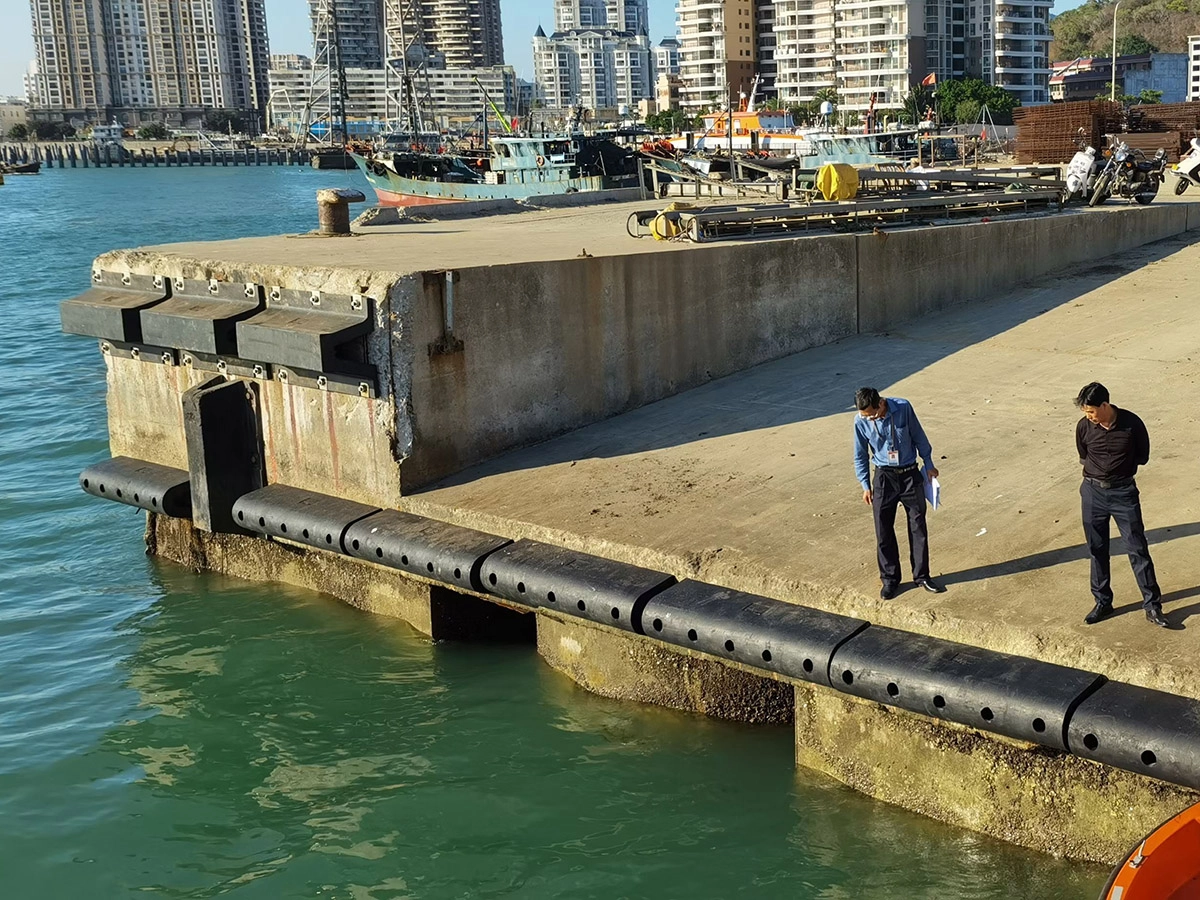
A reliable inspection process should cover both the rubber body and the accessories. The most common inspection items include cracks, cuts, deformation, missing rubber, separation, wear, ozone cracking, bolt-hole damage, loose fasteners, corrosion, bent supports, and panel deformation.
For practical purchasing decisions, we recommend buyers evaluate the supplier in five layers:
- Material control: rubber compound quality, steel grade, anti-corrosion treatment, and traceability.
- Dimensional control: length, height, hole spacing, panel alignment, and tolerances.
- Visual quality: surface defects, air bubbles, edge damage, finish consistency, and coating condition.
- Assembly quality: bolt torque, anchors, washers, chains, support parts, and panel fit.
- Performance verification: compression behavior, reaction force, energy absorption, and durability tests.
At Nanjing Taidun, we treat inspection as a process, not a final checkpoint. This is especially important for OEM customers who need stable repeat orders and brand consistency across multiple projects.
Our internal logic follows four stages:
1. Incoming material inspection.
2. In-process inspection.
3. Pre-shipment inspection.
4. Project feedback review.
This approach helps reduce hidden risk in products such as rubber fenders, mooring bollards, and marine anchoring equipment. It also supports better product stability for foreign brands that need dependable private-label supply.
Before choosing a marine fender supplier, buyers should ask for evidence in the following areas:
| Inspection area | What to confirm |
|---|---|
| Rubber compound | Formula stability, hardness control, aging resistance |
| Steel parts | Corrosion protection, weld quality, thickness |
| Drawing control | Updated specifications, revision management |
| Test records | Load, compression, and appearance inspection records |
| Packaging | Anti-damage packing, export-ready labeling |
| Traceability | Batch number, production date, inspection file |
| Complaint handling | Clear corrective action and response time |
This checklist is especially useful for OEM buyers who manage private labels or multi-country distribution. A supplier with documented inspection discipline is usually easier to work with when scaling, customizing, or resolving field issues.
A strong marine fender inspection guide should combine visual checks with functional testing. Industry references recommend periodic checks, occasional checks after abnormal berthing, and structured evaluation of deterioration levels so hidden damage is not missed.
In real factory practice, we look for these quality signals:
- Clean rubber surface without deep cracks, cuts, or abnormal deformation.
- Properly seated accessories with no looseness or missing parts.
- Uniform panel alignment and stable steel fabrication.
- Consistent anti-corrosion protection on exposed metal parts.
- Test results that match the required specification, not just a catalogue description.
If a supplier cannot explain how they verify performance, the buyer is taking unnecessary risk.
Many marine fender problems are not discovered at first glance. Some appear only after repeated compression, exposure to sunlight, salt, moisture, or improper storage.
The most common avoidable defects include:
- Rubber surface cracking from poor compound control.
- Panel corrosion due to weak coating or poor storage.
- Loose bolts caused by insufficient assembly control.
- Misalignment between rubber body and steel accessories.
- Inconsistent performance caused by weak process control.
For buyers, the lesson is simple: a better inspection system usually means fewer on-site failures.
A practical supplier should not only deliver products, but also help customers maintain them. Maintenance guidance for rubber fender systems highlights four key inspection moments: initial check, daily check, periodic check, and occasional check after abnormal events.
This matters because many failures are caused by operational conditions rather than manufacturing alone. A supplier with field knowledge can help customers reduce downtime by recommending the right inspection frequency, replacement timing, and spare-part strategy.
One major gap in many competitor articles is that they discuss product quality but not lifecycle quality. In our experience, buyers often save money on purchase price and lose much more later through repair, delay, downtime, and replacement.
That is why smart procurement teams now evaluate:
- Initial product quality.
- Ease of installation.
- Maintenance frequency.
- Spare-part availability.
- Expected service life.
- Total cost of ownership.
This lifecycle view is especially important for ports that cannot afford operational interruption. It also gives OEM buyers a stronger basis for choosing a long-term partner instead of a one-time vendor.
As a Chinese OEM factory serving overseas brands, wholesalers, and manufacturers, Nanjing Taidun Marine Equipment Engineering Co., Ltd. focuses on three things: stable quality, flexible customization, and reliable project communication. Our work is built for customers who need more than standard catalog supply.
We support OEM customers with:
- Product customization for market-specific requirements.
- Consistent production control for repeat orders.
- Export-oriented packaging and labeling.
- Technical communication for project application.
- Integrated supply across marine fenders, bollards, and anchoring products.
For brand owners, this means a cleaner supply chain and fewer quality surprises. For project buyers, it means better alignment between product design and actual port use.
Use this simple rule when evaluating suppliers:
- If the supplier only talks about price, be cautious.
- If the supplier talks about inspection, traceability, and performance testing, that is a stronger sign.
- If the supplier can explain defects, maintenance, and lifecycle value, that is usually a better OEM partner.
For marine infrastructure products, quality is not what the supplier says. Quality is what the product still delivers after installation, repeated use, and harsh environmental exposure.
If you are sourcing from a Marine Fender Supplier, the real question is not whether the product looks acceptable on the day of shipment. The real question is whether the supplier has a serious inspection system that protects your brand, your project, and your customers over time.
At Nanjing Taidun Marine Equipment Engineering Co., Ltd., we build OEM marine equipment with the mindset that inspection is part of product value. If you want a supplier who understands marine fender quality from both the factory floor and the port reality, we are ready to support your next project.
CTA: Contact Nanjing Taidun Marine Equipment Engineering Co., Ltd. to request OEM specifications, inspection support, and customized marine fender solutions for your market.
The most important part is verifying both material quality and functional performance, because a marine fender must perform under repeated impact and marine exposure.
Industry guidance supports initial, daily, periodic, and occasional inspections, with periodic checks typically performed at least once a year depending on facility importance.
Common defects include cracks, cuts, wear, deformation, corrosion, loose fasteners, and panel damage.
OEM quality control helps ensure repeatable specifications, stable performance, and brand consistency across batch production and export orders.
Buyers should ask for material traceability, test records, dimensional inspection procedures, corrosion protection details, and packaging standards.
- Coastal Development Institute of Technology. Guidelines for the Maintenance of Rubber Fender Systems (2nd Edition).
- Trelleborg Marine Systems. Performance verification of marine fenders.
- Coastal/industry guidance summary on marine fender inspection and maintenance.
- SME Fender. Rubber Fender Testing Guide.
- PIANC-related design/testing discussion for marine fender systems.
- OECD. Analysis of the marine equipment industry and its challenges.
Hot Tags: China, Global, OEM, private label, manufacturers, factory, suppliers, manufacturing company


