

Views: 226 Author: Nanjing Taidun Publish Time: 2026-10-29 Origin: Site
Content Menu
● Rubber Fender Manufacturer Testing Standards You Should Know Before Ordering
>> PIANC 2024 Versus PIANC 2002: What Has Changed?
● Full-Size Rubber Fender Performance Testing: Energy and Reaction
>> Understand the Load–Deflection Curve
>> Compare Like-for-Like Test Conditions
● Rubber Compound Testing: Why Hardness Alone Is Not Enough
>> Link Material Results to the Delivered Fender
● Pneumatic Fender Testing: Apply the Correct ISO Standard
● How to Audit a Rubber Fender Test Report
>> Distinguish Type Approval From Shipment Verification
● Three OEM Procurement Controls That Improve Testing Transparency
>> 1. Agree the Inspection Plan Before Production
>> 2. Define What Happens After a Failed Test
>> 3. Control Changes Across Repeat OEM Orders
● Illustrative Example: Why Two Performance Limits Matter
● Working With Nanjing Taidun on an OEM Testing Specification
>> 1. What is the main rubber fender testing standard?
>> 2. Does PIANC 2002 evidence prove PIANC WG 211 compliance?
>> 3. Is Shore A hardness enough to approve a rubber fender?
>> 4. Should every fender undergo full-size compression testing?
>> 5. Can accelerated aging tests prove a guaranteed service life?
>> 6. Can an OEM buyer request independently witnessed testing?
At Nanjing Taidun Marine Equipment Engineering Co., Ltd., we serve overseas brands, wholesalers, and manufacturers seeking OEM marine rubber fenders, mooring bollards, and marine anchoring products. For buyers researching "Rubber Fender Manufacturer Testing Standards You Should Know," our starting point is straightforward: evaluate the evidence behind the performance claim, not simply the catalogue number.
Taidun's public materials describe in-house physical-property testing, compression-testing equipment, and support for project testing documentation. Buyers should confirm the exact scope, applicable standards, and inspection arrangements for each order rather than assume every product carries identical approval. [taidunmarine]
This guide explains which standards matter, what a reliable test report should contain, and how OEM buyers can turn technical requirements into a practical purchasing specification.

The most important principle is verification. Different documents address different questions: system design, full-size fender performance, rubber properties, or a specific pneumatic-fender category. They are complementary—not interchangeable. [pianc]
| Standard or guideline | Main purpose | What buyers should check |
|---|---|---|
| PIANC WG 211, Fender Guidelines 2024 | Guidance on fender-system design, manufacture, and testing | Project applicability, testing scope, and supporting evidence |
| PIANC WG 33, 2002 | Earlier fender-design guidance, still referenced in existing specifications | Whether the contract explicitly requires this edition |
| ASTM F2192 | Determining and reporting marine-fender energy absorption and reaction | Test method, conditioning, speed, and performance curves |
| ISO 17357-1:2014 | High-pressure floating pneumatic rubber fenders | Correct product category and inspection requirements |
| ISO 17357-2:2014 | Low-pressure floating pneumatic rubber fenders | Correct pressure category and applicable tests |
| ASTM rubber-property methods | Individual material characteristics | Method, specimen identification, conditions, and acceptance limits |
The scope distinctions above follow PIANC, ASTM, and ISO publications. Always specify the required edition in the purchase agreement.
PIANC WG 211 provides updated guidance covering the design, manufacture, and testing of fender systems. PIANC also acknowledges a transition period from WG 33 because suppliers need substantial testing work to reorganize their catalogues.
For procurement, this means "PIANC compliant" is incomplete wording.
Ask the manufacturer:
- Which PIANC document and edition apply?
- What testing supports the offered fender model?
- Does the evidence cover its size, compound, and performance grade?
- Which project-specific verification tests are included?
- What independent witnessing is available?
Taidun's published information references PIANC 2002. Where a tender requires WG 211, request a project-specific compliance review and supporting documentation rather than treating earlier evidence as automatic proof of compliance with the newer guidance. [taidunmarine]
A marine fender must absorb the required berthing energy without exceeding the permitted reaction force. These requirements must be assessed together. A high energy figure does not compensate for excessive loading on the vessel or berth.
Reaction force describes resistance during compression. Energy absorption corresponds to the area under the loading curve up to the evaluated deflection.
A useful report should therefore show more than a single maximum value. Request:
- Reaction force against deflection.
- Energy absorption against deflection.
- Rated or design deflection.
- The acceptance envelope.
- Identification of the tested fender.
- Test conditions and any applied adjustments.
ASTM F2192 addresses quantitative testing, reporting, and verification of energy absorption and reaction force. Its published scope also distinguishes methods used to establish rated performance data.
Temperature, compression velocity, conditioning, and approach angle belong in the comparison—not in a footnote that buyers overlook.
For example, ASTM F2192 describes specified conditions for published rated performance data, including broken-in fenders, temperature stabilization, approach angle, and test timing, with exceptions for pneumatic fenders. PIANC WG 211 also emphasizes conditioning and clearly established base performance.
Before comparing two quotations, put their test conditions side by side. Otherwise, apparently similar catalogue figures may describe different testing circumstances.
A hardness reading answers one material question. It does not independently establish full-size energy absorption, reaction force, aging resistance, or durability. These require different tests and evidence.
A practical rubber-property review includes:
| Property | Common test reference | Procurement question |
|---|---|---|
| Tensile strength and elongation | ASTM D412 | Does the compound meet the specified mechanical requirements? |
| Durometer hardness | ASTM D2240 | Was hardness measured using the specified instrument and procedure? |
| Heat-aging behavior | ASTM D573 | How did relevant properties change after the agreed exposure? |
| Ozone-cracking resistance | ASTM D1149 | What exposure conditions and assessment criteria were used? |
These methods measure different characteristics. Their use does not create one universal acceptance limit for every marine-fender application. Specify the test conditions and permitted results separately.
For OEM purchasing, an excellent laboratory result has limited value if its connection to the shipped product is unclear.
Require traceability between:
1. The approved compound specification.
2. The production or mixing batch.
3. The material-test specimen.
4. The finished fender identification.
5. The inspection and shipment records.
PIANC-related industry guidance also discusses thermogravimetric analysis, or TGA, as an additional way to investigate compound composition. Treat it as supporting evidence, not a substitute for performance and durability testing.
Not every rubber fender belongs under ISO 17357.
ISO 17357-1:2014 addresses high-pressure floating pneumatic rubber fenders. ISO 17357-2:2014 addresses low-pressure floating pneumatic rubber fenders. Both cover their respective categories' materials, performance, dimensions, and testing or inspection requirements. [iso]
A solid cone or cell fender should not be marketed as meeting a pneumatic-fender standard simply because both products contain rubber.
When buying pneumatic fenders, identify the applicable pressure category first. Then request a compliance schedule mapping the offered product to the required standard and project inspection plan.
Suggested visual: use a product-selection diagram separating solid rubber fenders, high-pressure pneumatic fenders, and low-pressure pneumatic fenders.
From a procurement perspective, the best report is one that another qualified reviewer can understand without repeatedly asking what was tested.
Use this seven-point checklist:
1. Product identity: model, dimensions, grade, and serial or batch number.
2. Governing requirements: standard, edition, and approved project specification.
3. Test preparation: conditioning, break-in procedure where applicable, and recovery periods.
4. Test setup: equipment identification, measurement arrangement, and calibration evidence.
5. Recorded results: force, deflection, energy, and relevant curves.
6. Acceptance decision: clearly stated limits and pass/fail findings.
7. Accountability: test date, responsible personnel, witness details, and report authorization.
This checklist translates the performance-reporting and verification principles in ASTM and PIANC guidance into a purchasing review process. The contract should define the final deliverable requirements.
PIANC-related guidance separates fundamental testing, type approval testing, and project-specific verification testing. These serve different purposes.
Type approval evidence can support confidence in a product range. It does not identify which units were inspected for your shipment.
Ask which evidence establishes published performance, which validates the offered product family, and which verifies your production order. Avoid accepting one certificate as an answer to all three questions.
Do not leave test selection until the shipment is ready.
Write an inspection and test plan covering material testing, full-size performance testing, sampling, witnessing, reporting, and nonconformity handling. Separate included work from optional inspections.
Where third-party attendance is required, identify the inspector and hold points early. PIANC-related guidance recognizes independent witnessing and verification arrangements as important parts of credible testing.
A sampling percentage is incomplete without an escalation rule.
The plan should state whether a failure triggers additional testing, batch segregation, investigation, replacement, or rejection. WG 211 industry explanations describe escalation from an initial sample to larger samples and potentially the full batch. Use the governing document and agreed contract to establish the applicable procedure.
This prevents a failed result from becoming an improvised commercial negotiation.
For repeat orders, establish an agreed change-notification process covering the compound, geometry, manufacturing route, and performance designation.
Then identify which changes require engineering review or renewed testing. This is a recommended purchasing control, not a claim that one universal requalification rule applies to every fender.
For private-label brands, the objective is consistency between the product approved initially and the product delivered later.
Consider a hypothetical specification requiring at least 500 kNm of energy absorption and no more than 800 kN of reaction force.
- Fender A achieves 520 kNm but reaches 850 kN.
- Fender B achieves 505 kNm and reaches 780 kN.
Under these simplified criteria, Fender A fails despite absorbing more energy. Fender B meets both numerical limits.
The example is illustrative, not a Taidun project result. Final acceptance would still require compliant test conditions and review of the applicable reaction envelope and deflection limits. PIANC WG 211 explanations emphasize achieving the energy requirement without exceeding the permitted reaction through the relevant deflection range.
Suggested video: show a witnessed compression test with synchronized force, displacement, and energy readings, plus a visible product identification label.
Taidun's published materials describe rubber-fender testing facilities and support for engineering drawings, material certificates, inspection reports, and pre-delivery documentation. The product information also describes witness-testing arrangements available for discussion. [taidunmarine]
When requesting a quotation, send:
- Fender type, dimensions, and quantity.
- Required energy absorption and maximum reaction.
- Governing standard and edition.
- Operating conditions and installation arrangement.
- Material-testing requirements.
- Third-party inspection expectations.
- Private-label and traceability requirements.
Send Nanjing Taidun your technical specification and request a project-specific testing proposal with the quotation. Ask the proposal to identify included tests, acceptance limits, sampling, witness points, and final documentation before placing the OEM order.
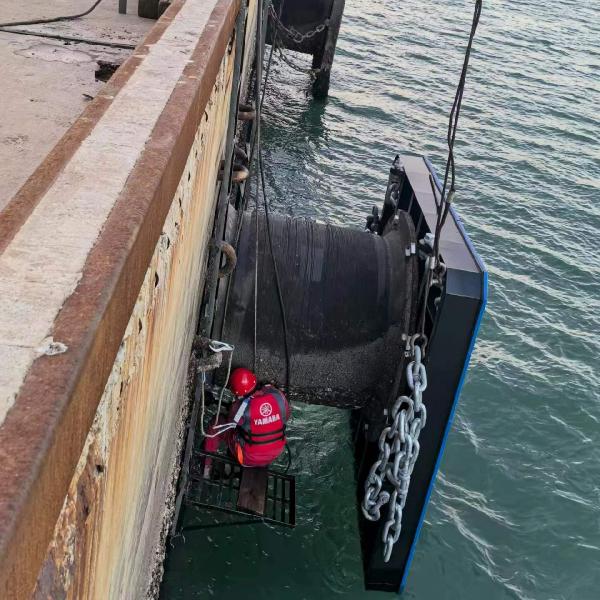
There is no single standard covering every product and purpose. PIANC provides fender-system guidance, ASTM F2192 addresses energy and reaction testing, and ISO 17357 covers specified pneumatic-fender categories.
No automatic equivalence should be assumed. Identify the required edition and assess the supporting evidence against it. PIANC acknowledges substantial changes and a transition involving additional type approval testing.
No. Durometer hardness measures indentation hardness. Full-size performance and other material characteristics require separate testing.
Specify the sampling and escalation requirements in the contract. The appropriate scope depends on the governing guidance and project requirements; do not assume every project requires identical sampling.
Not by themselves. They evaluate behavior under defined accelerated conditions. ASTM specifically cautions that accelerated ozone-test results may not correlate directly with outdoor exposure or service performance.
Yes, this can be specified in the inspection plan. Agree the witness organization, equipment arrangements, test scope, acceptance criteria, and reporting responsibilities before production. [pianc]
Hot Tags: China, Global, OEM, private label, manufacturers, factory, suppliers, manufacturing company


