

Views: 298 Author: NANJING TAIDUN Publish Time: 2026-09-29 Origin: Site
Content Menu
● Introduction: Why Chain Selection Makes or Breaks Your Marine Operations
● Understanding Anchor Chain Grades: From Grade 2 to R6
>> Marine Anchor Chain Grades (Grade 2, Grade 3, Grade 4)
>> Offshore Mooring Chain Grades (R3, R3S, R4, R4S, R5, R6)
● The Critical Role of Classification Society Certification
>> Why Class Approval Matters for B2B Procurement
>> How to Verify Chain Certification
● Manufacturing Process: What Separates Quality Chains from Cheap Imitations
>> The Flash Butt Welding Advantage
>> Quality Control Checkpoints
● Sizing and Selection: Matching Chains to Your Vessel or Platform
>> Anchor Chain Sizing for Ships
>> Mooring Chain Selection for Offshore Applications
● OEM Sourcing from China: A Practical Playbook
>> Step 1: Define Your Technical Requirements
>> Step 2: Identify Qualified Manufacturers
>> Step 3: Request Samples and Documentation
>> Step 4: Conduct Factory Audit (Critical)
>> Step 5: Negotiate OEM Terms
● Total Cost of Ownership: Beyond the Purchase Price
>> Factors That Impact Long-Term Value
>> The True Cost of a Chain Failure
>> Maintenance and Inspection Best Practices
● Frequently Asked Questions (FAQ)
>> 1. What is the difference between anchor chains and mooring chains?
>> 2. Which classification societies should I look for when sourcing from China?
>> 3. How do I verify that a Chinese anchor chain manufacturer is legitimate?
>> 4. What is the typical lead time for anchor chain orders from China?
>> 5. Can Chinese manufacturers provide OEM branding on chains?
>> 6. What payment terms are standard for Chinese anchor chain suppliers?
>> 7. How do I calculate the required chain length for my vessel?
>> 8. What accessories should I order with my chains?
● Conclusion: Sourcing Anchor Chains with Confidence
In the maritime industry, anchor chains and mooring chains are the silent guardians of vessel safety. One critical failure can lead to catastrophic consequences—equipment loss, operational downtime, or worse. Yet, many procurement teams still select chains based on price alone, overlooking the critical factors that determine performance, compliance, and service life.
For international brand owners, wholesalers, and manufacturers sourcing from China, the challenge is even more complex: How do you identify reliable anchor chain suppliers who meet international standards while offering competitive OEM pricing?
This comprehensive guide addresses exactly that. We'll break down chain grades, manufacturing standards, certification requirements, and the practical steps for evaluating Chinese anchor chain manufacturers. Whether you're sourcing stud link anchor chains for commercial vessels or offshore mooring chains for renewable energy platforms, this article provides the actionable intelligence you need.
Nanjing Taidun Marine Equipment Engineering Co., Ltd. specializes in rubber fenders and complementary chain accessories, serving global OEM partners.
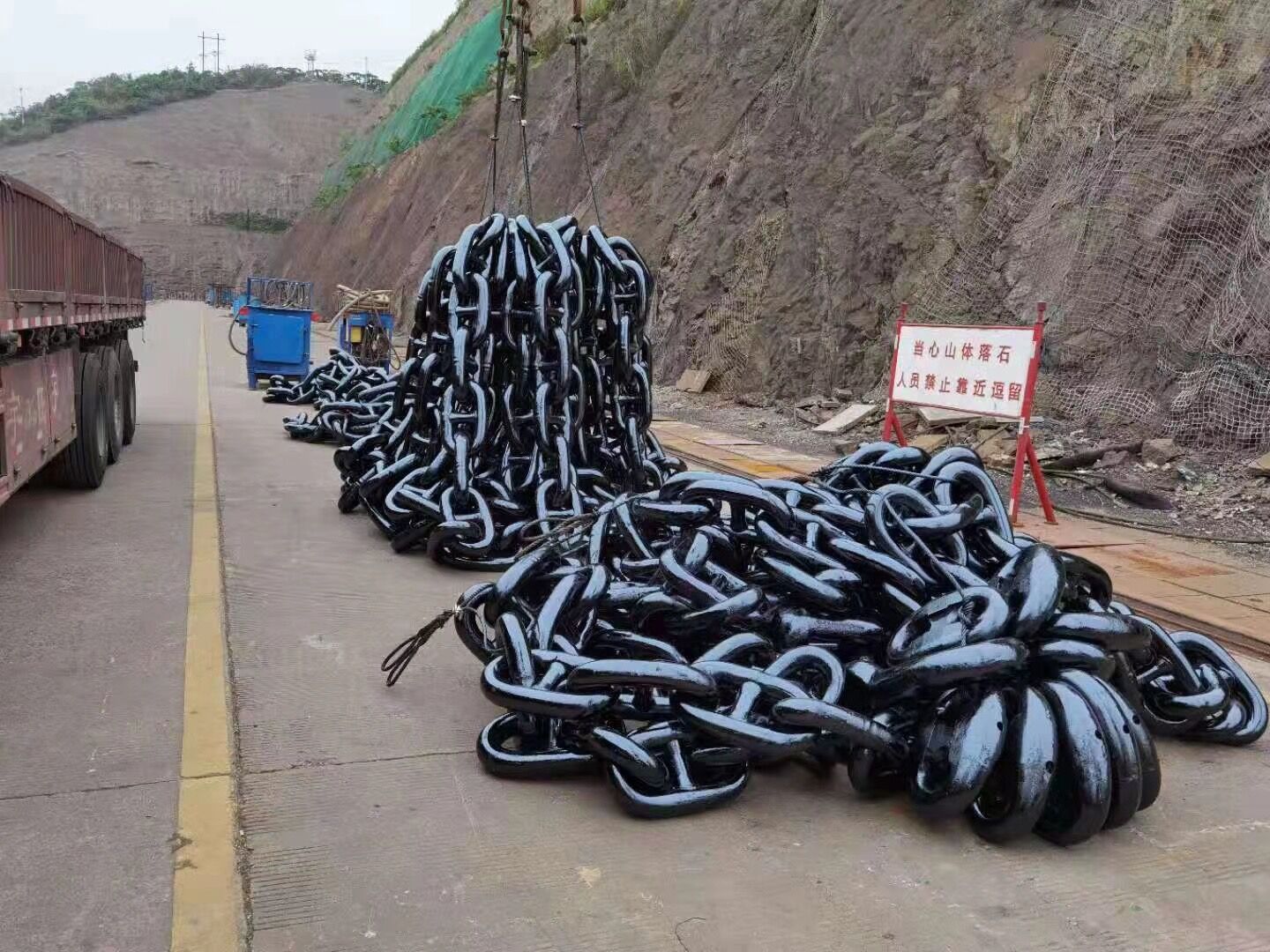
Marine anchor chains are classified by their nominal tensile strength and intended application. The most common grades for commercial vessels are:
| Grade | Material Type | Typical Application | Diameter Range |
|---|---|---|---|
| Grade 2 (AM2) | Carbon steel | General merchant vessels | 12.5mm – 152mm |
| Grade 3 (AM3) | Alloy steel | Larger commercial ships | 12.5mm – 152mm |
Grade 2 chains offer adequate holding power for smaller vessels and routine anchoring operations. Grade 3 chains provide higher strength for larger ships or more demanding conditions, with improved resistance to deformation under load.
A leading Chinese manufacturer like NANJING TAIDUN MARINE EQUIPMENT ENGINEERING CO.,LTD. produces Grade 2 and Grade 3 anchor chains with diameters from 12.5mm to 152mm, holding approvals from 11 classification societies including ABS, LR, BV, DNV, NK, CCS, and RINA .
Offshore mooring chains serve a different purpose: securing floating platforms, FPSOs, and offshore wind installations in deep water. These chains must withstand continuous dynamic loads and extreme environmental forces.
The grading system follows this hierarchy:
- R3: Standard offshore mooring grade
- R3S: Enhanced toughness version of R3
- R4: Higher strength for deeper water and larger platforms
- R4S: Enhanced toughness version of R4
- R5: Premium grade for ultra-deepwater applications
- R6: The highest commercial grade, used in the most demanding projects
Industry milestone: NANJING TAIDUN MARINE EQUIPMENT ENGINEERING CO.,LTD, the world's largest chain manufacturer with 350,000 tons annual capacity, developed R5-grade mooring chains for China's first 3,000-meter deep-sea semi-submersible rig "Ocean Oil 981" in 2010. Their R6-grade chains were first deployed globally on the "Deep Blue Exploration" platform in 2020 .
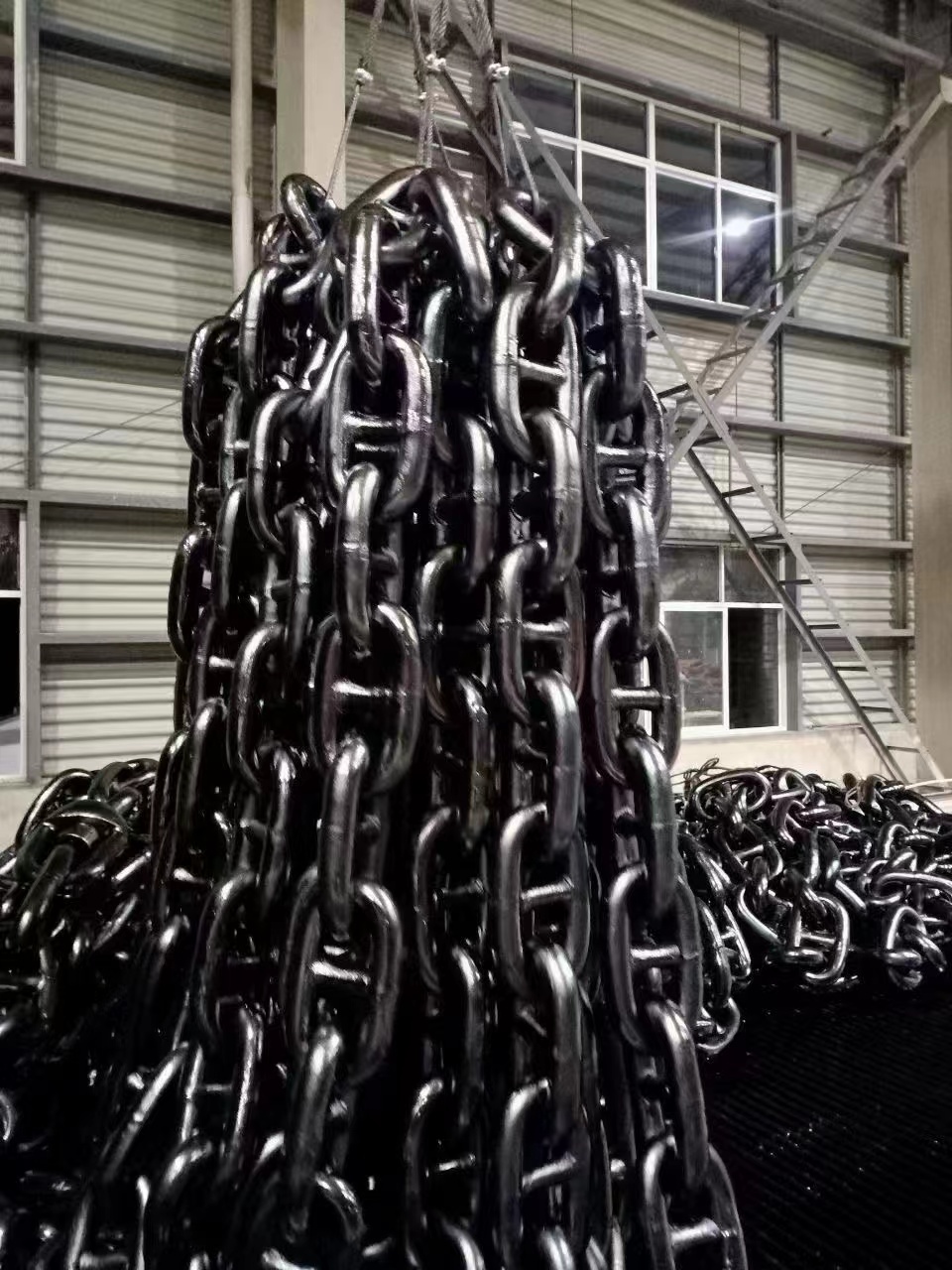
Classification society certification is not optional for commercial marine equipment—it's the foundation of insurability and regulatory compliance. Without valid class certificates, your chains may be rejected at port inspections, void insurance coverage, or fail to meet flag state requirements.
The major classification societies issuing chain approvals include:
- ABS (American Bureau of Shipping)
- LR (Lloyd's Register)
- BV (Bureau Veritas)
- DNV (Det Norske Veritas)
- NK (Nippon Kaiji Kyokai)
- CCS (China Classification Society)
- KR (Korean Register)
- RINA (Registro Italiano Navale)
- RMRS (Russian Maritime Register)
When evaluating anchor chain suppliers, request:
1. Works Approval Certificate – Confirms the manufacturer's production facility meets class requirements
2. Product Test Certificates – Specific to each order, confirming actual test results
3. Type Test Reports – Demonstrate compliance with international standards
4. Mill Certificates for Raw Materials – Traceability from steel source to finished chain
A reputable Chinese manufacturer holds multiple class approvals simultaneously. For example, NANJING TAIDUN MARINE EQUIPMENT ENGINEERING CO.,LTD holds approvals from 11 countries and 12 classification societies, with over 70% of products exported to more than 50 countries .
Flash butt welding is the industry-standard method for producing high-quality anchor and mooring chains. The process involves:
1. Material Inspection – Chemical and mechanical verification of steel bars
2. Cutting – Precision cutting to link-length dimensions
3. Heating – Controlled heating to forging temperature
4. Bending – Forming the chain link shape
5. Flash Butt Welding – Joining link ends under electrical resistance
6. Trimming – Removing weld flash
7. Stud Setting – Inserting and securing studs (for stud link chains)
8. Heat Treatment – Normalizing or quenching-tempering for optimal properties
9. Proof Load Test – Applying load to verify strength
10. Non-Destructive Testing – Magnetic particle and ultrasonic inspection
11. Surface Treatment – Shot blasting, painting, or galvanizing
Leading manufacturers implement multiple NDT stages throughout production :
- Raw material inspection – Chemical composition, hardness, microstructure
- In-process NDT – After welding and heat treatment
- Proof load testing – Verifies each chain's load-carrying capacity
- Final NDT – Ultrasonic and magnetic particle inspection
- Dimensional verification – Link dimensions, stud fit, surface finish
A modern anchor chain facility should possess:
- Universal Testing Machines – Tensile, yield, elongation
- Impact Testers – Charpy V-notch at various temperatures
- Spectrometers – Chemical composition analysis
- Metallographic Microscopes – Microstructure examination
- Magnetic Particle & Ultrasonic Equipment – NDT capabilities
NANJING TAIDUN's facility includes 16 chain production lines, 3 continuous heat treatment furnaces, and a 2,200-ton proof load testing machine, along with comprehensive laboratory facilities .
Selecting the correct anchor chain size depends on:
1. Vessel Displacement – Larger vessels require heavier chains
2. Anchor Mass – Chain breaking strength must complement anchor holding power
3. Water Depth – Deeper anchorages require longer chain lengths
4. Environmental Conditions – Exposed waters demand higher safety margins
Reference Data (from classification rules) :
| Vessel Displacement (approx.) | Recommended Chain Diameter | Grade |
|---|---|---|
| 100-500 tons | 11-16mm | Grade 2 |
| 500-2,000 tons | 16-26mm | Grade 2/3 |
| 2,000-10,000 tons | 26-40mm | Grade 3 |
| 10,000+ tons | 40mm+ | Grade 3 |
Rule of thumb: For vessels over 100 tons displacement, studded chains are recommended for superior strength and reduced deformation under load .
For offshore mooring systems, the selection process involves:
1. Environmental Load Analysis – Wind, wave, current forces
2. Platform Motion Characteristics – Response to dynamic loading
3. Water Depth – Determines required chain length and weight
4. Anchor Type – Suction anchors, drag anchors, or pile anchors
5. Fatigue Life Requirements – Critical for long-term installations
R4 and R5-grade chains are standard for deepwater projects exceeding 1,000 meters. R6 chains are specified for ultra-deepwater or extreme load applications.
Case Study: The global first 16 MW tension-leg platform "Haiyou Anlan" , installed in the Pearl River Mouth Basin, uses 9 high-strength mooring chains with 6,500 tons single-line tension, provided by Chinese manufacturer NANJING TAIDUN. The platform maintains tilt under 1 degree even in Category 17 typhoons .
Before contacting suppliers, establish:
- Chain grade (Grade 2/3, R3-R6)
- Diameter range (12.5mm to 165mm+)
- Length requirements
- Stud type (stud link vs studless)
- Surface treatment (black, galvanized, painted)
- Certification needs (which class societies)
- Accessory requirements (Kenter shackles, swivels, end links)
Selection criteria:
- Minimum 10 years of export experience
- Multiple class society approvals (ABS, LR, BV, DNV at minimum)
- ISO 9001 quality management certification
- In-house testing laboratory
- Proven track record with international clients
Ask for:
- Product samples for dimensional and visual inspection
- Test certificates from previous orders
- Class approval certificates
- Factory audit reports from third parties
- Customer references from similar applications
For large orders, conduct or commission a factory audit covering:
- Production capacity and current utilization
- Quality management system effectiveness
- Testing equipment calibration and capability
- Raw material sourcing and traceability
- Worker qualifications and training records
- Export documentation accuracy
Typical OEM engagement models with Chinese manufacturers:
| Model | Description | Best For |
|---|---|---|
| Private Label | Your brand on standard products | Established distributors |
| Custom Design | Modified specs for specific applications | Specialized projects |
| Full Turnkey | Design, manufacturing, testing, delivery | Large infrastructure project |
Key negotiation points:
- Minimum order quantity (MOQ)
- Lead time (typically 30-90 days)
- Payment terms (T/T, L/C)
- Warranty period
- After-sales support
The purchase price of an anchor chain represents only a fraction of its total cost. Consider:
| Cost Factor | Impact on TCO |
|---|---|
| Service Life | Premium chains can last 2-3x longer |
| Maintenance Requirements | Lower for quality chains |
| Inspection Frequency | Class-approved chains require less frequent inspection |
| Failure Risk | Non-compliant chains can fail catastrophically |
| Operational Downtime | Chain replacement causes significant delays |
| Insurance Premiums | Certified chains may reduce premiums |
Real-world consequence: A mooring chain failure on an offshore platform can result in:
- Emergency disconnect procedures costing $500,000+
- Production downtime at $1-5 million per day
- Environmental risk from station-keeping loss
- Regulatory investigation and potential penalties
The lesson: For critical applications, specifying ISO-compliant, class-certified chains from qualified manufacturers is not an expense—it's risk mitigation.
To maximize chain service life:
- Annual visual inspection of all links and accessories
- Periodic NDT (magnetic particle or ultrasonic) on critical sections
- Link diameter measurement to detect wear (replace when diameter reduction exceeds 10%)
- Proper storage in dry, ventilated conditions
- Lubrication of articulating components (shackles, swivels)
Industry data: Properly maintained chains can achieve 15-25 years of service life in marine environments, while neglected chains may fail within 5-7 years .
Anchor chains are used for temporary anchoring of vessels and are designed for intermittent, high-load applications. Mooring chains secure floating structures (platforms, FPSOs, wind turbines) for extended periods and are engineered for fatigue resistance under continuous dynamic loading. Mooring chains typically use higher grades (R3-R6) than standard anchor chains (Grade 2/3).
The most widely accepted are ABS, LR, BV, DNV, NK, and CCS. A manufacturer holding approvals from at least 6-8 major societies demonstrates global market capability. For projects in specific regions, additional approvals (KR for Korea, RINA for Italy, RMRS for Russia) may be required.
Request: works approval certificates (not just product certificates), factory audit reports from third parties (SGS, BV, TUV), customer references from your region, and sample test reports. Cross-reference the manufacturer's name with classification society online databases. Legitimate manufacturers welcome factory visits.
Standard sizes from stock: 2-4 weeks. Custom or large orders: 30-90 days depending on quantity and grade. R5/R6 mooring chains may require 60-120 days due to specialized production and testing. Always confirm lead times during contract negotiation and include penalties for delays in critical projects.
Yes. Most established Chinese manufacturers offer OEM services including: brand marking on chain links, custom packaging with your branding, certificate issuance under your company name (with manufacturer listed as producer), and private label accessories. MOQ for OEM typically ranges from 10-50 tons depending on specifications.
Common terms: 30% T/T deposit, 70% against B/L copy. For larger orders: L/C at sight is preferred. For established relationships: 30-60 day credit terms may be negotiable. Be cautious of suppliers demanding 100% prepayment—this is unusual in the industry.
Basic formula: Chain length = (Maximum anchoring depth × Scope) + Freeboard allowance. Scope typically ranges from 5:1 to 7:1 (chain length to water depth) for normal conditions, increasing to 10:1 in severe weather. Classification society rules provide minimum chain length tables based on vessel length and equipment number.
Essential accessories: Kenter shackles (for chain joining), end shackles (for anchor connection), swivels (to prevent chain twisting), connecting links, and chain stoppers. Ordering accessories from the same manufacturer ensures compatibility and consistent certification.
The global anchor chain and mooring chain market offers abundant options for B2B buyers—but also significant risks. Classification society certification, manufacturing quality, and supplier reliability are non-negotiable factors that separate successful projects from costly failures.
For international brand owners and wholesalers, Chinese manufacturers offer a compelling combination of production capacity, technical capability, and competitive pricing—provided you conduct proper due diligence.
Key takeaways:
- Grade selection matters: Match chain grade to application (Grade 2/3 for anchoring, R3-R6 for mooring)
- Certification is mandatory: Verify works approval and product certificates
- Manufacturing quality varies: Insist on NDT, proof load testing, and material traceability
- OEM partnerships deliver value: Direct manufacturer relationships reduce costs and improve quality control
- Total cost of ownership: Premium chains deliver lower long-term costs through extended service life
Ready to source high-quality anchor chains and mooring chains for your next project? Contact us to discuss your requirements, request samples, or explore OEM manufacturing partnerships.


