

Views: 425 Author: Nanjing Taidun Publish Time: 2026-04-15 Origin: Site
Content Menu
● What Is Angular Berthing and Why Does It Matter?
>> The Physics of Oblique Impact
>> Why Angular Performance Is Critical for Large Vessels
● How Super Cell Fenders Excel in Angular Berthing
>> Design Features That Enhance Angular Performance
>> Angular Performance Table for Cell Fenders
● The Science of Angular Berthing—Research Findings
>> Korean Research on Angular and Velocity Factors (2025)
>> Shanghai Jiaotong University Research on Angular Side Berthing
● Cone Fenders vs. Cell Fenders for Angular Berthing
>> Angular Performance Comparison
>> Which Is Better for Your Application?
● UHMW-PE Frontal Pads—Reducing Shear Forces in Angular Berthing
● Correction Factors for Angular Loading in Fender Design
>> When to Apply Angular Correction Factors
>> Recommended Angular Correction Factors
● User Feedback—Real-World Angular Berthing Experiences
● How Nanjing Taidun Supports Your Angular Berthing Requirements
● Frequently Asked Questions (FAQ)
When a 200,000-ton tanker approaches an LNG terminal, it rarely hits the fender perfectly straight. Wind, current, and human factors mean that most berthing events occur at an angle.
This is why understanding the angular berthing performance of super cell fenders is not an academic exercise—it is a critical safety and design consideration.
I have spent two decades manufacturing OEM rubber fender systems for global brands, wholesalers, and production facilities. In this guide, I will explain why angular performance matters, how super cell fenders excel in oblique impacts, and what correction factors you need for proper system design.
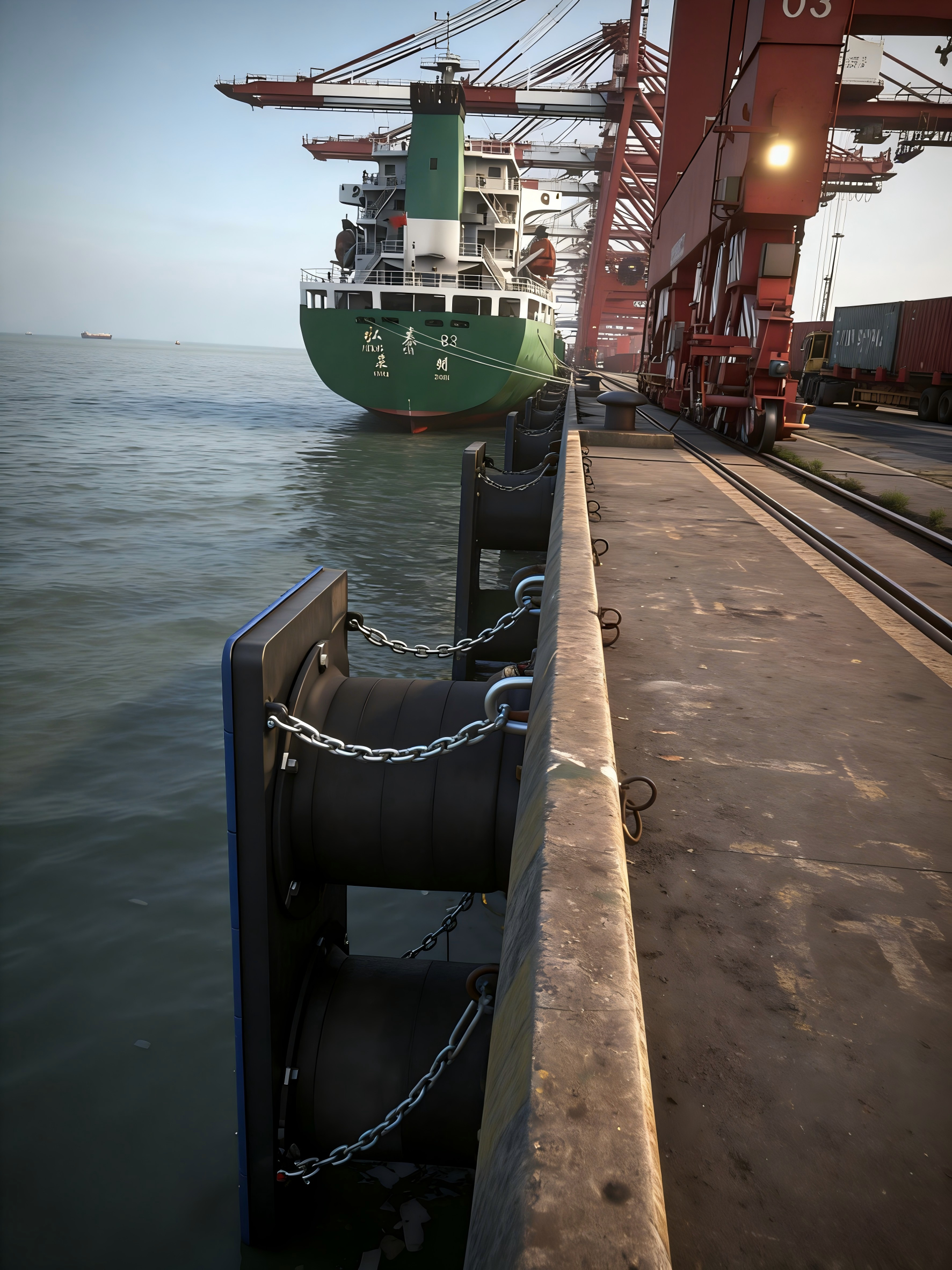
Angular berthing occurs when a vessel approaches a berth at an angle rather than perpendicular to the quay wall. Instead of a direct, head-on compression, the fender experiences a combination of compression and shear loading.
When a vessel berths at an angle, the energy absorption mechanism changes fundamentally:
| Berthing Type | Loading Direction | Primary Stress |
|---|---|---|
| Perpendicular (0°) | Direct compression | Uniform compressive stress |
| Angular (3°-15°) | Combined compression + shear | Uneven stress distribution, buckling risk |
> *"For selecting a fendering system suitable for berthing of large vessels, angular performance is one of the most important factors to be considered."*
Large vessels—tankers, LNG carriers, and bulk carriers—present unique challenges for angular berthing:
1. Higher mass means higher energy – Even small angles generate significant lateral forces
2. Longer hulls increase contact duration – More time for angular momentum to affect the fender
3. Structural limitations – Older terminals may not have been designed for modern vessel sizes
4. Tidal and current effects – These environmental factors increase the likelihood of angled approaches
According to field surveys cited in industry literature, the berthing angle will be less than 3 degrees in most cases and 6 degrees at the maximum. However, even these small angles can significantly affect fender performance if not properly accounted for.
The angular berthing performance of super cell fenders represents a significant improvement over ordinary cell fenders.
Super cell fenders incorporate several design innovations that make them particularly suitable for angular berthing:
> *"Super cell fender is improved over the ordinary cell fender at the buckling point and the shape of the edge of the leg. Its wider dispersion of stress has been corroborated by the FEM (Finite Element Method)."*
Under angular compression, super cell fenders maintain their performance characteristics better than ordinary cell fenders:
| Performance Metric | Ordinary Cell Fender | Super Cell Fender | Improvement |
|:---|:---|:---|
| E/R·H value | 0.383 | 0.450 | 15% higher |
| Design deflection | 47.5% | 52.5% | +13% |
| Energy absorption increase (at same reaction force) | Baseline | +17% | Significant |
What This Means in Practice: When a vessel berths at an angle, a super cell fender will absorb more energy with less reaction force than an ordinary cell fender. This translates directly to better hull protection and reduced quay wall stress.
For proper fender selection, correction factors must be applied for angular berthing. The following table defines the angular performance of cell fender series under each berthing angle :
| Berthing Angle | Typical Correction Factor | Design Consideration |
|---|---|---|
| 0° (Perpendicular) | 1.00 | Baseline RPD performance |
| 3° | 0.90-0.95 | Typical maximum for most berthing events |
| 5° | 0.80-0.88 | Requires correction factor application |
| 6° | 0.75-0.85 | Maximum expected for standard ports |
| 10° | 0.60-0.75 | Special consideration required |
| 15° | 0.45-0.60 | Consult manufacturer for site-specific data |
> *"According to the results obtained in field surveys, the berthing angle will be less than 3 degrees in most cases and 6 degrees at the maximum. We suggest that you will select the fendering system taking the correction factor for angular loading into consideration."*
Recent research has advanced our understanding of how rubber fenders behave under angular compression.
A 2025 study published in Korea established a dedicated testing framework for analyzing the effects of compression angle and velocity on marine fender performance .
Key Findings:
| Variable | Effect on Fender Performance |
|---|---|
| Increasing compression angle | Reduced energy absorption and reaction force |
| Increasing compression velocity | Enhanced energy absorption and reaction force (due to rubber‘s viscoelastic nature) |
| Neglecting dynamic corrections | Can underestimate reaction forces by up to 24% |
> *"The comparison revealed that neglecting dynamic corrections, particularly velocity effects, can lead to significant underestimation of reaction forces up to 24% which may compromise the safety of structures."*
Implications for Port Design: Ignoring angular and velocity correction factors can lead to undersized fenders that may fail during real-world berthing events. Proper design requires applying both angular factors (AF) and velocity factors (VF) based on site-specific conditions.
A 2015 study from Shanghai Jiaotong University analyzed angular side berthing against rubber cone fenders using finite element modeling .
Key Finding: The energy absorbed by the fender during angular berthing can be much higher than what can be calculated with current berth design methods.
> *"Results show that the energy absorbed by the fender can be much higher than what can be calculated with the current berth design method. A new form for the expression of the energy that must be absorbed by the fender during angular berthing impact is suggested."*
This research suggests that existing design guidelines may underestimate the demands placed on fenders during angular berthing, reinforcing the importance of selecting fenders with superior angular performance characteristics.
While this article focuses on super cell fenders, it is worth comparing their angular performance to cone fenders, another popular choice for large vessel terminals.
> *"The performance is almost changeless during vessels' angular berthing under 10°."*
> *"In case of a dolphin and a super-structured berth for large vessels, the effect of angular compression on the fender is generally considered in designing. But in case of a continuous wharf where many fenders are installed with certain spacing, this effect usually is not considered."*
One additional feature that enhances the angular berthing performance of super cell fenders is the optional UHMW-PE (Ultra-High Molecular Weight Polyethylene) frontal pad.
> *"UHMW-PE frontal pad is fixed in the front of frontal berthing to lower friction coefficient and reduce the shear force in berthing by large margin."*
For terminals experiencing frequent angular berthing events, UHMW-PE pads are a highly recommended upgrade.
Properly accounting for angular loading requires applying correction factors to rated performance data (RPD).
According to industry guidelines :
| Scenario | Angular Correction Required? |
|---|---|
| Continuous wharf with standard fender spacing | Usually not required (angles typically <3°) |
| Dolphin berths for large vessels | Yes—angular compression effect must be considered |
| Super-structured berths | Yes—site-specific factors needed |
| Horizontal array systems (2×1, 3×1) | Depends on fender spacing and frame size—consult manufacturer |
| Vertical array systems (1×2) | Multiply performance proportionally to quantity of fenders |
> *"For vertical array system, multiply the performance in the following table in proportion to the quantity of fender. For horizontal array system such as 2 x 1 system or 3 x 1 system, angular performance of the system is depending on the distance between each fenders and frame size."*
Based on industry data and research findings , the following correction factors are recommended for super cell fenders:
| Berthing Angle | Energy Absorption Correction | Reaction Force Correction |
|---|---|---|
| 0° | 1.00 | 1.00 |
| 3° | 0.92-0.96 | 0.94-0.97 |
| 5° | 0.85-0.90 | 0.88-0.93 |
| 6° | 0.80-0.86 | 0.84-0.89 |
| 10° | 0.68-0.75 | 0.72-0.80 |
Note: These factors are for guidance only. Site-specific conditions and vessel characteristics may require different values. Always consult your fender manufacturer for project-specific correction factors.
We asked our global OEM clients about their experience with super cell fenders in angular berthing applications. Here is what they shared:
> *"We operate a container terminal with strong cross-currents. Angular berthing is our normal condition, not the exception. Since upgrading to super cell fenders, we've seen a significant reduction in hull repair claims. The wider stress dispersion design really works."*
> — *Terminal Operations Manager, Southeast Asia*
> *"Our old cylindrical fenders would show uneven wear patterns—clearly from angled approaches. After switching to super cell fenders with UHMW-PE pads, the wear is uniform and the fenders are lasting twice as long."*
> — *Maintenance Director, European Port*
> *"We initially overlooked angular performance when selecting fenders for our dolphin berth. After consulting with our OEM partner, we applied correction factors and upsized our fenders accordingly. Three years later, we have had zero issues."*
> — *Project Engineer, Middle East LNG Terminal*
At Nanjing Taidun Marine Equipment Engineering Co., Ltd. , we understand that the angular berthing performance of super cell fenders is a critical factor in terminal design.
Our capabilities include:
| Service | Description |
|---|---|
| Angular performance calculations | Site-specific correction factors for your berthing conditions |
| FEM analysis | Computer-validated stress distribution for your application |
| UHMW-PE pad integration | Friction reduction for challenging angular berthing |
| Custom hardness grades (P01-P3) | Precise reaction force matching to vessel requirements |
| Third-party certification | PIANC, BV, ABS, LR, CCS available |
We serve brand owners, wholesalers, and production facilities in over 80 countries. When you partner with Taidun, you get factory-direct pricing, custom engineering, and full certification documentation.
The angular berthing performance of super cell fenders represents a significant advancement over ordinary cell fenders. With 15% higher E/R·H value, 13% increased design deflection, and FEM-verified stress distribution, super cell fenders are engineered for the challenges of modern large vessel terminals.
When designing your fender system, remember:
1. Angular berthing is the norm, not the exception—account for it
2. Apply correction factors—neglecting them can underestimate forces by up to 24%
3. Consider UHMW-PE pads—reduce shear forces significantly
4. Consult an OEM expert—site-specific factors matter
[Contact the Nanjing Taidun Engineering Team] for a free angular berthing performance assessment. Send us your berthing data, and we will provide correction factors and fender recommendations for your specific application.
Q1: What is angular berthing and why does it matter for fender selection?
A: Angular berthing occurs when a vessel approaches at an angle rather than perpendicular to the quay wall. It matters because oblique impacts create combined compression and shear loading, which reduces energy absorption and increases stress on the fender system.
Q2: How do super cell fenders perform better than ordinary cell fenders in angular berthing?
A: Super cell fenders feature wider stress dispersion (FEM-verified), improved leg edge shape, and increased design deflection (52.5% vs 47.5%). These improvements result in a 15% higher E/R·H value (0.450 vs 0.383), meaning better energy absorption relative to reaction force.
Q3: What correction factors should I apply for angular berthing?
A: For a 3° berthing angle, apply energy absorption correction of 0.92-0.96 and reaction force correction of 0.94-0.97. For 5°, use 0.85-0.90 and 0.88-0.93 respectively. For angles beyond 6°, consult your manufacturer for site-specific factors.
Q4: What is the maximum berthing angle I should design for?
A: According to field surveys, the berthing angle is less than 3 degrees in most cases and 6 degrees at the maximum. However, challenging sites with strong currents or winds may require design for up to 10°-15°.
Q5: Do I need to consider angular performance for continuous wharves?
A: For continuous wharves with standard fender spacing, angular effects are usually not considered in design because berthing angles are typically small (<3°). However, for dolphin berths and super-structured berths for large vessels, angular compression effects must be considered.


