

Views: 267 Author: Nanjing Taidun Publish Time: 2026-11-03 Origin: Site
Content Menu
● Double Bitt vs Single Bitt Bollard: The Practical Difference
● Why Heavy-Duty Tugboat Berthing Requires More Than a Capacity Label
>> Mooring Loads Are Not the Same as Tug Bollard Pull
>> Fender Performance Also Affects the Arrangement
● When a Double Bitt Bollard Is the Better Choice
>> Evaluate How Crews Will Handle the Lines
>> Do Not Assume Each Bitt Has the Full Assembly Rating
● When a Single Bitt Bollard Is the Better Choice
● Three Engineering Checks That Prevent Expensive Selection Errors
>> 1. Check Combined Loads, Not Just Individual Lines
>> 2. Verify the Full Line-Angle Envelope
>> 3. Treat the Foundation as Part of the Product
● Rope Compatibility: A Small Detail With Major Consequences
● An OEM Procurement Checklist for Overseas Buyers
>> Information to Include in Your RFQ
>> Documents to Agree Before Manufacturing
● Inspection and Maintenance: Protecting Performance After Installation
● Request a Project-Specific OEM Bollard Review
>> Is a double bitt bollard always stronger than a single bitt bollard?
>> Can a single bitt bollard hold two mooring lines?
>> Should tug bollard pull determine the shore-bollard rating?
>> Which design is better for large tidal changes?
>> Can a double bitt bollard replace a single bitt on existing anchors?
>> What should an OEM buyer prioritize beyond price?
At Nanjing Taidun Marine Equipment Engineering Co., Ltd., we support overseas brands, wholesalers, and manufacturers with OEM marine bollards, rubber fenders, and anchoring products. When comparing double bitt vs single bitt bollard for heavy-duty tug boat berthing, our starting point is straightforward: select the complete mooring arrangement, not simply the bollard shape.
A double bitt bollard can offer useful flexibility when handling multiple lines. A single bitt bollard can provide an effective solution where its geometry, rated capacity, and installation suit the berth. Neither design is automatically stronger or safer.
The deciding factors are line loads, lead angles, rope compatibility, operating procedures, and the supporting structure. This guide focuses on shore-mounted bollards used to secure berthed tugboats—not on assuming that ordinary berth fittings are approved for active towing.

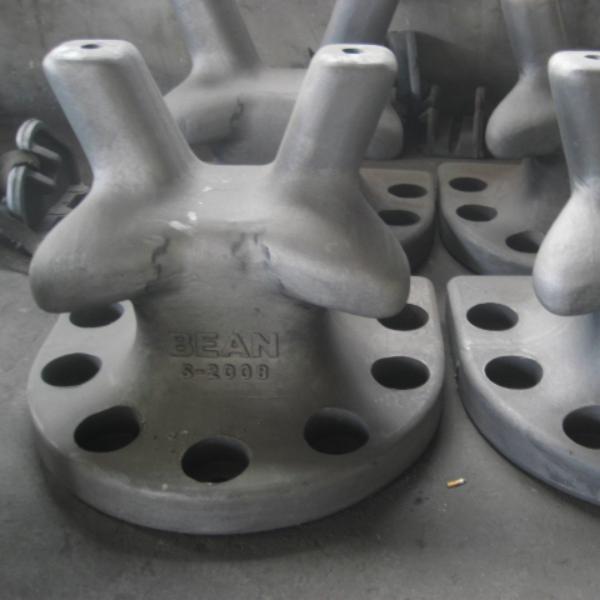
A single bitt bollard has one principal upright body around which mooring lines are secured. A double bitt bollard has two uprights within a defined assembly, providing additional options for arranging lines.
Terminology varies between suppliers. Procurement teams should compare drawings rather than assume that "double bitt," "twin horn," and other product names describe identical geometry.
| Selection factor | Single bitt bollard | Double bitt bollard |
|---|---|---|
| Basic configuration | One principal upright | Two uprights in one assembly |
| Line handling | Can accommodate multiple lines when approved | Offers additional line-arrangement options |
| Space requirement | Often suits constrained layouts; verify dimensions | May need more installation and handling space |
| Load capacity | Determined by the specific engineered design | Determined by the specific engineered design |
| Strongest selection reason | Suitable capacity and geometry with a straightforward arrangement | Operational flexibility for the intended line arrangement |
| Critical limitation | Multiple lines still share the approved assembly capacity | Two uprights do not establish two independent capacities |
Our recommendation is to compare system suitability before comparing price.
*Suggested visual: Place a labeled single-versus-double bitt drawing here, showing rope contact areas, baseplates, anchor positions, and required handling clearance.*
"Heavy-duty" is not a complete engineering specification. Two tugboats of similar size can impose different berth demands because of their exposure, operating schedules, and mooring arrangements.
A sheltered service berth differs substantially from an exposed quay affected by passing-vessel wash, tidal changes, or persistent current.
Tug bollard pull describes towing performance under specified test conditions. It should not be copied directly into a shore-bollard purchase specification.
Berthing loads depend on the moored vessel and its environment. Active towing, propulsion thrust against restrained lines, or other special operations require separate assessment when relevant.
A useful engineering brief includes:
- Tug dimensions, drafts, and operating conditions.
- Wind, current, waves, tides, and passing-vessel effects.
- Mooring-line positions, materials, and characteristics.
- Expected horizontal and vertical lead angles.
- Simultaneous loading from adjacent vessels.
- The berth structure and available foundation information.
Fenders manage vessel contact with the berth; mooring lines restrain vessel movement. Their functions differ, but their layouts interact.
Check whether the fender stand-off distance changes line geometry, whether projecting equipment creates chafe points, and whether the tug can move without trapping lines.
Purchasing bollards and fenders separately should not mean designing them independently.
A double bitt arrangement deserves consideration when the approved mooring plan benefits from additional line-handling options.
Potential applications include berths where crews regularly handle several lines or where the layout requires clearly organized securing positions.
However, operational flexibility must be demonstrated on the actual drawing.
Before selecting a double bitt bollard, ask:
1. Can crews place and remove each line without disturbing another?
2. Is there sufficient room for the specified rope eyes?
3. Can lines lead toward their fairleads without crossing unnecessarily?
4. Are contact surfaces suitable for the rope construction?
5. Can personnel work without entering hazardous bights?
A design that looks convenient in a catalog may become awkward once large rope eyes, quay equipment, and restricted access are included.
A stated assembly capacity does not automatically apply independently to both uprights.
Ask the supplier to identify whether the rating covers the complete unit, particular loading directions, simultaneous lines, and specified vertical angles.
Unless the engineering documentation explicitly permits it, do not interpret a 100-tonne-rated double bitt assembly as two separate 100-tonne securing points.
A single bitt bollard should not be dismissed as a light-duty alternative.
Appropriately engineered single bitt designs can accommodate demanding mooring applications. Some are specifically configured for steep line angles and can accept more than one line, subject to their approved capacity.
A single bitt solution may be appropriate where:
- The mooring arrangement is comparatively straightforward.
- Available quay space favors its particular footprint.
- Its profile retains lines throughout the required angle range.
- An existing installation can be reused after structural verification.
- Operators prefer the approved handling arrangement.
The important distinction is between a suitable engineered product and an unsuitable one—not between one upright and two.
For replacement projects, matching the old bolt pattern is only an initial dimensional check. It does not establish that the existing concrete, anchors, or quay structure remain adequate.
When multiple lines share a bollard, their combined effect depends on magnitude and direction.
Two lines pulling in similar directions can produce a high resultant load. Different directions may reduce the net force, but that does not eliminate local stresses or structural demands.
Do not assume equal load sharing. Rope stiffness, initial tension, vessel movement, and line length can produce uneven loading.
The engineer should assess the relevant simultaneous load cases, including their effects on the bollard body, base, anchors, and supporting structure.
A bollard rating is meaningful only within its approved loading conditions.
Vertical angles change with tide, vessel draft, freeboard, and the distance between the vessel and the quay fitting.
Steeper lines can change uplift and overturning demands. Horizontal direction also matters, especially where the base or anchorage is not equally resistant in every direction.
Request an approved loading envelope rather than relying on a single capacity figure.
*Suggested diagram: Show the same tug at high and low water, with the resulting changes in vertical line angle.*
A stronger casting cannot compensate for an inadequate foundation.
Review:
- Concrete strength and condition.
- Quay-edge distances.
- Reinforcement and structural load paths.
- Anchor size, grade, embedment, and installation method.
- Baseplate seating and grout requirements.
- Existing cracks, corrosion, or previous repairs.
A wider double bitt base may alter load distribution, but it does not automatically make a weak jetty safe. Foundation adequacy requires project-specific assessment.
Bollard selection must account for the rope as well as the steel or iron fitting.
Check contact diameter, surface finish, edge radii, rope-eye dimensions, and potential abrasion points.
The rope manufacturer's requirements are particularly important for high-performance synthetic ropes. An unsuitable bend relationship can undermine performance even when the rope's stated breaking strength appears sufficient.
The MAIB investigation into the LNG carrier Zarga provides a relevant industry lesson: rope strength alone did not establish a safe system because compatibility with the vessel's fittings also mattered.
This was not a tugboat shore-bollard comparison. Its value here is the transferable principle: specify the rope and fitting as compatible components.
Avoid rough contact surfaces, sharp transitions, and unapproved repairs in rope-bearing areas.
For brand owners and distributors, a defensible specification is more valuable than a quotation containing only dimensions and nominal tonnage.
At Nanjing Taidun, our OEM product offering includes marine bollards alongside fenders and anchors. Project requirements should be agreed during technical review rather than inferred from general catalog descriptions.
Provide:
1. Berth location and installation drawings.
2. Tug particulars and intended operating conditions.
3. Required rated capacity and its engineering basis.
4. Horizontal and vertical loading requirements.
5. Rope material, diameter, and eye dimensions.
6. Foundation information and installation constraints.
7. Material, coating, marking, and inspection requirements.
8. Private-label requirements and required documentation.
Clarify units as well. A force expressed in kN is not the same notation as a mass expressed in tonnes. When "tonnes" is used for a load rating, confirm the intended force convention.
Depending on the project specification, the documentation package may include:
- Approved general arrangement and anchorage drawings.
- Material certificates and traceability records.
- Inspection and test plans.
- Dimensional inspection reports.
- Specified nondestructive examination records.
- Coating inspection records.
- Installation and maintenance instructions.
- Agreed third-party inspection documentation.
Distinguish material certification, product testing, design verification, and third-party witnessing. These activities provide different evidence and should not be treated as interchangeable.
Neither bollard design remains reliable without inspection.
Establish an inspection regime based on the manufacturer's instructions, berth exposure, operating frequency, and competent engineering advice.
Look for movement, deformation, cracks, corrosion, loose or damaged fasteners, foundation deterioration, and rope-contact damage.
Keep identification and rated-capacity markings legible. Report significant abnormalities and isolate suspect equipment pending assessment.
IMO guidance addresses shipboard mooring equipment inspection and maintenance. It provides useful safety context, but it should not be presented as automatic certification of a shore-mounted bollard or quay foundation.
For each operation, crews also need clear communications and procedures that control exposure to tensioned lines, bights, and potential snapback.
Choosing between single and double bitt bollards should produce a documented engineering decision—not simply a preferred silhouette.
Send Nanjing Taidun Marine Equipment Engineering Co., Ltd. your berth drawing, tug particulars, rope specification, required load cases, and branding requirements.
Ask for a project-specific OEM proposal covering the bollard configuration, anchorage interface, inspection scope, and documentation package. Where foundation information is incomplete, identify that gap before approving manufacture.
No. Capacity depends on the engineered product, material, geometry, loading direction, anchorage, and supporting structure. Compare approved ratings under equivalent conditions.
Yes, some designs permit this. Confirm the supplier's approved arrangement and assess the combined loading. Two lines do not create additional bollard capacity.
Not by itself. Shore-mooring demand requires assessment of the vessel, environment, line arrangement, and intended operations. Special towing or thrust-loading conditions need explicit consideration.
Neither design wins automatically. Select a profile and installation approved for the full vertical line-angle range while checking rope retention, uplift, and foundation demands.
Only after verification. Check the bolt arrangement, load distribution, anchors, concrete, reinforcement, and structural condition. Dimensional compatibility alone is insufficient.
Prioritize a clear load specification, verified installation interface, rope compatibility, traceable materials, agreed inspection requirements, and usable technical documentation.
1. Nanjing Taidun Marine Equipment Engineering Co., Ltd. — [Marine Bollard].
2. Nanjing Taidun Marine Equipment Engineering Co., Ltd. — [Single Bitt Bollards];[Double Bitt Bollards].
3. Trelleborg Marine and Infrastructure — [Single Bitt Bollards].
4. Trelleborg Marine Systems — [Bollard Application Design Manual].
5. International Maritime Organization — [Safe Mooring];[MSC.1/Circ.1620: Guidelines for Inspection and Maintenance of Mooring Equipment Including Lines]
6. UK Marine Accident Investigation Branch — [MAIB Safety Bulletin 1/2016: Zarga].
7. UK Maritime and Coastguard Agency — [A Reminder About Mooring Deck Safety].
Hot Tags: China, Global, OEM, private label, manufacturers, factory, suppliers, manufacturing company


