

Views: 236 Author: Nanjing Taidun Publish Time: 2026-11-04 Origin: Site
Content Menu
● Foam Filled Fenders vs Inflatable Marine Fenders: The Essential Difference
>> How foam-filled marine fenders work
>> How inflatable marine fenders work
● Why Scrap Metal Wharves Create Difficult Fender Conditions
● Puncture Resistance Is Not the Same as Damage Tolerance
>> What happens when a foam fender is punctured?
>> What happens when a pneumatic fender is punctured?
● Side-by-Side Comparison for Scrap Terminal Buyers
● How to Select Fender Performance Without Misleading Comparisons
>> Check energy absorption and reaction force together
>> Evaluate positioning across the operating envelope
● A Five-Step Puncture-Risk Assessment for Scrap Wharves
● A Practical Damage-Triage Framework
>> Surface wear requiring monitoring
>> Damage requiring prompt technical assessment
>> Damage requiring immediate operational control
● OEM Procurement: What Overseas Brands Should Specify
● Compare Lifecycle Cost, Not Just Purchase Price
● Build the Specification Around the Berth
>> 1. Are foam-filled fenders puncture-proof?
>> 2. Can a damaged foam fender stay in service?
>> 3. Does a chain-and-tire net eliminate puncture risks?
>> 4. How often should scrap-wharf fenders be inspected?
>> 5. Are pneumatic fenders unsuitable for scrap terminals?
>> 6. What information helps an OEM manufacturer recommend a suitable system?
At Nanjing Taidun Marine Equipment Engineering Co., Ltd., we support overseas brands, wholesalers, and manufacturers seeking OEM marine fenders, mooring bollards, and anchoring products. For buyers comparing foam filled fenders vs inflatable marine fenders, puncture risks in scrap metal wharves deserve particular attention.
The central question is not simply which fender has the toughest exterior. It is what happens after sharp steel damages that exterior.
A properly specified foam-filled fender does not depend on internal air pressure, making it generally more tolerant of localized skin punctures. An inflatable marine fender relies on retained air pressure, so a penetrating cut can compromise its performance.
However, neither design is immune to scrap-metal damage. The right choice combines damage tolerance, verified berthing performance, practical maintenance, and control of sharp objects around the berth.
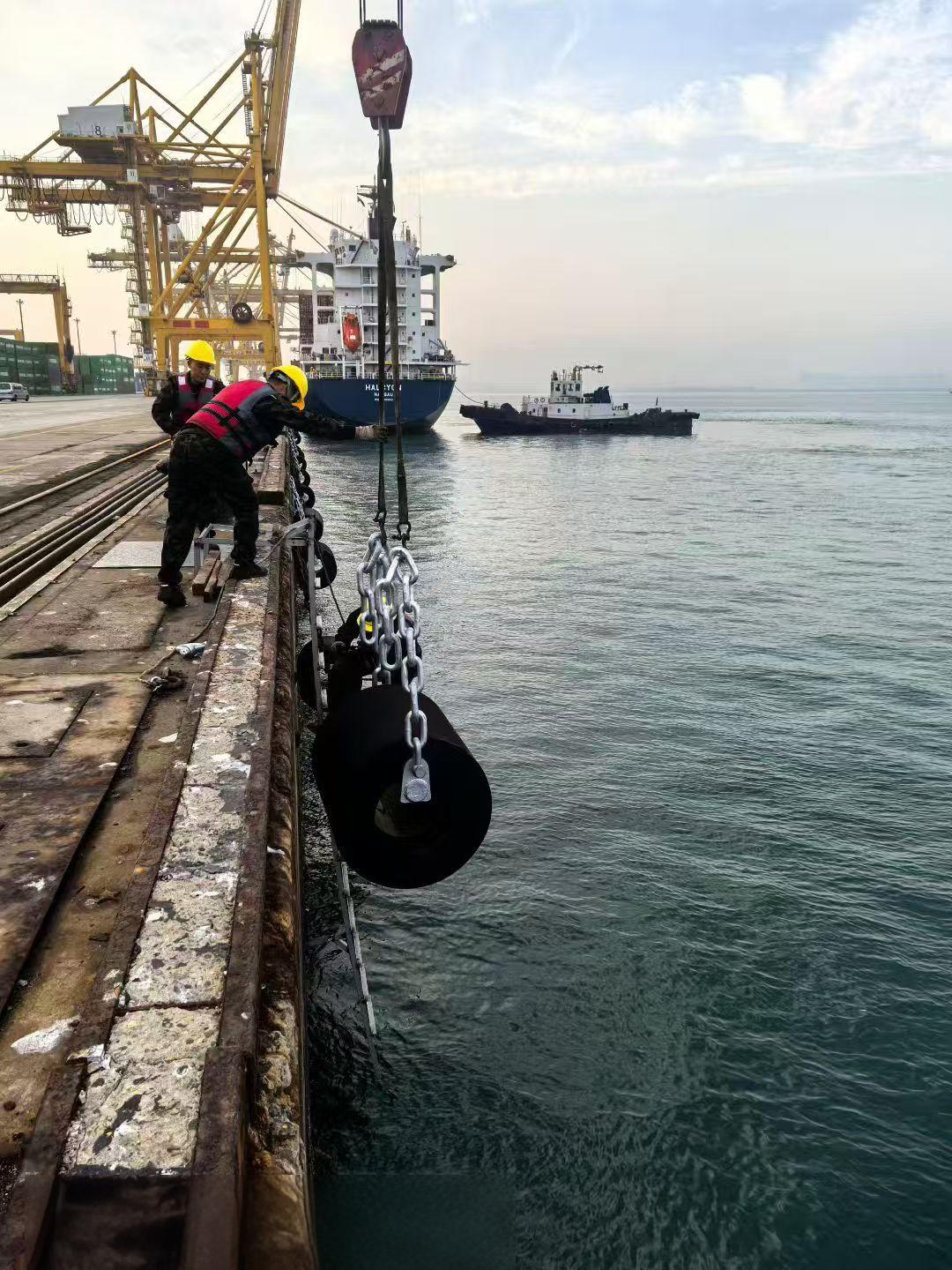
Both systems cushion contact between vessels and berthing structures. Their energy-absorption mechanisms differ.
A typical foam-filled marine fender combines:
- A resilient, closed-cell foam core.
- A reinforced protective elastomer skin, commonly polyurethane.
- End fittings and internal arrangements appropriate to its design.
- Optional external protective equipment.
The foam absorbs energy as it compresses. Its closed-cell structure supports buoyancy without requiring an inflated chamber.
Localized skin damage therefore does not trigger deflation. Nevertheless, deep cutting, missing foam, crushed areas, or damaged fittings can affect serviceability.
Here, "inflatable marine fenders" means industrial floating pneumatic rubber fenders, not lightweight recreational boat accessories.
These fenders absorb berthing energy through compression of an air-filled rubber body. Their construction typically includes reinforcement, an air-retaining inner layer, and external rubber protection.
Some designs incorporate chain-and-tire nets. Pressure-control equipment depends on the product specification.
Maintaining the specified internal pressure is essential. A fender that still looks inflated should not automatically be assumed to deliver its rated performance.
A scrap terminal combines berthing loads with potential cutting, snagging, and abrasion hazards.
Examples include:
- Protruding steel plate edges.
- Wire bundles and loose cable.
- Irregular scrap caught near the waterline.
- Damaged quay fittings.
- Rough barge surfaces or projecting hull attachments.
These hazards do not always act independently.
A projecting edge may first scrape a fender, then catch the same location as the vessel moves. Repeated contact can turn shallow surface damage into a deeper cut.
This makes three damage mechanisms important:
| Damage mechanism | What happens | Inspection priority |
|---|---|---|
| Abrasion | Repeated rubbing removes exterior material | Worn areas and exposed reinforcement |
| Cutting or puncture | A sharp object penetrates the surface | Depth, location, leakage, and core exposure |
| Snagging or tearing | A projection catches a surface or accessory | Torn skin, displaced nets, fittings, and restraints |
The practical implication is straightforward: fender selection cannot compensate for uncontrolled sharp steel in the contact zone.
For procurement purposes, the most useful distinction is damage-tolerance.
Puncture resistance describes how difficult it is to penetrate a protective surface. Damage tolerance describes how the product behaves after damage occurs.
A localized breach in a closed-cell foam fender does not release a supporting air chamber. The fender may retain buoyancy and some operational capability.
That does not establish that every damaged foam fender remains safe to use.
A deep tear may affect reinforcement. Severe cutting may remove energy-absorbing material. Damage around an attachment can undermine positioning even when the body still floats.
Exposed foam requires prompt attention under the applicable manufacturer's repair instructions.
A cut through the air-retaining structure creates a leakage path. The rate and consequences depend on the opening, pressure, loading, and operating conditions.
Not every surface mark causes a leak. Conversely, an apparently small penetrating defect can require removal and specialist evaluation.
Avoid treating an improvised patch as proof that rated performance has been restored.
| Selection factor | Foam-filled marine fenders | Inflatable pneumatic marine fenders |
|---|---|---|
| Energy absorption | Compression of resilient foam | Compression of retained air |
| Localized skin puncture | Does not cause deflation | Can cause leakage if the air-retaining structure is penetrated |
| Pressure checks | Not required for the foam body | Required according to manufacturer instructions |
| Significant damage | Can affect skin, foam, reinforcement, or fittings | Can affect rubber, reinforcement, air retention, or fittings |
| Protective net | Available on certain designs | Common on certain designs |
| Repair assessment | Evaluate skin, core, reinforcement, and attachments | Evaluate rubber, reinforcement, leakage, and pressure equipment |
| Main procurement concern | Verified construction and performance after realistic wear | Verified construction, pressure integrity, and maintainability |
For a berth with persistent sharp-object exposure, foam-filled fenders merit strong consideration.
Pneumatic fenders remain a valid option where their performance suits the vessel and berth, hazards are controlled, and pressure inspection and repair support are dependable.
Do not select a fender solely because it matches the dimensions of the existing unit.
Two equally sized products can have different energy absorption, reaction force, and operating limits.
The selected system must absorb the calculated berthing energy without exceeding allowable loads on the vessel or supporting structure.
Request:
- Rated energy absorption.
- Corresponding reaction force.
- Rated deflection.
- Performance curves and test conditions.
- Applicable tolerances and correction factors.
- Relevant hull-contact pressure information.
"Higher energy absorption" is not automatically better if the resulting reaction force is unsuitable.
A floating fender must remain in the intended contact zone through relevant changes in tide, draft, and vessel movement.
Review restraint geometry, clearances, attachment loads, and likely snagging points.
Foam construction does not solve a positioning problem. Neither does a chain-and-tire net.
The following workflow is a practical planning tool, not a substitute for engineering design.
1. Map the contact zone. Record where vessels actually touch the system across representative drafts and water levels.
2. Identify cutting hazards. Inspect quay edges, vessel projections, damaged fittings, and areas where scrap accumulates.
3. Review damage history. Separate abrasion, skin cuts, leakage events, attachment failures, and handling damage.
4. Assess operational consequences. Determine whether a damaged fender can be isolated and whether a suitable replacement is available.
5. Define acceptance requirements. Translate the risks into construction specifications, inspection triggers, repair arrangements, and spare-unit planning.
Photographs should include a scale, location reference, and date. A close-up alone may not reveal whether repeated damage comes from a fixed projection or a positioning problem.
The following categories help organize inspection findings. They are not automatic permission to continue operating.
Examples include shallow abrasion without exposed reinforcement, visible foam, leakage, or displaced fittings.
Record the location and compare photographs over time. Increase inspection attention if wear repeatedly develops in the same area.
Examples include exposed reinforcement, foam exposure, deeper cuts, localized deformation, or recurring pressure loss.
Protect the area from further loading where practicable and seek manufacturer guidance.
Examples include active leakage, major tearing, significant material loss, damaged attachment hardware, or a displaced fender that no longer protects the contact zone.
Control access and berthing activity under the terminal's safety procedures. Do not place personnel between a vessel and the berth for inspection.
Buoyancy alone is not an acceptance criterion.
For buyers working with Taidun, a detailed RFQ creates a stronger foundation than a request for "heavy-duty fenders."
Include vessel dimensions, displacement range, approach conditions, berth drawings, water-level range, allowable loads, and photographs of known hazards.
For foam-filled products, request information covering:
- Foam type, density, and construction.
- Skin material, reinforcement, and specified thickness.
- Energy absorption and reaction-force verification.
- End-fitting and restraint arrangements.
- Repair procedures and field-repair limitations.
- Traceability and inspection records.
For pneumatic products, request the applicable pressure class, performance data, air-retention testing, reinforcement details, and pressure-equipment requirements.
ISO 17357-1 addresses high-pressure floating pneumatic rubber fenders. ISO 17357-2 addresses low-pressure products. Neither should be presented as a blanket foam-fender certification.
Private-label specifications should also define markings, documentation language, packaging, and responsibility for warranty assessment.
A lower initial quotation can become less attractive if damage repeatedly disrupts operations.
Compare the following cost categories:
- Purchase, freight, and installation.
- Inspection labor and equipment.
- Routine maintenance.
- Repairs and replacement components.
- Spare-fender availability.
- Handling and changeover.
- Operational disruption.
Use actual terminal records where available. Do not assign universal failure rates or savings percentages without supporting evidence.
For example, avoiding air-pressure checks may reduce one maintenance task, but foam fenders still need inspections and repairs.
The better commercial question is: which system provides the required protection with a maintenance burden the terminal can reliably manage?
For scrap metal wharves, the strongest reason to consider foam-filled fenders is their independence from an air chamber. Localized skin punctures do not cause deflation.
The strongest reason not to oversimplify the choice is that sharp steel can damage either system.
Start with the exposure, verify the required performance, and plan for the consequences of damage.
For an OEM discussion with Nanjing Taidun Marine Equipment Engineering Co., Ltd., send your vessel details, berth arrangement, current fender specification, and damage photographs. Request a comparison covering performance, construction, inspection, and repair requirements—not simply a matching diameter and length.

No. Their protective skin and internal materials can be cut or torn. The advantage is that they do not depend on an inflated chamber, so a localized skin puncture does not cause deflation.
Possibly, but damage severity matters. Remaining afloat does not prove adequate energy absorption or attachment integrity. Obtain manufacturer guidance, particularly when foam, reinforcement, or fittings are affected.
No. A net can provide protection in suitable configurations, but it does not prevent every sharp object from reaching the fender. Inspect the net, connections, and underlying surface.
Follow the product manual and terminal risk assessment. Include checks after abnormal contact, suspected sharp-object exposure, pressure loss, or displacement. Harsh local conditions may justify more frequent checks than a general maintenance schedule.
Not necessarily. They can be appropriate where verified performance, hazard controls, maintenance capability, and replacement arrangements support their use. Selection should follow site-specific assessment.
Provide vessel particulars, berthing conditions, allowable loads, water-level range, berth drawings, current equipment details, and photographs. Damage history is especially useful for identifying whether the main issue is material wear, sharp contact, or positioning.
1. Nanjing Taidun Marine Equipment Engineering Co., Ltd. — "Foam Filled Fender." Company product information describing closed-cell foam, reinforced protective skin, and optional protective arrangements. Commercial performance claims require model-specific verification. [taidunmarine]
2. Trelleborg Marine and Infrastructure — "Foam Fenders & Buoys." Technical brochure describing closed-cell foam construction, reinforced polyurethane skins, buoyancy, and behavior following localized skin puncture. [trelleborg]
3. Trelleborg Marine and Infrastructure — "Foam Fenders: Handling, Storage, Installation and Maintenance Manual." Supports periodic inspection, prompt repair of cuts and gouges, and immediate repair attention when damage exposes the foam core. [trelleborg]
4. Trelleborg Marine and Infrastructure — "Pneumatic Rubber Fenders: Installation and Maintenance Manual." Covers pressure checks, leak assessment, reinforcement damage, repair limitations, and manufacturer evaluation of punctured fenders. [trelleborg]
5. ISO — "ISO 17357-1:2014: Ships and marine technology — Floating pneumatic rubber fenders — Part 1: High pressure." Defines the standard's scope for materials, performance, dimensions, testing, and inspection. [iso]
6. ISO — "ISO 17357-2:2014: Ships and marine technology — Floating pneumatic rubber fenders — Part 2: Low pressure." Defines requirements for low-pressure floating pneumatic rubber fenders and clarifies limitations of its scope. [iso]
7. The Yokohama Rubber Co., Ltd. — "Pneumatic Fender Handling Manual." Includes precautions concerning sharp protrusions during inflation and handling. [y-yokohama]
Hot Tags: China, Global, OEM, private label, manufacturers, factory, suppliers, manufacturing company


