

Views: 425 Author: Nanjing Taidun Publish Time: 2026-05-07 Origin: Site
Content Menu
● Why Quality Control Is Non-Negotiable for Frontal Steel Panels
● The 7-Stage Quality Control Framework for Marine Steel Panels
>> Stage 1 – Raw Material Verification
>> Stage 2 – Dimensional Inspection
>> Stage 3 – Non-Destructive Testing (NDT) for Weld Integrity
>> Stage 4 – Mechanical Properties Verification
>> Stage 5 – Coating and Corrosion Protection QC
>> Stage 6 – Load Testing and Structural Validation
>> Stage 7 – 100% Final Inspection
● Advanced QC Technologies Transforming Panel Quality
>> Statistical Quality Control (SQC) for Panel Production Lines
>> 3D Laser Scanning for Perfect Fit Verification
>> Automated Ultrasonic Thickness Mapping
● User Feedback – Real-World Perspectives on QC Rigor
● Red Flags to Avoid When Selecting a Frontal Panel Supplier
● How Nanjing Taidun Ensures Zero-Compromise Quality
● Frequently Asked Questions (FAQ)
A marine fender frontal steel panel is the critical interface between a vessel's hull and the berthing structure. When a 200,000-ton tanker makes contact, that panel absorbs forces that could otherwise crack concrete or crush steel. A poorly manufactured panel—with weak welds, inconsistent thickness, or subpar coatings—doesn't just fail. It fails catastrophically.
According to industry data, testing protocols for marine steel panels must cover everything from dimensional tolerances (±1.5mm, height deviation ≤3‰L) to weld integrity and coating adhesion .
I have spent two decades manufacturing OEM rubber fender systems and steel frontal panels for global brands. In this guide, I will walk you through the complete quality control and testing for marine steel frontal panels—from incoming material verification to final load testing and coating validation.
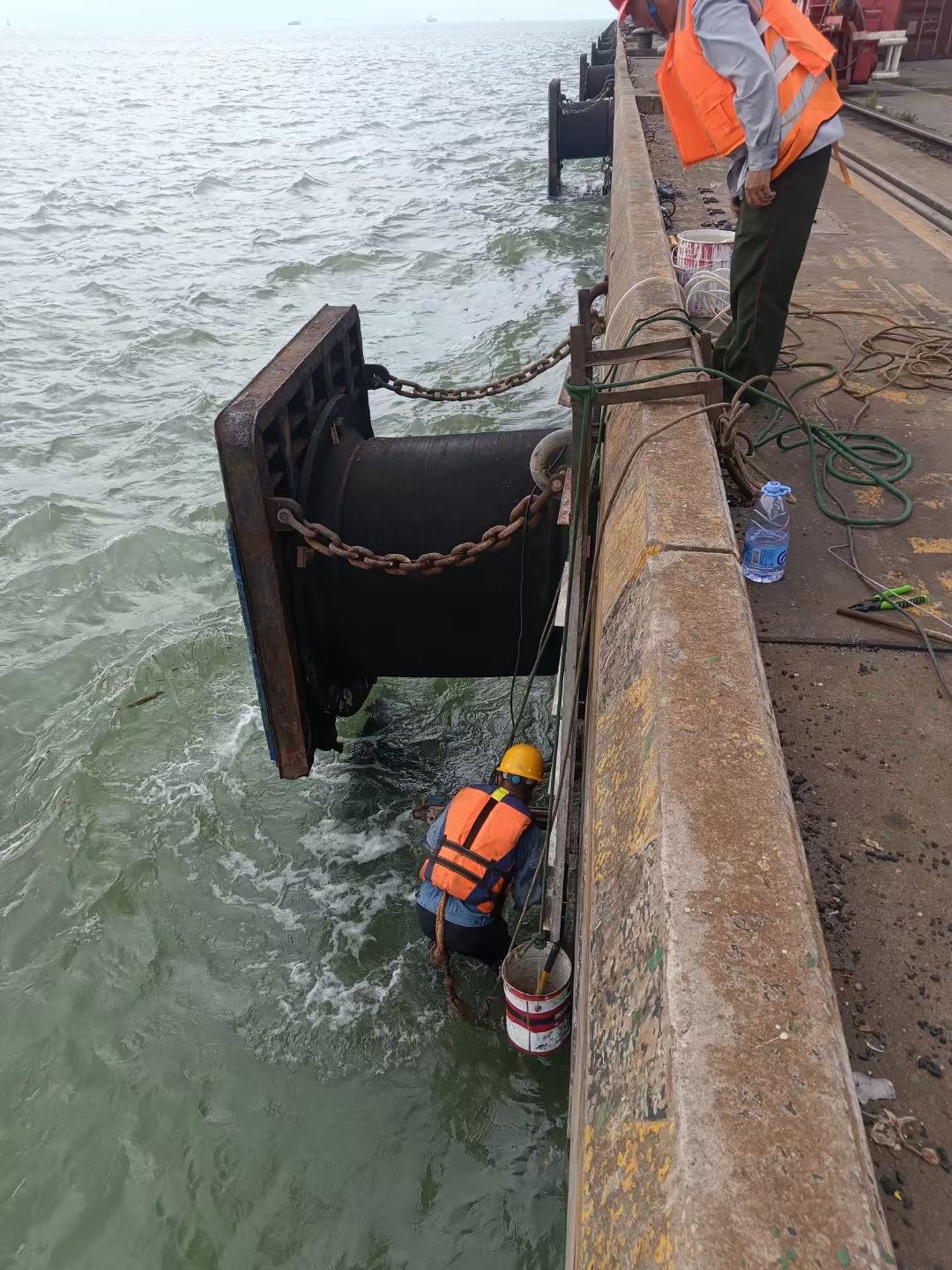
A frontal panel isn't just a steel plate with holes. It's an engineered component that must:
- Distribute impact forces evenly across the rubber fender
- Resist corrosion in C5-M marine environments (salt spray, humidity, tidal cycling)
- Maintain structural integrity after hundreds of thousands of impacts
- Secure the fender system through chain attachments and mounting brackets
The cost of poor quality:
- Panel failure under load → fender detachment → vessel hull damage ($500k–$2M+)
- Premature corrosion → panel replacement within 3–5 years instead of 15–20
- Weld cracks → unplanned downtime, crane mobilization costs
- Coating failure → accelerated steel degradation, safety hazards
> *"Quality assurance isn't about catching defects at the end—it's about engineering them out of every step."
Quality control begins before the first cut.
Material certificate checks require inspectors to verify:
- Steel grade matches specification (Q235B, Q345B, AH36, or marine-grade equivalents)
- Mill certificates comply with classification society requirements (ABS, BV, DNV, LR, CCS)
- Heat/lot numbers are traceable from certificate to physical steel
- Dimensional tolerances meet GB/T709 or ASTM A6 standards
Critical requirement: Carbon equivalent (CEV) must be ≤0.43% for weldability in marine environments .
Chemical composition verification via:
- Optical emission spectrometry (OES) – 18-element analysis, 0.001% precision
- Carbon-sulfur analyzers – infrared absorption method
> *"Any deviation from specified chemistry means the panel cannot be certified for marine service—regardless of how well it's fabricated."
Once steel is verified, every plate undergoes dimensional inspection.
Key measurements :
| Parameter | Tolerance | Inspection Method |
|---|---|---|
| Length | ±3mm (standard) | Laser rangefinder / tape |
| Width | ±3mm (standard) | Laser rangefinder / tape |
| Thickness | Negative tolerance ≤0.3mm | Ultrasonic thickness gauge |
| Flatness (per meter) | ≤4mm/m | 1m straight edge + feeler gauge |
| Hole position | ±1.5mm | CMM or template |
| Weld profile | Reinforcement ≤3mm, undercut ≤0.5mm | Weld gauge |
Advanced measurement technologies: Laser trackers and total stations now achieve precision of 1.8μm + L/250, enabling real-time conformity verification during fabrication .
Welds are the structural backbone of a frontal panel. NDT detects subsurface flaws invisible to the naked eye.
NDT methods for marine steel panels :
| NDT Method | Detects | Acceptance Standard |
|---|---|---|
| Ultrasonic Testing (UT) | Internal porosity, lack of fusion, cracks | Sensitivity: Φ2mm flat-bottom hole equivalent |
| Magnetic Particle Testing (MT) | Surface/subsurface cracks | Crack detection ≥99% |
| Dye Penetrant Testing (PT) | Surface-breaking defects | Visual confirmation |
| Radiographic Testing (RT) | Internal weld defects | Digital or film X-ray |
Critical note for UT: Equipment must be calibrated to ASTM E317-21, using 2.5–5MHz transducers depending on plate thickness .
After welding, sample coupons (cut from production panels or test plates) confirm mechanical performance.
Required tests :
| Test | Property Measured | Acceptance Criteria |
|---|---|---|
| Tensile (ISO 6892-1) | Yield strength, tensile strength, elongation | Q345B: ≥345MPa yield |
| Guided Bend | Ductility and weld soundness | No cracks after 180° bend |
| Charpy V-Notch Impact | Toughness at operating temperature | -20°C: ≥34J average |
| Hardness (Rockwell B or Brinell) | Panel surface hardness | Consistent with base material |
Marine frontal panels destined for Classification Society approval require that sample panels be welded under the same conditions and tested according to IACS UR W11/W17 requirements .
The coating system is the only thing standing between raw steel and saltwater corrosion.
Coating inspection checklist :
| Parameter | Specification | Inspection Tool |
|---|---|---|
| Surface preparation | Sa 2.5 (near-white metal blast) | Visual comparator |
| Profile depth | 50–85 microns | Surface profile gauge |
| Primer DFT | 75–125 microns | Magnetic thickness gauge |
| Topcoat DFT | Minimum 200 microns total | Magnetic thickness gauge |
| Adhesion | No detachment, Class 1 (ISO 2409) | Cross-cut tape test |
| Continuity | No holidays/pinholes | Holiday spark detector |
Salt spray testing: Representative coated samples are tested per ASTM B117 for 500–1,000 hours. Red rust creep at scribe must be <2mm after 500 hours for marine acceptance .
> *"Missing 10% of coating coverage on a panel creates a failure initiation point that can compromise the entire fender assembly."
Can the panel survive impact?
Static load testing involves applying PIANC-simulated berthing loads through hydraulic rams. For a 1200mm Cone fender panel, validation typically includes :
- 100% of rated reaction force for 5 minutes (no permanent deformation)
- 125% of rated reaction force (no weld cracking)
- Load deflection curve verification against design specifications
Documentation requirement: Every load test is recorded, with force/deflection curves included in the Certificate of Conformance.
Low-cost suppliers test 1 panel per 100. Quality-driven OEMs test 100% of panels .
Final inspection checklist:
| Check | Method | Pass/Fail Criteria |
|---|---|---|
| Visual weld inspection | Magnifying glass, strong illumination | No cracks, porosity, undercut |
| Dimensional audit | CMM or certified templates | All within tolerances |
| Coating thickness | 5-point measurement per face | Full coverage, spec thickness |
| Thread verification | Go/No-go gauges for bolt holes | Smooth engagement |
| Marking and traceability | Verification against documents | Unique serial number applied |
Every qualified panel receives:
- Certificate of Conformance (CoC) with test data
- Traceable serial number stamped into steel
- Mill certificate copies (retained by OEM for 10+ years)
Recent research from Politecnico di Torino introduced a novel SQC methodology specifically for monitoring panel lines in shipyards . The methodology accounts for:
- Customization and specific quality characteristics of different panels
- Measurement uncertainty of large-volume metrology instruments (laser trackers, total stations)
- ISO 14253-1:2017 compliance for conformity verification
Key insight: Early detection of anomalies in panel fabrication allows immediate correction, reducing rework costs by up to 30% .
Traditional tape measures are obsolete for complex panel geometries.
Capabilities:
- Accuracy: ±2mm over 20m length
- Dimensional validation against 3D CAD model
- Flange flatness deviation mapping
- Bolt hole position verification (point cloud to CAD)
Why it matters: A panel that appears "visually square" may be out of tolerance by 5mm diagonally—enough to prevent proper chain alignment during installation .
Manual thickness checks at 5 points per panel miss localized thinning.
Advanced approach: Automated UT scanning generates 2D thickness maps of the entire panel surface, identifying:
- Localized grinding damage (often at weld toes)
- Incoming plate thickness variations
- Hidden lamination defects
> *"We rejected three container loads from a cheap supplier after finding undersized welds and missing coating on 25% of panels. The so-called 'savings' disappeared when we had to re-order elsewhere. Now we only buy from ISO 3834 certified fabricators."*
> — *Procurement Manager, Southeast Asian Port Group*
> *"On our last project, the supplier's QC failed at three points—wrong steel grade on certificate (AH36 instead of EH36 for -20°C toughness), failing Charpy tests, and holidays in the coating. Our independent inspection saved a major incident."*
> — *Senior Marine Surveyor, International Classification Society*
> *"The 100% load testing requirement seemed excessive until we had a panel failure at 60% of rated load during commissioning. That panel never should have shipped. Now we require video proof of every load test."*
> — *Port Engineer, Middle East LNG Terminal*
| Red Flag | Why It‘s Concerning |
|---|---|
| No in-house NDT capabilities | Welds cannot be properly verified |
| Cannot provide material traceability | Unknown steel grade, questionable origin |
| Generic CoC without test data | No proof panels were actually tested |
| No salt spray test records | Coating likely inadequate for C5-M environment |
| Rejects third-party inspection | Quality non-compliance is almost certain |
| No flatness measurement records | Panel warp will cause installation issues |
At Nanjing Taidun Marine Equipment Engineering Co., Ltd. , quality control and testing for marine steel frontal panels is not an afterthought – it's engineered into every process.
Our QC commitment:
| Capability | Description |
|---|---|
| ISO 9001:2015 certified | Comprehensive quality management system |
| In-house NDT | UT, MT, PT – Level II certified technicians |
| 100% dimensional inspection | Including CMM validation |
| Full load testing | Static and dynamic validation |
| Third-party witness | ABS, BV, DNV, LR, CCS – your choice |
| Full documentation | Traceable CoC with every panel |
| 10-year record retention | Complete lot traceability |
We serve brand owners, wholesalers, and production facilities in over 80 countries. Your specifications become our production standard.
Quality control and testing for marine steel frontal panels requires discipline across seven stages: material verification, dimensional inspection, NDT weld validation, mechanical testing, coating QC, load testing, and 100% final inspection.
Don't accept shortcuts. Demand documented test results. Verify certifications. And partner with an OEM that treats quality as the only acceptable outcome.
[Contact the Nanjing Taidun Engineering Team] for a QC consultation or to request our Frontal Panel Quality Verification Package, including sample test reports and inspection checklists.
Q1: What NDT methods are required for marine steel frontal panels?
A: At minimum: Ultrasonic Testing (UT) for internal weld flaws and Magnetic Particle Testing (MT) or Dye Penetrant Testing (PT) for surface cracks. For Classification Society approval, all weld require 100% UT .
Q2: How is coating quality verified for marine frontal panels?
A: Through a four-step process: (1) surface profile verification, (2) dry film thickness (DFT) measurement at five points per panel side, (3) cross-hatch adhesion testing (ISO 2409), and (4) 500-hour salt spray testing of representative samples .
Q3: What dimensional tolerances apply to frontal steel panels?
A: Typical tolerances per ISO 2768-mK: length/width ±3mm, thickness negative tolerance ≤0.3mm, flatness ≤4mm per meter, hole position ±1.5mm. Tighter tolerances require custom agreements .
Q4: How are frontal panels load tested?
A: Panels are mounted to a reaction frame and hydraulically loaded to 100% of rated reaction force for 5 minutes, verifying no permanent deformation. Load-deflection curves are recorded .
Q5: What documentation should accompany certified frontal panels?
A: Full documentation includes Certificate of Conformance (CoC) with test results, material mill certificates, NDT reports, coating thickness records, load test curves, and for class-approved panels – classification society stamp .


